SMS OTP (one-time password) is still one of the most common ways to add a second authentication factor. It is familiar, broadly supported, and relatively easy to integrate, which is why it remains the default choice for many applications.
83% of US adults who use MFA (multi-factor authentication) receive their code by SMS, while one-third of consumers say they avoid MFA because they find it inconvenient. Most attempts to improve that experience focus on delivery speed and conversion. There is another question worth asking: does the authentication flow need to generate and deliver a user-visible credential at all?
That is where Silent Authentication differs from OTP.
Instead of creating a code and sending it through the SMS delivery chain, Silent Authentication verifies possession of the phone number through the mobile network. The user does not need to receive, copy, or submit a credential.
This post looks at that difference from a privacy and architecture perspective.
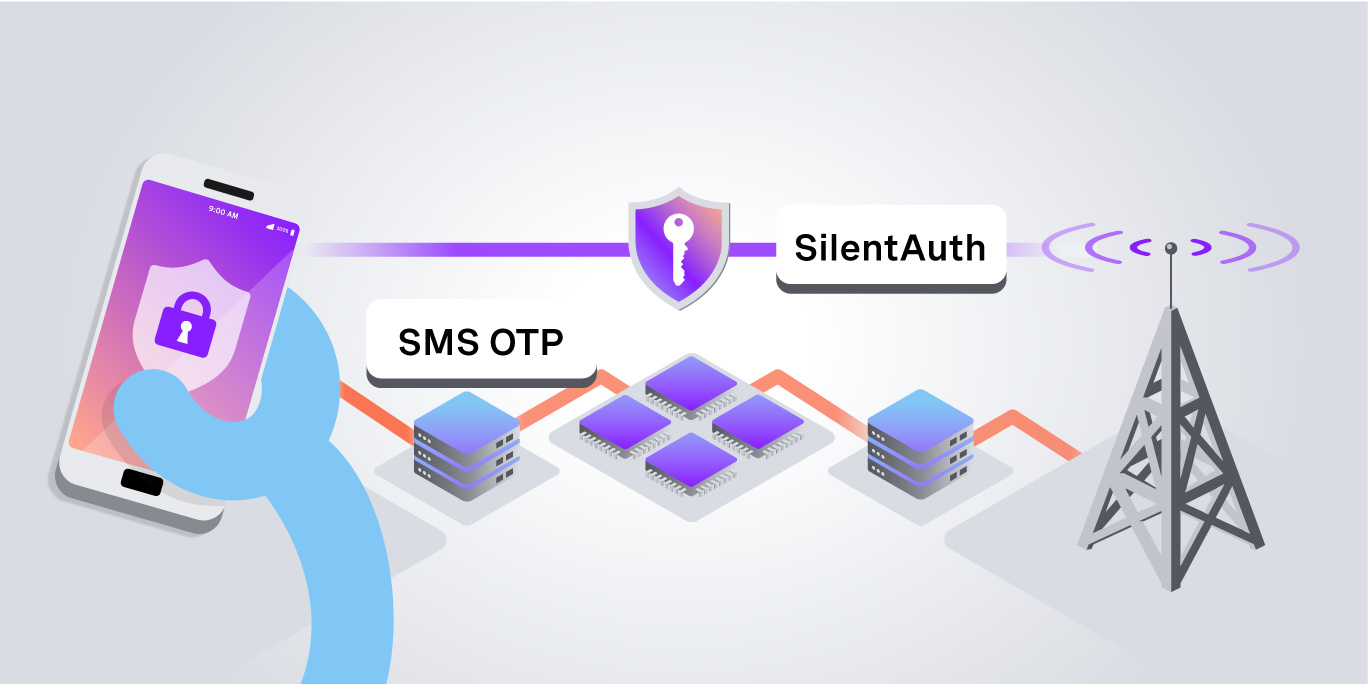
SMS OTP sends a credential through four intermediaries before it reaches you. Silent Authentication never generates one. Fewer hops. Better privacy.
The Privacy Cost of SMS OTP
OTP creates a credential that has to travel.
That sounds abstract, so here's the concrete version. When your application sends an OTP by SMS, the code passes through several systems before it reaches the user's device. It traverses a chain:
Every transfer is an exposure point. The code exists as a readable value at multiple points in that chain, and your app has no visibility into or control over most of them.
SS7 is the protocol that routes most of the world's SMS traffic. It dates back to the 1970s and was designed long before modern end-to-end encryption became common. Researchers have demonstrated live interceptions of SMS OTPs in the wild. In 2017, criminals purchased SS7 access from a foreign carrier, used it to redirect German banking customers' OTPs to attacker-controlled phones, and drained their accounts. O2 Telefónica confirmed the attack.
SIM swapping is another attack vector: because control of the phone number is treated as evidence of possession, an attacker who socially engineers a carrier support rep can bypass your OTP entirely. The Vonage SIM Swap Insight API gives you a signal for exactly this case, but it's a detection layer on top of an existing vulnerability, not a fix for it. They don't need to intercept anything. They redirect delivery to their own device.
Smishing is subtler but arguably more damaging at scale. SMS OTP creates a user behavior that phishing attacks can imitate: receiving a code and being asked to act on it. That makes the authentication flow easier to reproduce in social-engineering attacks. The phishing message doesn't need to be sophisticated. The user is already conditioned.
SS7 interception is not the highest-probability threat for every application. The architectural question is narrower: if the verification can work without generating a user-visible credential, do you still need to create and transport one?
How Silent Auth Works (and What It Doesn't Do)
OTP generates a secret, delivers it to the user, and asks them to return it. Silent Authentication does something different. It checks whether the SIM in the device matches the phone number being verified. No user-facing confirmation code is created, and the user does not need to transcribe or submit a value.
The workflow request looks like this when you initiate a Silent Auth check via the Vonage Verify API:
The API responds with a check_url. Your mobile client opens that URL over the device's cellular connection. The carrier intercepts the request, checks whether the SIM in the device matches the phone number in the request, and returns a result. Your server polls for the outcome:
No code was sent to the user. The verification happened entirely within the carrier's network.
One counterargument worth taking seriously: "Silent Auth still has an internal code. It's not truly zero-credential." Technically correct. There is an internal token in the synchronous flow. But that token never enters user-controlled space. It doesn't land in an inbox, appear on a lock screen, or sit on a clipboard. There's no notification for a phishing page to imitate, and nothing for a user to be tricked into reading aloud. The distinction that matters for privacy isn't whether a token exists internally. It's whether a token exists somewhere a human can be deceived into handing it over.
Data Minimization: The Principle That Ties This Together
Data minimization is the idea that you collect and generate only what you need to accomplish a task. It's a principle, not a rule, but it has regulatory teeth. GDPR Article 5(1)(c) says personal data must be "adequate, relevant and limited to what is necessary."
OTP works against the data-minimization goal because it creates an additional sensitive value that must be transported and protected. You generate a credential, which then requires protection in transit. The protection overhead isn't a separate design decision. It's a direct consequence of having generated the credential in the first place. Once the application creates that credential, it also takes on the responsibility of protecting it across the delivery infrastructure it only partially controls.
Silent Authentication doesn't make that tradeoff. Not because it was designed for GDPR compliance, but because not generating unnecessary data is good engineering. The privacy alignment with Article 5(1)(c) is a side effect of building the mechanism correctly, not a compliance checkbox.
The carrier was already in the auth chain before you sent a single OTP. The phone number belongs to the carrier. When you add SMS, you also add the aggregator that routes it and every hop between them. None of those parties have a legal or contractual relationship with your user. The carrier does.
Silent Auth doesn't introduce a new trusted party. It removes the ones that had no business being there.
The Carrier Trust Model
The trust chain comparison makes this concrete.
With OTP:
Your app → SMS provider → aggregator → SS7 routing → carrier → user
With Silent Auth:
Your app → Vonage → carrier → result
That's a shorter chain with fewer parties in it. Each extra hop in the OTP path is an intermediary that touches the credential in transit. The carrier was already part of the mobile identity relationship before your app existed. SMS delivery adds intermediaries that weren't. The carrier has a signed contract with the subscriber. The subscriber chose a carrier. None of that is true of the aggregators sitting in the OTP chain.
That answers the trust objection directly. You're not choosing between trusting an SMS provider and trusting a carrier. You're choosing between a long chain that includes both, and a short chain that includes only the party with a pre-existing user relationship. The carrier is present in both. The aggregator is present only in one.
Building It: Use Silent Auth First, Fall Back to SMS
Standard Silent Authentication requires a cellular connection. The Vonage iOS and Android libraries handle this by forcing the check_url request over cellular even when the device is on Wi-Fi. If cellular is unavailable, the workflow falls through to your next channel automatically.
That limitation is reduced with Silent Authentication Advanced, currently in alpha, which uses a SIM-level cryptographic handshake via the GSMA TS.43 standard and works across cellular, Wi-Fi, and VPN. Opting in is one parameter change: add "mode": "advanced" to the silent_auth channel in your workflow. Carrier rollout is underway.
For standard Silent Auth, coverage is live across US, UK, Canada, and Western Europe. For apps serving other regions, the fallback handles it.
Silent Auth must be first in the workflow. It can't be used as a fallback for another channel. After it, you can chain any combination of SMS, RCS, voice, WhatsApp, or email, depending on your users and regions. The full channel ordering rules are in the Verify Workflow API Guide. SMS is the most common choice for its reach; WhatsApp and RCS are worth considering if your users are already on those channels and you want to stay off the SS7 layer entirely. Here's a typical configuration:
When Silent Auth succeeds, no credential enters user space. When it falls back, the tradeoffs of whichever channel you chose apply. If you want to go from these snippets to a running implementation, the Silent Authentication Node.js tutorial walks through the full server and client setup. At that point, the security and privacy properties of the fallback channel apply.
If Silent Auth succeeds, the user got the private path. If it falls back, they got the same experience they'd have had with SMS-only. Either way, you gave Silent Auth the first shot.
Conclusion
OTP combines possession verification with a user-visible interaction. That interaction is familiar and broadly supported, but it also creates a value that can be intercepted, forwarded, copied, or socially engineered.
Silent Authentication removes the friction and the attack surface at the same time. In a rare case of win-win, the security and UX improvements point in the same direction. Removing the user-visible credential reduces both interaction cost and several classes of attack.
The industry is already moving in this direction. NIST recommended against SMS 2FA in 2016. Singapore, the UAE, and India have moved to restrict or ban it in financial services. The 2017 Germany bank drain confirmed SS7 interception wasn't theoretical. Despite those concerns, SMS OTP remains widely deployed because of its reach and familiarity.
You don't have to wait for a regulator to make the architecture decision. The tools are available now.
Ready to try it? Sign up for a Vonage API account, then read the Silent Authentication concept guide and the Vonage Verify API overview.
Further Reading
- Introducing Vonage Silent Authentication: The foundational explainer — start here if you want more context on how Silent Auth works before diving into the implementation posts.
Introducing Vonage Silent Authentication: The foundational explainer — start here if you want more context on how Silent Auth works before diving into the implementation posts.
- Every Passkey Needs a Silent Partner: How Silent Auth pairs with passkeys for a complete auth stack.
Every Passkey Needs a Silent Partner: How Silent Auth pairs with passkeys for a complete auth stack.
- Improve Your Multifactor Auth With the Verify API and SIM Swap Insight: If SIM swap is in your threat model, this shows how to add detection as an additional signal alongside Silent Auth.
Improve Your Multifactor Auth With the Verify API and SIM Swap Insight: If SIM swap is in your threat model, this shows how to add detection as an additional signal alongside Silent Auth.
- Frictionless Authentication on iOS: Silent Network Verification With Vonage Verify: Practical iOS implementation with a Dev Mode console that makes the silent flow visible.
Frictionless Authentication on iOS: Silent Network Verification With Vonage Verify: Practical iOS implementation with a Dev Mode console that makes the silent flow visible.
- Introducing Silent Authentication Advanced in the Verify API: SIM-level cryptographic verification that works over Wi-Fi and VPN.
Introducing Silent Authentication Advanced in the Verify API: SIM-level cryptographic verification that works over Wi-Fi and VPN.