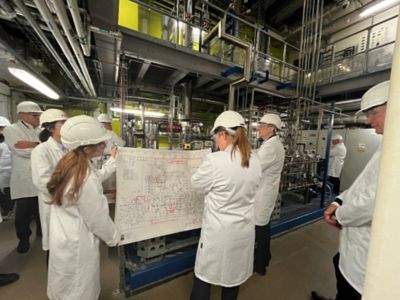
The focus of the Minister’s visit was the Carbon Capture Pilot Plant at Imperial College London, a unique facility that stands as a testament to what's possible when business, education and engineering come together with purpose. The Carbon Capture Pilot Plant, which is equipped with an ABB control system and instrumentation, is the only dedicated facility of its kind located within an academic institution anywhere in the world.
During her visit, Cecilie Myrseth engaged with ABB experts and Imperial students on topics such as the importance of partnerships between education and business, how to ensure a steady pipeline of skilled engineers to develop and operate new technologies, and how this can help address the sustainability challenge.
A leading provider of carbon capture, utilization and storage (CCUS) technologies, ABB works across the full spectrum of CCUS, from automation and electrical systems to measurement systems and advanced contaminant monitoring. ABB’s latest projects include Norway’s Northern Lights project, where ABB supported with competence during concept phases and delivered the automation and electrical systems to Phase 1, and is in the process of delivering Phase 2 of the project.
“Since 2012, the Carbon Capture Pilot Plant at Imperial has trained more than 4,500 students, giving them real-world experience with advanced industrial technologies within CCUS,” said David Lincoln, Digital Lead at ABB’s Measurement & Analytics division. “Every student who learns on this plant gains exposure to the kind of industrial-grade equipment and processes they'll encounter in their professional careers. Our shared goal is to equip students with the technical skills and confidence needed to launch successful careers in chemical engineering, preparing them to tackle the challenges of tomorrow’s world.”
Technology at the heart
Imperial students who had worked on the plant over the summer led the Minister through the ABB control room and guided her around the installation. The young engineers didn't just present the technology, they brought it to life, answering questions and providing insights that only hands-on experience can deliver. The students also invited the Minister to step in to clear simulated alarms [HK2.1]on the distributed control system.
The pilot plant operates with more than 100 ABB instruments and sensors that monitor temperature, pressure, carbon dioxide levels, and flow rates with exacting accuracy. All systems are integrated with the ABB Ability System 800xA distributed control system, providing comprehensive oversight and control of the entire process.
In her closing remarks, Minister Myrseth reflected on what she had witnessed, calling it "a really great example of a collaboration." She was genuinely impressed with the capability and dedication of the students involved.
The partnership between ABB and Imperial College London's Chemical Engineering department spans more than two decades. In 2010, Imperial approached ABB for support with developing the Carbon Capture Pilot Plant and the collaboration moved beyond research. Imperial started to build the Carbon Capture Pilot Plant to be used for undergraduate teaching, research and demonstration. The Carbon Capture Pilot Plant first opened its doors to students in 2012.
Minister Myrseth's visit was a reminder that the transition to a low-carbon future isn't something that happens in isolation – it happens through collaboration, investment in people and a shared commitment to solving the world's most pressing challenges.