Today at Advertising Week, we’re unveiling the next phase in our Sponsorships program: three new formats to help participating publishers earn more and reach new readers, plus new ways for brands to measure the trust, awareness, and consideration these partnerships build.
“Tonight, we’re getting Boston Market and going clubbing,” my mom would sometimes say when I got off the school bus.
On club nights, the lights went all the way down and the music all the way up. Our family climbed onto the couch and jumped up and down to ’90s dance hits that insisted tonight was everything: Jennifer Lopez’s “Waiting for Tonight,” Amber’s “This Is Your Night,” Real McCoy’s “Another Night.” My mom—a librarian just over five feet, a former COBOL programmer, a New Yorker who never wears patterns, florals, or logos, whose currency of love is warmth and worry, who describes her midlife crisis as switching from Diet Pepsi to Diet Coke—would fly off the couch like a confetti cannon.
I loved club nights for the reasons people have loved dancing forever: it’s silly in the most serious of ways and never gets old. Once, my dad came back from a trip to London with new records by Portishead and Massive Attack. My brother and I marveled at the meteorite that crashed into our living room. (Concussive breakbeats! Spacey reverbs!) And the club came alive anew.
Often I’d ask to turn a car radio to KTU (“The Beat of New York!”). The station’s DJs came from the warehouses in Chelsea and the Meatpacking District, and their mixes reminded me of home. It was a request sometimes met with bemusement—the look that adults might give an unsupervised child, like the time I showed up on Halloween in fifth grade dressed as a can of Budweiser.
I was always thankful to Boston Market because of club nights. We didn’t need to order dinner to dance, but having nothing to cook or clean made it easier. And I stayed fond of the chain even after I learned that it resembled neither “Boston” nor a “Market,” and that its Caesar salad had more calories than a Big Mac.
What is the difference between an ad and a sponsorship?
An ad grabs you by the collar; a sponsorship is the wind at your back. The campaign, the infrastructure, the idea—these things alone don’t determine whether something is an ad or a sponsorship. Like an algorithm, advertising tech itself is neutral. A sponsorship business can standardize and scale just as an ads business can. Ultimately, the difference between the two lies more in effect than intent. Advertising captures attention, whereas sponsorship empowers experience. Boston Market was a sponsor.
Since joining Substack this year to lead sponsorships, I’ve spent a lot of time talking with publishers, marketers, and agencies about how to support the thousands of subscription businesses being built here.
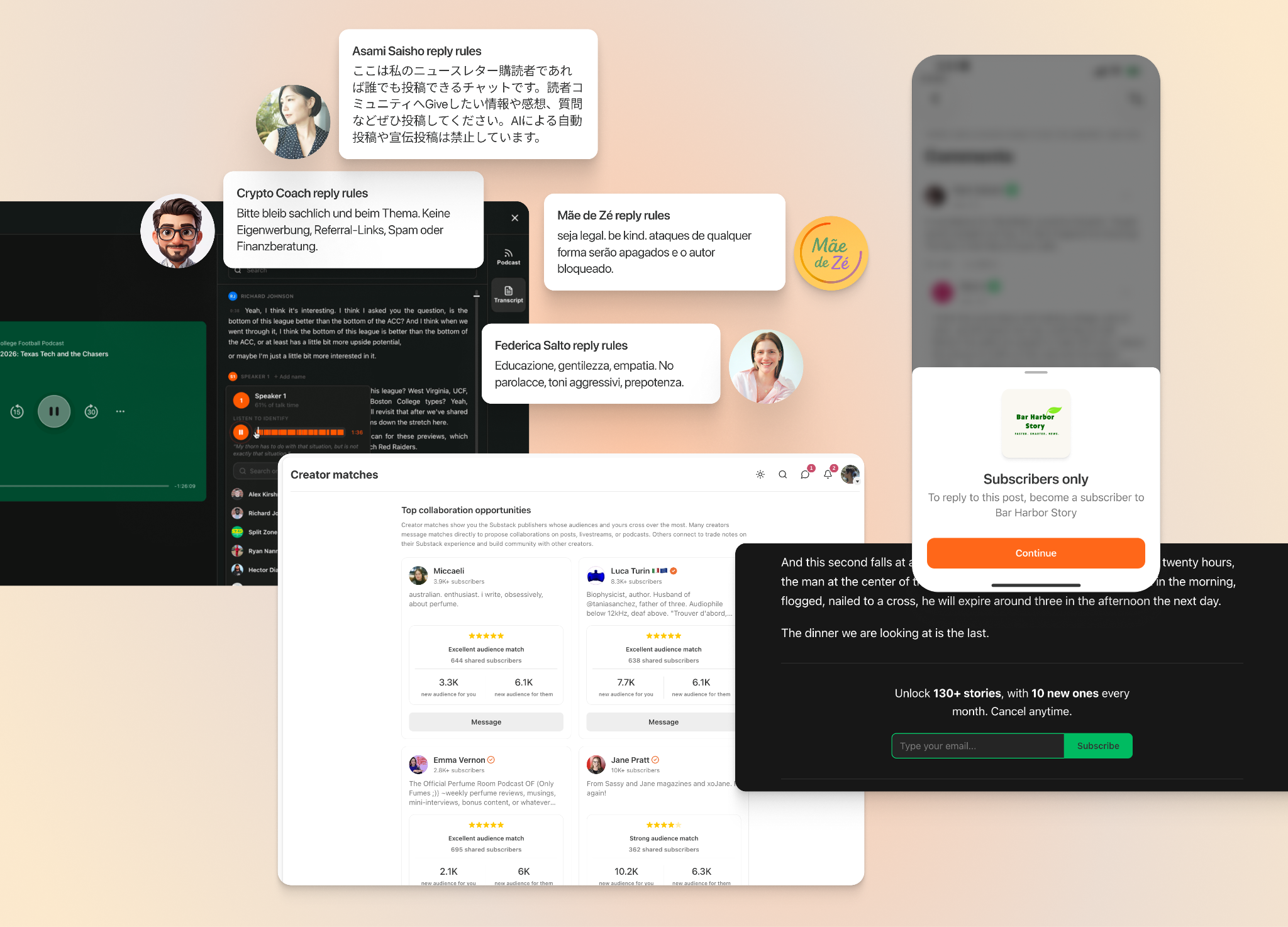
In June, we announced the first phase of our native sponsorships program and introduced Creator Kits for Substack bestsellers, a customizable media kit that can help brands understand a publication and its audience. Over the past few months, we’ve been testing new ideas with brands like Balenciaga, Uber, and T-Mobile so that we can create more opportunities for publishers to earn money while preserving the direct subscriber relationship. Publishers choose whether they want to participate in sponsorships, and can opt in through their Creator Kit. It’s one part of our broader investment in making Substack the best place to build a sustainable, independent media business.
We’re still early in this process and learning what works. At the same time, we’re bringing more brands into the program and building a growing pipeline of campaigns across different categories. Today, I’m heading to Advertising Week to share some of what we’ve been building. We wanted to give you an early look at what we’ll be announcing.
Pioneering new sponsorship formats
We’re not just trying to recreate existing advertising models. Instead, we are focused on a new economic engine for culture, creating trust for publishers, subscribers, and brands alike. That thinking is behind three new formats:
The upgrade
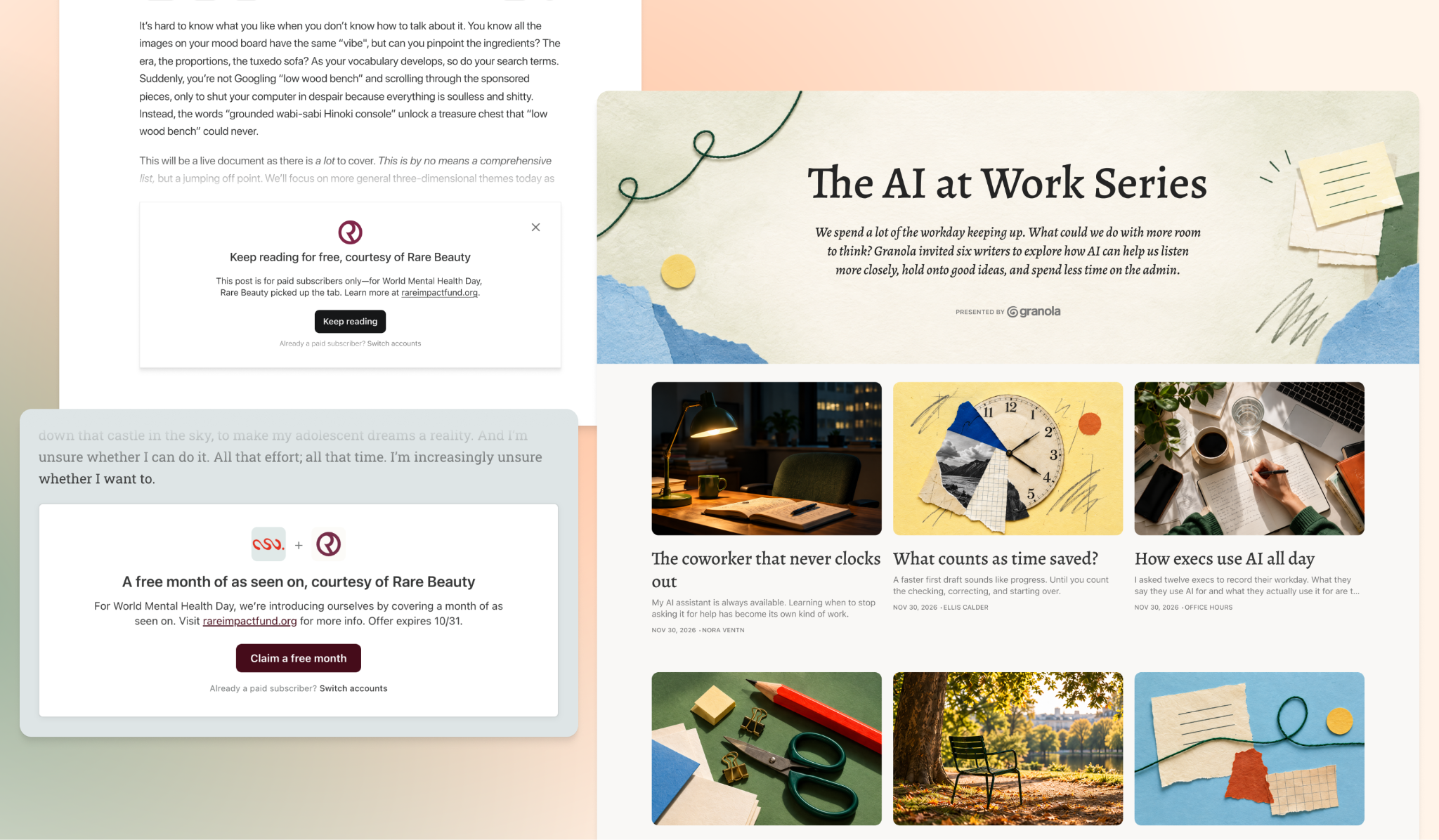
A brand provides a month of paid access for a publisher’s free subscribers, giving them access to the publication at no cost. Readers get to experience the full publication and can become paying subscribers when the sponsored month ends. The brand earns goodwill with key audiences by giving them more of the writing they love.
The unlock
A brand sponsors one of a publisher’s paid posts, making it free for everyone to read. The publisher gets paid for their work and can reach new readers who may go on to subscribe, or even become paid subscribers. Readers get to try a post that would otherwise be behind the paywall.
The masthead
A brand partners with writers and creators to present work on a theme in a dedicated destination on Substack. Think of it as a digital zine, like a retail brand collecting gift guides, a hotel brand highlighting ambitious travel writing, or a tech brand selecting the best writing about the future. For most brands, it’s a stronger starting point than launching their own publication: they’ll partner with publishers that people already follow and tap into a built-in audience.
Measuring more than attention
The better we can demonstrate the value of these formats, the more opportunities we can create. Often, creator marketing is measured only by impressions and clicks, not by the real impact of developing trust, credibility, and authority.
To present a more well-rounded picture, we’re now offering Kantar studies for large-scale campaigns, supporting meaningful measurement through independent, privacy-safe surveys that track changes in brand awareness, perception, and consideration.
Where we’re going
What’s our vision for the future of sponsorships?
For publishers, a world where ads work for writers instead of writers working for ads. A world where subscriptions are the floor, but not the ceiling. A world where any creator who opts in can get the income to go all-in.
For brands, you can earn real standing instead of shouting through feeds and swipes. Get the space to go deep, to say thank you, and to back communities that will grow your business.
And for subscribers, it’s less “there’s an ad” and more “that’s interesting” or “they made this possible.”
Right now, our team is bringing small groups of bestsellers and brands together as we test and learn. If you’re a brand interested in sponsorships, please reach out to sponsorships@substackinc.com or sign up here. If you’re a bestseller interested in sponsorships, turn on your Creator Kit to let us know you’d like to be considered for potential opportunities.
If you’ve already turned your kit on and haven’t heard from us, know we’re still early in that process and look forward to bringing more publishers into the program soon.
Turn on your Creator Kit
We’re excited to keep building with you.