Welcome to Model Behavior, our interview series featuring writers and creators on AI’s frontier. In previous editions, we spoke to author George Saunders and music producer Rick Rubin about AI and the creative process. Today we’re chatting with British entrepreneur and technology writer Azeem Azhar, who leads Exponential View, a research and media company exploring how emerging technologies are reshaping business and society.
Azeem Azhar is asking—and trying to answer—the pressing questions of our exponential age. Is AI making us dumb? Is there a bubble bound to burst? And most recently, in this week’s New York Times, if it doesn’t, who’s going to end up paying for the boom?
Azeem heads up research group Exponential View, a team of about 10 based in London with backgrounds ranging from astrophysics to consulting. They publish a podcast and two weekly newsletter editions to nearly 170,000 subscribers on Substack. The team also recently launched the AI Investment Brief by Exponential View, a separate weekly newsletter for professional investors, and publishes other flagship projects, including The State of the AI Economy, an annual report that uses their own methodology to size “the generative AI economy from the bottom up.” Managing director Marija Gavrilov told us that subscription revenue is the largest source of Exponential View’s funding and that the group is “AI-native in practice, not just in subject matter. The team has built its own research infrastructure…AI agents handle much of our monitoring, data collection, and pre-production work.”
Azeem has gone on the record several times to share his misgivings over what AI is doing to cognition, creativity, and reading, even as he and his team build a homegrown suite of tools and agents. He says their tools are built for accuracy, though they have also helped the team quickly cover big stories, like this week’s Anthropic IPO (more on that from Azeem below). In today’s Model Behavior, we ask him how AI figures in his writing process, about the agents he has built—some modeled after people in his life—and for a closer look at the tools his team uses to research, write, and keep track of their own thinking.
How much does Exponential View spend on AI tools each month?
It’s probably around $10,000 a month. Most people have a couple of the pro accounts, so that’s probably about 400 bucks a month [each]. I’d say about 75% is token expense and 25% is subscriptions of different types.
You also always building new tools—which we’ll get into in a second—but is there anything in your tool graveyard?
It’s really interesting, because [AI tools] don’t have a very long half-life. We used to have a prompt library. If you wanted to see prompts that other people had used to do things, you could pull from that library, and we just don’t update it anymore. The models are good enough for you to be slightly incoherent, and they’ll give you what you need. Another example: I built a tool that allowed us to watermark our charts. You can now do that in a single-line prompt on Claude or on ChatGPT, so we don’t use that anymore.
I also built a tool that was like a super-clever thesaurus. You’re casting around for a word, and what the tool would let you do is put in your paragraph, explain what the word is, and then figure out lots of synonyms, and in what ways they weren’t exact synonyms for the word you had written. Because as a good writer knows, you’re sometimes looking for just the right word to mean “tired,” and “tired,” “fatigued,” “knackered,” “cream crackered,” they all mean slightly different things. When you’re hitting that moment of writer’s block, that can be quite helpful. What I actually found is that in doing that, you were interrupting the thinking process for the person as they were writing.
So we’ve also learnt quite a lot about how we write with advanced AI. And before I get onto our actual tools, I’ll just explain that I’m handwriting with a fountain pen.
Fountain pen! What’s your pen of choice?
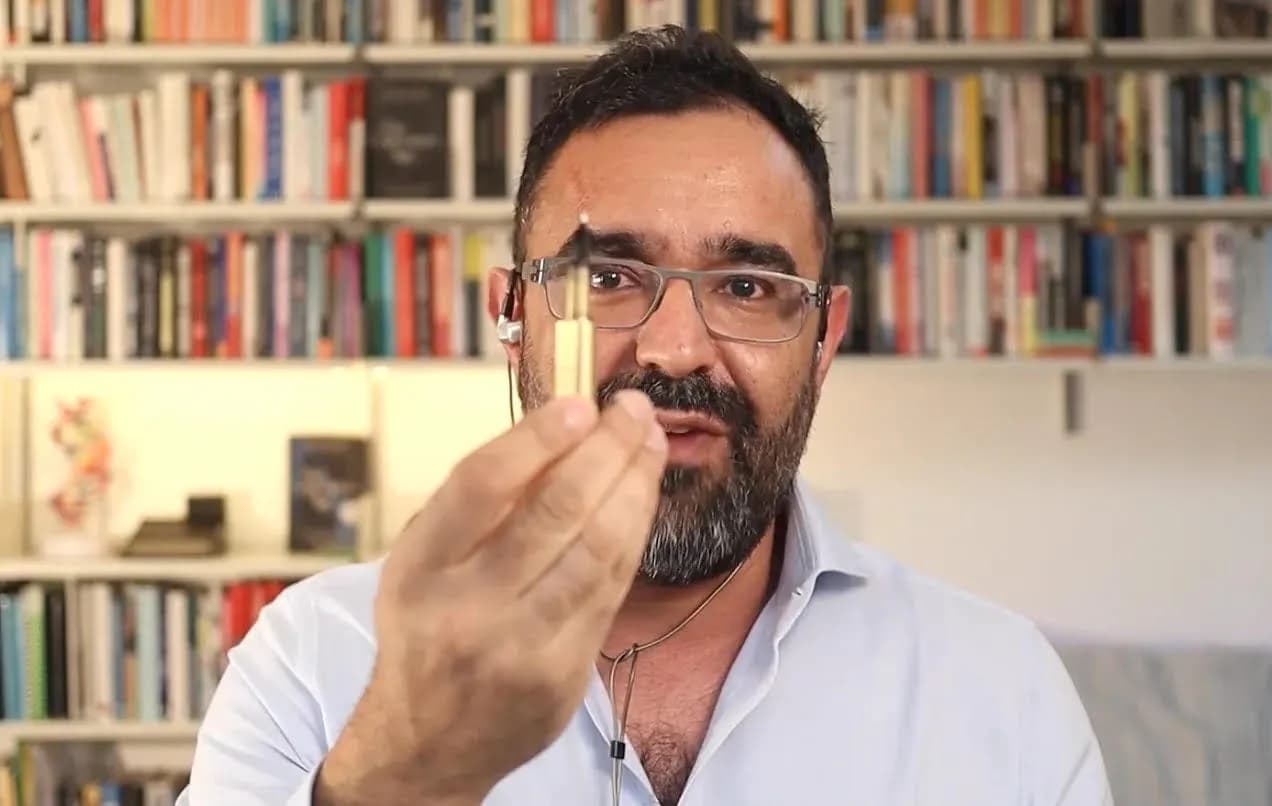
It’s called the Kolo. You can get them in Times Square. Opposite the Ned [Hotel], there’s an ice cream shop that sells alcoholic ice creams, and two doors down is a beautiful stationery shop where they sell these. The alcoholic ice cream is also quite nice.
One of the things that’s definitely changed in the last year is that I’m using a lot of fountain pen right now. I’m having to, because the models are getting better and better, and in a way they second-guess your thinking if you get to them too quickly.
How much of your writing happens pen-to-paper?
Everything starts on pen and paper, unless I’m traveling a lot, in which case it will start with a dictated voice note to Otter. But it all starts there. It never starts in Google Docs or Microsoft Word or anywhere else.
Azeem gives a video tour of the team’s Prism editorial system and The Brain.
Prism, your team’s AI editorial research system, is the primary tool I was interested in hearing about. You’ve given us a helpful video tour. Could you also describe it and tell us what problem it’s solving for?
Prism is the editorial research system for Exponential View. What it does is try to help someone who’s writing something through the process of writing. Because we’re a research house, we have to be consistent week to week. And if we’re inconsistent, we have to be deliberate about being inconsistent. If I’m really excited about, I don’t know, self-driving cars or GLP-1s, and then I write something that’s deeply critical of them, I need to be explicit that there’s a change in view.
What Prism does is take everything that you or I might read in the week or in the day, create a database of it, and index it all. I’m talking about everything: tweets, academic papers, my notes from news articles. They all live in there. Anyone on the team can see what other people are reading and can query across that. You can ask questions like, What’s been happening generally with other countries, other than the U.S., building data centers? Now, if you go to Perplexity or Google News, you get a very unfiltered view of the world. You get everything. If you put it to Prism, you get my team’s view of that over the last four years, and that’s really important, because we’ve consistently worked together. We’re building similar ways of thinking and also very different ways of critiquing each other, and Prism is trying to bring all of that together.
It is like the editorial conference I used to attend 30 years ago at The Economist, where all the writers are in a room, and people have read similar things and different things. They’ve got shared opinions and differing opinions, and you argue a point out. It’s a really helpful tool for us, and it’s plugged into everyone’s ChatGPT and Claude. Whenever you’re doing something, you can say, “Hmm, what did we say about X topic?” and it’ll pull that out, and it’ll put out all the evidence we have supporting that topic and how our belief around it has changed over the last few years.
If it’s built from what your team chooses to read and has already written over the years, are you ever concerned that it could become a closed information loop?
That’s definitely a risk. As a team, we’re quite heterogeneous, so we look at the world in slightly different ways. That’s one important thing. But the second thing is that there’s a lot of material that makes its way in through sources we’re not looking at. There are some automated feeds. A good example would be academic research: a lot of what’s publicly available on [open-access archive for scholarly articles] arXiv and places like that makes its way in. Another is social media. One of my agents reads Twitter for me, and it will go off and look at things in a slightly random, mad, peripatetic way to bring things in. The “For You” feed is quite powerful and varies quite a lot day-to-day and during the day. The items that come in at 4:00 in the morning my time, which is, I guess, 8:00 p.m. San Francisco time, are really different to anything I would see myself.
And then the other thing is a cultural piece, which is that everyone on the team is encouraged to read outside of their subject. You will see things from The New York Review of Books or The New Yorker that the team is reading. We do that because, to your point, if writers just rely on the technology, on ChatGPT or on Claude, you will find yourself smoothing away all of the rough edges that actually provide the friction for good writing.
The agent I use most of all is one called R. Cukier, modeled on my friend Kenn Cukier, who’s a senior editor at The Economist. He’s renowned for his ability to frame arguments very well…I could call up Kenn directly, but he has a family, he has a life, he has a job.
Marija Gavrilov, your managing director, told us that Prism has cut the work of assembling your Sunday edition—your weekly briefing on the week’s news in AI and beyond—from about three days to one. How does that work?
What we used to have to do is bookmark lots of things, or add them to Obsidian, and then walk our way through them over the course of a day or two and try to assemble it all.
Now, say I see something interesting on X. I can get one of my agents, the one called RMA1, to go off and grab the debate around that topic, and that makes its way into Prism.
I don’t often sit at a desk. I travel a lot, but I do have lots of four- or five-minute gaps where I’m waiting for the aircraft gate to open or something like that, and I can pop onto X, see things I think might be interesting, and send them into Prism via RMA.
Every day, other agents2 walk across what the team has selected and say to us, “These are the themes that are going on.” Some of those agents are really simplistic. They’re almost like, “We’re just going to look at chips.” Others are much more nuanced. They’re looking for cross-cutting themes that disagree with one of our long-held beliefs. They’ll be walking across hundreds of items that the team thought might or might not be interesting, and that gives us a head start when, on a Thursday or a Friday, we’re putting the newsletter together. We can go through and say, “Oh, this reminds me. Yes, this was happening.”
One of the things I think really good writers can manage is finding common threads across different signals. There’s a guy called Janan Ganesh at the FT who’s really good at this kind of cultural criticism, and the AIs are never going to be particularly good at that. But they can do quite a lot of it very cheaply. So you’re getting this inspiration that would be incoherent, that you’d never be able to publish, and what you’re able to do as a human is say, “Oh yes, that brings something to mind. That’s the one I want to use.”
And the final piece is that, because everything’s already been registered and logged, there’s none of that going back through your browser history asking, “Where did I see that?” We’ve seen it all already, and we put it together. It’s really compressed the time and, I think, increased the quality.
We still have to deal with new problems, one of which is that we don’t forget anything now, so the editorial choices on a Thursday or a Friday are much harder than when it’s just whatever’s top of mind.
Some of the agents you’ve built—the personas—are modeled after specific people, right?
That’s right, we have quite a lot of them. The purpose of a persona is that we can load it up with the knowledge of a particular expert. In one case, that’s Ray Dalio, the big hedge fund guy who has a particular way of thinking. The idea is that when you’re trying to navigate a space, you can imagine having a dinner party with people who have very, very different views of the world, Ray Dalio being one, or Annie Ernaux, the Nobel laureate in literature, being another. You throw that together in an attempt to see what connections emerge. What I’ve discovered is that it’s a last-ditch writer’s-block remedy more than anything else.
The agent I use most of all is one called R. Cukier, modeled on my friend Kenn Cukier, who’s a senior editor at The Economist. He’s renowned for his ability to frame arguments very well. I’ll often call up R. Cukier—and I could call up Kenn directly, but he has a family, he has a life, he has a job—so I’ll call up R. Cukier and say, “Where is the framing of this argument fraying? Where is it going off on a tangent?” That agent is particularly helpful because it’s designed to do one thing. It’s got a very tight prompt. Perhaps one time in three, something useful comes out of it, but it’s so easy to do that you just do it.
What does your friend make of this?
Oh, he loves it. I always get hearts and that huggy emoji.
It’s very difficult to take AI-generated text and turn it into real human text. It’s almost as if they’ve taken all the ingredients for the cake and made a bad cake that looks like a cake, and now you’re trying to turn that into a good cake, but you can’t get the egg and the flour and the sugar out.
How worried are you about AI voice seeping into your writing?
I’m really, really worried about it. There’s a brain worm that runs around, which is these words like “clean” and “brutal” and “legible” that I had never really used before. Sometimes I can’t get them out of my head, because I’m reading so much AI-generated material. All of the research that I read, the first pass has been done by the agents before I go off and read it myself. In every interaction with ChatGPT, if I’m looking for a recommendation for a cleaning product in the house, it’ll have “brutal” and “load-bearing” in there.
So I’m really worried about that for my writing. But it’s not the writing; it’s actually the thinking, because writing and thinking are so closely connected. I do find that I’m deliberate now about when I think in this back-and-forth iteration with the AIs and when I stop, get the pen and paper out, and turn everything off. That ratio matters, and there’s quite a lot of time spent doing that. If you’re a writer, you have to be very careful, because these things will produce progressively more mellifluous prose that’s very hard to reverse out of.
I’ll give you an example. Sometimes when we’re mocking things up—and I don’t mean newsletters but when we test out new products—we used to use filler text, “lorem ipsum dolor.” Now you don’t do that. You’ll just use AI-generated text, and you’ll be looking at it, and it’s very difficult to take AI-generated text and turn it into real human text. It’s almost as if they’ve taken all the ingredients for the cake and made a bad cake that looks like a cake, and now you’re trying to turn that into a good cake, but you can’t get the egg and the flour and the sugar out. These are the things we’ve learnt over the last year or so. And if you’re a writer on your own, the question is how you find the discipline and the self-awareness and the self-checking not to fall down the slippery slope.
Writers who learned their craft before these tools and writers who are now growing up with them may relate to the work very differently. How do you think about that?
I haven’t read that much from very young writers. There are some I’ve followed and observed on Substack, like Ruxandra Teslo, who does bio stuff, but she was obviously writing before these things were big, so I can’t really comment on that.
The thing I would say about writing is that when you’re writing something that’s not in the training data, it’s a new thing that you’re bringing into the world. Those connections are new, and the ideas are new. And I’ve found that even at a conceptual level, I’m being dragged back by the weight of all the ideas in the training data. They don’t have anything new. They’ve got loads of old stuff, because we haven’t been indexed yet. Tomorrow’s newsletter has not been put into ChatGPT. That’s quite challenging, and it’s really difficult in fields where you might not be an expert. I’m an expert in one small, narrow area, and I can absolutely see that the LLM is taking me to a world in which my ideas don’t exist, and that’s not the point of my ideas. That’s why my ideas come out into the world.
As a writer, you’ve got to be quite careful about saying, “This is a research tool that helps me. Oh look, I was able to find 75 case studies of X or Y rather than three on Google searches.” But then you’ve got to be very thoughtful about whether the statistical patterns of those case studies are going to shape how you respond to them and where your argument goes. That, I think, is quite difficult.
You’ve previously described writing as a “fractal,”, with the words as the final layer over a bed of purpose, structure, and argument. Across those layers, where do you think AI can be used?
It’s really useful in structure. Structure is the critical part of the kind of writing that I do. As a writer, you get carried away, and you think you’re going to go from New York to Miami, and you find yourself in Nashville, and it’s like, “Hey, how did this happen?” So what I will often do is run a first draft, then type it in and ask Claude to tell me what it thinks the golden thread of the piece is. If its golden thread is not my golden thread, then I’ve gone awry. You can ask other permutations of that, too, like, where in the structure did I go off track? It will come back with suggestions, and some of them can be very good. Sonnet 5 used to be very good at this. And some of them you don’t want to accept, because you’re the writer, and if you want to take a detour to Nashville, you will take a detour to Nashville, and the reader will come with you. That’s your right as a writer. Anyone who’s written a book will know that getting the structure wrong is the most painful thing in any redrafting. And when it comes to purpose—which in a way is the golden thread—again they can be very helpful, because you can go back and forth saying, “Is what I’m saying making sense?” You can choose to disagree with them, but that’s the equivalent of the conversation you’d have with your editor.
On the actual words, I’m really hesitant. Something gets lost. When I’ve got an ugly turn of phrase, I’ll sometimes use a prompt that says, “Look at this text and find the ugliest, most plodding phrases and bring them out.” I’ll take a look at them and say, “Yes, that’s right,” and I’ll redraft that myself.
And the last thing I think is really valuable, depending on what you’re writing, is that my work tends to be quite research-driven. In my new book, where I have a big chapter of 7,000 words, I’ll take each paragraph or pair of paragraphs that might have an argumentative claim and get it red-teamed by the AIs. By that I mean, attack the argument, find academic research that disagrees with it, find research that agrees with it. That’s the final test. I’ve obviously already done a lot of that in my research, but it strengthens the quality of thinking for my style of writing, which happens to be somewhere between mainstream and a bit research-oriented.
I think some people might read this and think you’re draining the human creative process out of writing in the name of productivity.
It’s not made me more productive! I’m still spending as much time working and writing as I was.
It’s about quality. A lot of the sources for my new book are in French, and I don’t speak French well enough to get through them. So I need the translation to help me make my way through it. Otherwise I would have relied on other people’s quotations, translated in an English book about that, and that’s not me going to the source.
But I’ll show you something else. [Azeem holds up a draft chapter.] That’s five pages of paper taped together with sticky tape, written with a four-color ballpoint pen. As I worked through the chapter, there’s a whole stack of printed-out pages and handwritten pages. What I’ve done is add tools to my armory as a writer. I’m pretty certain James Joyce didn’t use Post-it Notes. He might even, if he were around, refuse to use Post-it Notes, and that’s his right as a writer, to decide what tools he wants to use. I’ve just added some additional tools to the armory. But the thing you still need to do is really understand what it is you’re saying.
Can I give you one example? In my new book, there’s a vignette about something that happens in the 1840s or 1850s. I read a lot of the secondary books on this topic, and they all sort of agreed on what had happened. As I read it, I realized there was a mathematical mistake. It was about a large number of people doing something, and if you multiplied the number of people by the number of days they had to do it, they just couldn’t have done what they were claimed to have done. The maths didn’t work, but nobody had noticed. They were all copying each other, as people writing trade press books do.
So I was able, with the help of my agents, to dig further and further back, to the academic papers, to JSTOR, which is the academic journal library of tens of thousands of peer-reviewed publications, and still further back until eventually we found the 1850s government documentation, which was in a language I didn’t speak. I was able to grab that and say, “Okay, I’m now convinced this number is correct, and I’m not going to give my readers, who’ve given me their time, something that’s not accurate.” Five years ago, you and I would have gone to Wikipedia, because it’s a small bit in a paragraph in a big chapter in a bigger book, and just used Wikipedia as a reference. Seventeen thousand people, that’s a number, off we go. Now, for the same amount of time, I’ve got much more certainty about the story I’m telling and what I’m putting in front of my readers.
For what I do, which is nonfiction, research-oriented writing, it’s been incredibly helpful. Fiction might be a different perspective, and poetry, right?
You’ve built a very rigorous system around tracking evidence and how Exponential View’s perspectives have changed over time. Can you tell me about The Brain?
We have a new bit of software that one of the team built, which we’re calling The Brain3. What it does is look at everything we’ve written and analyze it for the beliefs that are in there. A belief might be, for example, “We think the AI’s impact on jobs will take 10 years, not two years.” That’s an example of a belief. It will connect that to other things we’ve written when we’re talking about the same type of thing, and that constructs something we know implicitly, which is what we think about this issue but have not put down explicitly anywhere.
Those beliefs can then turn into what we call a house view. A house view is just: what does Exponential View right now think about this issue? Because we are editorializing our research in that way. Once you’ve got a house view, you can always check what you’re writing against it and see whether it agrees or disagrees. It doesn’t matter if it disagrees. It’s very valuable for the writer to know, “Oh, I’ve diverged from what we’ve said before.” I intended to, I now know that I have, and I can adjust appropriately by telling readers, “This is not what we normally say, but . . .”
Part of that is something I learned 30 years ago at The Economist, which does have house views, but they get institutionalized by 80 people sitting in a room every week in the editor’s office. When I think about the people who read Exponential View, we’re human, and we’re entitled to be a little bit inconsistent with our beliefs. That’s the nature of it. But I also don’t ever want to fall into the trap of chasing the exciting meme of the moment. We do fall into that trap when it diverges from the world we’ve been building for our readers over the last 10 years. So house views are really valuable for me, especially on topics I might not have looked at for a year, where I have to ask, “What do I actually think about this?” and I can go back.