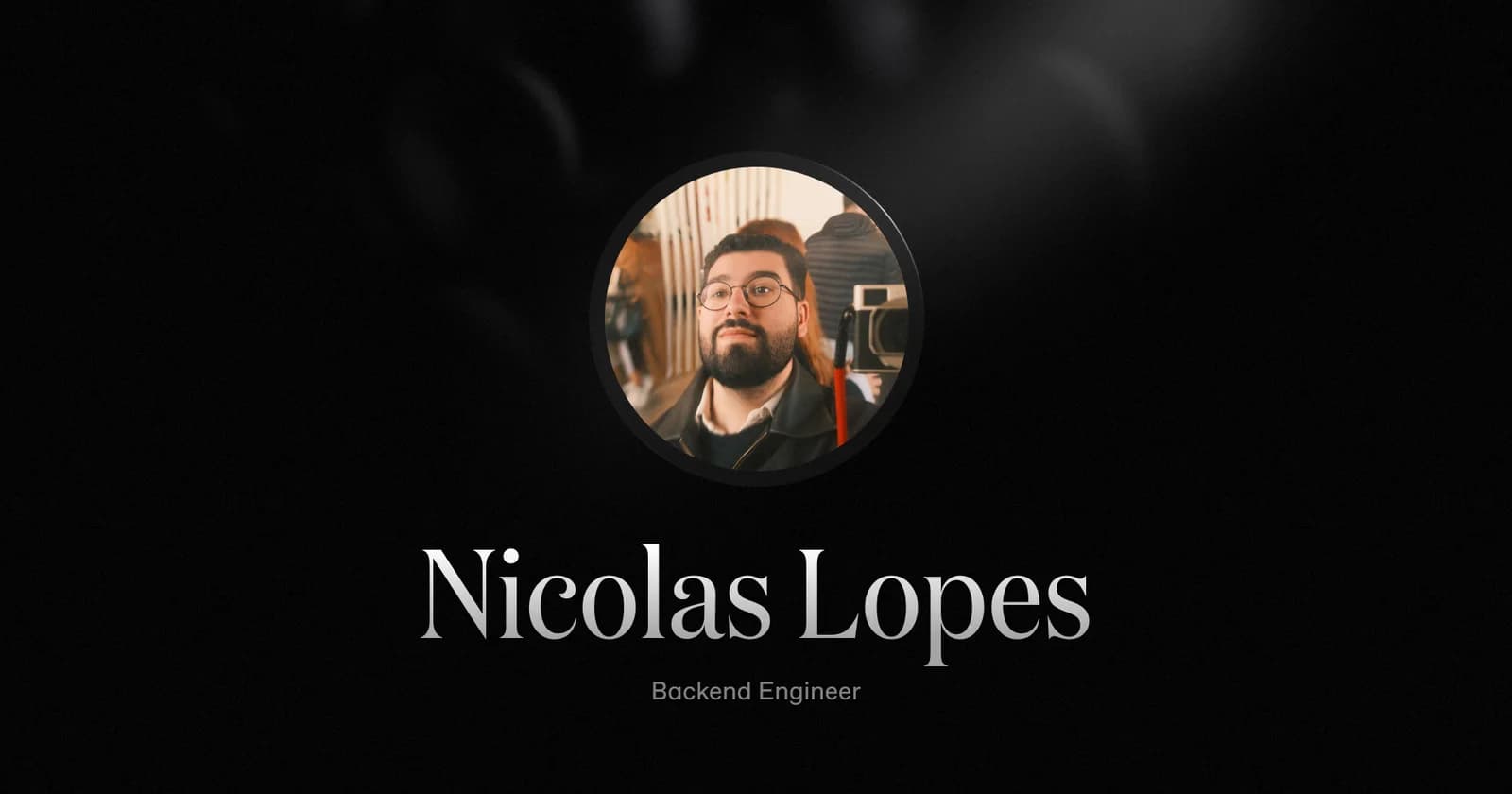
Today, we're excited to share that Nicolas Lopes is joining the Resend team as a Backend Engineer.
Nicolas is joining us from Natal, Brazil, where he grew up surrounded by computers and developed a lifelong curiosity for technology. He loves building products, exploring interesting engineering problems, and going down rabbit holes just to understand how things work. His last ChatGPT query was "what's the pixel of sound."
Nicolas comes to us from Clerk, where he worked on enterprise authentication and multi-tenancy, helping developers ship B2B features without building them from scratch. At Resend, he'll help shape and scale the layers on top of email, such as automations and inboxes.
Outside of work, he's usually planning his next trip, taking pictures along the way, discovering new food spots, or hunting for his next great coffee. He's always happy to trade recommendations on any of those.
More about Nicolas
How did you get into software?
My dad was always into computers, mostly fixing them rather than programming, so we always had computers around the house growing up.
I remember being curious about how people actually made software. My dad had once mentioned how difficult programming was, which, naturally, made me want to try it. I went on YouTube, found a C++ tutorial, copied and pasted every single line of code, and ran downstairs shouting, "Hey, look, I made a calculator!"
Some time passed, but the curiosity stuck. Eventually, my dad got me an Arduino, and that's when I started taking programming more seriously. I was fascinated by the intersection of software and electronics. Writing a few lines of code and watching something physical happen in front of you never got old.
Fun fact! I was always curious why red LEDs lit up with less voltage than blue ones. Turns out, it has everything to do with the visible light spectrum, red light carries less energy, while blue light sits at the higher-energy end, meaning it takes more voltage to produce it.
I found it fascinating that something as tiny as an LED could be a gateway into understanding the physics of light and how the universe works. At nine, that felt like discovering a cheat code to the universe.
From that point forward I never stopped thinking about computers any single day.
What does your desktop/home screen look like?
I like keeping my workspace relatively minimal. My background usually rotates between photos I took. I spend a lot of time in the terminal, and I appreciate tools that get out of the way and let me focus on what I'm building.
My browser tabs, on the other hand, are a completely different story.
Why are you at Resend?
I think we're at a particularly interesting moment in software.
With the agentic era unfolding, the way we build products is changing pretty dramatically. I see an increasingly important distinction between companies building products and companies building the infrastructure that enables those products to exist.
Email is a great example of the latter.
It's an essential piece of almost every product, but it's surprisingly difficult to get right. Nobody really says, "Why don't you just roll your own SMTP server?" And for good reason: all the operational complexity that comes with email makes it a problem most teams would rather delegate.
What drew me to Resend is that it's tackling exactly this kind of problem. It's become the name that consistently comes up when developers ask what they should use for email. That's a pretty remarkable position to earn in a developer ecosystem. Without mentioning all the effort and craft that goes on every single corner of the product.
Where do you find #inspiration?
Whether it's software, photography, architecture, or cooking, I love seeing people who take something seriously and push it beyond what's strictly necessary. In other words, craftsmanship.
Food is an interesting example. At its most basic level, it has a very practical purpose: feeding yourself. But then you get into the world of exceptional cuisine, Michelin-starred kitchens, and chefs who travel halfway across the world to source a particular ingredient.
The purpose hasn't really changed. You're still making food. But the attention to detail, technique, experimentation, and obsession with quality take it somewhere entirely different.
I think there's a parallel with software. You can build something that works, or you can spend the time understanding every little detail and make something exceptional.
Travel also plays a big role in how I find inspiration. Experiencing different cultures, seeing how people approach everyday things, and getting outside your usual environment are great ways to challenge your perspective.
And, obviously, a good coffee shop helps.
If you weren't programming, what would you be doing?
Probably medical school.
For a while, that was actually the plan. I was preparing for the exams with the intention of studying medicine. But somewhere along the way, when the pandemic hit, I got caught up building a local food delivery startup with friends.
I started spending more time thinking about the product, figuring out how to build it, and solving all the little problems that came with making it work.
What started as a side project gradually became something I was much more excited about than the path I'd originally planned for myself.
Looking back, it's funny how a food delivery startup that began as a toy project ended up changing my career direction. I guess I found another way to spend my time helping people, just with a different kind of problem to solve.
Favorite tool?
Currently, Rex, a tool in public beta.
I'm a big fan of the amount of craft that goes into it. I particularly enjoy Mitchell Hashimoto's (@mitchellh) approach to developing software, mainly his willingness to explore primitives properly rather than just shipping the obvious implementation and making the world a better place.
I also think Rex has the potential to become a pretty disruptive alternative to traditional SSH workflows. It's an interesting space, and I'm excited to see where it goes.
Favorite hotkey?
Ctrl + L
I love keeping my terminal clean. There's something satisfying about clearing everything and getting back to a single tail command, watching exactly what I need without all the noise.
Favorite place to visit?
I genuinely cannot pick one.
Greece, Japan, and China are probably among my favorites, but I really enjoy traveling in general. There's something about arriving somewhere completely unfamiliar, walking around without a particular destination, discovering a great restaurant, and getting a feel for how people live.
If I had to give one answer, I'd say Planet Earth.
Advice for ambitious software engineers?
First, as an engineer, learn to communicate well. Be clear, transparent, and honest. Technical skills will get you far, but being someone people can trust and rely on makes all the difference.
Second, don't overthink life. Don't get too attached to plans or wait for the perfect opportunity. The world is your oyster. You can literally walk out of your house, meet people, try things, build something, and end up somewhere you never imagined. Stay curious, take initiative, and let life surprise you.