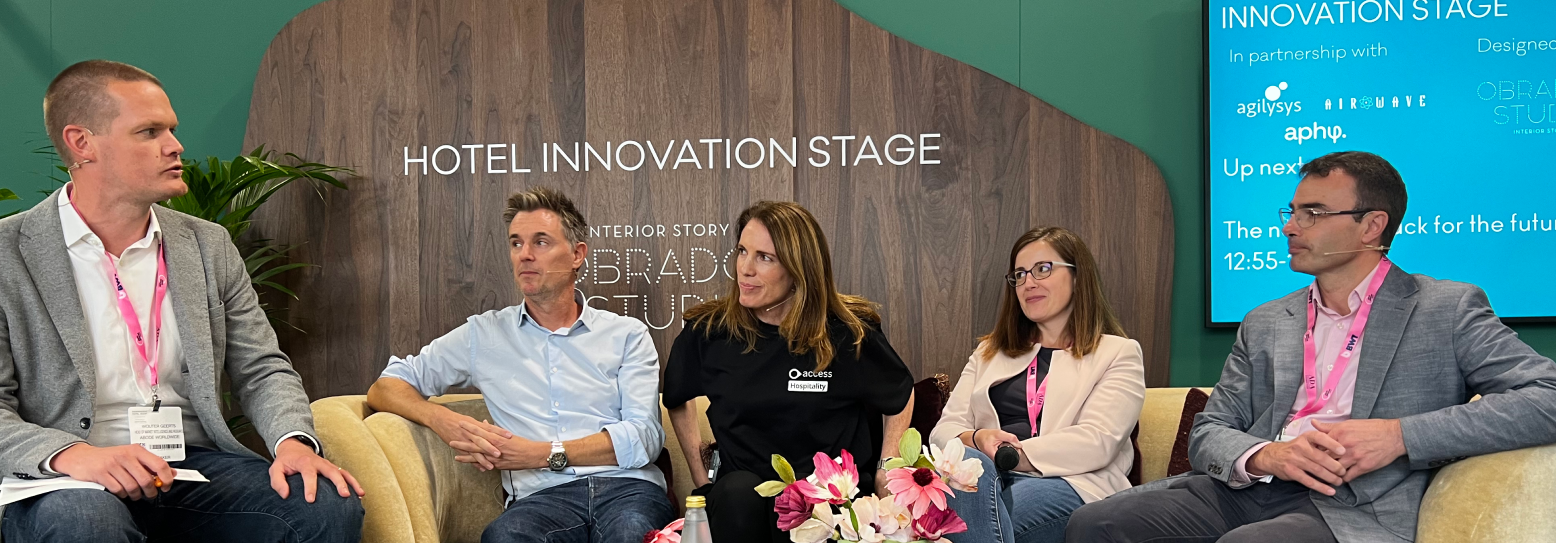
AI might be changing hospitality, but one thing became clear during a panel at this year’s Independent Hotel Show London: the future of the industry isn’t simply about adopting more technology. It’s about making sure people can actually use it.
That was the thread running through The new skills stack for the future of hospitality, which saw our very own CMO, Sandrine Zechbauer, take to the Innovation Stage alongside Julian Tee, Director at Compass Hotels Management; Matthew Parsons, Founder of Etude Agency; and Nicola Longfield, Chief Commercial Officer at Access Hospitality.
Keeping the conversation moving was Wouter Geerts, Head of Market Intelligence and Research at our friends at Abode Worldwide, who did a brilliant job of getting beyond the AI hype and drawing out some of the bigger questions around skills, jobs, technology and what all of this actually means for hotel teams.
Sitting in the audience, what struck me was how little of the conversation was really about AI tools themselves. Instead, it was about what happens around them: the systems hotels are already juggling, the quality of the data sitting behind them, the skills teams need, and the importance of knowing what good actually looks like before asking technology to deliver it.
AI may be ready. But are hotels?
There’s no shortage of ways AI can already be used in hospitality. Guest communications, revenue and rate management, scheduling, marketing, reporting and back-office processes all came up during the discussion. Tasks that once took hours can increasingly be completed in minutes.
But Nicola made an important distinction: technology itself may no longer be the biggest barrier. Operational readiness is.
For hotels, adopting AI isn't as simple as adding another tool to the tech stack. It means thinking about how roles and processes need to change around it, and what teams should actually do with the time technology gives back to them.
If AI saves five hours a week, for example, those five hours don't automatically turn into five hours of better hospitality. Leaders have to decide where that capacity should go. Is it more time with guests? More proactive revenue management? Better marketing? Less admin?
That question of what we do with the time we get back may ultimately be more important than how much time AI can save.
Before AI can simplify hospitality, there’s some untangling to do
One of the most interesting parts of the conversation came from research, Sandrine shared. RMS set out to understand how hospitality businesses were coping with their existing technology before adding AI into the mix, and the findings reveal a gap between the promise of technology and the reality operators are experiencing.
Hotels surveyed were typically managing multiple systems, while 83% said they were facing increased operational stress due to technology not working as it should. Nine in ten rated their data readiness below three out of five, and around a quarter didn't have anyone specifically responsible for managing their technology stack.
You can dig into the findings in our 2026 Hospitality Engineer Report, created in partnership with RoomPriceGenie.
And these aren't necessarily futuristic AI problems. Operators reported dealing with incorrect rates between systems, duplicate guest data, and inaccurate reporting. Some said they were spending upwards of seven hours a week fixing issues.
That’s an important reality check. AI is only as useful as the information and systems underneath it. If your data is fragmented, inaccurate or difficult to access, adding AI doesn't magically fix the foundations.
“You cannot run good AI if you don't have good data.” - Sandrine Zechbauer, CMO, RMS
“You cannot run good AI if you don't have good data.”
- Sandrine Zechbauer, CMO, RMS
The hospitality engineer: the new skills AI is bringing to hotels
That’s where the idea of the “hospitality engineer” comes in: someone who combines hospitality know-how with a stronger understanding of technology.
That doesn't necessarily mean every receptionist needs to become a developer or every hotel manager needs to understand the technical workings of an API. In fact, the panel had an interesting debate around exactly that.
Sandrine argued there’s growing value in people who understand how systems connect and how information flows, particularly while hotels are still dealing with fragmented technology. Nicola’s view was that technology itself should become simple enough that teams don’t need to understand everything happening underneath it.
But there was plenty of common ground too: curiosity matters.
The people who experiment, ask questions and want to understand why something works — or doesn't — are likely to become increasingly valuable. Sandrine has already seen that within RMS: when new AI tools have been introduced, some of the most interesting uses have come from the people curious enough to explore what they can do with them.
Perhaps, then, the future skills stack isn't about everyone becoming deeply technical. It's about combining hospitality knowledge with enough technological fluency and curiosity to ask better questions.
Don’t automate away your understanding of the business
For me, one of the strongest points of the session was also one of the simplest. AI can analyse data, surface information and recommend an action remarkably quickly, but someone still needs to know whether the answer looks right.
Julian warned against allowing teams to become so reliant on systems that they lose the knowledge required to interrogate their output.
If you don't understand your costs, how do you know whether the numbers AI gives you make sense? If you don't understand your guests, how do you know whether you're attracting the right ones? If you don't understand the fundamentals of revenue management, how do you recognise a bad recommendation?
As Julian put it towards the end of the session, once a business loses the ability to understand whether an outcome is good or bad, it has effectively lost control of the business.
That feels like an important distinction between using AI and outsourcing your judgement to it.
And the human skills? They might become even more valuable
For all the discussion about technology, nobody on the panel was suggesting that hospitality's traditional skills were becoming irrelevant. Quite the opposite.
AI can analyse a report or optimise a rate, but hospitality still relies on people who can read a situation, understand a guest and know when the human touch matters. And as more administrative processes become automated, those human interactions may become an even bigger point of differentiation.
One anecdote from the panel summed this up particularly well. Wouter shared that a hotel school he advises is seeing hospitality students recruited into industries such as banking and retail specifically because those sectors value the soft skills hospitality teaches.
Those skills are difficult to teach. The challenge for hospitality may therefore be making sure it doesn't lose the people who are naturally good at hospitality while chasing the next technical skill.
So where should hotels start?
Perhaps the most useful advice from the entire session was not to start with AI at all.
Start with the problem.
What’s consuming the most time in your business? Where is the biggest source of friction? Maybe it’s guest communications. Maybe it’s scheduling. Maybe your team spends hours pulling together reports or jumping between systems. Maybe it’s marketing, finance or revenue management.
Choose one problem and work out whether technology can genuinely solve it.
Trying to transform finance, marketing, revenue, housekeeping, distribution and front office simultaneously risks turning AI into a huge IT project. Tackling one clearly defined problem gives teams something they can test, measure and learn from.
And you don't necessarily have to figure it out alone. Sandrine also pointed to the AI Hospitality Alliance, which brings together practical resources, education and a community for hospitality professionals looking to build their understanding of AI. RMS is a founding partner, and it's another useful place to start if someone in your team is keen to learn and experiment.
That feels like a far more useful approach than adopting AI simply because everyone else appears to be doing it.
And, as Sandrine pointed out, if it feels like everyone else has already figured this out, they haven't. Hotels are at very different stages, and many are still working through the fundamentals of their existing technology, data, and processes.
The goal isn't to become the most AI-enabled hotel. It's to build a business where technology removes friction, people understand the decisions being made, and teams have more capacity for the part of hospitality technology still can't replicate: being human.
Q&A: AI and the future of hospitality skills
How is AI changing jobs in hospitality?AI is increasingly taking on tasks such as reporting, revenue analysis, guest communications and other administrative processes. That doesn't remove the need for hospitality teams, but it is changing where people spend their time and the mix of skills some roles require.
What skills will hospitality professionals need in the future?Alongside traditional service skills, technological fluency, curiosity and problem-solving are becoming increasingly valuable. The panel also explored the idea of the “hospitality engineer”: someone who can bridge the gap between hospitality know-how and technology.
How can hotels prepare for AI?Start with the problem, not the technology. Look at where your team is losing the most time or experiencing the most friction, make sure the data and systems underneath it are reliable, and then explore where AI or automation could genuinely help.
Will AI replace the human side of hospitality?AI can automate tasks, analyse information and help teams make faster decisions, but human judgement and service skills still matter. As more routine processes become automated, the ability to understand guests, read situations and deliver genuinely good hospitality could become even more valuable.
![Top Hotel Management Software in Nigeria [2027]](https://images.unsplash.com/photo-1637019916030-9f851c2eca13?crop=entropy&cs=tinysrgb&fit=max&fm=jpg&ixid=M3wxMDgwOTg1fDB8MXxzZWFyY2h8MXx8VG9wJTIwSG90ZWwlMjBNYW5hZ2VtZW50JTIwU29mdHdhcmUlMjBOaWdlcmlhJTIwMjAyN3xlbnwxfDB8fHwxNzkxMjkxMzk4fDA&ixlib=rb-4.1.0&q=80&w=1080)