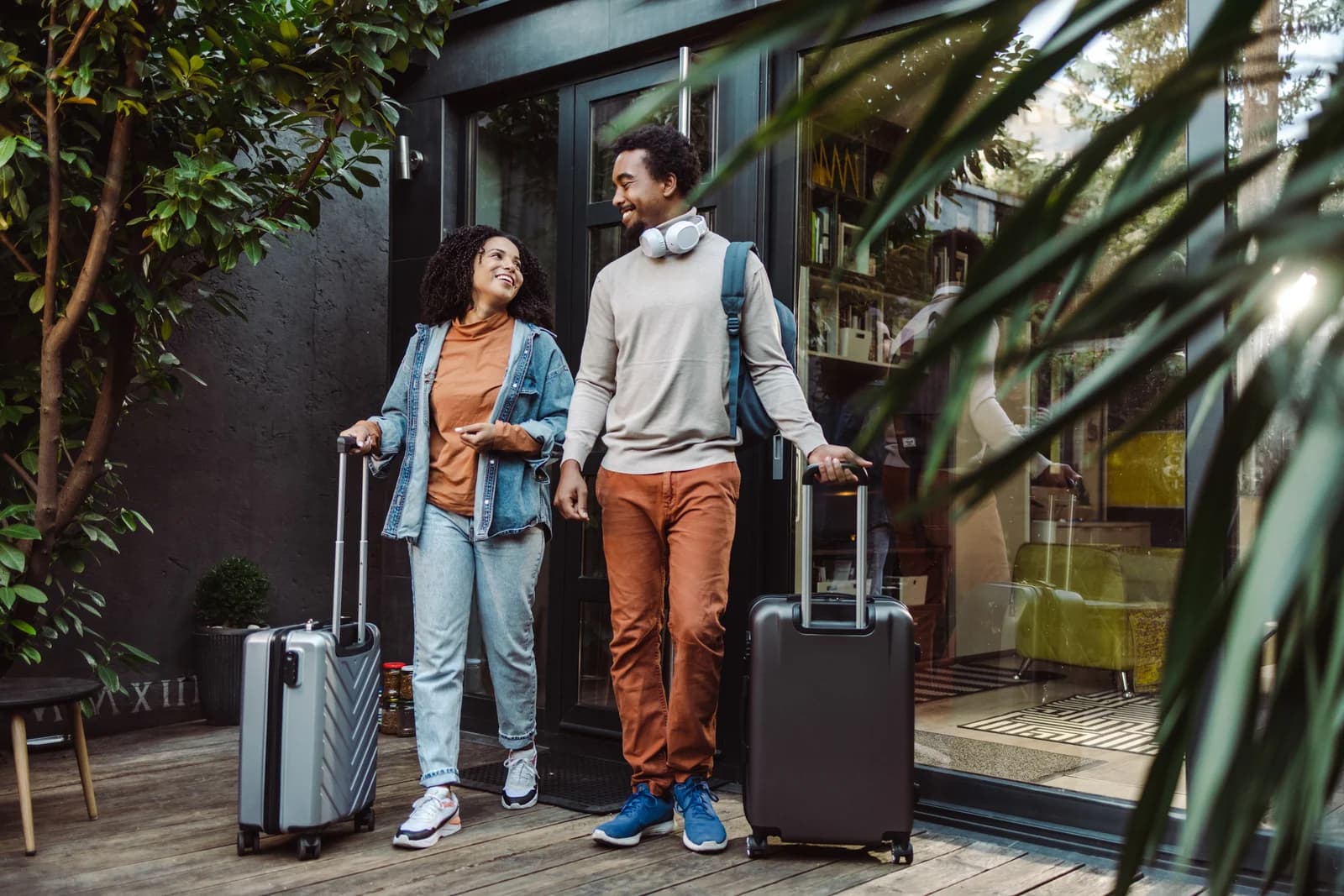
If you could save up to ten minutes on every check-in and checkout at your hotel, imagine how much time that would be over a day, a week, or a year. A 2025 report from Hospitality Financial and Technology Professionals (HFTP) indicates that the average hotel can save up to six minutes at check-in and four minutes at checkout by introducing contactless interactions*.
Contactless hotel check-in saves you time and money, while impressing your guests. Traveler expectations have changed permanently since the early 2020s; contactless check-in (like contactless payments) is now expected across the accommodation industry. For many guests, a mobile check-in hotel is preferable to a traditional one.
This guide explains what contactless check-in is, how it works step by step, what different property types need to consider, and what to plan for before getting started. Whether you manage a hotel, motel, resort, campground, student accommodation, or serviced apartment, the fundamentals apply to all of them.
What is contactless hotel check-in?
Contactless hotel check-in is a process that allows guests to complete identity verification, registration, payment authorization, and room access without visiting a front desk. Guests complete the process from their smartphone—or a lobby kiosk—using a secure link sent by email or short message service (SMS), with no app download required.
You may see properties that offer this service marketing themselves as a mobile check-in hotel or digital check-in hotel, or simply offering QR code check-in. These terms all describe the same core process: removing the physical front desk interaction from the arrival experience and replacing it with a guided digital flow that the guest completes on their own terms, at their own pace.
There are two primary delivery channels. The first is pre-arrival mobile web—a secure link sent to the guest's phone before they arrive so they can use their browser to complete check-in steps. The second is an on-arrival kiosk—a lobby touchscreen that handles the same steps for walk-in guests or those who didn't complete pre-arrival check-in. The best implementations support both.
Why guests are done with the front desk
The shift toward contactless check-in isn't driven by technology for its own sake. It's driven by the same forces reshaping expectations across retail, finance, and travel more broadly: guests want the convenience and control they already experience everywhere else in their lives.
Researchers found that more than half of travelers surveyed—53.6%—said they would most like to see contactless check-in and checkout permanently adopted at hotels. And over 60% of hospitality executives globally identified a fully contactless experience as the technology most likely to be widely adopted across the industry**.
The reasons behind these preferences are practical: guests want to skip lines, arrive at any hour without coordinating with staff, and move straight to their room. They also want the flexibility to choose—contactless check-in should be an option, not a mandate. The same research found that almost half of travelers (47.1%) would be more likely to stay at a hotel offering self-service, while still appreciating a personal greeting from time to time**.
The business case speaks for itself
The business case for contactless check-in goes well beyond convenience. When the arrival process runs itself, your operation runs leaner—and your revenue opportunities expand.
The most immediate benefit is front desk efficiency. Routine steps—ID capture, payment authorization, room assignment, key allocation—happen automatically and feed directly into your property management system (PMS). Staff are freed from processing paperwork to focus on guests who need their attention.
Beyond efficiency, there's the cost angle. Digital key delivery eliminates the cost of printing and replacing physical key cards. Pre-arrival ID capture and payment reduce chargebacks and front desk errors. And for properties running lean overnight staffing, 24/7 self-service check-in removes the need for a dedicated after-hours presence at reception.
Then there's revenue. Contactless check-in creates natural moments to present upsell offers—room upgrades, early check-in, late checkout, parking, welcome packages—at exactly the right time in the guest journey: when they're engaged and anticipating their arrival. These aren't intrusive add-ons; they're relevant offers delivered when guests are most receptive.
And it goes further than that. Contactless check-in supports sustainability goals too. Smart lock integration can pair with automated lighting and climate controls, reducing energy use in unoccupied rooms—a genuine operational saving and an increasingly important signal to eco-conscious guests.
How it looks across different property types
As with everything in the accommodation sector, there are differences between property types. Here's how contactless check-in translates in practice across the range of accommodation types that benefit from it.
Hotels and motels: The most common use case. Guests receive a pre-arrival email or SMS with a secure link to complete ID verification, confirm their payment method, and receive a digital key. At motels—where lean staffing is often the norm—24/7 self-service check-in is particularly valuable. Guests arriving late after long drives don't need to wait for an attendant; they go straight to their room.
Luxury resorts: At the luxury end, contactless check-in isn't about removing service—it's about giving guests the choice to skip the desk and head directly to their room, so your team can focus on the moments that define a luxury stay: a personal welcome, a curated recommendation, an unexpected upgrade. The technology handles the admin; your staff handles the experience.
Campgrounds and RV parks: Pre-arrival check-in is especially well suited to outdoor propertieswhere cell coverage inside the park can be unreliable. When guests complete the check-in process before they leave home—uploading their details, confirming payment, and receiving an access code—they arrive ready to go regardless of signal conditions. Gate access codes delivered via email or SMS eliminate the need for a staffed entry point, enabling truly 24/7 arrivals.
Student accommodation: High-volume move-in periods are a natural fit for contactless check-in at scale. Rather than processing hundreds of students through a single desk over a weekend, the check-in flow runs in parallel—each student completes it on their own device, on their own timeline. Students (and their parents) also tend to prefer a more independent, less hands-on arrival experience, which contactless check-in delivers by default.
Serviced apartments: Long-stay guests benefit from self-sufficient access from day one. Coordinating key handoffs for every arrival is an operational overhead that contactless check-in eliminates entirely. Key-sharing capability—where guests can authorize a co-tenant or visiting family member—is also a practical feature for this segment that traditional key card systems handle poorly.
The check-in flow, start to finish
The process varies slightly between platforms, but the core flow is consistent. Here's how it typically works:
- Pre-arrival notification: The guest receives a branded email or SMS with a secure link to begin check-in. No app download is required; the process runs in their mobile browser.
- Identity and payment: The guest scans their government-issued ID and provides a payment method. This data flows directly into the PMS, completing the registration process digitally before arrival.
- Room assignment: The system assigns a room based on the guest's reservation, preferences, and real-time availability synced with the PMS.
- Key delivery: The guest receives a digital key via app, mobile wallet (Apple or Google Wallet), or QR code. At properties with a lobby kiosk, a physical key card can be printed on arrival as an alternative or fallback.
- Upsells and arrival messaging: Upgrade offers, add-ons such as early check-in, parking, or late checkout, and property arrival instructions are delivered automatically at the right moment in the journey.
This entire flow connects to and operates through your PMS—which is the critical integration point. Guest experience is enhanced and digital checkout can be offered via the guest portal.
A few things worth planning for
Getting contactless check-in right takes a little upfront planning. Here are the areas worth thinking through before you go live.
Technology failure scenarios
What happens when a digital key fails to generate, a guest's phone battery is dead, or cell service is unavailable at your property? Your implementation needs a fallback. Every well-designed contactless check-in system includes a backup path—a lobby kiosk, a PIN code, or a staff member who can issue a physical key on request. Plan this before you go live, not after your first complaint.
Guests who aren’t ready
Older travelers, international guests with unfamiliar ID documents, and guests without smartphones all need an alternative path through the check-in process. Contactless check-in should be an option, not a requirement. Properties that position it as the only option tend to create friction for a segment of their guests that could easily have been avoided.
Hardware compatibility
Contactless check-in only works if your door locks support digital access. Upgrading to Bluetooth Low Energy (BLE) or Near Field Communication (NFC)-compatible smart locks is often the most significant upfront investment in any implementation. Factor this into your vendor evaluation and your budget—the software is rarely the expensive part.
Staff change management
Front desk teams need to understand that this technology isn't replacing them. It's replacing the paperwork. Reframe their role: less time processing ID and swiping credit cards, more time engaging with guests who need their help. Appointing a named internal champion to lead the transition—someone who understands the technology and can answer their colleagues' questions—significantly improves adoption and morale.
Where RMS fits in
The RMS front desk software facilitates contactless check-in, and RMS operates an open application programming interface (API) that connects your PMS to the best-fit contactless solution for your property type, your guest profile, and your existing hardware.
That means you can integrate your access and door lock systems directly with RMS rather than being locked into a single vendor's ecosystem. For properties managing multiple accommodation types—a hotel with a campground on the same site, or a serviced apartment block alongside student housing—the open integration model is particularly valuable since different property types often benefit from different tools.
Getting started
The good news is that implementation doesn't have to be overwhelming. Starting with the right PMS integration is the foundation. Once your PMS can communicate with a contactless check-in platform in real time, the rest of the guest journey—ID capture, payment, room assignment, key delivery, upselling—follows from that connection. Guests are ready for it. The technology is ready. It's just a matter of getting set up.
Start exploring contactless check-in integrations that work with RMS.
FAQ
- Do guests need to download an app to use contactless check-in? No. Many modern contactless check-in systems work via secure mobile web links sent by email or SMS. Guests complete the full check-in process in their browser—no app, no account setup, no extra steps.
Do guests need to download an app to use contactless check-in?
No. Many modern contactless check-in systems work via secure mobile web links sent by email or SMS. Guests complete the full check-in process in their browser—no app, no account setup, no extra steps.
- Is contactless check-in secure? Yes. Reputable systems use encrypted data transfer and verified payment processors. ID verification and payment capture happen before any room access is granted, not after.
Is contactless check-in secure?
Yes. Reputable systems use encrypted data transfer and verified payment processors. ID verification and payment capture happen before any room access is granted, not after.
- Does contactless check-in work for properties that don't have a front desk? Yes—it's well suited to lean-staffed properties. The technology handles ID capture, payment, room assignment, and key delivery automatically. Staff can redirect their time toward service requests and guest experience rather than routine check-in administration.
Does contactless check-in work for properties that don't have a front desk?
Yes—it's well suited to lean-staffed properties. The technology handles ID capture, payment, room assignment, and key delivery automatically. Staff can redirect their time toward service requests and guest experience rather than routine check-in administration.
- What hardware does a property need to use contactless check-in? At minimum, door locks that support digital access—typically BLE or NFC-compatible smart locks. Many properties also add a lobby kiosk as a fallback option for guests who prefer in-person assistance or don't have a smartphone.
What hardware does a property need to use contactless check-in?
At minimum, door locks that support digital access—typically BLE or NFC-compatible smart locks. Many properties also add a lobby kiosk as a fallback option for guests who prefer in-person assistance or don't have a smartphone.
* Why Contactless Hotel Experience Technology Is an Investment and Not a Digital Cost of Doing Business, HFTP, 2025
** Hospitality in 2025 will be Automated, Intelligent … and more Personal, Skift