Blog
What hospitality leaders need to understand about agentic AI and the hotel booking journey
November 13, 2026
Mirja Sickel
VP Hospitality Distribution - Amadeus
In the travel industry, we've been talking about conversational AI and agentic booking as a "someday" scenario for a couple of years now. That someday is getting closer. A new wave of personal AI agents can already plan, compare and recommend travel in seconds, and they're beginning to act on travelers' behalf. But a future where an AI agent can manage the whole traveler journey isn't here yet. It’s one thing for personal AI agents to propose a booking. The real challenge for hospitality will be in ensuring that an agentic AI offer can be verified, booked, paid for and serviced reliably.
The paradox is that while agentic AI may simplify things for travelers on the surface, the reality behind the scenes of hospitality becomes more complex.
Our approach to hotel marketing, distribution, payments, revenue management, disruption and customer servicing all need to adapt in order to communicate effectively with AI agents. How do we ensure that our industry infrastructure is up for the task? These are the questions Amadeus has been exploring to make sure the hospitality industry is ready for this revolutionary shift in travel booking.
Key takeaways
- Personal AI agents are evolving, but reliable end-to-end hotel booking and servicing still require significant orchestration behind the scenes.
- The real challenge for hospitality will be in ensuring that an agentic AI offer can be verified, booked, paid for and serviced reliably.
- To be considered, hotel offers must be clear, accurate, structured and bookable in the systems AI assistants actually trust.
- Travelers are split on how much they trust AI with checkout. The industry needs to support both AI-native booking and handoff to a trusted seller, without losing a traveler's intent in the process.
- The real test of agentic travel isn't the booking. It's what happens when plans change and someone needs to fix it, fast, without starting over.
- Intermediaries that simply pass bookings through will matter less. Those that make hotel content usable, connect bookable offers, and turn demand into insight will matter more.
The illusion of simplicity
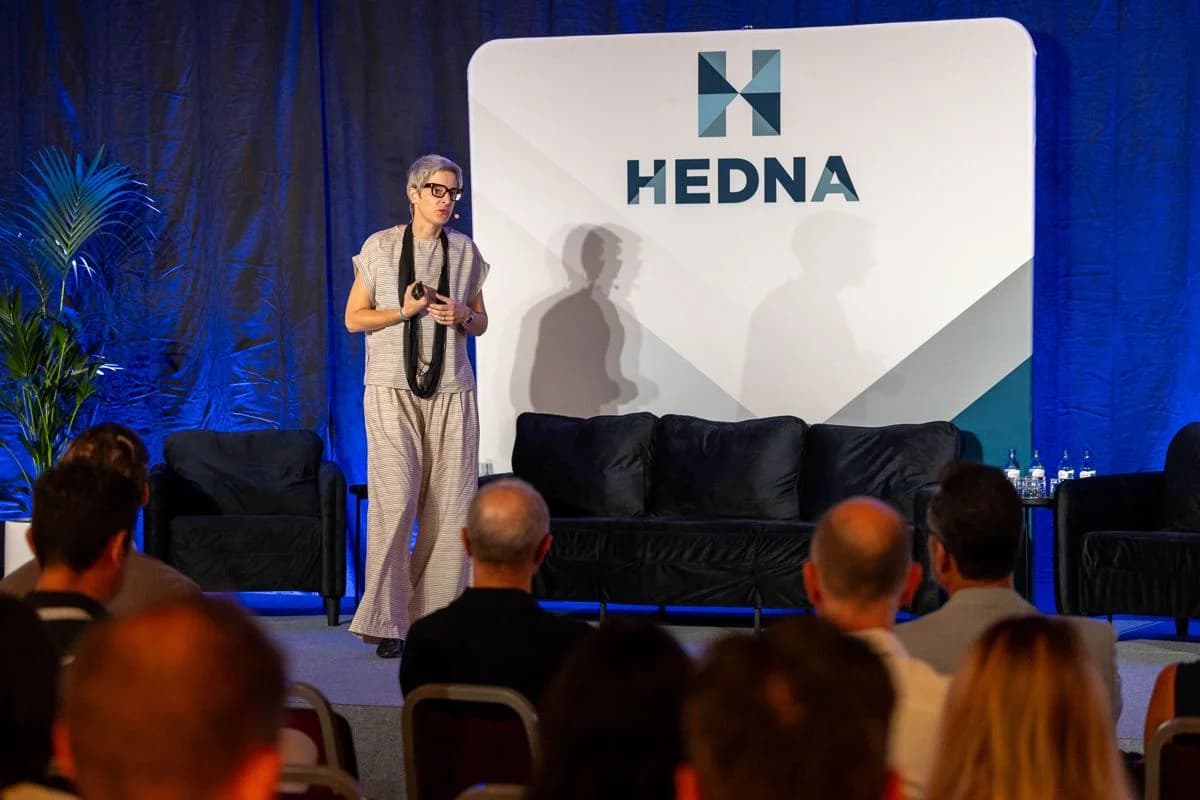
When I booked a hotel room to go to the HEDNA conference in September, I went through pages of results. Next time I need a hotel, I can simply open my AI assistant and type, "I want a quiet room in Lisbon within walking distance to the conference with breakfast before 7am, free cancellation, under €200."
Within seconds, my AI assistant returns three options. One is closer to the conference, but it’s above my budget. One is cheaper, but breakfast starts too late. The third is a smaller independent hotel with courtyard-facing rooms, breakfast from 06:30 and a flexible rate under €200. I’ve found my match. I’ve found my match. The AI assistant made the experience feel simple because the ecosystem did the difficult work behind it.
My request only works if, weeks earlier, a hotel decided which guests it wanted and built a real offer for them. If "quiet" maps to an actual courtyard-facing room. If "breakfast before 7am" is a verified, current fact, not a stale listing. None of that gets generated by the AI assistant in the moment. It has to already exist, accurately, in systems the AI can trust.
How to be discovered in the world of AI
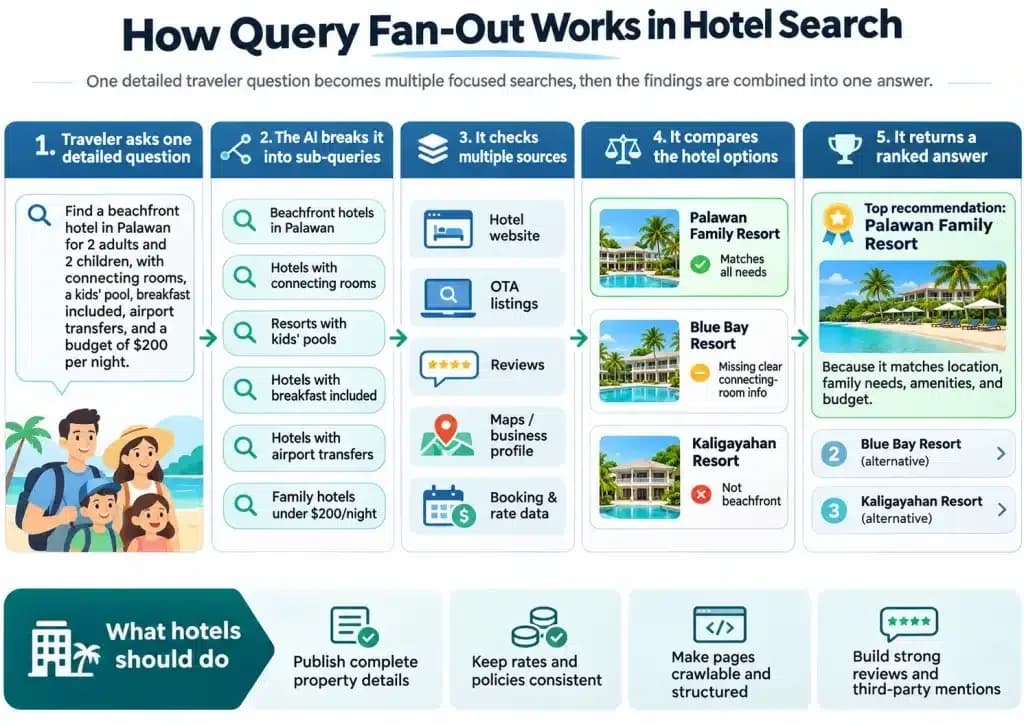
If an AI assistant only surfaces three options instead of three pages of search results, a hotel that matches my wishes but doesn’t know how to describe its offering will likely never be considered.
In this new world of agentic AI, hotels must understand their unique offering and communicate it clearly and accurately for AI chatbots and real human travelers alike.
My hotel request sounds simple enough, but behind the scenes it requires an entire ecosystem to work in sync. Content systems describe rooms and services. Revenue management helps determine price. The CRS confirms which room and rate can be sold. Live room-and-rate details must be linked to the relevant room characteristic, so it is clear what is part of the booking, and what remains only a request. Distribution makes the offer accessible, and the property must be able to deliver on it.
AI agents may know where to look to provide answers, but all the facts must be accurate, and the systems involved need to agree. In short, this entire process requires some orchestration.
What makes a hotel different must become bookable
My AI assistant has found a suitable offer. I say “Yes, book it.” The next question is how that offer becomes a real reservation.
The selected hotel room, rate, and conditions pass through the hotel’s reservation system. The hotel checks the latest availability and total price, then returns a final offer. I review and approve it.
This is similar to metasearch, but two things are different. First, metasearch normally begins with a destination, dates, and occupancy. But my AI journey began with intent: quiet, walkable, early breakfast, and a flexible cancellation within a set budget. This nuanced request has to survive the booking process. Another big difference is that I may never leave my AI assistant chat window to complete the booking
Travelers don't agree on how much to trust AI – yet
I may be willing to complete my booking within my AI assistant chat, but not all travelers are ready to do that just yet. Research we recently carried out found 65% of travelers would book inside an AI assistant — but only 20% are comfortable letting it spend without approval first.
My conclusion: we can’t design for one inevitable checkout path. We must build for both AI-native bookings and handoffs to a trusted seller. In both cases, we must make sure a traveler's nuanced intent and requests are reflected in the booking.
Leaving the conversation should not mean beginning again. The receiving channel must confirm what remains available and make any change in price or conditions clear. The two paths may involve different technology, responsibilities and economics, but they should not produce different understandings of what the traveler intended to buy.
Disruption and servicing are the real test
The scenario I find most interesting isn't the booking, but the servicing or disruption. Imagine I’ve made it to my courtyard hotel in Lisbon, but I want to extend my stay. Will my AI assistant know what to do?
Depending on the hotel’s setup, the CRS checks whether the room can be extended and at what price, while the PMS may need to confirm the operational change. If the room is unavailable, it can return another valid option. The assistant presents the additional price and new conditions and I approve them.
Now suppose the modification cannot be completed digitally. The assistant should take me to the human who can help, carrying the reservation details and my request. I should not have to explain everything again.
Amadeus’s US research found that 49% considered real-time rebooking when plans change a useful AI capability. The same research found that travelers still preferred human assistance when something went wrong.
In other words: the best AI-enabled journeys don’t require AI to do everything. People do not demand automation. They demand resolution.
We can now see the Lisbon journey from the hotel’s perspective: Market intelligence showed where demand was forming. The hotel marketing team chose the guests it wanted, and communicated the hotel’s strengths clearly via its website and various distribution platforms. My AI assistant found these descriptions, matched it with my asks, and brought a bookable offer into consideration. Payment made my approval a commitment. The hotel delivered the stay, and servicing kept the reservation when my plans changed.
A conventional digital journey often leaves a visible referral path. But now, the most important part of my decision may happen inside an AI conversation. The hotel won’t be able to trace how my preference was formed or why it entered the shortlist.
This is where technology partners can help. Those that can make fragmented hotel content usable, connect executable offers, support payment and servicing, and help hotels understand the value of the resulting demand may become more important.
No company needs to own every step, but the steps have to work as one accountable commercial process. This is why the future of travel depends on orchestration, and this is where Amadeus brings something distinctive: the reservation systems hotels run on, trusted records of what can be sold and serviced, deep integration with the systems that make travel work, and the ability to connect those capabilities across the ecosystem at scale.
A new kind of trust, built in advance
Conversational AI agents are only starting to appear in our day to day lives. For now, agentic AI may only be able to suggest a booking that aligns with our travel plans, but travelers expect more. Our entire hospitality infrastructure must adapt so that agentic AI bookings are as reliable as those made by a human.
We must find ways to ensure that conversational AI recommendations are confirmed and can be fully managed and serviced in the same way as all other bookings. Because at the end of the day, an unhappy traveler may not remember that their booking journey started with an AI chatbot, but they will remember the hotel provider that let them down.
Agentic AI isn’t a trend we will want to ignore. Hotels that don’t adapt may never even be considered. The next hotel I book will appear in my top three choices because weeks before, the pieces were already in place: an accurate offer, a system that could confirm it, a path to deliver it. That's not a coincidence. That's orchestration, and it's the work our industry needs to start now, not once agentic AI has already decided who travelers trust. Amadeus is building for that future: the technology that helps hotels and other travel retailers be found, booked and served, wherever travelers start.
Links gallery
About HEDNA
HEDNA (the Hotel Electronic Distribution Network Association) is the industry body connecting hoteliers, technology providers, OTAs, GDSs and payment companies around how hotel rooms are bought, sold and paid for. I shared these ideas at the HEDNA conference in Lisbon this September, where the industry gathered to work through exactly these questions of distribution, trust and AI.