Google’s query fan-out is changing how travelers find hotels online by turning one detailed travel question into multiple related searches and combining the findings into a single answer. Instead of searching separately for hotel locations, room rates, amenities, reviews, and policies, travelers can now describe the stay/accommodation requirement they want in Google AI Mode. For hotels, this creates new ways to be discovered, but being visible for a broad keyword may no longer be enough. Hotels need accurate property information, useful website content, credible online mentions, and booking details that match what guests want.
For hotel owners, operators, and management teams, the opportunity is no longer to rank for one head term. It is to ensure every verifiable fact a traveler might need—room types, pet policy, parking, meeting space, dining, accessibility, check-in time, cancellation terms, and direct-booking cost, etc. —is accurate, crawlable, consistent, and easy for search systems to understand.
In this blog, you will learn what query fan-out is, how it works, how it cites hotels, and, most importantly, what hoteliers like you must do to stay discoverable.
What is a Query Fan-Out in Hotel Search?
Query fan-out became widely known in search marketing when Google introduced AI Mode on March 5, 2025. Query fan-out in hotel search is a technique AI-poweredsearch systems use to break a complex hotel discovery question into several smaller searches, or sub-queries. It then retrieves relevant information and combines the findings into one response.
How does it help a traveler?
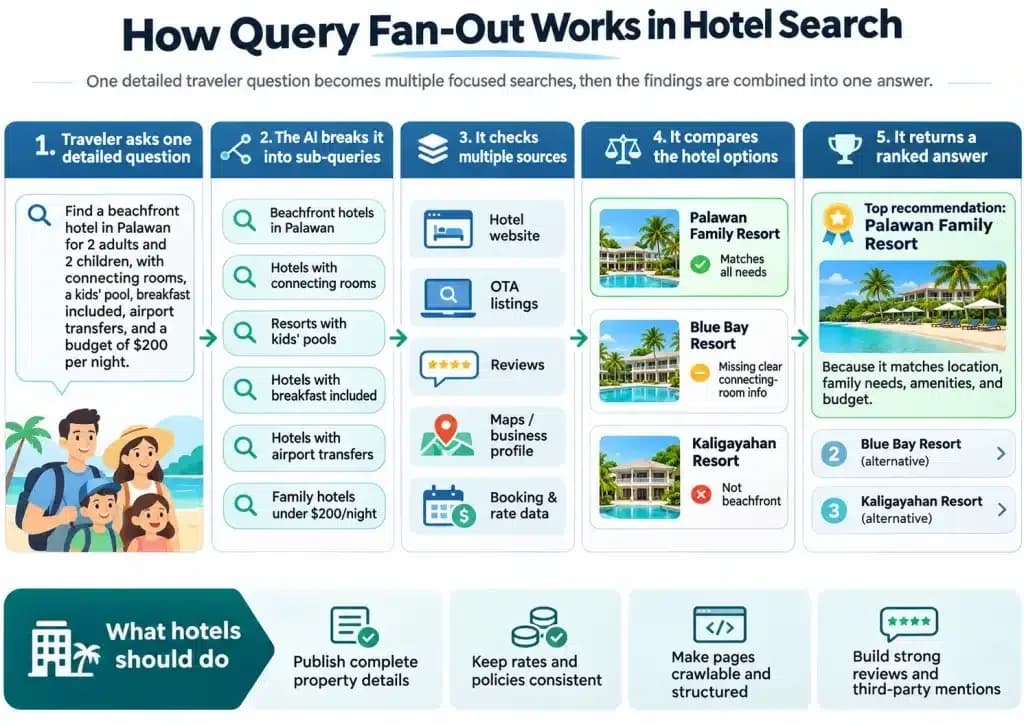
Instead of searching separately for hotel locations, room rates, amenities, reviews, etc., travelers can describe the stay (the kind of hotel) they want in Google AI Mode. For example, a traveler searching for “best resorts in Palawan in the Philippines” may see many properties. However, someone asking, “Which beachfront resort in Palawan has connecting rooms, a kids’ pool, airport transfers, and breakfast under $200 per night?” gives the search system a much clearer picture of what matters to the traveler.
Here is a step-by-step example of how query fan-out helps hotels find travelers:
Imagine a family of four planning a holiday in Palawan, the Philippines.
The parents open Google AI Mode and enter the following question:
“Find a beachfront hotel in Palawan for two adults and two children, with connecting rooms, a kids’ pool, breakfast included, and airport transfers. Our budget is $200 per night.”
Step 1: The AI system identifies what the traveler wants.
The search system interprets the original question and identifies the requirements. In this case, they are:
- Destination: Palawan, Philippines
- Location: Beachfront
- Guest type: Family of four
- Room requirement: Connecting rooms
- Facilities: Children’s swimming pool
- Meal plan: Breakfast included
- Transport: Airport transfer
- Budget: Approximately $200 per night
This search combines location, accommodation type, amenities, services, price, and guest suitability. The system needs information about each requirement to develop a useful answer.
Step 2: It generates several related hotel searches.
The AI system creates several hypothetical subqueries such as. These are examples of searches the system might generate, not a disclosure of Google’s exact internal queries.
- Best beachfront family hotels in Palawan: Property suitability and location
- Palawan resorts with connecting rooms: Room configuration
- Resorts in Palawan with kids’ pools: Family facilities
- Palawan beachfront resorts with breakfast: Meal plans
- Palawan resorts offering airport transfers: Transport services
- Family resorts in Palawan under $200: Room rates
- Reviews of family-friendly Palawan resorts: Guest experiences, their reviews
This process is called query fan-out: breaking a broad request into smaller, more specific questions.
Step 3: It retrieves hotel information from different sources.
The system uses relevant search results and available data sources to investigate the subqueries. In the process, it may retrieve information from:
- The resort’s own website
- Google Search and eligible business information
- Travel publications and destination guides
- OTAs
- Guest review platforms
- Relevant booking and pricing sources
- Guest-generated content on their social media platforms
Different sources may provide different kinds of evidence. The property’s website may explain whether connecting rooms are available. Guest-generated content on their social media pages may describe amenities, beach access, room quality, and the swimming pool. Guest reviews on OTAs may shed light on their experience, food quality, staff behavior, etc.
Step 4: It assesses the property against the requirements.
Let us say the AI system finds three properties. Note: We are using fictional resort names for easy understanding.
- Palawan Family Resort: Its website clearly describes connecting rooms, a children’s pool, a beachfront location, breakfast packages, and airport transfers.
- Blue Bay Resort: It offers beach access, breakfast, and airport transfers, but its website does not clearly confirm connecting rooms.
- Kaligayahan Resort: The property has family suites and a children’s pool, but it is located farther from the beach and does not clearly describe airport transfers.
All three properties could suit different travelers. However, the first property – Palawan Family Resort matches the traveler’s requirements.
Step 5: It generates a response with hotel recommendations.
The AI system’s recommendation may read something like this:
“For a family-friendly stay in Palawan that hits every requirement on your checklist, Palawan Family Resort is the top recommendation, followed closely by a couple of exceptional alternatives. These resorts sit right on the coast, feature excellent pools for children, provide smooth airport logistics, include breakfast, and offer connecting room configurations safely within your $200 per night budget.”
The answer may include links to the official hotel website or other supporting sources. Please note that the system will also suggest a couple more options, typically 3-5 other resorts. The traveler can review the information, compare alternatives, and continue toward booking.
Step 6: The traveler asks a follow-up question.
The family may then ask, “Which of these hotels offers free cancellation and vegetarian breakfast?” This prompts the search system to retrieve additional information about cancellation terms and dining options. The original shortlist can change as the guest adds new requirements. Properties that matched the first search may no longer be the best fit. Another resort may become more relevant because it clearly offers the newly requested features.
The lesson for hotels: Your website should answer more than “Where is the hotel?” and “How much does a room cost?” It should also answer the detailed questions travelers ask when choosing where to stay.
Query fan-out benefits travelers by turning a single hotel search into a more complete, needs-based research process. Instead of manually checking multiple websites for family rooms, accessibility, airport transfers, breakfast timings, cancellation policies, or meeting facilities, travelers can state their requirements and let the search system investigate and find the property that matches their requirements. This makes it easier to build a shortlist, compare properties on the factors that genuinely matter, and refine choices through follow-up questions—such as moving from “beachfront hotels” to “beachfront hotels with wheelchair-accessible rooms.”
Want to See Hotelogix in Action
Book a Live Demo
How does it benefit hotels?
One thing is clear – query fan-out rewards hotels with clear, complete, coherent, and credible information, not just keyword stuffing. A property that clearly answers the questions travelers actually ask has more opportunities to get cited or recommended. A small independent hotel with excellent, accurate, accessible, well-structured, and specific information can therefore compete and draw attention alongside larger chains.
How hotels get cited.
Your hotel’s chance to get cited icreases when your brand website page contains a clear, trustworthy answer to one of the sub-questions generated by the traveler’s prompt. For example:
- A room page that explains accessible features in detail
- A dining page that states vegetarian, vegan, Jain, or allergen-friendly options
- An experiences page that describes curated local itineraries
- A meetings page that specifies capacities, AV equipment, and banquet configurations
- A policies page that clearly explains pets, children, parking, cancellations, length of stay restrictions, deposit policies, and check-in/check-out time
- A location guide that offers genuinely useful local knowledge
- A reviews or guest-story page that provides first-hand perspective
A step-by-step guide to make your hotel ready for query fan-out discovery.
You cannot control every recommendation an AI search system makes.
You can, however, improve the quality, accessibility, and accuracy of the information available about your properties.
Here is a practical action plan to start with:
Step 1: Identify the questions your ideal guests ask.
Start with your main guest segments. For example:
- Business hotels: Meeting facilities, airport transfers, early breakfast, reliable Wi-Fi, and proximity to central business districts.
- Family resorts: Connecting rooms, children’s pools, extra beds, activities, and meal plans.
- Boutique hotels: Neighborhood character/attractions, local experiences, heritage features, and personalized services.
- Full-service hotels: Restaurants, spa facilities, events, business services, and room categories.
- Hotel groups: Property locations, facilities, group booking options, and differences between individual hotels. Make sure each location reflects its actual facilities rather than using the same generic description across all properties.
What to do: Do not assume every traveler searches for the same features. Create a list of 20–30 genuine guest questions and group them under rooms, food and beverage plans/options, location, facilities, transport, policies, dining, pet-friendly policies, EV charging availability, free/paid Wi-Fi, exact location from the railway station or the airport, and booking cancellation/modification policies.
Step 2: Make facts consistent everywhere.
This is very important. Your website, booking engine, Google Business Profile, OTA listings, metasearch feeds, social profiles, and review responses should reflect the same information. For example, if your website says “pets allowed on request,” then the OTA listing should not say “no pets.”
What to do: Leave no room for conflicting information. Therefore, resolve discrepancies at the source, then update every platform.
Step 3: Audit your hotel’s public information.
Ask yourself: Can a traveler easily find room occupancy limits? Are connecting rooms described? Is breakfast included or charged separately? Are airport transfers complimentary or paid?
Look for missing or vague descriptions.
For example, “family-friendly rooms” says little about the actual sleeping arrangements. A better description is: “Our family suite accommodates two adults and 2 kids and includes one king bed and two single beds.”
What to do: Ask reservations and operations teams to verify each important facility and policy before updating the website. Only publish such details when they are accurate for your property.
Step 4: Publish useful destinations and local travel content.
Hotel discovery often begins with a destination question rather than a property name. A traveler might search:
- “Where should a family stay in Palawan?”
- “Which area in New York is best for business travelers?”
- “Where can couples stay in Cambodia away from busy streets?”
These are opportunities for destination-focused hotel content. Write about the local area using accurate information. Include nearby attractions, transport options, distances, travel considerations, and practical advice.
What to do: Create relevant articles that answer real destination questions and naturally connect readers to the hotel’s location or room pages.
Step 5: Strengthen guest reviews and third-party mentions.
Search systems may retrieve information from guest review websites and travel publications while researching hotels. That is why your hotel’s online reputation through guest reviews matters, and you should encourage guests to leave reviews through appropriate post-stay communications. Respond to feedback and rectify repeated service issues. Also look for legitimate opportunities to appear in destination guides, tourism association websites, local event pages, and credible travel publications.
What to do: Build a review-management process and pursue relevant, authentic guest feedback. Additionally, work with local guides/influencers, creators, credible travel publications, event coverage, and community discussions. All of this can contribute to the broader evidence about your hotel. Remember this: Google prioritizes high-quality content and blocks spam.
Step 6: Make your hotel’s website technically accessible.
Search systems need to discover and process your webpages. Ask your SEO or website team to check whether important pages can be crawled and indexed. Review:
- Robots.txt and indexing instructions
- Canonical URLs
- XML sitemap
- Mobile usability
- Internal linking
- Page loading performance
- Descriptive headings
- Accessible, text-based content
Hotel and lodging-related schema can describe relevant property information when implemented correctly.
What to do: Use Google Search Console to identify indexing issues and fix important technical problems before investing in advanced AI-search tactics. Do not chase query fan-out with hundreds of near-identical pages. Google specifically cautions against creating separate content for every possible query variation as it violates its policy.
Step 7: Keep room rates and availability accurate across connected booking channels.
Your hotel rates and inventory can change throughout the day, and those changes should reflect across booking channels in real time. This matters when a traveler moves from an AI recommendation to a booking page.
If the room is no longer available or the final price differs from the advertised offer, the visitor may abandon the reservation.
What to do: Invest in a connected tech setup that includes a cloud-based Hotel PMS, integrated with a channel manager and booking engine.
The Role of a Modern Cloud-Based Hotel PMS.
A cloud-based hotel property management system does not directly determine whether Google AI Mode or another AI search tool will cite your hotel. However, it supports the accurate data and booking journey behind that visibility and helps you prepare for AI-powered travel discovery by keeping operational information accurate, connected, and booking-ready.
1. Accurate room availability supports dependable booking information.
A cloud PMS records reservations and room-inventory changes in real time. When connected to a channel manager,booking engine or distribution system, these updates flow instantly to participating sales channels. This live synchronization is critical during an AI query fan-out. For example, when an AI agent checks inventory APIs for eligible hotel booking data, current inventory ensures the property is marked as “available.”
2. Connected systems support consistent hotel rates.
Room prices vary dynamically by room category, season, demand, meal plan, and booking conditions. A PMS integrated with a channel manager or a booking engine helps maintain uniform rate integrity (rate parity) across OTAs and direct sales channels. This matters immensely when an AI splits a user’s prompt to filter by budget. For example, isolating hotels under $150 per night. If the rates fed by the PMS are inconsistent, the hotel may not appear in the AI’s final recommendation carousel because of conflicting pricing.
3: PMS reports help your marketing teams understand guest demand.
PMS-generated reports offer you insights into occupancy, booking patterns, length of stay, and guest segments. They enable your marketing team to identify highly relevant content topics. Say your hotel is experiencing strong family demand. You can use PMS data to prioritize website content around family suites, dining, and child-friendly facilities. Similarly, a business-centric property can focus on meeting spaces and amenities, and other relevant corporate services. Operational data help you identifywhat guests actually want, allowing your team to create rich, crawlable website text that AI engines look for.
4: Multi-property management helps hotel groups maintain operational oversight.
For hotel groups or chains, a cloud PMS with multi-property management capabilities supports centralized operational oversight. It lets management see how demand differs between city hotels and leisure properties. Each property’s website and business listings must describe its actual offering. A family resort and a corporate city hotel should not use identical descriptions, because property-specific details matter in traveler searches.
Query fan-out turns hotel discovery into a test of operational clarity. The hotels most likely to be cited are not necessarily those with the largest advertising budgets. They are the properties whose real strengths are described accurately, consistently, and helpfully across the web. Your task is to make it easy for AI systems to understand what makes your property suitable for a traveler. To become discoverable and cited by AI systems, make sure your brand story is consistent everywhere.