When people think about an LGBTQ+ employee network, they might imagine Pride events, awareness activities or colleagues coming together around shared experiences. Those things can be part of it. But after years of being involved in LGBTQ+ inclusion at Amadeus, I’ve come to value something much simpler: knowing there are people around you who may understand your experience.
That was part of what drew me to Amadeus Proud. Earlier in my career, being open about who I was at work had not always felt so straightforward. At Amadeus, I saw colleagues creating a community where it was OK to be yourself, and I wanted to contribute to that.
Amadeus Proud began in 2016 and has since grown into a global employee-led network for LGBTQ+ colleagues and allies. There are many waysto be part of it. Some colleagues get involved in activities and initiatives. Others come to connect, listen or learn. And some may simply value knowing the community is there if they ever need it.
Over time, my own relationship with Proud has evolved. At first, what mattered was finding a community. Gradually, I found myself thinking more about how I could help create that experience for others.
That evolution has also happened more broadly at Amadeus. Today, our work on LGBTQ+ inclusion sits within Amadeus for All, our broader approach to creating an inclusive workplace where everyone can thrive and contribute. Proud is one way this comes to life, alongside our policies, learning and partnerships.
It builds on work developed over a number of years. In 2018, Amadeus signed the UN Standards of Conduct for Business tackling discrimination against LGBTI people. Since then, that work has continued through employee communities, policies, learning and external partnerships.
LGBTQ+ inclusion is not something one employee network can deliver alone. It takes colleagues, leaders, People & Culture teams and allies, working in different ways to help create an environment where people feel they belong.
And some of the challenges we face are bigger than any single company.
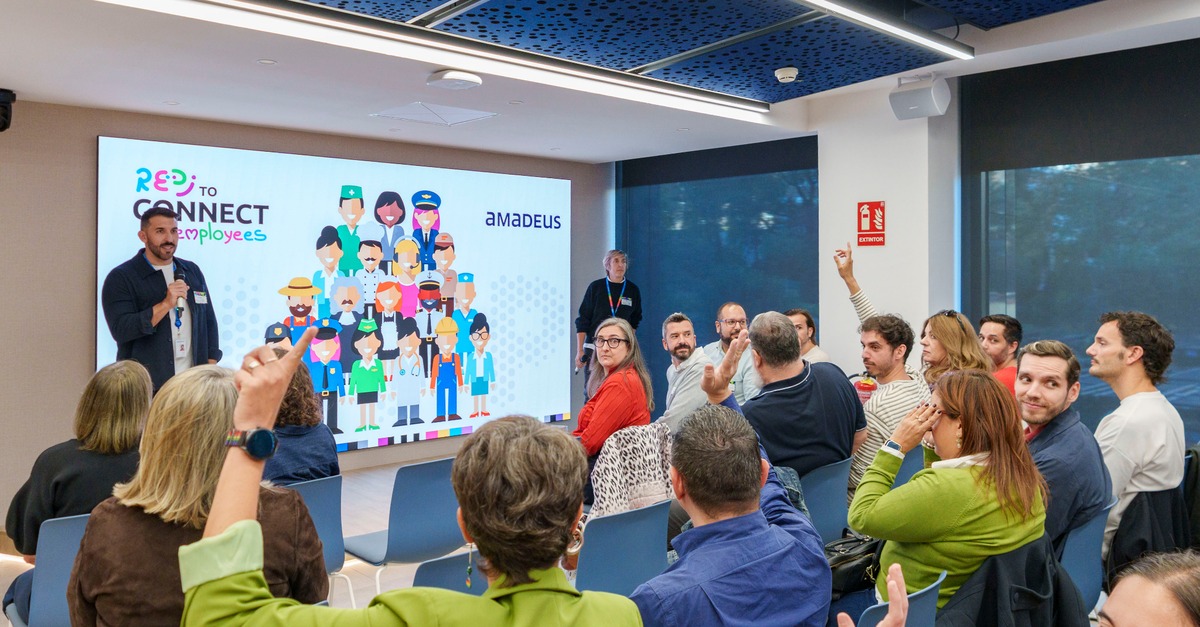
That is why collaboration beyond Amadeus matters too. Amadeus was one of the companies that co-founded REDI (Red Empresarial por la Diversidad e Inclusión LGBTIQ+), the Spanish Business Network for LGBTI Diversity and Inclusion. Through REDI, companies can share experiences and learn from one another. REDI To Connect Employees (RTCE), REDI’s network of employee resource groups, brings together the people involved in those communities across different organizations.
I’ve stayed involved because of the people. There is real value in meeting someone from another organization and realizing that they are facing a similar challenge or have found an approach you can learn from. Collaboration allows us to share what works and think about what we might do together.
One current RTCE project focuses on LGBTQ+ young people moving from university into the workplace. A ManpowerGroup study, Diversity at Work 2026, suggests that only four in ten young LGBTQ+ people are open about their identity at work. REDI describes a pattern it calls the “closet cycle”: young people who may be open about who they are in their personal lives becoming less visible when they enter the workplace.
The project brings together volunteers and university contacts from different REDI companies to help students understand what working in inclusive organizations can look like before they make that transition.
For me, it shows the value of widening the circle. By pooling our contacts, experience and energy, we can work together on challenges that would be much harder for one employee network or company to tackle alone.
That spirit of collaboration is also why bringing members of the RTCE community together at Amadeus in Madrid matters. It gives us a chance to learn from one another, exchange experiences and continue building connections across companies.
Despite all the networks, initiatives, and collaboration, I keep coming back to something much smaller.
Inclusion is ultimately experienced person by person. You may not be able to change an entire organization yourself. But you can listen. You can be an ally. You can create space for someone to be themselves.
And sometimes, making sure one other person knows they belong is where change begins.