Sabrina Jackson
VP of Product Management, Duetto
The future is more automation. Explainability is how you earn trust.
AI will set your rate. It won’t take the call from your GM on Monday.
Here’s what I’ve seen happen when nobody can explain a recommendation. People override it, ignore it, or trust it blindly. All three waste the automation you paid for, and the last one is the sneaky one, because it can cost you margin before anyone notices.
One revenue leader told us he won’t hand his team a new profit target until the system can act on it. Otherwise he’s just asking them to do more manual work.
I’ve spent nearly ten years building pricing and revenue solutions for hotels, and the hardest question I’ve watched revenue teams face was never “what should the rate be?” It’s the one that comes right after. “Why?”
The teams that can answer it have the edge.
Owners ask a slightly different version of the same question. They want to know what it did to the bottom line. A rate that lifts revenue but costs margin isn’t a win, which is why we think in terms of performance engineering. Profit is the number everyone shares, not revenue alone.
The future is more automation, with more of it acting on your behalf. The real question is whether you can stand behind every decision it makes and explain why.
AI is no longer the differentiator.
Most of the AI conversation in hotels right now is about speed. In a recent AIHA and HEDNA study of 109 unique use cases, about 6 in 10 name time savings as the main payoff, and fewer than 1 in 10 mention control or explainability. Pricing automation is one of the most mature categories on that list, with agents updating rates several times a day. They’re very good at acting. Explanation hasn’t kept pace.
~6 in 10
name time savings as the main payoff
<1 in 10
mention control or explainability
Speed is no longer the edge. The real test is whether the answer holds up when your GM says, “Okay, but why?” Whether you’re buying AI or building it, these three questions are where I’d start.
What changed and what is it assuming?
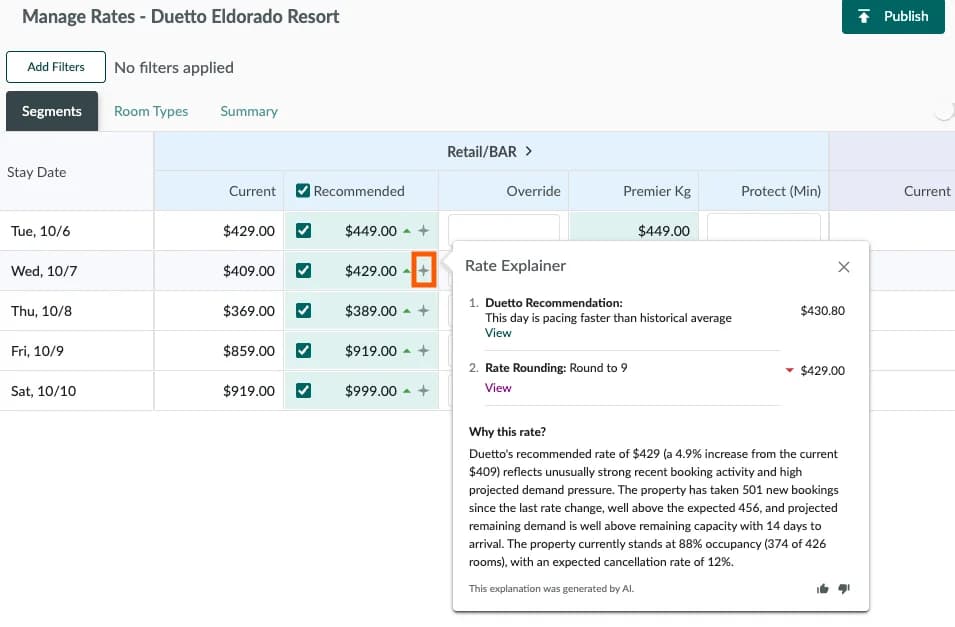
Say a system raises Saturday’s rate by $20. A black box hands you the new price and wishes you luck. An explainable one tells you why. Pickup is ahead of last year for that date, a competitor just sold out, and a group released its unsold block. It also shows what it’s assuming and what would change its mind, and it lets you hold the rate if you know something it doesn’t, like an event it hasn’t heard about yet (there’s always one).
Red flags
A bare number, or a confidence score with no reasons behind it.
Quick check
Pick one recommendation and ask for the explanation in terms your GM or owner would accept.
Does a rate code mean the same thing at every property?
AI doesn’t fix messy definitions. It scales them. Here are two common issues we hear from customers:
An orphaned rate code that still exists.
It’s about 1% of room nights at most hotels in a portfolio and zero at one. AI flags it in seconds, but only someone who knows the property can say whether it’s a mapping mistake or a legitimate exception. (The answer is usually in a spreadsheet or in someone’s head.)
The same booking, two answers.
Say an OTA’s public rate is $100. One reservation lands at $100 with commission still owed. Another lands at $80 with commission already deducted. Your ADR blends to $90 and a channel mix shift looks like a rate drop. The math is right. The story is wrong.
One revenue leader put it better than I could. He can change what the data says just by moving a booking to a different rate code, and the guest stays exactly the same. Feed that to a model and you get a confident answer built on a mislabeled input. And you can’t explain a number built on a code nobody can define, which leaves someone signing off on it anyway.
Red flags
Segments, rate codes, or commission treatments that differ between properties.
Quick check
Take one rate code and see whether three properties define it the same way, before or after commission.
Who can step in and can you see what it did?
Every automated action should leave a trail you can follow and a person who can override it.
Autonomy gets earned and it gets earned call by call. A quiet Tuesday in January can run on autopilot, because if the rate is a little off, the cost is small. A sold-out event weekend with a group fighting for the same rooms is a different animal. So is an owner with expectations and a brand with standards to hold. The more a wrong call costs, the more you want to see what the machine did and why it did it.
Red flags
Actions you can’t trace or no named person who owns the override.
Quick check
Pick one automated change from last week and trace it from the input to the action to the person who could have stopped it.
We test the same way you do.
We recently tested an early concept with revenue leaders: one view of room revenue, cost and ancillary revenue. AI got us to a working prototype fast, and let us get through dozens of calls and documents in minutes instead of days.
What it couldn’t tell us was whether we were right. People liked the view. Nobody wanted to be the one entering the cost data. (Turns out a lovely prototype can still ask a revenue manager to do finance’s job.) And even with perfect data, many wanted help understanding before they wanted to be told what to do. That’s shaping what we build next.
We label what’s evidence and what’s still a hypothesis, same as you would with a pricing strategy. Test, recalibrate, stay honest. That’s how we change direction without dropping what customers depend on today.
Delegate the routine. Own the answer.
Here’s the test for any recommendation you’re about to accept, from a person or a machine: what changed, what is it assuming, and what would make it wrong? If it can answer those, you can defend the call to a GM, hold it when an owner pushes, and override it when you know something it doesn’t. If it can’t, you’re not delegating. You’re guessing faster. That’s also how autonomy gets earned.
Hand off the routine calls and keep the ones that need you. The GM’s call is coming either way and the only choice is whether your answer is “the system said so” or “here’s what changed, here’s what it assumed, and here’s what I’d override.”