Key takeaways
- Social media in healthcare builds patient trust, supports recruitment, raises public health awareness, and creates direct communication channels with patients, but compliance with HIPAA, FDA, and FTC regulations is non-negotiable.
- A documented healthcare social media policy with approval workflows protects your organization from violations that can carry fines of more than $2.1 million per violation category per year.
- Healthcare organizations that focus on educational, engaging content on one or two priority platforms outperform those spreading resources thin across every network.
- AI tools can save healthcare social teams significant time on content creation, but every post needs human review and compliance approval before publishing.
Social media in healthcare is the use of public social platforms by healthcare organizations to communicate with patients, educate the public, recruit staff, and build their brand. That includes hospitals and health systems, private clinics and group practices, public health agencies, pharmaceutical and medical device companies, and individual clinicians posting in a professional capacity.
In practice, most healthcare social media activity falls into a handful of use cases:
- Patient engagement: Answering common questions, sharing service updates, and staying connected between visits.
- Health education: Explaining conditions, procedures, and preventive care in plain language.
- Recruitment and employer branding: Showing what it’s like to work at your organization.
- Brand building: Establishing credibility and patient trust before someone becomes a patient.
- Crisis communication: Responding quickly to incidents, closures, or negative press.
- Public health outreach: Promoting screenings, vaccination campaigns, and community programs.
What makes healthcare different from other industries is the regulation. Marketing teams in most sectors worry about tone and timing. Healthcare teams also have to consider protected health information, advertising law, and professional licensing rules, where a single post can trigger a federal investigation. That tension, high opportunity paired with high risk, shapes everything that follows in this guide.
Bonus: Download a free social media toolkit for healthcare professionals with post ideas, templates, and more. Save time and get inspired!
An active social media presence can help healthcare organizations do everything from attracting new patients to recruiting top talent. Here’s a closer look at the most impactful benefits.
How does social media build patient trust and brand recognition?
Social media builds patient trust and brand recognition by creating a consistent, values-driven presence that signals credibility before someone ever walks through your doors. Healthcare organizations aren’t usually what most people associate with brands, like remembering a Coca-Cola commercial from their childhood. But brand recognition and perception is even more important for healthcare organizations because a provider-patient relationship centers around patient trust.
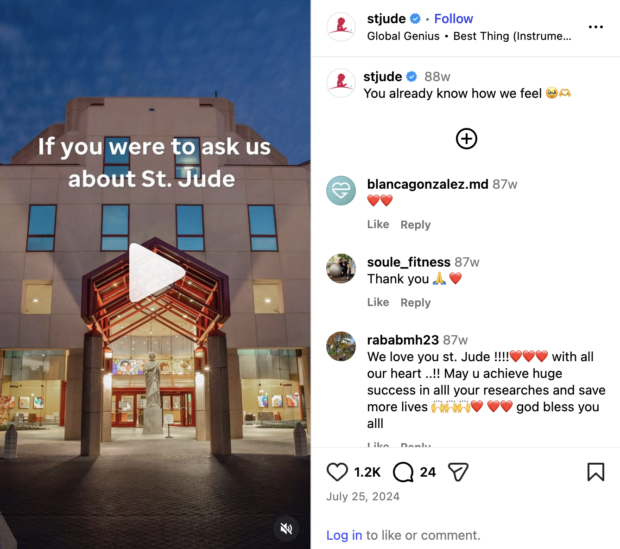
When prospective patients research providers online, a consistent, values-driven social presence signals credibility. Posts demonstrating your values go a long way toward building trust with both prospective patients and employees, like this Reel from St. Jude’s:
How can social media raise public health awareness?
For public health bodies like health authorities or government offices, social media is a powerful tool to reach the majority of your region’s population relatively inexpensively.
Agencies with established followings can push out guidance during a seasonal flu surge, a local outbreak, or a product recall far faster than through traditional channels alone, and they can correct false claims while the conversation is still active.
For those in the B2B health space, social media is both a way to promote your products to healthcare organizations and help contribute to public health literacy with educational content.
How does social listening help healthcare organizations stay informed?
Besides sharing your own news, social media keeps you informed about what your competitors and industry as a whole are up to.
For healthcare organizations specifically, social listening can help you track emerging health trends, monitor misinformation about treatments or conditions, and benchmark your presence against other health systems in your region.
With Lumen, the integrated insights and listening app inside Hootsuite Social OS, you can search for keywords across billions of online sources in seconds. More than search results, Lumen shows you relevant conversations in context, including measuring positive vs. negative brand sentiment and the most popular content for your keywords.
How does social media support healthcare recruitment and employer branding?
Healthcare faces ongoing staffing challenges, and social media has become one of the most effective channels for reaching potential hires where they already spend time.
Hospitals and health systems that showcase workplace culture, share employee testimonials, and highlight professional development opportunities on platforms like LinkedIn and Instagram can differentiate themselves in a competitive labor market.
This goes beyond posting job listings. Behind-the-scenes content, “day in the life” videos from nurses or technicians, and posts celebrating team milestones all help prospective employees picture themselves at your organization.
For large health systems managing recruitment across multiple locations, a consistent employer brand built through employee advocacy can reduce cost-per-hire and shorten time-to-fill for critical roles.
Parliament, the employee advocacy app in Hootsuite Social OS, gives staff a library of pre-approved posts they can share to their own networks, which keeps advocacy on-message without adding another approval bottleneck.
How can social media improve patient engagement and communication?
Social media gives healthcare organizations a direct line to patients outside of clinical settings. Organizations use it to share appointment reminders, post-care instructions, answers to common health questions, and updates about new services or locations.
This kind of ongoing communication builds a sense of community. Patient-facing Facebook groups, Q&A sessions on Instagram Stories, and educational YouTube series all create touchpoints that keep your organization top of mind between visits. The result is stronger patient loyalty and a more informed patient population.
Schedule your personalized, risk-free demo
Join social media's most memorable brands in healthcare, biotech, and pharma by signing up for Hootsuite. Start with a risk-free demo now.
What are the risks and common mistakes of social media in healthcare?
The biggest risks in healthcare social media are regulatory violations, misinformation spreading unchecked, and reputational damage from mishandled public conversations.
Even well-meaning healthcare organizations can stumble here. A proactive approach to social media risk management starts with understanding what tends to go wrong. Here are a few examples of what to steer clear of.
Sharing patient information without consent
Sharing patient information without written consent is not just a reputational risk. It is a violation of HIPAA that can result in fines exceeding $2.1 million per violation category per year and potential criminal charges.
While no medical professional has likely done this with ill intent, it does happen. Training staff on HIPAA-compliant social media practices is essential, and organizations should err on the side of caution and avoid potentially sensitive information altogether if there’s any question about whether content is anonymous enough.
Using stigmatizing or outdated medical language
Not using the most current medical language may imply a bias or judgment, even if you didn’t mean to come across as judgmental at all.
An example could be referring to substance use disorder issues with (unintentionally) stigmatizing language which may alienate potential patients. The National Institute of Health has some great advice on science-based language relating to this example, though there are parallels for many other health topics.
Making unsubstantiated health claims
Healthcare organizations are unlikely to make claims on social media without clinical evidence. But vague language can still trigger regulatory scrutiny. Phrases like “clinically proven” or “doctor recommended” require specific sourcing, and the FTC has made it clear that the burden of proof falls on the advertiser.
Be prepared to back up any claims with evidence if asked, and have your compliance team review content that references product efficacy or health outcomes before it goes live.
Running misleading healthcare ads
Healthcare ads need to follow much stricter rules than regular consumer ads. The main key is ensuring they are clear, accurate, and not misleading in any way, even by way of omission.
Misleading by omission is particularly common on social media, where character limits and short-form formats make it tempting to highlight benefits without mentioning risks. For example, promoting a weight-loss medication without disclosing common side effects, or advertising a procedure’s success rate without noting the criteria that defined “success” in the study. Both could draw FDA or FTC scrutiny.
In addition to being governed by privacy laws like HIPAA, healthcare ads are also regulated by the FDA and FTC in the United States and other government bodies worldwide.
How do you handle misinformation on healthcare social media?
Handling misinformation starts with monitoring. You cannot correct a false claim about a treatment, condition, or your own organization if you don’t know it’s circulating. Social platforms are where many people encounter health information first.
Pew Research found only 7% consider it highly accurate, which means inaccurate claims often reach patients before clinical guidance does. That gives healthcare organizations a practical reason to engage: patients are going to look for answers somewhere, and a credible voice in the feed is better than silence.
A few tactics that work:
- Publish proactive educational content: Myth-busting posts and plain-language explainers give patients something accurate to find and share.
- Monitor emerging claims with social listening: Lumen can surface spikes in conversation around treatments, conditions, or your brand so you can respond while the topic is still live.
- Report policy-violating content: Each platform has a reporting mechanism for health misinformation. Use it rather than arguing in the comments.
- Partner with credible health voices: Clinicians on your own staff, academic partners, and public health agencies all carry authority that amplifies a correction.
- Correct without repeating the claim: Lead with the accurate information rather than restating the false version.
Document your approach in your social media policy so your team doesn’t have to improvise under pressure.
How should healthcare organizations handle negative reviews on social media?
Negative comments and reviews are inevitable for any healthcare organization, and how you respond is visible to everyone else reading. The complicating factor is HIPAA: acknowledging that a commenter is your patient, even implicitly, can constitute a disclosure of protected health information. Follow a consistent process:
- Respond promptly: A same-day acknowledgement signals that you take feedback seriously.
- Never confirm or deny a patient relationship: Keep the public reply generic. Thank the person for the feedback and express a willingness to help.
- Move the conversation offline: Share a patient relations phone number or email so specifics are handled through a secure channel.
- Document the interaction: Log the complaint and your response for compliance and quality improvement records.
- Review your response templates quarterly: Pre-approved language keeps replies fast, consistent, and compliant.
Healthcare social media is governed by a patchwork of federal, regional, and industry-specific regulations. Compliance in regulated industries isn’t optional. Violations can result in significant financial penalties, loss of licensure, and lasting damage to your organization’s reputation. Here’s what you need to know.
What does HIPAA mean for social media?
HIPAA’s Privacy Rule applies to any communication channel, including social media. It prohibits the disclosure of protected health information (PHI) without explicit written patient consent. To date, HHS OCR has settled or imposed penalties in 152 cases totaling $144.9 million, spanning national pharmacy chains, major medical centers, and small provider offices alike.
PHI includes any individually identifiable health information: names, photos, medical record numbers, treatment details, and even information that could allow someone to identify a patient indirectly.
The consequences of a HIPAA violation on social media are serious. The U.S. Department of Health and Human Services can impose fines exceeding $2.1 million per violation category per year. Even well-intentioned posts, like celebrating a patient’s recovery, can constitute a violation if proper written authorization wasn’t obtained first.
What FDA and FTC rules apply to healthcare social media?
The FDA regulates how drugs, medical devices, and health products are promoted, including on social media. Any efficacy claims must be substantiated, and posts about prescription products must include fair balance (mentioning both benefits and risks).
The FTC, meanwhile, enforces truth-in-advertising standards and requires that any health-related claims be backed by competent and reliable scientific evidence.
Even saying something like, “XYZ Product works for most people,” without citing your source can land you in trouble with the FTC. What counts as most: 90%, 75%, 51%? Which study verified that claim? While you don’t need footnotes in a social media post, be prepared to back up any claims with evidence if asked.
A few resources to keep bookmarked:
What regional and professional body regulations should you know?
Beyond U.S. federal law, healthcare organizations need to be aware of regional regulations and professional body guidelines that may apply to their social media activity.
In Canada, Health Canada restricts direct-to-consumer advertising for prescription drugs, and the Canadian Code of Advertising Standards applies to health claims made on social media. In the EU, GDPR requires explicit consent before using any patient data, including in social media content.
U.S. state-level health data privacy laws add another layer. Statutes such as Washington’s My Health My Data Act regulate consumer health data that falls outside HIPAA’s scope, including data collected through websites, apps, and advertising pixels, and several states have enacted similar legislation. If you run paid social campaigns or track conversions, loop in your privacy counsel.
Professional licensing bodies may also set their own social media guidelines. For example, the British Columbia College of Physicians and Surgeons explicitly lists what doctors can and cannot do when advertising or communicating with the public, including on social media. Failure to follow these guidelines may jeopardize your ability to practice in your region.
Make sure you’re aware of any social media-specific guidance from your regulatory body before you begin posting.
Regulation
Jurisdiction
What it covers
Key social media implication
HIPAA
United States
Patient health information privacy
Never post PHI without written consent; fines exceeding $2.1M per violation category
FDA
United States
Drug/device advertising claims
All efficacy claims must be substantiated; fair balance required
FTC
United States
Truth in advertising
No misleading health claims; influencer disclosures required
State health data privacy laws
United States (varies by state)
Consumer health data outside HIPAA
Consent requirements for ad tracking and pixels on health-related pages
Health Canada
Canada
Health product advertising
Restrictions on direct-to-consumer Rx advertising
European Union
Personal data protection
Patient data requires explicit consent for any use
A healthcare social media policy is a core component of your social media governance framework: a documented set of guidelines that defines how your organization and its employees should use social media. Without one, you’re relying on individual judgment to navigate a landscape where a single misstep can result in regulatory penalties or reputational harm.
Here are the core components your policy should cover:
- Authorization: Define who is allowed to post on behalf of the organization and on which platforms.
- Approval workflows: Establish a review and sign-off process for all content before it goes live, including who reviews for clinical accuracy and regulatory compliance.
- HIPAA and privacy protocols: Spell out what constitutes PHI, how to obtain patient consent for social content, and what to do if a potential violation is identified.
- Content standards: Set guidelines for tone, language, and the types of claims that can and cannot be made on social media.
- Crisis communication procedures: Outline how the team should respond to negative press, misinformation, or a data breach on social channels, including designated spokespeople and escalation paths.
- Employee personal use guidelines: Clarify expectations for employees’ personal social media activity as it relates to the organization, patient privacy, and professional conduct.
- Archiving and record-keeping: Define how social media content and interactions are archived for compliance and legal purposes.
Starting from a healthcare policy template can accelerate the drafting process. Once finalized, make it accessible to every employee, not just the social media team. Regular training sessions help ensure the guidelines stay top of mind, especially as regulations and platforms evolve. For reference, some health departments publish their policies publicly, like this county health department social media policy.
The best practices that separate strong healthcare social media programs from struggling ones come down to format, cadence, and discipline about what you say yes to. A workable healthcare social media strategy picks a few content types that serve patients, commits to a schedule the team can sustain, and routes everything through compliance review before it publishes.
What types of content perform best for healthcare brands?
Healthcare organizations that consistently grow their social presence tend to mix several content types rather than relying on one format. Based on current healthcare social media trends, here are the types that tend to perform well:
- Educational Reels and short-form videos: Quick health tips, myth-busting, and explainers. The Mayo Clinic Minute series is a great example of fast-paced, informative Reels.
- Provider spotlights: Introduce your doctors, nurses, and specialists to humanize your organization and build trust.
- Patient testimonials (with consent): Real stories from patients who’ve had positive experiences, shared with proper written authorization.
- Behind-the-scenes content: Tours of new facilities, day-in-the-life posts from staff, or prep for community health events.
- Myth-busting and FAQ posts: Address common health misconceptions directly. These tend to earn high engagement and shares.
- Community health events: Promote free screenings, vaccination drives, or wellness workshops to drive both online engagement and in-person attendance.
This Reel from Cleveland Clinic demonstrates how to make educational content engaging:
How often should healthcare organizations post on social media?
There’s no universal posting frequency that works for every healthcare organization. The right cadence depends on your team’s capacity, the platforms you’re on, and your social media goals.
That said, consistency matters more than volume. Posting three times a week on one platform with high-quality, compliant content will outperform daily posts across five platforms that feel rushed or generic. Start with a sustainable schedule, track what resonates, and adjust from there.
You don’t need to be on every social platform out of obligation. 49% of healthcare organizations say their biggest social media challenge is related to the cost or time it takes to maintain their presence on multiple platforms, according to Hootsuite’s Healthcare Social Media Trends report.
Focus your time and budget on the one or two platforms that are driving the most results. According to Pew Research, only three platforms (YouTube, Facebook, and Instagram) are used by at least half of U.S. adults. Here’s a quick breakdown of how each major platform fits into a healthcare social media strategy:
Platform
Best for
Healthcare use case
Audience
Community building, events
Patient community groups, health education, event promotion
Broad; skews 30-65+
Visual storytelling, Reels
Provider spotlights, behind-the-scenes, educational Reels
18-44
Recruitment, thought leadership
Employer branding, research sharing, B2B health
Professionals, job seekers
TikTok
Short-form video, younger audiences
Myth-busting, quick health tips, humanizing providers
18-34
YouTube
Long-form education
Procedure explanations, patient stories, provider Q&As
Broad
X (Twitter)
Real-time updates, professional discourse
Public health alerts, conference engagement, policy discussion
News-focused professionals
For example, Northwestern Medicine prioritizes video content for TikTok and Instagram rather than trying to “do it all.” Their videos make excellent use of tools to hold the viewer’s attention, like this countdown timer, which increases the likelihood of people watching the entire video.
AI adoption in healthcare social media is accelerating, but trust remains a concern. say they’re less likely to engage with or trust AI-generated content, according to Hootsuite’s Healthcare Social Media Trends report, although that varies widely by generation. Gen Z is, predictably, more likely to trust AI content, whereas baby boomers are the least likely.
Even so, AI use is growing rapidly across healthcare organizations, with some planning to compared to 2023.
The key is using AI to save time without sacrificing trust or regulatory compliance. In a regulated industry, that means governed AI with a traceable record of what was generated, who reviewed it, and who approved it. Here are a few guardrails to keep in mind:
- Never input PHI into AI tools: Most AI platforms are not HIPAA-compliant, and any patient data entered could be stored or used in model training.
- Always have a human review AI-generated content: AI can draft posts, suggest captions, and repurpose content, but a clinician or compliance officer should review anything that touches health claims or patient-facing messaging.
- Build AI into your existing approval workflows: Treat AI-drafted content the same way you’d treat content from a new team member: it needs sign-off before it goes live.
- Keep an audit trail: Record which posts were AI-assisted and who signed off, so you can demonstrate oversight if a regulator asks.
You can use AI content creation tools to save time without sacrificing trust by ensuring you have an approval workflow to fact-check content before publishing.
Inside Hootsuite Social OS, Wisdom handles AI orchestration and Perch handles content creation and publishing, so you can draft and schedule weeks’ worth of posts, then route them to your team for clinical accuracy and compliance sign-off before anything goes live.
Evaluating social media ROI is a challenge for many brands, healthcare organizations included. said they were concerned about their social media ROI.
- Website referral traffic: How many visitors come to your site from social media, and which pages do they visit?
The #1 social media tool