To be honest, ‘SIP trunking vs VoIP’ is not really a valid comparison as they are not competing technologies in the same way as ‘iPhone vs Android’ or ‘PlayStation vs. Xbox’.
The problem is that people often use the terms interchangeably, when they actually describe different things. In short:
- VoIP is the technology that carries calls over the internet.
- SIP is the protocol that sets those calls up and ends them.
- SIP trunking is the service that connects your phone system to the public telephone network.
The three concepts are complementary, not competing, and most businesses use both SIP trunking and VOIP in their communication portfolios.
This guide explains how each works, where they differ, and how they both fit into a secure and scalable voice solution that runs reliably and consistently across countries and continents.
The confusion comes from three terms sitting at different levels. VoIP is the category, SIP is one protocol inside it, and SIP trunking is a connectivity service built on that protocol.
In short, all SIP trunking uses VoIP, but not all VoIP uses SIP trunking. And SIP is the most common protocol, but not the only one VoIP can run on.
VoIP digitizes your voice, splits it into small data packets, sends them across an IP network, and reassembles them at the other end. A desk phone, softphone, or mobile app handles the digitizing. Your provider then routes the call to its destination.
This is why VoIP has taken over from analog lines. The global shift away from the traditional telephone network, known as PSTN switch-off in many markets, is pushing businesses to move their calling onto IP.
VoIP handles calls between IP-connected users well. A call from one employee’s softphone to another’s stays on your IP network.
Reaching a customer’s mobile or landline is different. Those numbers sit on the PSTN, and your IP network needs a bridge to get there. That bridge is where SIP trunking comes in.
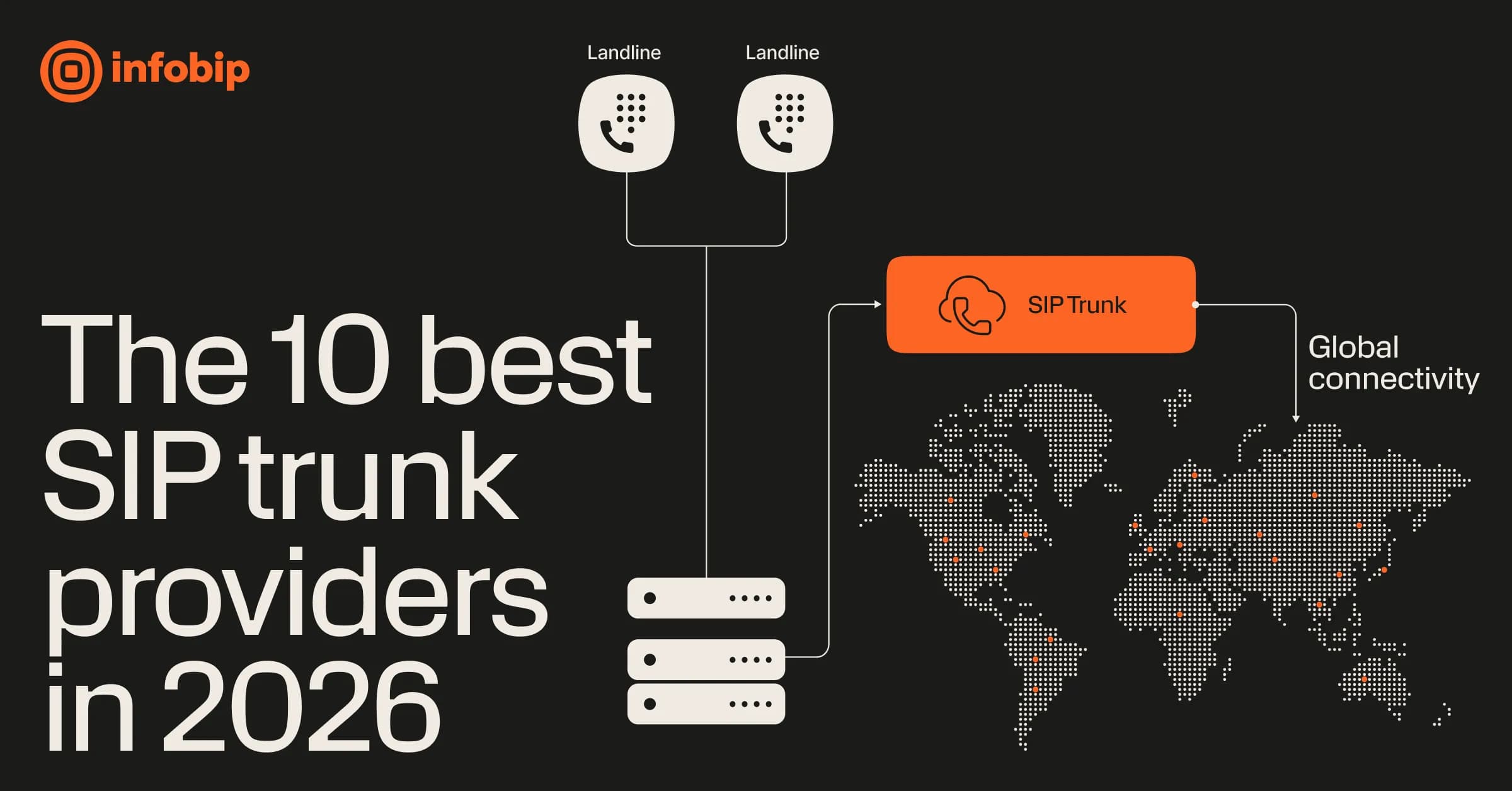
A SIP trunk replaces the physical phone lines that once connected a business to the telephone network with a virtual connection over the internet. Your IP PBX (a private branch exchange, the system that routes calls inside your company) connects to a provider through a session border controller (SBC), a security gateway that sits at the edge of your network. The provider carries the call over IP and hands it to the PSTN when the destination is an outside number.
The old analogy still helps. A traditional trunk was a shared line that many users drew on as needed. A SIP trunk does the same thing virtually.
Each concurrent call uses one channel. If you need to handle 200 calls at once, you need 200 channels. Unlike a legacy PRI circuit, which is physical and has fixed capacity, SIP channels can be added or removed on request. That flexibility suits businesses with seasonal peaks or fluctuating call volumes.
The SBC sits between your network and the outside world. It enforces security policies, hides your internal network details, and keeps traffic flowing between your PBX and the provider. If you are weighing trunking for a regulated business, ask how the provider authenticates and encrypts the connection.
The core difference is scope. VoIP is the broad technology for calling over IP. SIP trunking is one specific way to deploy it, by connecting a phone system you already run to the telephone network.
Hosted VoIP is fast to launch because the provider runs the platform. SIP trunking gives you more control, because you keep your own PBX and decide how calls route, but someone needs to configure and maintain it. This is a trade-off between simplicity and control, not good against bad.
Hosted VoIP usually charges per user. SIP trunking usually charges per channel, which can suit businesses with a PBX already in place and heavy call volume. At scale, total cost depends on your PBX investment, how well you use your channels, and your international rates. Compare those, not headline prices.
Most businesses end up using both. VoIP defines how voice travels over IP, and SIP trunking defines how those calls reach the outside world. A common setup is an IP PBX running internal VoIP calling, extended with SIP trunks for external reach.
This also answers a question many buyers ask i.e. do you need SIP trunking if you already have VoIP? If you run your own PBX and need to call outside numbers, yes. If you use a fully hosted VoIP service, the trunking is typically built in, so you are already using it.
Infobip’s SIP trunking solution fits this pattern. It connects the PBX, SBC, or contact center platform you already run to Infobip’s global network, so you add reach and reliability without replacing your phone system.
Start with what you already own, then check what your team can support and where your calls need to go.
Choose hosted VoIP if:
- • You have no existing PBX to preserve.
- You want fast deployment with minimal IT overhead.
- Your team is small or distributed.
- You prefer the provider to manage updates.
Choose SIP trunking if:
- You have an IP PBX or SBC you want to keep.
- You want control over routing and features.
- Your call volume is high or fluctuates.
- Your in-house IT team can manage configuration.
Once voice spans multiple sites and countries, the decision stretches beyond either option. Check these before you commit:
- International coverage: Where you can originate and terminate calls, and at what rates.
- Redundancy and uptime: How routing fails over when a path degrades.
- Compliance: Call recording and data residency requirements for regulated industries.
- Automation: Whether you can manage trunks through an API instead of tickets.
- Fit with engagement strategy: How voice connects to the other channels your customers use.
These factors point toward a platform, not just a trunk or a hosted plan.
At enterprise scale, the question shifts from ‘SIP trunking or VoIP?’ to ‘How do I run voice reliably, globally, and as part of a connected customer engagement strategy?’ Infobip Voice answers that with SIP trunking as one module in a wider voice platform, and Voice as one channel inside AgentOS.
Infobip SIP trunking links your existing PBX, SBC, or contact center platform to Infobip’s network without rip and replace. Through AgentOS, Infobip’s agentic AI platform, it can then tie that voice traffic into the same customer profiles, journeys, and analytics as SMS, WhatsApp, RCS, and email.
It supports integrations with Freshworks, Genesys PureCloud, Cisco Webex, and OpenAI Realtime, and you can create, update, and delete trunks through an API. Authenticated SIP Trunking adds carrier-grade, authenticated SIP over TLS and SRTP, the preferred connection for external Voice AI providers and cloud contact centers.
The trunk is one layer. Infobip Voice also includes the Calls API for custom call control, scenario APIs for IVR (interactive voice response), Click-to-Call, and Number Masking, plus Branded Calling ID, which shows your verified business name and logo before the customer answers in the US market.
Voice AI agents, currently in Early Access, extend IVR into natural conversations. Customers speak instead of pressing keys, and the agent hands off to a live agent without losing context.
Infobip Voice supports outbound calling to 195 destinations and inbound calls in 68 countries, with SIP trunking available across 40+ data center locations on four continents. Redundant routing and built-in retry logic support reliability at volume.
Voice runs on the same AgentOS platform as SMS, WhatsApp, RCS, and chat apps. Call data flows into the same customer profile as every other interaction, so a call can hand off to chat, and a customer who phoned yesterday is recognized when they message today. Your cloud contact center agents see that full history in one view.
If you are ready to modernize voice without replacing your phone system, start with Infobip SIP trunking and see how it connects your PBX or contact center to a carrier-grade global network. For a deeper primer, read what SIP trunking is and why businesses need it. Planning voice across multiple countries, or adding AI to your calls? Talk to the Infobip team about enterprise voice and see how SIP trunking, programmable APIs, and Voice AI agents fit your setup.