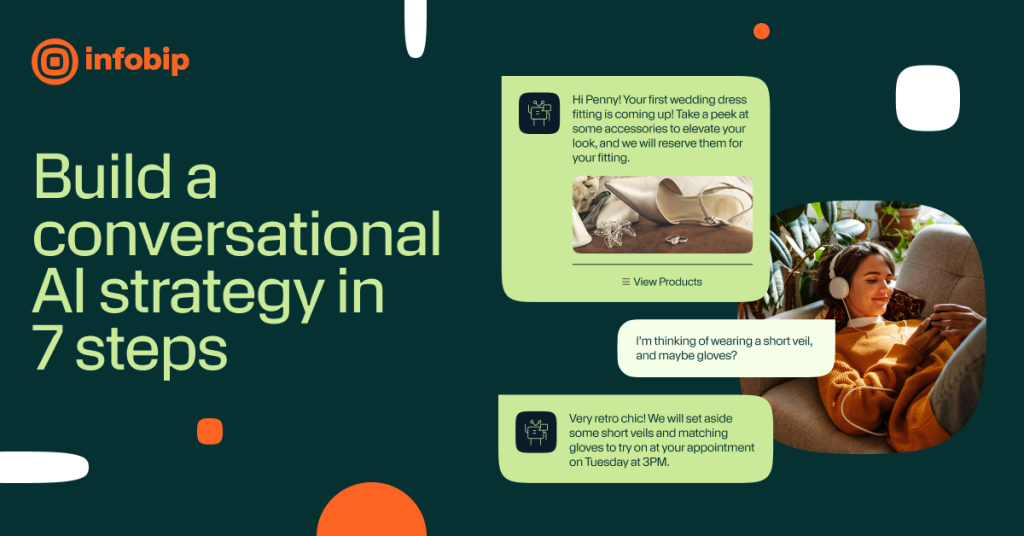
- A conversational AI strategy is a plan for using AI-powered conversations (chatbots, AI agents, voice assistants) to reach business goals across the customer journey.
- Adoption is no longer the hard part as 96% of brands automate customer communication and 84% use AI for support. Scaling the solution becomes challenging
- Only 50% of brands have systems fully ready to be connected to other solutions via API, and 58% have fully integrated channels, which limits what AI can do.
- Mature brands layer AI on top of what works. They keep rule-based flows for simple tasks and use agentic AI for complex, multi-step journeys.
- Customers trust AI more when a human is easy to reach. Smart handoffs and clear AI disclosure are now part of the strategy, not an afterthought.
- Start by benchmarking your brand against industry peers with theCX Assessment
A conversational AI strategy used to start with one question; “When should we start with AI?” In 2026, most brands have already answered it. According to Infobip’s CX maturity research, 96% of organizations use automation in their customer communications and 84% use AI for customer support.
A conversational AI strategy used to start with one question; “When should we start with AI?”
In 2026, most brands have already answered it. According to Infobip’s CX maturity research, 96% of organizations use automation in their customer communications and 84% use AI for customer support.
That’s where conversational AI and customer experience (CX) maturity come together. CX maturity is a framework that measures how ready a brand’s customer communication is to deliver great conversational experiences, and to support AI. It looks at three dimensions:
- Journey maturity: which parts of the customer journey you automate on messaging and mobile channels, from discovery to re-engagement.
- Sophistication: how advanced each use case is, and what technology powers it, from simple rule-based flows to agentic AI.
- System potential: which of your systems are API-ready and connected, and what you can realistically build next with the tools you already have.
It comes down to how deeply AI and automation are built into each customer journey. Two brands can both say they’ve “automated fraud alerts.” One sends an SMS. The other lets the customer block their card, talk to an agent with full context and order a replacement, all in one WhatsApp conversation.
A strategy is what turns the first experience into the second. It takes brands from long wait times, generic messages and one-way notifications to fast, personalized, two-way conversations. It’s not a simple journey, but with a solid strategy and an experienced partner, brands can build stronger relationships through conversational experiences powered by AI.
A few reasons why this is important for business operations include:
Conversational AI can power chatbots or virtual assistants that can chat with customers any time of day – no more working-hours-only call centers. This boosts overall satisfaction with your brand’s customer support services and provides your audience with the convenient support they are looking for.
A powerful part of AI is the ability to take valuable customer data and use it to create personalized experiences. This helps brands build a deeper and more loyal relationship with their customers by sending hyper personalized messages that take into account their demographics, behavior, purchasing history, and anything else relevant enough to tailor their experience.
Conversational AI makes time to resolution much faster. Customers can get an instant response to a query instead of waiting for a response or in a long call queue. With self-service use cases, customers can resolve their own queries much faster than with traditional solutions.
Most customer queries are often simple and routine that can be handled by a conversational AI chatbot. Things like FAQs, status updates, account information, or even booking appointments can be quickly resolved through a chat. Conversational AI automation allows brands to handle multiple queries at once, making the entire journey more enjoyable for end-users.
Live agent support is still a critical part of a brand’s customer support solution. Live agents are able to focus on the most complex and sensitive tasks that come through, while the conversational AI system handles the mundane and repetitive tasks that take up too much time. That means that customers can complete some tasks through a self-service conversational chatbot, while others with more serious or complicated tasks can connect with a live agent faster.
Conversational AI interactions help collect valuable data from customers. By understanding the types of queries customers have, the frequency, where the pain points are, how satisfied they are with the solution, and even behavioral data, important insights can be collected. This helps brands make more informed decisions with their strategic planning, ultimately giving them a competitive edge.
Example: A bank uses conversational AI to message a customer on WhatsApp about a suspicious transaction. The customer is able to verify or deny the transaction and block the card while the fraud team investigates further.
So, what makes for a successful strategy? There are seven key components that help brands build a more impactful solution. The first five shape the conversation itself. The last two decide whether it can scale.
NLP powers conversational chatbots to understand human language. It’s important that for the solution to be truly conversational, the AI can understand things like intent, sentiment, and even slang. For example, a retail customer that is waiting for their delivery might ask:
For example, a retail customer that is waiting for their delivery might ask:
I placed an order last week and it still hasn’t arrived. Where is it?
Thanks to NLP, the chatbot can understand the context of the order placement, the timeframe being last week, the sentiment that the customer isn’t happy, and the inquiry asking where the order is.
Based on this, the conversational AI chatbot might respond with:
Sorry to hear your order hasn’t arrived yet. Could you please provide your order number? Orders typically arrive within 5-7 business days, so we’ll make sure everything is on track.
Not every conversation needs the same kind of AI. The technology behind conversational experiences now ranges across five levels:
The biggest shift is agentic action. A chatbot that only retrieves answers can tell a telco customer how to upgrade their mobile plan. An AI agent connected to the telco’s CRM and billing system can make the change for them, right in the chat.
Mature brands don’t replace one level with the next. They layer them. In Infobip’s research, 38% of organizations running advanced agentic AI still use rule-based automation. Keep simple, predictable tasks on rules, and deploy AI where real-time decisions create better outcomes.
The entire point of this solution is to keep the customer journey and interactions conversational. That means that the customer can use natural language through texting or voice to communicate with an AI and get human-like responses. They don’t need to simplify their language or use specific semantics to get the answer they are looking for. They can interact with the AI chatbot as if they are talking to a live agent.
For example, a bank customer might ask about their card in a few ways:
Can I raise my card limit?
I need a higher limit for a trip next week.
Why was my payment declined? Can you increase my limit?
The CUI will understand all of these as a request to change the card limit and respond accordingly:
Hi Rose, your current limit is $2,000. Would you like to raise it to $3,000 until the end of the month?
Having a solid knowledge base is a crucial component of a conversational AI strategy. A knowledge base is what the AI uses to understand situational queries and provide the right responses. It’s also key to improving response accuracy and limiting the risk of AI hallucinations, because generative AI can ground its answers in your approved content instead of guessing.
With a thorough knowledge base, AI can quickly retrieve the information it needs about customers and scenarios to generate the right responses.
For example, with a good knowledge base, the AI can provide different responses to the same query based on customer data:
What’s the best phone plan for me?
The response can change based on if the customer is new or existing, if they are a frequent traveler, if they hold a family plan, or how much data they use monthly.
Conversational AI wouldn’t be all that effective if it was on the wrong channel. The entire point is for the interaction to be convenient, fast, and familiar, so use the channels customers are already on.
Brands use 5–6 channels on average. Email(93%), WhatsApp (75%), social media (69%) and SMS (62%) lead adoption. Rich channels are where conversational AI can do the most, because buttons, carousels, payments and media let customers finish a task inside the chat.
This is the component most strategies skip, and the one that decides whether AI can scale. AI agents need access to customer data and the ability to take action in your systems. That depends on how connected your tech stack is.
Today, 60% of brands have fully centralized customer data, but only 50% say their systems are fully API-ready. Brands automating 10 or more use cases are far more likely to be API-ready (68%).
In the CX maturity framework, this is called system potential: what you can build with the tools you already have. Most brands own more capability than they use. Before buying new technology, map which of your systems (CRM, customer data platform, contact center, fraud detection) can be connected through APIs.
Last but definitely not least, analytics show whether your conversational AI is working and where to improve it. Track performance from day one, so every change to your strategy is based on real conversation data. We cover the key metrics in how to measure success below.
A solid strategy is the key to building a successful conversational AI system. Here’s a step-by-step guide on where to start and how to plan your conversational AI journey.
Before you set goals, know where you stand. Measure your response times, cost to serve, automation rate, and understand which use cases and channels you already run.
Then go one level deeper. Which systems are API-ready? Is your customer data centralized or siloed? How advanced are the use cases you’ve already automated? These answers tell you what you can build quickly and what needs groundwork first.
The CX maturity assessment scores your organization on journey maturity, sophistication and system potential, and benchmarks you against peers in your industry and region. Benchmark your brand by completing the assessment below:
What exactly do you want to achieve with a conversational AI solution? Having a driving force behind your transformation effort will help your brand stay on track and understand how successful your implementation was. Here are a few examples of objectives brands might have for using this technology:
- Reduce agent workload by 20% in 9 months through an AI-powered self-service chatbot.
- Increase customer retention rates by 20% by offering proactive support and tailored recommendations.
- Increase eCommerce sales by 15% within the first quarter through AI-driven personalized product recommendations.
- Resolve 70% of frequently asked questions through a chatbot within six months, reducing average response time by 40%.
It’s important to be as specific as possible. Include specific use cases like customer support, lead generation, or personalized recommendations to make sure you are laser focused on what you can offer customers through AI. Ensure your KPIs are measurable, like response accuracy, CSAT scores, first contact resolution or time to resolution. This way, you can easily understand how successful the solution was at the end of your timeframe.
Brands should always be aware of who they are talking to. Sending poorly targeted or over generalized messages can quickly lead to your campaigns and efforts falling flat with your customers.
Brands should do their due diligence and ensure the AI capabilities meet the expectations of customers and solve real problems they have. They can do this by analyzing demographics, preferences, communication styles, and preferred channels. Through customer data insights, surveys, feedback, and customer interaction history, brands can build detailed personas that help uncover the needs of their audience.
By mapping out end-to-end journeys, brands can better understand the pain points and opportunities of each touchpoint and see where AI can have the greatest impact.
Most brands start with use cases that are generally easy to automate like feedback collection (56%) and reminders (52%). The use cases that drive the deepest customer value are far less automated and include loyalty management (35%), delivery management (28%), customer onboarding (26%) and returns and refunds (15%). That gap is where your strategy can make the biggest difference.
Here are a few examples of how conversational AI can be implemented at different stages of the customer journey:
A new banking client is usually bombarded with files and new information regarding contracts, accounts, and other sensitive documents. Conversational AI can guide the whole process in one conversation like collecting KYC documents, capturing terms acceptance, answering questions and sending reminders when something is missing. Only 26% of brands automate onboarding today.
Technical issues take up a lot of time for telco call centers, and voice still accounts for 56% of telco channel use. A conversational AI agent can guide customers through fixing issues on their own. If it still cannot be resolved, it can transfer them to a live agent with full context or book an appointment for technical support.
Returns are not fun for customers and brands alike, and only 15% of brands automate them. An AI assistant can guide customers through the return process, collect photos of damaged items, trigger the refund and send updates on their shipment and payment. It can also pause promotional messages while the issue is open.
The tools and software brands choose to build and launch their conversational AI solution can make or break their strategy. Brands need to choose tools that align with the objectives, goals, and infrastructure of the business.
Brands should evaluate things like:
- NLP and generative AI capabilities
- Support for AI agents that can take action through APIs
- Omnichannel support and journey orchestration
- Scalability
- Analytics
- CX consultants and AI professionals
- Integrations with other tools and composability
Your AI solution should integrate with existing systems like CRMs, ERPs, CDPs, ticketing platforms and other back-end systems. That’s what lets an AI agent pull records, update data and complete tasks, instead of only answering questions. Full integration is ideal. With partially integrated tools, channels, and systems, brands will likely fall short of delivering the best experiences.
Start with what you already have. Brands across every industry and region in Infobip’s research could do far more with their existing tech stack than they currently do.
Now it’s time to create the conversational flow for your use cases. Every use case is made up of four layers, and a mature implementation designs all of them:
- Entry points: how the customer starts the interaction (click-to-chat buttons, QR codes, ads, IVR call deflection)
- Core modules: the functional heart of the use case (card block, booking, payment)
- Exit points: how the journey ends (in-chat resolution, agent escalation, go-to-app handoff)
- Follow-ups: what happens next (status notifications, reminders, feedback collection)
A basic implementation covers only the core. For example, a basic complaint flow logs a ticket and sends a confirmation email. The customer waits, calls back and repeats their issue. A mature flow starts in chat, uses guided questions, accepts photos, pulls up the order, routes by severity and closes with a status update and follow-up.
AI can sometimes get a bad reputation for hallucinating or providing false information, which is why training data quality is critical. Use historical chat logs, support tickets and FAQs to teach the AI the context, intents and variations in how customers ask for things, and keep updating it as new queries come in and your products and services change.
For example, a conversational AI chatbot should recognize both of these messages as a shipping issue:
It’s been 7 days and my package still hasn’t arrived.
When will my order be delivered?
Now that your AI solution is set up and trained, it’s time to test conversations and identify gaps, bugs, or limitations before it’s deployed to your audience. Brands should conduct user testing with their target audience and gather feedback, test for ambiguous queries or out of scope requests, and measure the performance of the chatbot against the KPIs you set in step two.
Start with a focused pilot on one high-volume use case. Once it hits its KPIs, deepen it (add entry points, exit points and follow-ups) before you add new use cases, channels or regions. Through feedback, brands can learn about new pain points and areas for improvement. Updating the knowledge base with new data, feedback, and old conversations will give the AI better context and refine intent mapping.
Customer needs and expectations will change over time, which means the AI needs to adapt too. Re-benchmark your CX maturity regularly to see how far you’ve come and where to go next.
To make the most of your strategy, here are some actionable tips to develop a successful solution:
- Pilot, then deepen before you broaden: A pilot project lets you test, learn and refine before a full-scale launch. But many pilots stall before they scale. Once a pilot works, upgrade that use case into a full journey before adding new ones.
- Layer sophistication selectively: Not every interaction needs agentic AI. Keep rule-based flows for simple, predictable triggers and deploy AI agents where complex, multi-step decisions create better outcomes.
- Design smart handoffs to agents: Set clear escalation triggers based on sentiment, urgency or complexity, and make sure the human agent receives the full conversation history. Five9 found trust in AI more than doubles when a human option is visible.
- Be transparent about AI: Tell customers they’re talking to AI from the very first message. Under the EU AI Act, this has been a legal requirement since 2 August 2026 for chatbots that reach EU users, wherever the company is based.
- Ensure data privacy and security: Ensure you are compliant with data protection laws like GDPR, CCPA, or HIPAA. Use encryption and anonymization to secure user data, log AI interactions, and be transparent with customers about how their information is used.
- Build the right team: Successful conversational AI needs more than technology. Bring together conversation designers, AI and data specialists, CX owners and the business teams who own each use case, with executive sponsorship to keep them aligned.
- Foster a culture of continuous learning: Review conversation history regularly to identify gaps, update the AI knowledge base with new data, and encourage users to give feedback.
Careful planning and design should be at the heart of your strategy. Each step of your conversational journey should be well thought-out and planned based on brand and customer needs.
- Conversational flows: Design conversations interaction by interaction. Anticipate questions, keep responses clear, and add follow-ups and fallback paths for when the AI can’t understand a prompt.
- Tone of voice: Match your brand, audience and channel. A bank might stay formal, but WhatsApp users expect a more relaxed, human tone than they would over email.
- Context: Remember and use information from previous conversations, so customers never have to repeat themselves.
- Clear expectations: Explain what the AI can and can’t do from the start.
- Error handling: Use clarifying prompts and alternative suggestions, with a smooth escalation path to a live agent.
- Multimodal interaction: Offer flexibility with text, voice, or image-based inputs.
- Accessibility and inclusivity: Design for different languages, users with disabilities and diverse needs.
- Ethics and transparency: Disclose AI use, explain how data is used and make sure the AI treats all users fairly.
Omnichannel capabilities and conversational AI combined can offer customers the smoothest experiences. An omnichannel approach lets customers move between channels and continue the same conversation, giving AI agents and live agents all the context they need.
Yet only 58% of brands say their digital channels are fully integrated. For the other 42%, customers hit friction every time they switch channels.
Imagine the frustration of chatting with a technical support chatbot on WhatsApp, not resolving the issue, and then being transferred to a human agent on a phone call who asks you to repeat the issue again. Or reporting a problem by email, calling to follow up, and then getting a promotional SMS while the issue is still open.
With an omnichannel platform, all the context from the chatbot conversation goes directly to the agent, so they can help without asking repetitive questions. All information, data, detailed profiles and conversation history are stored in one place, where all tools are connected. That includes:
- All channels needed for communication
- Customer engagement tools for marketing
- Customer data platform
- Cloud contact center
- Chatbot and AI agent builders
Automation handles single tasks like sending a notification, routing a query, flagging a fraud event. Orchestration connects those tasks into one continuous journey. For example, a customer starts a complaint on RCS, uploads a photo, receives an automatic refund, gets a shipping notification and is asked for feedback, with full context carried through every step.
Only 27% of brands use a journey orchestration tool today, which is a big reason why so many automated use cases stay disconnected.
Brands first need to determine which channels their customers prefer, and make sure they’re fully integrated. Each channel has its own features and capabilities, so the conversational flows built on WhatsApp can look very different from those on RCS, Viber, or web chat. With an orchestration platform, adding a new channel becomes a configuration decision rather than an engineering project.
There are many ways brands can tell whether their strategy is paying off. Start by comparing against the baseline you set in step one. Key metrics to track:
- Customer satisfaction score (CSAT): Ask customers to rate the experience right after the conversation, on the same channel, and track user sentiment during the chat.
- Conversation duration and drop-off: Long chats can signal a chatbot loop. Track where customers abandon conversations.
- Engagement: How often customers reply, click buttons or share media with the chatbot.
- Task completion and first contact resolution: How often the AI resolves queries without a human, and on the first try. Agentic AI should raise both.
- Conversion rates: For marketing and sales use cases, how many conversations lead to a sale or payment in chat.
- Customer retention: Whether customers come back after using your conversational AI, or churn rises.
- Call volumes and average handling time: Fewer calls to the contact center, and shorter ones when agents start with full context.
- Time to resolution: Simple use cases should resolve in just a couple of messages.
- Cost per resolution and revenue impact: Track sales, customer lifetime value and cost per resolution. Conversational AI can have a big impact on revenue by lowering the load on call centers, streamlining internal processes and opening new revenue streams.
Explore Agent OS