Choosing a SIP trunk provider is one of the more complex buying decisions for an organization. There are a lot of factors to be considered – especially for global companies that need to maintain a consistent and high-quality voice experience across all the regions that they operate.
Controlling costs is just as important. A rate that reads as a fraction of a cent per minute can turn into a very different monthly bill once channels, DID fees, E911, and international routes are added. The devil is in the detail!
To make evaluation easier, we looked at dozens of providers – going beyond the glossy product pages and brochures and directly comparing the factors that matter most – global reach, network reliability, pricing models, interoperability, and security.
We came down to a shortlist of 10, but then we went further and analyzed the key strengths that might make each provider the best choice for particular use cases and requirements.
Jump straight to a provider evaluation:
- Infobip for global omnichannel enterprises unifying voice, messaging, and AI.
- Twilio for developers building custom voice applications
- Sinch for global voice at carrier scale
- Vonage (Ericsson) for Microsoft Teams direct routing
- Bandwidth for US enterprises needing direct Tier 1 carrier access
- Telnyx for teams wanting a private network with API control
- Plivo for cost-effective programmable voice
- 8×8 for integrated UCaaS and contact center
- RingCentralfor enterprise teams replacing a legacy phone system
- AVOXI for global virtual numbers and international reach
- Nextiva for unlimited domestic US and Canada calling
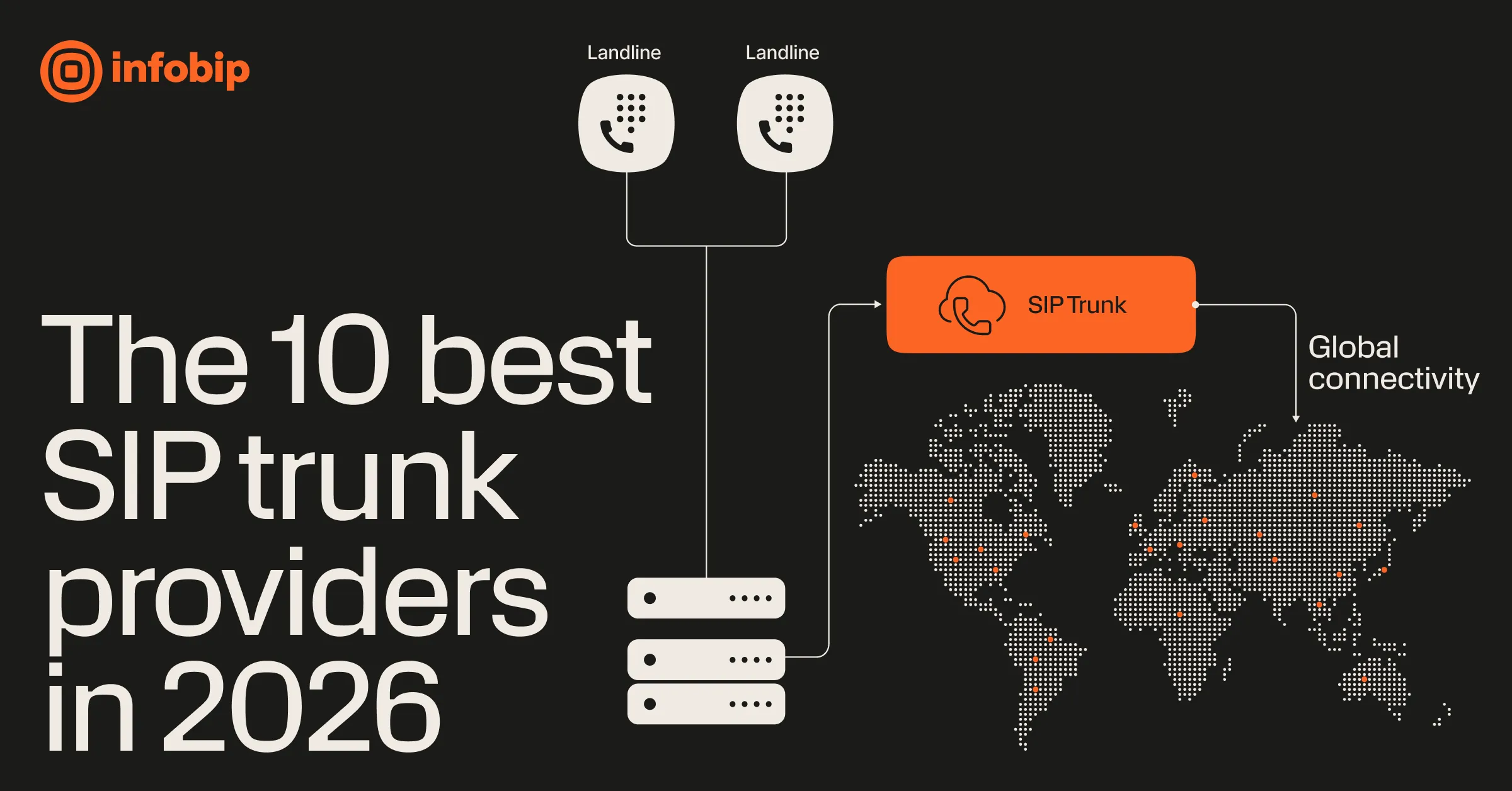
A SIP trunk provider connects your business phone system to the public telephone network over the internet, replacing traditional physical lines such as PRI or analog circuits. Using Session Initiation Protocol (SIP), it lets your PBX or contact center make and receive calls as data, so you can scale capacity, add international numbers, and cut telecom costs without new hardware.
Providers tend to fall into four groups, and knowing which one you are dealing with makes the shortlist much clearer:
- CPaaS and programmable voice platforms: API-first providers offering elastic SIP trunking billed per minute and channel, built for teams creating custom voice applications. Infobip, Twilio, Sinch, Vonage, Telnyx, and Plivo sit here.
- UCaaS platforms with bundled SIP trunking: Providers that include trunking inside a wider unified communications and contact center suite, usually priced per user. Think 8×8, RingCentral, and Nextiva.
- Dedicated SIP trunk specialists: Focused, often self-serve providers that do trunking and little else, frequently on a per-channel model. AVOXI is an example.
- Wholesale and carrier-grade network providers: Companies that own the underlying tier 1 network rather than reselling it, aimed at high-volume enterprises. Bandwidth is the clearest example.
About this comparisonThis roundup was researched and written by Infobip’s content team working with SIP trunking experts in the business. We used each provider’s own documentation and pricing pages, independent review sites, and hands-on knowledge of building voice infrastructure. We evaluated more than 20 providers against the five criteria below and shortlisted 10.
We assessed every provider against these five criteria:
- Global reach and coverage – how many countries the provider supports for inbound and outbound calling, and the breadth of local, mobile, and toll-free numbers.
- Network reliability – published uptime SLAs, redundancy and failover, and whether the provider owns its network or resells another carrier’s.
- Pricing model and scalability – elastic per-minute, per-minute and channel, per-channel, or per-user billing, transparency, and how cleanly the model scales.
- Integrations and interoperability – compatibility with common PBX and SBC systems, Microsoft Teams, CRMs, and the availability of APIs.
- Security and compliance – TLS and SRTP encryption, STIR/SHAKEN, E911, and certifications such as HIPAA, GDPR, and ISO 27001.
Disclosure: Infobip publishes this article and appears as the first entry. We have aimed to describe every provider, including our own, on the same factual basis, and we note where Infobip is not the right fit. Pricing reflects published US rates in 2026 and should be verified with each provider before purchase.
SIP trunking type: CPaaS / programmable voice platform
Pros
- Voice and messaging on one platform via AgentOS
- Outbound calling to 195 countries, inbound in 68
- Programmable trunks, BYOC, and no-code options
Cons
- Enterprise oriented, so pricing is largely custom
- Platform breadth can exceed teams wanting a bare trunk
- Voice-specific case studies are in progress
Most providers on this list sell you a trunk. Infobip sells you the trunk plus every other channel your customers use, on one platform. That is the core difference. Infobip SIP Trunking connects your existing PBX or SBC to a global carrier network for outbound termination and inbound origination, then ties that voice traffic into the same customer profiles, journeys, and analytics as SMS, WhatsApp, RCS, and email through AgentOS, Infobip’s agentic AI platform.
This consolidated approach will become the default operating model in the future, but Infobip is ahead of the curve.
For reach, Infobip supports outbound calling to 195 countries and inbound in 68, backed by 40+ distributed data centers across four continents with redundant routing. You can provision and manage trunks in the portal or programmatically through the Calls API, which also lets you bridge SIP with PSTN or WebRTC to build custom scenarios. A US Unlimited Plan covers domestic calling under a fair usage policy, and bring your own carrier connects your existing setup to a tier 1 IP network for call quality.
Where Infobip pulls ahead of pure SIP trunk vendors is the layer above the trunk. Certified integrations with Freshworks, Genesys PureCloud, Cisco Webex, and OpenAI Realtime plug voice into existing contact center stacks, while Voice AI agents (in Early Access) extend IVR into natural language conversations that hand off to a live agent without losing context. Branded Calling ID and number masking round out trust and privacy. Enterprises like Bolt, Mukuru, and Nissan Saudi Arabia already run customer communications on Infobip’s platform.
If you only need a standalone SIP trunk plugged into an on premise PBX, that breadth is more than you require. But if voice is one channel in a wider customer engagement strategy, Infobip is built for exactly that.
Infobip pricing: Custom pricing through sales. A US Unlimited Plan offers unlimited domestic outbound calling under a fair usage policy, with pay-as-you-go rates for global Voice and per-country number rental.
SIP trunking type: CPaaS
Pros
- Pay-as-you-go with no channel or port fees
- Coverage in around 100 countries
- Deep API ecosystem plus bring your own carrier
Cons
- Dedicated developer resources required
- Per-minute costs add up at high volume
- Some users flag a learning curve on setup
Twilio has been the go-to vendor for programmable voice, although other vendors now have comparable offerings that are actually superior in some ways, for example AI integration. Elastic SIP Trunking delivers PSTN connectivity in around 100 countries from the console or the API, with pay-as-you-go pricing and no contracts, channel fees, or port fees. Bring your own carrier lets you keep an existing carrier relationship while routing through Twilio’s network.
The platform’s real strength is its ecosystem. Trunking sits alongside Programmable Voice, Verify, and messaging APIs, so a developer can wire up call recording, transcription, and least cost routing without leaving the stack. Unlimited call concurrency scales elastically, and TLS plus SRTP secure signaling and media. For teams building a voice product rather than just replacing phone lines, that depth is important.
The trade-off is that Twilio rewards technical teams and can feel heavy for a straightforward PBX connection. Reviewers consistently note that subaccounts, regulatory requirements, and API integration take effort, and per-minute rates that look tiny become significant at scale unless you negotiate committed-use discounts. If you want a simpler unmetered channel model, Nextiva is easier, and if you want a private network rather than the public internet, Telnyx is a better option.
Twilio pricing: Pay-as-you-go. US origination from $0.0045/min and termination from $0.007/min, with per-second billing, no channel or port fees, and committed-use discounts for high volume.
SIP trunking type: CPaaS
Pros
- Owns a tier 1 network
- Both self-service Elastic SIP and managed Enterprise SIP
- Good compliance: STIR/SHAKEN, E911, HIPAA, GDPR, ISO 27001
Cons
- Headline pricing requires contacting sales
- Two SIP products can confuse first-time buyers
- Number coverage narrower than some rivals at 60 to 70 countries
Sinch competes with Infobip and Twilio as a full CPaaS, and its voice arm rests on a tier 1 network the company owns rather than resells. That network processes more than 300 billion minutes annually, which shows up as consistent quality and the ability to offer two service tiers on one platform – a self-service Elastic SIP option with a 99.95 percent SLA, and a fully managed Enterprise SIP option with a 99.999 percent SLA.
Coverage spans direct connections in 60 or more countries and local numbers in 70 or more, with encryption via TLS and SRTP and a compliance stack covering STIR/SHAKEN, E911, HIPAA, GDPR, and ISO 27001. Bring your own carrier support powers platforms like Microsoft Teams and Webex Calling, and porting is handled by an experienced team, which matters for large migrations.
The main friction is clarity. Choosing between Elastic and Enterprise SIP takes a conversation with sales, and public per-minute pricing is thin, so budgeting requires a quote. Number coverage, while solid, trails Infobip’s inbound reach. For enterprises that value owning the underlying network and want a single vendor for voice and messaging, Sinch and Infobip are the two closest options here, with Bandwidth the alternative if the priority is a US-only carrier relationship.
Sinch pricing: Elastic SIP is pay-as-you-go with per-minute rates plus monthly number fees. Enterprise SIP uses tiered commitments with custom pricing.
SIP trunking type: CPaaS and UCaaS
Pros
- Microsoft Teams direct routing integration
- 25 or more prebuilt third-party integrations
- Elastic SIP plus AI Studio voice agents from one dashboard
Cons
- International calling carries additional fees
- Blends UCaaS and API products, which adds complexity
- Inbound number coverage around 70 countries
Now part of Ericsson, Vonage pairs a Communications APIs business with a UCaaS platform, and its SIP trunking is the bridge between them. The standout reason to shortlist Vonage is Microsoft Teams: Vonage Business Communications offers direct routing that adds enterprise calling features natively inside Teams, which is a clean path for organizations standardizing on Microsoft.
The SIP dashboard has an onboarding wizard that provisions trunks in a few clicks, and Vonage layers programmable voice on top, including AI Studio voice agents, premium text-to-speech, speech recognition, and a Voice Inspector tool for call diagnostics. With 25 or more integrations across CRMs and collaboration tools and inbound number coverage in 70 or more countries, it suits mid-market teams that want API flexibility without a fully developer-led build.
Where it gets complicated is the product surface area. Buyers have to navigate between VBC, Communications APIs, and elastic SIP trunking, and international calling adds fees on top of the per-line rate. If Teams is not your environment, Vonage’s main differentiator matters less, and a pure CPaaS like Twilio or Infobip gives you more voice programmability, while a UCaaS bundle like RingCentral covers unified communications more completely.
Vonage (Ericsson) pricing: SIP trunking from $13.99 per line per month, with elastic per-minute options and additional charges for international destinations.
SIP trunking type: Wholesale / carrier-grade
Pros
- Owns a nationwide US tier 1 network
- Powers Microsoft Teams, Zoom, and RingCentral
- Direct carrier control over SLAs and E911
Cons
- Custom quote with an annual commitment
- Not self-serve for small teams
- Built primarily for high-volume accounts
Bandwidth is one of the few names here that owns and operates its own nationwide US voice network instead of reselling another carrier’s. That distinction is the entire pitch. Many well-known platforms, including Microsoft Teams, Zoom, and RingCentral, run on Bandwidth as their underlying carrier, which tells you where it sits in the stack.
For large enterprises, direct network ownership means tighter control over service levels, carrier-backed E911 compliance, and call authentication without a third-party intermediary. Bandwidth’s APIs and app handle number migration and trunk provisioning, billing runs on six-second increments, and coverage extends to 65 or more countries for multinational needs. This is the option a legal or compliance team reaches for when they require a direct carrier relationship on paper.
The cost of that carrier-grade posture is accessibility. Pricing is a custom quote that typically comes with an annual commitment, there is no self-serve path for a small business to spin up a trunk quickly, and Bandwidth focuses its sales attention on high-volume accounts. Smaller teams are better served by SIP.US or Nextiva, and if you want owned-network reliability with a global rather than US focus, Sinch is the closer match.
Bandwidth pricing: Custom quote, usually with an annual commitment. Published US API rates include local outbound around $0.0100/min and inbound around $0.0055/min.
SIP trunking type: CPaaS
Pros
- Traffic runs on a private IP network, not the public internet
- Transparent tiered per-channel pricing
- Self-serve Mission Control portal plus full API
Cons
- Developer oriented, so non-technical setup is harder
- Support leans ticket-first
- Smaller brand footprint than Twilio
Telnyx built its own private, global IP network and routes voice traffic across it rather than the public internet, which is its headline reliability and quality argument. For teams that care about jitter, latency, and control, that architecture is a genuine differentiator, and it comes with a self-serve Mission Control portal plus a full API for provisioning trunks programmatically.
Pricing is unusually transparent for this category. Telnyx publishes a tiered per-channel structure that starts around $12 per month for the first 10 channels and drops to roughly $8 per channel above 250, so the average cost falls as you scale. It also offers pay-as-you-go per-minute billing for variable traffic. Encryption, fraud protection, and instant number provisioning are all included.
Like Twilio and Plivo, Telnyx is aimed at technical buyers, so a non-developer connecting a single PBX will find it less hand-holding than Nextiva or SIP.US. Support is primarily ticket-based, and the brand is less widely recognized than Twilio, which can matter to risk-averse procurement teams. But for engineering teams that want private-network quality with predictable channel pricing, Telnyx is one of the strongest value options on this list.
Telnyx pricing: Tiered per-channel pricing from about $12/month for the first 10 channels down to about $8/month above 250 channels, or pay-as-you-go per minute.
SIP trunking type: CPaaS
Pros
- Low per-minute rates with unlimited concurrent calls
- 99.99% uptime across seven global points of presence
- Simple self-service console and clear API
Cons
- Support is ticket-only, with no live phone or chat
- Fewer prebuilt integrations than larger platforms
- Local numbers in around 70 countries
Plivo’s SIP trunking service, Zentrunk, competes directly with Twilio and Telnyx on the developer-friendly CPaaS axis, and it wins on price. Outbound calling starts around $0.0065 per minute and inbound around $0.0025, with volume discounts on top, and unlimited concurrent calls are included at no extra cost, so you are not paying for channel capacity you may not use.
The network holds up its end. Zentrunk runs across seven points of presence spanning five continents with at least three local carrier connections in each major region, backed by a 99.99 percent uptime commitment. Calls terminate through one-hop local carriers for low post-dial delay, and the platform includes TLS and SRTP encryption, IP authentication, and fraud alerts. You can self-provision numbers in more than 70 countries and reach 150 or more for calling from a clean console.
The main knock is support: like Bandwidth, Plivo handles help through a ticketing system rather than live chat or phone, which frustrates users who need immediate answers. Its integration catalog is also thinner than 8×8 or Vonage. But for a scaling company that wants low, predictable per-minute costs and does not need enterprise hand-holding, Plivo is one of the best value picks here.
Plivo pricing: Pay-as-you-go. Outbound from about $0.0065/min and inbound from about $0.0025/min, with volume discounts and unlimited concurrent calls included.
SIP trunking type: UCaaS
Pros
- Voice, video, chat, and contact center in one platform
- Unlimited international calling to 48 countries on higher tiers
- Strong compliance and call-quality analytics
Cons
- Overkill for plug-and-play needs
- Pricing requires a custom quote
- More complex than a standalone trunk
8×8 folds SIP trunking into a broader unified communications and contact center platform, which makes it a strong fit for customer-facing organizations that want one system for voice, video, chat, and CCaaS rather than a trunk bolted onto separate tools. For multinationals, higher tiers include unlimited international calling to up to 48 countries and competitive metered rates to more than 200 destinations.
The platform’s depth shows in operations. 8×8 supports virtually any IP-PBX, including Asterisk and Switchvox, offers unlimited concurrent calling so you do not pay for extra capacity, and layers in quality monitoring, compliance tooling for HIPAA and GDPR, and a Secure Pay feature that lets contact centers take payments without agent involvement. Analytics and reporting on call performance are a genuine strength.
That capability is also the catch. 8×8 is engineered for enterprise needs and can be overkill and more expensive than necessary for a small company that just wants a plug-and-play trunk. Pricing is quote-based, starting around $12 per user per month at the most basic configuration and rising with contact center features. If you want the UCaaS bundle without the enterprise weight, RingCentral or Nextiva are lighter, and for a bare trunk, SIP.US is far simpler.
8×8 pricing: Custom, quote-based pricing. Entry configurations start around $12 per user per month, with SIP trunking capacity and contact center features at higher tiers.
SIP trunking type: UCaaS
Pros
- 99.999% uptime SLA
- Coverage across 50 or more countries
- Integrations with Salesforce, Microsoft 365, and Google Workspace
Cons
- You pay for UC features a pure trunk buyer will not use
- Per-user pricing rather than per-channel
- SIP capacity lives in higher tiers
RingCentral is one of the largest UCaaS providers, and its SIP trunking is best understood as part of a comprehensive communications suite covering voice, video, messaging, and contact center. It suits mid-market and enterprise teams that are ready to replace a legacy phone system entirely, not those looking for a standalone carrier layer under an existing PBX.
On the fundamentals, RingCentral is enterprise-grade: an SLA-backed 99.999 percent uptime, coverage across 50 or more countries, and deep integrations with Salesforce, Microsoft 365, and Google Workspace. HD voice, smart call routing, role-based administration, and network analytics come as part of the platform, so teams that adopt the whole suite get a consistent experience across channels.
The trade-off is cost and fit. Organizations that only want SIP trunking to plug into an existing PBX will pay for UC features they do not need, and pricing is per user rather than per channel, starting around $20 per user per month with trunk capacity in higher tiers. If you want the same all-in-one idea with a lighter footprint, Nextiva is more affordable, and 8×8 is the closer match for heavy contact center use.
RingCentral pricing: From about $20 per user per month for the core UC plan, with SIP trunking capacity included at higher tiers. Contact sales for enterprise pricing.
SIP trunking type: Dedicated SIP specialist
Pros
- Strong international virtual number coverage
- Responsive support and quick implementation
- Straightforward plans without heavy API complexity
Cons
- Fewer API capabilities than Twilio or Plivo
- Smaller prebuilt integration ecosystem
- Detailed pricing requires contacting sales
AVOXI focuses on global voice connectivity and virtual phone numbers, which makes it a natural pick for businesses whose main challenge is international presence rather than deep programmability. Coverage reaches numbers in a large set of countries, with local, toll-free, and international options that let a company sound local in every market it serves.
The experience is deliberately streamlined. AVOXI leans on responsive support and fast implementation rather than a sprawling developer toolkit, so teams that want reliable global connectivity without standing up an engineering project tend to get live quickly. Elastic scaling, failover management, and E911 handling are covered, and there are three plans starting at $14.99 per user per month.
The limitations follow from that focus. AVOXI does not offer the programmable-workflow depth of Twilio or Plivo, its prebuilt integration catalog is smaller than 8×8 or Vonage, and full pricing details require a sales conversation, which frustrates buyers who prefer self-service research. For companies that prioritize international number coverage and hands-on support over API breadth, though, it is a focused, credible option.
AVOXI pricing: Three plans starting at $14.99 per user per month. Contact sales for volume discounts and larger deployments.
SIP trunking type: UCaaS
Pros
- Unlimited US, Canada, and Puerto Rico on the unmetered plan
- Free number porting and account setup
- 99.999% uptime and no developer required
Cons
- US and Canada centric, so limited global reach
- Best rates favor multi-year commitments
- Nudges buyers toward its full UCaaS platform
Nextiva is the pick for businesses that want predictable, unlimited domestic calling without touching an API. Its unmetered SIP plan covers unlimited inbound and outbound calling across the United States, Canada, and Puerto Rico for a flat per-channel rate, which makes budgeting simple for call-heavy operations like support desks and sales floors.
Setup is refreshingly low-friction. Nextiva works with dozens of popular IP-PBX systems, including Cisco, 3CX, and FreePBX, includes free number porting and account setup where many rivals charge, and runs on infrastructure with a 99.999 percent uptime claim and eight US points of presence. Built-in fraud protection, enhanced 911, automated failover, and detailed call records come standard, and unlike Twilio there is no need to learn APIs or hire a developer.
The constraints are geographic and commercial. Unlimited coverage is US, Canada, and Puerto Rico, so international-heavy businesses will look elsewhere, the best pricing typically assumes a multi-year agreement, and Nextiva actively steers customers toward its broader UCaaS platform. For domestic call volume with a simple PBX, though, its metered plan at $14.95 per month and unmetered plan at $24.95 per channel are tough to beat. Businesses needing global reach should compare Infobip or Sinch instead.
Nextiva pricing: Metered plan at $14.95 per month plus $0.008 per minute with 100 minutes included, or an unmetered plan at $24.95 per channel per month for unlimited US and Canada calling.