Security, Video, and Learning Better, Faster
Q3 was a busy one. (But when isn’t it!) Between new security tooling, Video SDK updates, and developer experience improvements, there's a lot to catch up on, so let’s jump right in.
This quarter, Vonage shipped releases across authentication, identity, video, and developer tooling. If you’re in the process of hardening your auth stack, building real-time video experiences, or just trying to spend less time context-switching between your AI assistant and the API dashboard, Q3 delivered tooling to make your work easier. And if you find yourself not sure where to even begin with Vonage, we’ve got something for you too.
Without further ado, here's a look at what landed in Q3.
Built for Developers by Developers
We’ll get into some of the more specific developments of the past quarter later in this post, but we want to start this off with some of our developer-first offerings. At Vonage, we take pride in our well-architected and well-documented APIs, but when it comes to solving technical challenges and driving innovation, that’s just half of the equation. We know there is so much out there for you to learn and stay ahead of the curve on -- even and especially if you're using AI. That’s why in addition to our APIs, we want to ensure you can easily find what you need, use the tools you already love, and get up and running with the least friction possible.
Follow a Learning Path
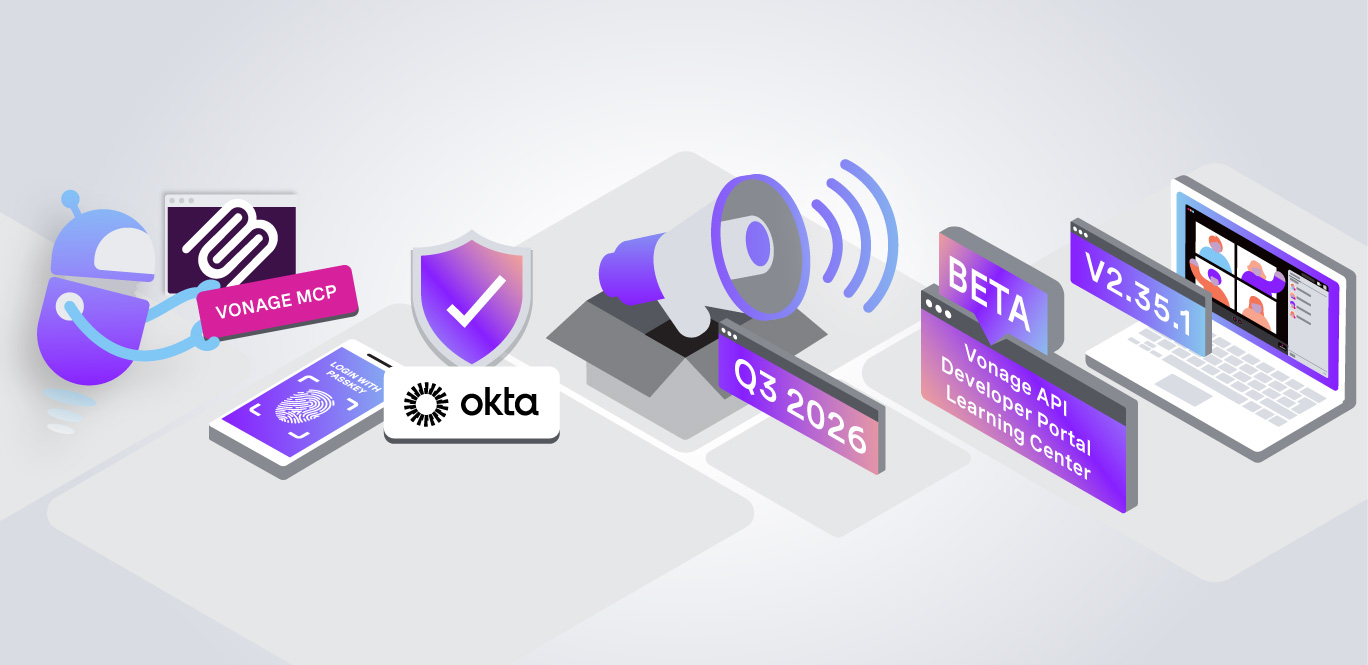
If you've ever opened the Vonage docs and thought, "Okay, but where do I start?" the Vonage API Developer Portal Learning Center is your answer. Now in public Beta, the Learning Center is organized around different content types to help you get started:
- Use Cases: Scenario-driven examples that connect business goals to technical implementation
Use Cases: Scenario-driven examples that connect business goals to technical implementation
- Learning Paths: Structured, step-by-step courses with interactive coding exercises
Learning Paths: Structured, step-by-step courses with interactive coding exercises
The Beta includes foundational and advanced content for the Video, Voice, Verify, and Messages APIs. GA is targeted for Q4 2026 and we're actively collecting feedback so if you have any thoughts or suggestions, look for the option to provide them within the Learning Path portals.
Vonage MCP Server Update: Reports, Numbers, and Charts
The Vonage MCP Server has been quietly steadily shipping since December 2025 and so we want to catch you up on everything new in versions 1.3.0 through 1.5.1.
You can now pull Reports API data, search for and provision phone numbers, create applications, and generate charts -- all from inside your AI assistant without switching tabs or writing custom scripts. This means you can go from prompting, "What numbers do I own?" to "Find me available numbers in the US with SMS and Voice" to "Attach this number to my app" in a single conversation. Additionally, the make-chart tool takes report data you've already retrieved and renders it as a chart on the spot.
The 1.5.1 release also includes a handful of reliability fixes worth noting such as a WhatsApp failover bug fix and better error handling for list-applications and list-purchased-numbers. We hope this helps make developing with Vonage and AI more efficient and intuitive.
Check out the video below to learn how to use Vonage's documentation MCP server with Kiro.
Own Your Security
We are all familiar with the concept of “secure by design,” but how often is security really part of our development process and not just an afterthought? Security by design is a lot more accessible when you’re equipped with the right tools for the job. This quarter, Vonage shipped two releases that do just that.
The Vonage Protection Suite for Okta
If your app uses Okta for identity management, you now have a plug-and-play way to level up your OTP delivery and fraud protection with no custom middleware required. The Vonage Protection Suite for Okta is a self-service connector on the Vonage Cloud Runtime (VCR) Marketplace that integrates directly with Okta Identity Engine. It intercepts Okta's Telephony Inline Hooks to deliver OTPs via SMS or Voice through Vonage Verify, with automatic channel fallback and intelligent routing across more than 200 countries.
But what about preventing breaches like SIM swap fraud? The connector can run optional pre-delivery security checks through Identity Insights -- such as number format validation, carrier lookup, and current carrier detection -- to flag or block compromised numbers before delivery. During delivery, Vonage Fraud Defender handles SMS pumping protection, geographic permissions, and velocity controls at no additional cost.
In other words, Okta remains the verification authority throughout the entire flow, while the connector just makes sure the delivery is smarter, safer, and more reliable.
Authentication Without Passwords
How many password resets have you completed recently? Be honest! Whether you’re storing or remembering them, passwords have always been the weakest link in the security chain. What if we offered you one less password to have to remember? Vonage now supports passkey (“passwordless”) authentication, joining Apple, Google, and Microsoft in adoption of the FIDO2/WebAuthn standard as the future of logging in.
Here's how it works: instead of a password, a passkey uses a cryptographic key pair. The private key lives securely on your device and nowhere else. The public key is registered with Vonage and used to verify your identity so no password is ever sent and no password is ever stored. When you log in, your device signs a cryptographic challenge using the private key after you verify via biometrics or a device PIN.
What makes passkeys stand out is that they're phishing-resistant by design. The private key is cryptographically bound to the registered domain, so it simply can't be used on a fake site. Passkeys also satisfy both authentication factors on their own, so there's no need for a separate second factor.
To get started, just use the "Log in with a passkey" option now available on the Vonage login page. You can manage all your registered passkeys from your Vonage Account Security settings and still recover access to your account in the old-fashioned way if necessary. Whether you want to go fully password-less or keep your existing 2FA methods alongside passkeys, the choice is now yours.
New from Vonage Video API
Modern video conferencing platforms are expected to deliver high-quality audio and video, reliable connectivity, and low-latency communication. Vonage strives to put the tools to deliver what users want right in your hands. The Video Client SDK 2.35.1 is here, and it brings two updates you’ve been asking for.
Promises and Scalable Layer Selection
First, the JavaScript SDK now supports modernasync/awaitand Promise-based patterns. If you've been working around the callback-heavy API, this one's for you. Methods that previously returned void now return a Promise; methods that returned an object now expose a .promise() function, enabling cleaner, more readable async code without breaking anything. But don’t worry -- callbacks still work! This is a non-breaking change you can adopt at your own pace.
The other big addition is the Scalable Layer Selection API. You can now programmatically query and dynamically configure Scalable Video Coding (SVC) layer settings for both VP8 Simulcast and VP9 SVC streams. In practice, this means you can call setScalabilityMode() on a publisher object to override the platform's default layer behavior. This is especially useful when you need fine-grained control over video quality based on device capabilities or network conditions.
Rounding out the release, we’ve also got Android 17 validation and a WebRTC M145 upgrade for native SDKs, keeping the SDK current with the latest platform and browser standards.
Looking Ahead
The Learning Center is on track for GA in Q4, and there's more content, tooling, and API updates in the pipeline. Keep an eye on the Vonage Developer Blog and our YouTube channel for what's coming next, or subscribe to the Developer Newsletter to get updates delivered right to your inbox.
Further Reading and References
- Q1 2026: Vonage Developer Recap: A roundup of Q1 product launches and developer updates from across the Vonage API platform.
Q1 2026: Vonage Developer Recap: A roundup of Q1 product launches and developer updates from across the Vonage API platform.
- Q2 2026: Vonage Developer Recap: Explore Q2 updates across Vonage APIs like Video, Voice, Messages, and network-powered security solutions.
Q2 2026: Vonage Developer Recap: Explore Q2 updates across Vonage APIs like Video, Voice, Messages, and network-powered security solutions.
- Where to Get Help When You’re Building with Vonage APIs: Building with Vonage APIs? Find the right help faster with docs, AI support, learning paths, tickets, and community.
Where to Get Help When You’re Building with Vonage APIs: Building with Vonage APIs? Find the right help faster with docs, AI support, learning paths, tickets, and community.
- Advanced Video Core API Features: Build advanced Vonage Video API skills across debugging, signaling, optimization, layout composition, and archiving.
Advanced Video Core API Features: Build advanced Vonage Video API skills across debugging, signaling, optimization, layout composition, and archiving.