Strategy
Want to stay ahead on social? Do a social media competitor analysis with our 4-step process, free SWOT template, and top tool picks for 2026.
- Also available in
- Deutsch
- Français
- Español
Key takeaways
- A social media competitor analysis reveals how your brand compares to competitors across content, engagement, audience growth, and share of voice.
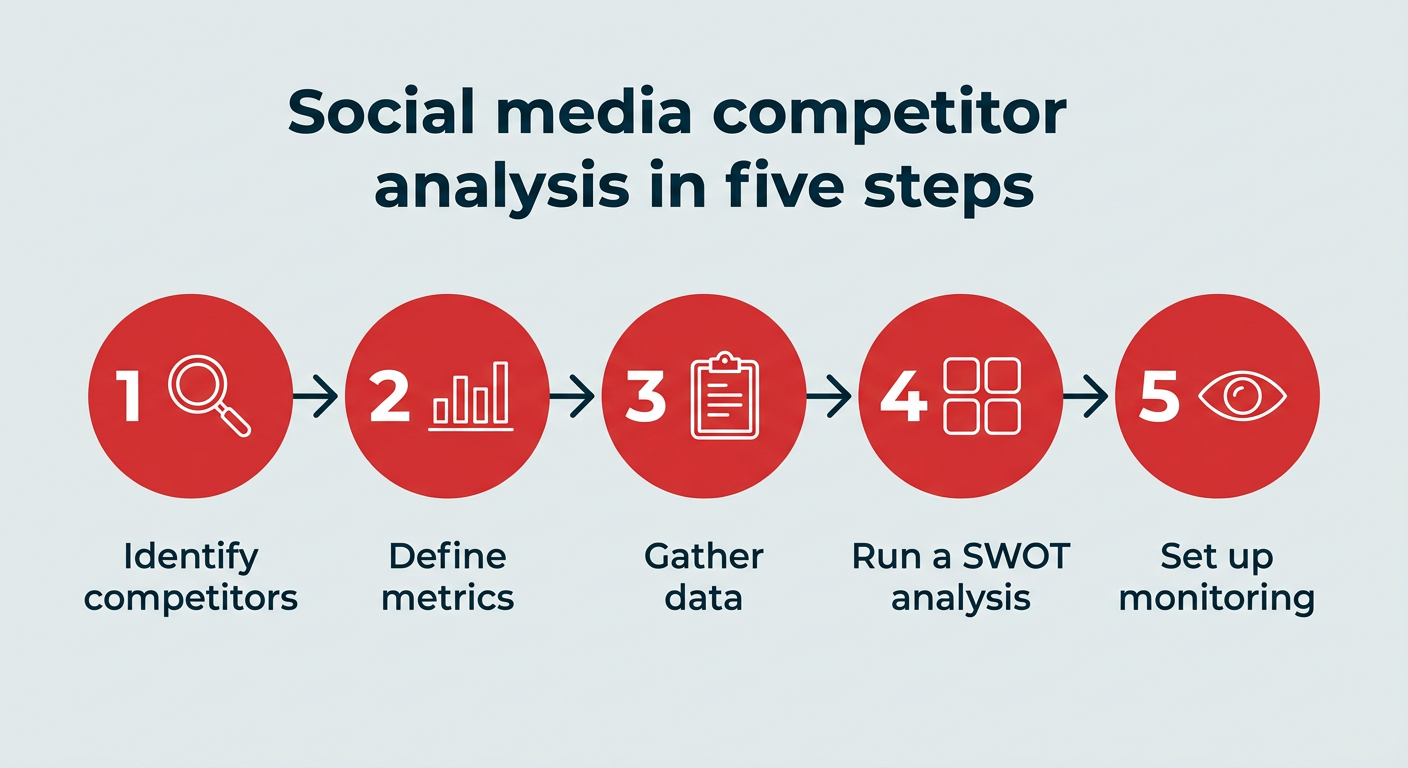
- The process follows five steps: identify competitors, define your metrics, gather performance data, run a SWOT analysis, and set up ongoing monitoring.
- Track metrics that tie to business impact, including engagement rate, posting frequency, content mix, sentiment, and paid activity.
- Tools like Hootsuite Social OS combine competitive benchmarking and social listening so you can act on insights without switching platforms.
A social media competitor analysis is the process of looking at your competitors’ social content and activity to understand how they compare to your own performance.
Done well, it does more than satisfy curiosity. It tells you where to spend your content budget, which formats to prioritize, and how quickly to respond when the market shifts.
When you run a competitor analysis, you can:
- Spot who your real competitors are on social
- See which platforms they’re active on
- Learn how they use each channel (organic posts, paid ads, influencer partnerships, or a mix)
- Spot new threats or emerging players
- Identify gaps, quick wins, and opportunities in your own social presence
Bonus!!!
Get a free, customizable competitive analysis template to easily size up the competition and identify opportunities for your brand to pull ahead.
Social media competitor analysis matters because it connects your social strategy to measurable business outcomes. Without competitive context, a 2% engagement rate is just a number. With it, you know whether you’re leading your category or falling behind.
A few things make this work more valuable right now. Content volume keeps climbing as 51% of content professionals now use AI to create posts, which makes differentiation harder and raises the bar for what stands out. Platform algorithms also reward relevance over frequency, so understanding which competitor posts actually land is more useful than counting how often they publish.
There’s a reporting angle too. Marketing leaders are regularly asked to justify social investment, especially with social advertising at 12.2% of budgets, and competitive benchmarking gives that case a credible reference point. It also shortens your reaction time: if a competitor shifts messaging, launches a product, or runs into a brand issue, you want to know before it becomes a trend.
Here’s what a solid competitive analysis on social media gives you:
- Content gaps: Topics, formats, or audiences nobody in your category is serving well
- Performance benchmarks: A realistic baseline for engagement, growth, and posting cadence
- Early threat detection: New entrants, pricing moves, and messaging shifts
- Budget justification: Competitive context that makes your resourcing case concrete
- Positioning input: Evidence for how your brand should sound different, not just louder
Put simply, competitor analysis turns your social data from a scorecard into a decision-making tool.
The most valuable metrics to track are the ones that show how competitors perform relative to your brand across content, audience, and engagement. You don’t need all of them. Pick the handful that map to your goals, then measure them consistently so trends mean something.
Metric
What it tells you
Where to find it
Engagement rate
How well content resonates, independent of audience size
Perch, native platform analytics
Follower growth rate
Whether a competitor’s audience is accelerating or stalling
Perch, native platform analytics
Posting frequency
Publishing cadence and how it correlates with performance
Manual profile review, benchmarking tools
Content mix
Which formats (video, image, carousel, text) they lean on
Manual profile review, benchmarking tools
How much of the category conversation your brand owns
Lumen, social listening tools
Sentiment
Whether mentions of a brand skew positive, neutral, or negative
Lumen, social listening tools
Audience demographics
Whether you’re competing for the same people
Meta Business Suite Insights, platform analytics
Paid or boosted activity
Where competitors are putting media spend
Platform ad libraries, engagement anomalies
Hashtag performance
Which tags and topics drive reach in your category
Platform search, listening tools
Engagement and growth metrics
Engagement rate is the clearest comparison metric because it normalizes for audience size. A competitor with 20,000 followers and strong engagement is often a better content benchmark than one with 500,000 followers and dead comment sections.
Follower growth rate adds the time dimension. Look at the trend over the last two or three quarters rather than a single snapshot, since campaigns and one-off viral posts can distort a month. Pair it with posting frequency to see whether more output is actually producing more growth, or just more noise.
Perch surfaces these side by side across your owned channels and competitor profiles, which saves you from rebuilding the same spreadsheet every quarter.
Sentiment adds the tone. A competitor can dominate share of voice while sentiment trends negative, which is an opening for you. Lumen, the integrated insights and listening app inside Hootsuite Social OS, tracks both across social and digital sources so you can see shifts as they happen instead of after the quarter closes.
Here’s how to analyze competitors on social media in five steps:
- Identify your competitors
- Define the metrics you will track
- Gather competitor data
- Run a SWOT analysis
- Set up ongoing monitoring
Here’s the detailed breakdown.
Step 1: Identify your competitors
Identify your competitive keywords
There’s a good chance you already know a few keywords your brand is trying to rank for. But take a beat to go even deeper.
For example, if you run a boutique Manhattan hotel with local art and wine tastings, your real competitors aren’t just “NYC hotels.” They’re other boutique experiences that attract the same kind of guest.
Tools like Google Ads Keyword Planner and Google Search Console can identify the most relevant keywords for your brand.
Not sure where to start? Plug in your own website into these tools. You’ll get a list of relevant keywords, along with the average monthly searches and estimated level of competition.
Or, you can plug in your known target keywords. Again, you’ll get a list of related keywords with data on search volume and competition.
Check who’s ranking for those keywords in Google
Next, search your top 5–10 most relevant keywords on search engines like Google. Look for:
- Brands ranking on page one
- Brands paying for ads (a signal they’re investing heavily)
- Emerging or indirect competitors who may not dominate SEO just yet
Click through your competitors’ websites and grab their social handles for your spreadsheet.
Look at who ranks in social search
Ranking on Google doesn’t always mean ranking on social platforms.
Since this is a social media competitive analysis, you need to see who shows up first in social search results, too. So, search your keywords directly in:
- Instagram Search
- TikTok Search (especially if your audience skews younger)
- YouTube
Take note of the brands that appear in Reels, For You, Shorts, or hashtag results. These are often your strongest content competitors, and they frequently differ from the brands winning in Google.
If you’re trying to reach a younger audience, make sure to run a search on TikTok too, since many Gen Z users now use it like a search engine.
See which brands your audience already follows
One of the easiest ways to spot competitors is to look at who your audience already follows.
Use platform analytics tools like Meta Business Suite Insights, TikTok Analytics, and Instagram Creator Insights to see what brands keep popping up.
As you scroll through the data, pay attention to:
- Brands your audience follows most often
- Patterns in interests or categories
- Competitors your audience interacts with regularly
Then, add any relevant brands to your competitor list.
Narrow your list to your top 3–5 direct competitors
By this point, your list is getting long. But don’t worry, you won’t run an analysis on every single name. Narrow it to 3–5 brands that attract a similar audience, offer similar products or experiences, and compete with you most actively on social media.
These are the competitors you’ll focus on for the rest of your analysis.
Step 2: Define the metrics you will track
Before you start collecting data, decide what you’re measuring. Pick five to seven metrics from the table above based on what you’re trying to improve, then apply the same set to every competitor and to your own accounts.
If your goal is content performance, lean on engagement rate, content mix, and top-performing posts. If it’s brand positioning, prioritize share of voice and sentiment. If leadership wants a growth story, follower growth rate and posting cadence will carry more weight.
Log your chosen metrics in the template so every review uses the same definitions. Consistency is what makes quarter-over-quarter social media benchmarking useful instead of confusing.
Step 3: Gather competitor data
Now it’s time to see what your competitors are actually doing on social. Click through each competitor’s profiles and make note of the following:
- What social media platforms are they on?
- How large is their following and how fast is it growing?
- Who are their top followers?
- How often do they post?
- What is their engagement rate?
- What is their social share of voice?
- What hashtags do they use most often?
- How many hashtags do they use?
- What type of content performs best for them? (e.g., videos, newsletters, webinars)
- What formats and themes repeat across their top posts?
- Which posts show signs of paid promotion?
- What do the comments say about how people feel?
You can gather a lot manually, but analytics tools make this so much faster. Check out the social media analytics tools mentioned below.
Turn customer conversations into your next breakthrough product
Request a demo to see how Hootsuite can help your product team discover emerging trends, validate ideas with real customer insights, and bring better products to market faster.
Review their content strategy and positioning
Look past individual posts and find the pattern. Note the content mix (how much is short video versus carousel versus static), the recurring themes, and the tone they use with their audience. Then check their best and worst performers side by side. The gap between them usually reveals what their audience actually wants, which is far more useful than a list of their most-liked posts.
Check for paid and boosted activity
Organic-looking posts with unusually high reach are often promoted. You can confirm it in a few ways: check platform ad libraries, look for “Sponsored” or “Paid partnership” labels, and watch for engagement spikes that don’t match a competitor’s normal baseline.
With an estimated $276 billion in social ad spend globally in 2025, knowing where competitors spend media budget keeps you from benchmarking your organic results against someone else’s paid campaign.
Assess engagement quality, not just volume
Read the comment sections. Are people asking buying questions, complaining about service, or tagging friends? Does the brand reply, and how fast? Engagement quality tells you whether a competitor has an audience or just an algorithm win.
Pro tip 💡: Don’t forget to track your own metrics in the same way. You’ll need them in the next step.
Step 4: Run a SWOT analysis
Now that you’ve got the data, it’s time to turn it into insights.
Enter: the SWOT analysis. It’s a great tool to help you think clearly about all of this information and strengthen your overall social media strategy.
Here are some items to list in each quadrant of the SWOT template.
Strengths
List metrics for which your numbers are higher than the competition. This is your competitive advantage!
Make sure to use your strengths as differentiators when shaping your future content and unique value proposition.
Weaknesses
List metrics for which your numbers are lagging behind the competition. These are areas you’ll want to focus on improving through testing and tweaks to your social media strategic plans.
Keep in mind: You could have both strengths and weaknesses for each social network.
For example, maybe your LinkedIn follower count is higher than your competitors but they have better follower growth. Or maybe you have fewer Instagram followers but higher engagement metrics.
That’s totally normal. Be as specific as possible, because these distinctions will help you identify your opportunities and threats.
Opportunities
Now that you can see where you stand compared to the competition, what gaps can you fill? Opportunities often come from shifts in the competitive landscape.
Maybe a competitor ignores TikTok. Maybe no one is speaking to a specific demographic or persona. Or maybe your content marketing mix is strong, but your posting frequency could be taken to the next level.
Look for areas where competitors’ products fall short, or where no one is addressing a specific audience need.
These are areas you’ll want to improve through testing and tweaks to your marketing efforts. The result? A stronger marketing strategy.
Threats
Now it’s time to look for anything happening outside your brand that could shake things up.
A new competitor, especially a fast-moving startup, is an obvious threat. But others can be more subtle.
For example, a competitor might:
- Launch new products or product lines
- Expand into a new market
- Update their offerings with new product features
- Shift their pricing strategy
Keep an eye on these signals so you can shift your social strategy in real time instead of getting caught off-guard.
Step 5: Set up ongoing monitoring
A competitor analysis isn’t something you check off once and forget. It needs to live in your workflow, whether you revisit it quarterly or a couple times a year.
And to do that well, you need a steady stream of fresh data.
That’s where ongoing monitoring comes in. Keeping an eye on what competitors post, how people react, and what’s popping in your industry helps you spot opportunities early and catch potential threats before they sneak up on you.
Set a cadence that matches your market. Quarterly reviews work for most teams, while fast-moving categories like retail, travel, and consumer tech usually need a monthly check.
The goal is simple: Stay aware of conversations happening around your brand, your competitors, and your space. When something important pops up, jot it down in the Notes column of your competitor analysis template so you can fold it into your next SWOT refresh.
It’s a small habit that makes your future reviews way smarter and way easier.
The most common mistake is treating competitor analysis as a one-time project instead of an ongoing practice. Here are the others worth watching for.
- Fixating on follower count: A big audience that doesn’t engage is a vanity benchmark. Engagement rate and comment quality tell you far more about whether content is working.
- Copying instead of adapting: If a competitor’s format works, the insight is why it works, not the post itself. Borrow the mechanic and apply it to your own positioning.
- Ignoring paid activity: Comparing your organic results to a competitor’s boosted posts will make your performance look worse than it is. Check ad libraries before drawing conclusions.
- Only tracking direct competitors: Indirect players and new entrants often take attention first. Keep two or three emerging brands on your watchlist.
- Skipping benchmarks and review dates: Without a baseline and a set cadence, you can’t tell progress from noise. Record your starting numbers and schedule the next review.
- Collecting data without acting on it: A finished spreadsheet isn’t an outcome. Every analysis should end with two or three decisions.
- Treating every platform the same: What wins on LinkedIn rarely wins on TikTok. Benchmark channel by channel, not brand by brand.
Avoid these and your analysis shifts from a reporting exercise to something your team actually uses.
The right competitor analysis tools pull benchmarking, listening, and reporting into one place so you spend your time on interpretation instead of data entry. Here’s how the main options compare.
Tool
Best for
Key features
Pricing tier
Hootsuite
Teams that want benchmarking, listening, and publishing together
Competitor benchmarking, social listening, analytics, scheduling
From $99/user/month
Rival IQ
Head-to-head competitive reporting
Benchmark reports, post analytics, industry averages
From $239/month (Drive plan)
Socialinsider
Content performance comparison
Competitor analytics, content breakdowns, campaign tracking
From ~$99/month
Synapview
Monitoring Reddit and blogs
Competitor and hashtag tracking outside major platforms
Contact for pricing
Mentionlytics
Mention tracking and sentiment
Brand and keyword monitoring, sentiment analysis
From ~$69/month (Basic plan)
Sprout Social
Social management with competitive add-ons
Competitor reports, word clouds, growth tracking
From $199/seat/month (Standard plan)
1. Hootsuite
Hootsuite helps you turn competitive research into smarter social strategy. Use Perch for competitive benchmarking across your owned channels, comparing engagement and follower growth, then turn those insights into better content.
Then, use Lumen to track competitor mentions, share of voice, sentiment, trends, and audience conversations across social and digital channels.
It also surfaces patterns that actually move the needle in your category, from top-performing posts to trending hashtags to the types of content everyone’s responding to. And with Wisdom, you can ask competitive questions in plain language instead of building a report to find the answer.
Because benchmarking, listening, and publishing all live inside Hootsuite Social OS, you can act on insights without switching tools.
Meet the Suite
Understand what matters, decide what to do next, and take action across every social workflow — all from one connected suite.
2. Rival IQ
Rival IQ is built specifically for competitive reporting. It pulls competitor profiles into head-to-head benchmark reports so you can compare engagement rate, posting cadence, and content performance at a glance.
It also publishes industry benchmark data, which is useful when you need a category average rather than a single rival to measure against. Teams that present competitive context to leadership on a regular schedule tend to get the most out of it.
3. Socialinsider
Socialinsider focuses on content performance comparison. You can track competitor accounts across major platforms and break their results down by format, topic, and campaign.
That makes it a good fit if your main question is “what kind of content works in our category?” rather than “how big is their audience?” Reports are exportable, which helps when competitive findings need to travel beyond the social team.
4. Synapview
Ready to go beyond social media competitor analysis? Synapview is an app that lets you monitor competitors and hashtags on Reddit and blogs, helping you deep dive into your competition across multiple platforms.
5. Mentionlytics
Mentionlytics is a social media monitoring tool for conducting a social media competitive analysis. You can discover everything being said about your brand, your competitors, or any keyword on X, Instagram, Facebook, YouTube, Pinterest, and web sources (news, blogs, etc.).
Plus, with its handy “sentiment analysis” feature, you can see not only what is being said about your competitors but how it’s being said. This can give your team insights that can guide product development and messaging.
PSA: Mentionlytics integrates with Hootsuite, so you can see everything it pulls in your Streams.
6. Sprout Social
Sprout Social is a social media management tool that offers some competitive analysis features.
Sprout’s tools help users track and measure growth across competitors’ social accounts and easily check how those stats compare to their own. A word cloud solution that surfaces trending topics and keywords is also available.
How do you turn competitive insights into action?
Turn competitive insights into action by translating your SWOT findings into specific, time-bound changes to your content calendar, posting strategy, and resource allocation. An analysis that doesn’t change a decision was just research.
- Pick two or three opportunities: Choose the gaps with the clearest path to impact, not every item in the quadrant. Fewer bets, executed properly, beat a long list.
- Update your content calendar: Translate each opportunity into actual posts, formats, or series with owners and dates attached.
- Set benchmarks and a review date: Record where you start on each chosen metric, then book the next review so progress gets checked rather than assumed.
- Test, then iterate: Run changes long enough to read the signal, keep what works, and drop what doesn’t before the next analysis cycle.
The teams that get the most from competitor analysis are the ones who treat it as an input to planning, not a report that lands and sits.
You can get one right here: our free template gives you one place to organize everything you’ve gathered, so you’re not rebuilding a spreadsheet every quarter.
This template will also help you track key metrics, industry benchmarks, and KPIs, as well as monitor pricing trends across competitors. PS. There’s a tab for your SWOT analysis, too, plus a Notes column for logging anything you spot during ongoing monitoring.
FAQ: Competitive analysis
What are the best competitive analysis frameworks for social media teams?
The best competitive analysis frameworks for social media teams typically center on SWOT, because it keeps the work practical. It helps you quickly see what you’re doing well, where you can improve, and how to turn those insights into better content and clearer priorities. Enterprise teams looking at category dynamics rather than individual rivals sometimes layer in Porter’s Five Forces for a broader market view.
What tools deliver the most accurate social media competitive insights?
The tools that deliver the most accurate social media competitive insights are those that combine benchmarking with listening, since engagement data alone misses the conversation around a brand. Hootsuite Social OS brings both together: Perch for competitive benchmarking and Lumen for mentions, share of voice, and sentiment, so you can read performance and context in one place.
How does social listening strengthen competitive analysis for large organizations?
Social listening strengthens competitive analysis for large organizations by filling in the “why” behind the data. It shows what people are actually saying about you and your competitors in real time, so sentiment shifts, early trends, and potential threats surface faster. That lets large teams adjust messaging and content before a shift becomes a problem.
How do you run a social media competitive analysis for enterprise brands?
You run a social media competitive analysis for enterprise brands by narrowing to your true competitors based on shared audiences, overlapping keywords, and product similarities, then analyzing their content, engagement patterns, and posting habits to find where they outperform you and where you have an edge.
How do you benchmark social KPIs against competitors at scale?
You benchmark social KPIs at scale by using tools that pull competitor metrics automatically, so you can compare engagement, follower growth, posting cadence, and content mix without manual collection. Once your benchmarks are set, review them quarterly to spot shifts, wins, and weak spots before they become bigger issues.
What are the 7 layers of social media analysis?
What is the 5 5 5 rule for social media?
Can ChatGPT analyze social media accounts?
How often should you update a social media competitor analysis?
What is the difference between a competitor analysis and social listening?
The #1 social media tool