
Key takeaways
- A boosted Reel is an organic video you promote with a set budget so it reaches people beyond your followers, appearing in the main feed, Reels tab, Explore page, and Stories.
- You can boost Instagram Reels directly in the app in six steps, or through Hootsuite for extra targeting, scheduling, and budget control.
- Boosting works best for top-of-funnel goals like brand awareness and engagement. Full Instagram ads give you deeper targeting and conversion optimization.
- Start with $10 a day over a 7 to 10 day run, then review results before scaling spend.
What is a boosted Instagram Reel?
A boosted Reel is an existing Instagram Reel that you pay to promote to a larger audience, using a budget and time frame you choose. Instagram turns the organic post into an ad without you ever opening Meta Ads Manager.
That matters because Reels already own a huge share of the attention on the platform. They account for 46% of the time people spend on the Instagram app, which is a big part of why short-form video keeps pulling budget away from other formats.
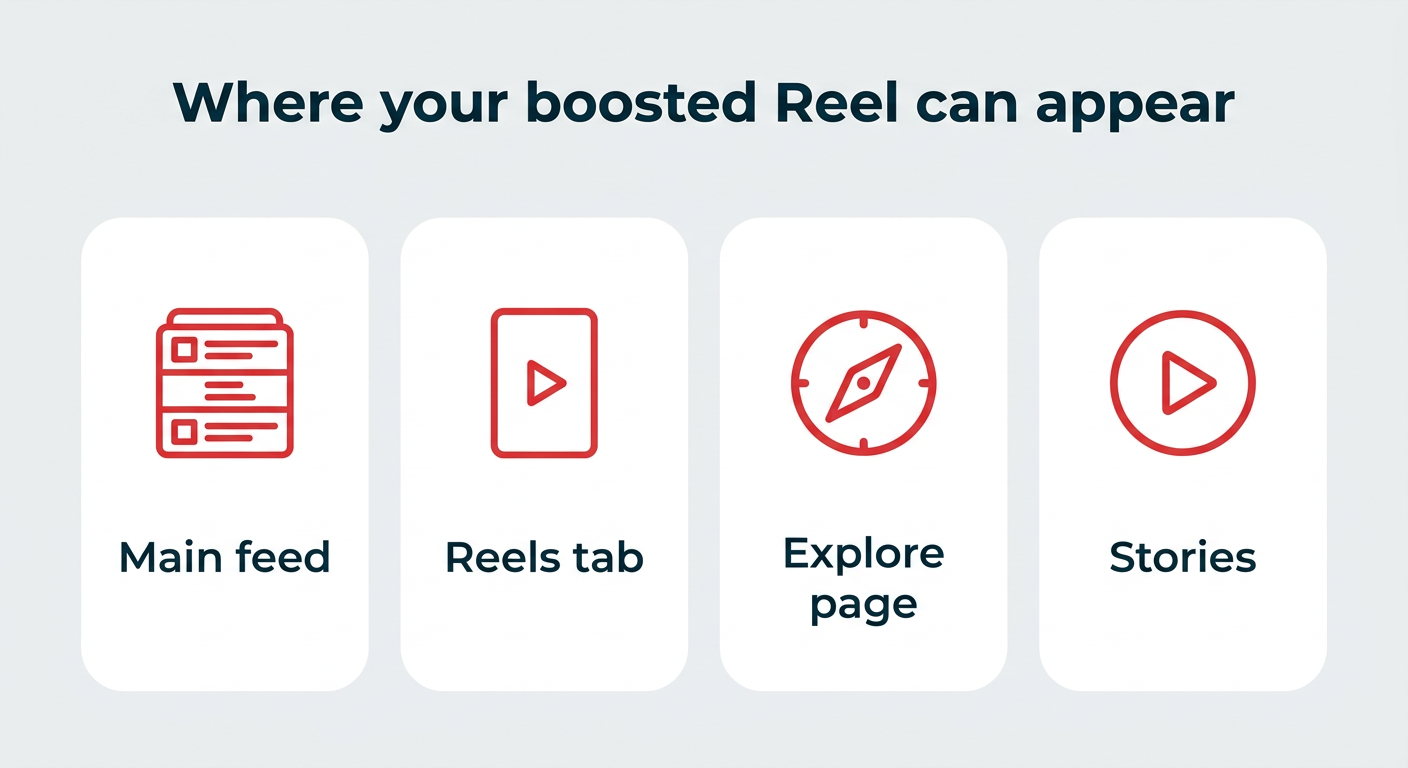
Once boosted, your Reel can appear in:
- The main feed: Alongside organic posts from accounts people follow
- The Reels tab: Mixed into the full-screen Reels experience
- The Explore page: Served to people discovering new content
- Instagram Stories: Between Stories from accounts they follow
Unlike organic Reels, which rely solely on Instagram’s algorithm for distribution, boosted Reels give you more control over who sees your content. They’re also simpler than full-scale Instagram ads, which trade that simplicity for advanced targeting and optimization options. More on that comparison further down.
Bonus: Claim your pack of free animated Instagram Reels templates created by Hootsuite’s professional designers. Easily customize them in Canva, and take your Reels game to the next level today.
What are the requirements to boost an Instagram Reel?
To boost an Instagram Reel, you need a business or creator account and a Reel that meets Instagram’s eligibility rules. Personal accounts can’t boost content at all, so switching account types is the first step if you haven’t already.
When choosing to boost a Reel, make sure it meets Instagram’s criteria:
- 60 seconds or shorter (see our troubleshooting guide for more on Reel length limits)
- Vertical aspect ratio (9:16)
- Cannot contain copyrighted music, GIFs, stickers, or camera filters from third parties
- The Reel cannot have been shared to Facebook
- It cannot be a Trial Reel
If a Reel doesn’t qualify, the Boost button will either be greyed out or Instagram will reject the boost after you submit it. You’ll get a notification explaining the reason, and any budget you set won’t be charged.
The most common culprit is licensed music, so if you plan to promote a Reel, use original audio or tracks from Instagram’s commercial audio library from the start.
How to boost Reels on Instagram
You can boost Instagram Reels in six steps from the app, and the whole process takes a couple of minutes. Here’s the short version before the detailed walkthrough:
- Choose the Reel you want to promote
- Tap Boost post or Boost Reel
- Set your goal
- Set your target audience
- Set your budget and duration
- Review and launch
Step 1: Choose your Reel
First step: pull up the Reel that you want to boost. You can access your Reels in two ways:
- From your Instagram profile feed (note that it won’t show any Reels that you’ve chosen to hide from your profile grid)
- From the Reels tab on your profile (will show all of your published Reels)
Step 2: Tap boost
If viewing the Reel from your profile grid, tap Boost post in the bottom right corner.
If viewing the Reel from the Reels tab, tap Boost Reel in the bottom right corner.
Step 3: Set your goal
The first decision you’ll need to make is what objective you want the Reel to achieve:
- Visit your profile: If you want to build brand awareness or new followers
- Visit your website: If you want to drive purchases or signups on an external website
- Message you: If you want to have personalized interactions with potential customers (pro tip: add a question or prompt in the Reel caption)
If you choose Message you, you can select the text for the CTA button.
Step 4: Set your target audience
Here, you can choose who you’d like to see your Reel.
You can let Instagram do the heavy lifting by selecting Suggested audience or set your own parameters by using a saved audience or creating a new one.
If you select Create your own, you can set the targeting for location, age, gender, and interests.
We suggest leaving the Advantage+ audience toggle on to allow the Instagram algorithm to expand your audience.
After you fill in the targeting, Instagram will show an estimated size of your audience. Your budget will determine how much of that audience you’ll reach.
Step 5: Set the budget and duration
At this step, you can choose the daily budget and time to run the boost. You can spend as little as $1 per day when boosting a Reel, with daily budget and duration set by you (in-app limits may vary by region and account).
Some notes:
- The budget cap is much lower when boosting a Reel in the mobile app. If you want to use a higher budget, you can spend more per day when boosting from the web
- If you’re using the Instagram app on an iOS device, Instagram applies a 30% Apple service fee to your total ad payment
- You may be charged tax based on your device location
Based on your budget and duration, Instagram will show you an estimated reach and results for your chosen objective.
Step 6: Review and launch
In the last step, you can review your settings for the boosting campaign. Based on your stored payment method, you may need to add funds or simply use a credit card.
After you publish the boost, Instagram will review your Reel to ensure it meets Meta’s ad standards. Reviews can take up to 24 hours, but in most cases, approvals only take a few minutes.
How much does it cost to boost Reels on Instagram?
Boosting a Reel costs whatever you decide to spend, starting at $1 per day, with the daily budget and duration you set (in-app spending limits may vary). Unlike when creating campaigns in Meta Ads Manager, you aren’t paying per click or impressions when boosting Reels. Instead, the cost is simplified based on how much you’re willing to spend per day and how long you wish to run the boost.
With average ad prices up 12% year-over-year in Q1 2026, here’s how common budget tiers tend to map to intent. Treat these as planning guides, not guarantees, since Instagram calculates your estimated reach based on your audience and objective at the time you set up the boost.
One budget note worth flagging: Boosting from the Instagram app on iOS involves a 30% Apple service fee. Instagram applies the fee to your total ad payment, so of a $100 payment made in the iOS app, roughly $70 goes toward your ad and $30 covers the fee. Boosting from the web or from a tool like Hootsuite avoids that fee entirely.
Even if you choose the same budget and duration settings for two different boosted Reels, the estimated reach and results may vary. Behind the scenes, costs for boosted Reels may vary based on:
- Time of year (and how many advertisers are targeting the same audience as you)
- Campaign goals (some results may be more competitive than others)
- How well your Reel performs (better performance may lead to wider audience reach and cheaper results)
- Audience size and overlap (narrow audiences in competitive markets cost more to reach)
Boosted Reels vs. Instagram ads: What’s the difference?
The short answer: boosting is a simplified promotion tool built into the Instagram app, while Instagram ads are full campaigns built in Meta Ads Manager with far more control. Both spend money on the same ad auction. What differs is how much you can steer.
Boosting gives you three objectives, basic demographic and interest targeting, and a single creative: the Reel you already posted.
Ads Manager opens up custom and lookalike audiences, conversion tracking, A/B testing, placement control, multiple creatives per campaign, and far deeper reporting.
If you’re promoting a Reel that’s already earning engagement and your goal is more eyeballs, boosting is the faster path. If you need to drive measurable conversions or reach a very specific segment, build the campaign in Ads Manager instead.
How to boost Instagram Reels using Hootsuite
Pro tip: If you’re already using a social media marketing tool (like Hootsuite), chances are you can boost posts from right inside the tool.
Here are some benefits of boosting Reels through Hootsuite:
- You can schedule a boost to run in the future
- Different objective options, including engagement and video views
- The option to set a total budget (rather than daily)
- Choose the exact start and end times for the boost, down to the minute
- More audience options, such as using custom or lookalike audiences that you’ve built on Facebook
- You’ll avoid the 30% Apple service fee
The three steps below cover the full flow: open your Instagram content, select your accounts, then choose your boost settings.
Step 1: Open your Instagram content in Hootsuite
In Hootsuite Social OS, open the view containing your Instagram feed content. Find your chosen Reel and tap the Boost post button.
Step 2: Select your accounts
Select the correct Instagram and ad account and tap Save.
Step 3: Choose your boost settings
In the next window, you can choose all of your boost settings on one page, including:
- Objective: Engagement, video views, or awareness
- Audience: Recommended, saved, or custom
- Placements: Include/exclude Facebook (we recommend including it for maximum reach)
- Budget and duration: Set a daily or total budget and the start and end times for the boost
Once you’re happy with the settings, tap Boost on Instagram, and that’s it!
You can then use Hootsuite to review your overall Instagram analytics during and after the boosting period.
#1 Analytics Tool for Growth
Beautiful reports. Clear data. Actionable insights to help you grow faster.
Start your free trial
How to track your boosted Reel performance
You can track a boosted Reel by opening the Reel and tapping View Insights, which shows paid and organic results side by side while the boost is live and after it ends. Instagram’s Professional Dashboard keeps a record of every promotion you’ve run, so you can compare boosts over time.
These are the metrics worth watching:
- Reach: How many unique accounts saw the Reel, split between paid and organic
- Impressions: Total views, including repeat views from the same account
- Profile visits: The clearest awareness signal, and the number to prioritize if your goal was profile visits
- Website clicks: Link taps driven by the boost, if you chose the website objective
- Engagement rate: Likes, comments, saves, and shares relative to reach, which tells you whether the paid audience responded like your organic one did
- Cost per result: Your spend divided by the outcome you optimized for, which is the number to compare across boosts
The catch with in-app insights is that they live inside each individual Reel. If you’re boosting regularly across several accounts, Hootsuite’s analytics give you a single view of paid and organic Instagram performance alongside your other channels, so you can spot which content types justify budget without exporting anything by hand.
Is it worth boosting Instagram Reels?
Boosting Reels is worth it when you want to extend the reach of content that’s already performing well organically. Reels ads reach approximately 726.8 million users on Instagram, making it particularly effective for brand awareness and engagement goals. It’s less effective when your success metric is a purchase or a qualified lead, because boosting can’t optimize for those outcomes the way an Ads Manager campaign can.
Boost when:
- A Reel is outperforming your organic average and you want to push it further
- You’re building awareness for a new account, product, podcast, or newsletter
- You’re learning paid social and want a low-risk way to start
- You need more top-of-funnel audience so your retargeting pool doesn’t run dry
Skip boosting when:
- Your goal is conversions or lead generation that needs pixel-based optimization
- You need custom audiences, lookalikes, or precise placement control
- The Reel flopped organically, since paying won’t fix weak creative
- You’re running multiple creative variants and need proper A/B testing
In short: boosting is a reach amplifier for content that has already proven itself, not a fix for content that hasn’t.
10 expert tips to boost Instagram Reels
To pressure-test the tactics above, we spoke with strategist and keynote speaker Jason Keath, Co-founder of marketing agency Social Fresh, who has been advising businesses on social strategy since 2008.
These days, Instagram Reels are a key lever for his clients, who range from startups to Fortune 500 companies. Here are Keath’s top tips for boosting Reels, based on insights from his client work.
Tip 1: Start with audience research
Before clients start putting money into ads or boosting, Keath helps them do audience research. “Our audience research informs the creative more than demographic and psychographic targeting.”
Keath suggests reaching out to customers and asking them these questions:
- “Why did you buy our product?”
- “Why did you start working with us?”
- “What pain point did we help you solve?”
- “If you hadn’t bought from us, what would you have done instead?”
The goal of asking these questions is to learn about the customer journey.
“Learning your audience’s needs, pain points, and emotional triggers will help you dial in what content will connect with your audience.”
Tip 2: Trust the algorithms
In the early days of Facebook and Instagram ads, the more specific your targeting, the better your ads performed. That’s no longer the case now that Meta’s algorithms do more of the work.
“Meta has gotten really good at finding audiences for you. For most clients, letting Instagram figure out where and whom to serve ads has been very successful.”
If you’re not 100% confident in the algorithmic overlords, you can always test your targeting against Instagram’s. Keath suggests the following plan:
- In month 1, test Instagram’s suggested audience
- In month 2, test your custom targeting (using the same creative as month 1)
- Compare the performance of both and continue with the winning targeting in month 3
Tip 3: Invest in competitive research
In addition to audience research, Keath also suggests investing in competitive research.
“We do benchmark research on our clients’ closest competitors and the audiences, channels, messaging, and creatives they’re using.”
Putting even a few hours into competitor research can reveal valuable Instagram insights for small businesses.
Keath’s competitor audits usually focus on these questions:
- What’s working? What’s not working?
- Are they using consistent messaging or call-to-actions?
- What formats are they using: UGC, animations, fast edits and transitions, static images?
Keath recommends researching at least three competitors on Instagram and any related brands you aspire to emulate.
Tip 4: Know your objective
Boosting isn’t always the best tactic for every business. Keath finds it generally works best for solo entrepreneurs, startups, and small organizations focused on driving brand awareness for a new business, product, or media platform.
“Starting an Instagram account for new podcasts or newsletters has become increasingly common. If you’re just getting into advertising, boosting is a good tool to learn the basics.”
Tip 5: Use boosting for top-of-funnel campaigns
Keath firmly believes that social is best for driving awareness.
“Asking someone to make an online purchase is always going to be a harder ask than liking, commenting, or sending a post to a friend. Those engagement metrics are more awareness-driving and easier to achieve with boosting.”
Even if your primary business objective is to drive leads or conversions, boosting can complement these efforts. “You can’t rely on retargeting your existing audience forever. You have to grow your top-of-funnel audience to have a sustainable advertising strategy.”
Tip 6: Test at least 3 creatives
For every test Keath runs, he aims to test at least three ads or content pieces against each other.
“An easy way for small businesses to do that is to look at your analytics for months one, two, and three. If you’re producing weekly content, you can learn one new thing each month to consistently iterate on.”
While conducting these tests, you should keep audience targeting constant to isolate the learnings about the creatives and messaging.
Tip 7: Start with $10 a day
If you have no idea what budget to use, Keath recommends starting with $10 a day.
Keath’s pro tip: “Don’t check your Reel’s performance every hour of every day. Set a length of days that you’re comfortable with, and only check the performance once the boost finishes. If you’re tempted to monitor the results because of the money you’re spending, you need to reduce the budget.”
Tip 8: Run 4, 7, and 10 day boosts
Keath generally sees the most benefits from running 7 to 10 days boosts.
“When you’re just starting out, start with 4-day runs. As you see success, work up to 7 and 10 days. The key is to get confidence that your creative and messaging are working.”
“After 10 days, you’ve probably reached the max point of performance for the Reel.”
Tip 9: Boost top-performing organic content
When choosing which Reels to boost, Keath recommends leaning into what’s working on Instagram organically, especially fresh content, since same-day posts make up over 30% of recommended Reels.
Right now, that could include:
- Send-worthy content: “Content that’s emotional, humorous, provocative, or has interesting stats — anything that would make someone send it to their friends or family members.”
- Value-add content: “Video content with explainers, tutorials, and inspiration lists; anything that leaves users feeling educated or inspired.”
- Playlist content: “Content where you answer common customer questions and create a watchable series.”
- Trends: “People tend to pay more attention to videos showing current trends.”
- Starting a story in the middle: “This is one of the more engaging content techniques with roots in ancient storytelling.”
“You should be boosting Reels content that’s already showing good signs of life on organic.”
Tip 10: Test as many formats as you can
“One of the biggest gaps we see with clients is not testing enough types of videos.”
To learn what content will resonate with your audience, you need to think like a scientist and experiment, experiment, experiment.
“Look at what’s working on Instagram, look at creators, and ask yourself, what would it look like to replicate that for your business?“
Common mistakes to avoid when boosting Reels
Most wasted boost budget traces back to a handful of avoidable decisions. Here are the ones that come up most often, and what to do instead.
- Boosting a Reel that flopped organically. Paid distribution amplifies whatever signal already exists. If a Reel got no saves or shares, budget won’t change that. Fix: only boost content performing above your own organic average.
- Boosting without a defined goal. Picking an objective at random makes results impossible to judge. Fix: decide whether you want profile visits, website clicks, or DMs before you tap boost, and measure against that one metric.
- Setting the budget too low to learn anything. A dollar a day for three days won’t produce usable data. Fix: give Instagram enough spend and enough days to optimize, starting around $10 a day for a week.
- Over-narrowing the audience. Stacking interests and demographics can shrink your audience so far that costs climb. Fix: start with the suggested audience or keep Advantage+ on, then test your own targeting against it.
- Using copyrighted music. Third-party licensed tracks make a Reel ineligible, and you’ll only find out after the boost is rejected. Fix: use original audio or Instagram’s commercial audio library on anything you plan to promote.
- Treating boosting as your whole strategy. Boosting individual Reels in isolation won’t compound. Fix: fold it into a broader social media strategy so paid spend supports a consistent organic cadence.
FAQ: Boost Instagram Reels
Is it worth boosting Reels on Instagram?
Boosting Reels is worth it when you want to extend the reach of content that’s already performing well organically, especially for brand awareness and engagement goals. It’s a weaker choice for conversion-focused campaigns, which need the optimization tools in Meta Ads Manager.
How much does it cost to boost a Reel on Instagram?
Boosting a Reel costs as little as $1 per day, with the daily budget and duration you set through the mobile app (in-app spending limits may vary by account and region). Most brands see a better learning curve starting at $10 a day.
What is the 5-3-1 rule on Instagram?
The 5-3-1 rule is a content planning framework suggesting that for every nine posts, five should provide value to your audience, three should build connection or personality, and one should directly promote your product or service. It’s a guideline for balancing your feed, not an Instagram policy.
Do people know if you boost a Reel?
Viewers can tell a Reel is boosted because it displays a Sponsored label beneath the account name, just like any other Instagram ad. Your existing followers won’t see the boosted version served as an ad unless they’re in your target audience.
What’s the difference between boosting a Reel and running an Instagram ad?
Boosting a Reel is a simplified way to promote existing content with basic targeting, while running an ad through Meta Ads Manager gives you advanced targeting, custom audiences, conversion optimization, and detailed analytics. Boosting takes two minutes; ads take planning.
How long should I boost an Instagram Reel?
Most marketers see the best results from boosting a Reel for 7 to 10 days, which gives Instagram’s algorithm enough time to optimize delivery. If you’re new to boosting, start with 4-day runs and extend as you build confidence in the creative.
Can I boost a Reel with music on it?
You can boost a Reel with music as long as it uses original audio or royalty-free music from Instagram’s audio library, but Reels with copyrighted music from third parties are not eligible for boosting. Check the audio before you publish if you plan to promote the Reel later.
What’s the best goal to choose when boosting a Reel?
The best goal depends on your objective, but for most brands, “Visit your profile” is the strongest choice for building awareness and growing followers. Choose “Visit your website” only if you have a clear offer and a landing page built for mobile traffic.
Can I boost an Instagram Reel from a creator account?
You can boost Reels from both Instagram business accounts and creator accounts, though some advanced boosting features may only be available on business accounts. Personal accounts can’t boost content at all.
How do I know if my boosted Reel is working?
You can check whether your boosted Reel is working by tapping “View Insights” on the Reel itself, where Instagram shows metrics like reach, impressions, profile visits, and website clicks. Compare your cost per result against previous boosts to judge whether performance is improving.
Save time managing your social media marketing strategy with Hootsuite. Publish and schedule posts, find relevant conversions, measure results, and more â all from one dashboard. Try it free today.
The #1 social media tool
Create. Schedule. Publish. Engage. Measure. Win.
By Laura Wong
Laura Wong is a Canadian social media strategist based in Amsterdam. She is the founder of SchoolofSocial.io, an online platform that helps anyone land their dream social media job. Besides social media, Laura is passionate about travel, photography, entrepreneurship, and finding the best bubble tea in every city she visits.
Related Articles
The #1 social media tool
Create. Schedule. Publish. Engage. Measure. Win.