Strategy
Social-first AI fixes the real-time gap: side-by-side comparison, key stats (only 28% trust), plus a 6-point checklist on data, trends, governance.
Download your social AI prompt guide
Key takeaways
- Social-first AI is AI designed specifically for social media, using real-time social data rather than static web content to power insights, content, and trend detection.
- Most general-purpose AI tools are adding work, not saving it, with 43% of social media managers spending 11+ hours a week on AI tools.
- Only 28% of social media managers are confident their tools reflect what’s happening on social right now, which forces constant oversight and edits.
- Hootsuite Social OS is built as a social-first AI system, connecting real-time intelligence (Lumen), content creation (Perch), and AI orchestration (Wisdom) in governed workflows.
Social-first AI is artificial intelligence designed around social media data and social media workflows. Instead of drawing on general web crawls with a training cutoff, it works from live signals across social platforms, so the insights and content it produces reflect what people are talking about now.
The distinction matters because social moves differently from almost every other marketing channel. A trend can form and fade inside 48 hours. Tone shifts by platform, by audience, and sometimes by week. General-purpose AI for social media tends to flatten all of that into something safe, generic, and slightly out of date.
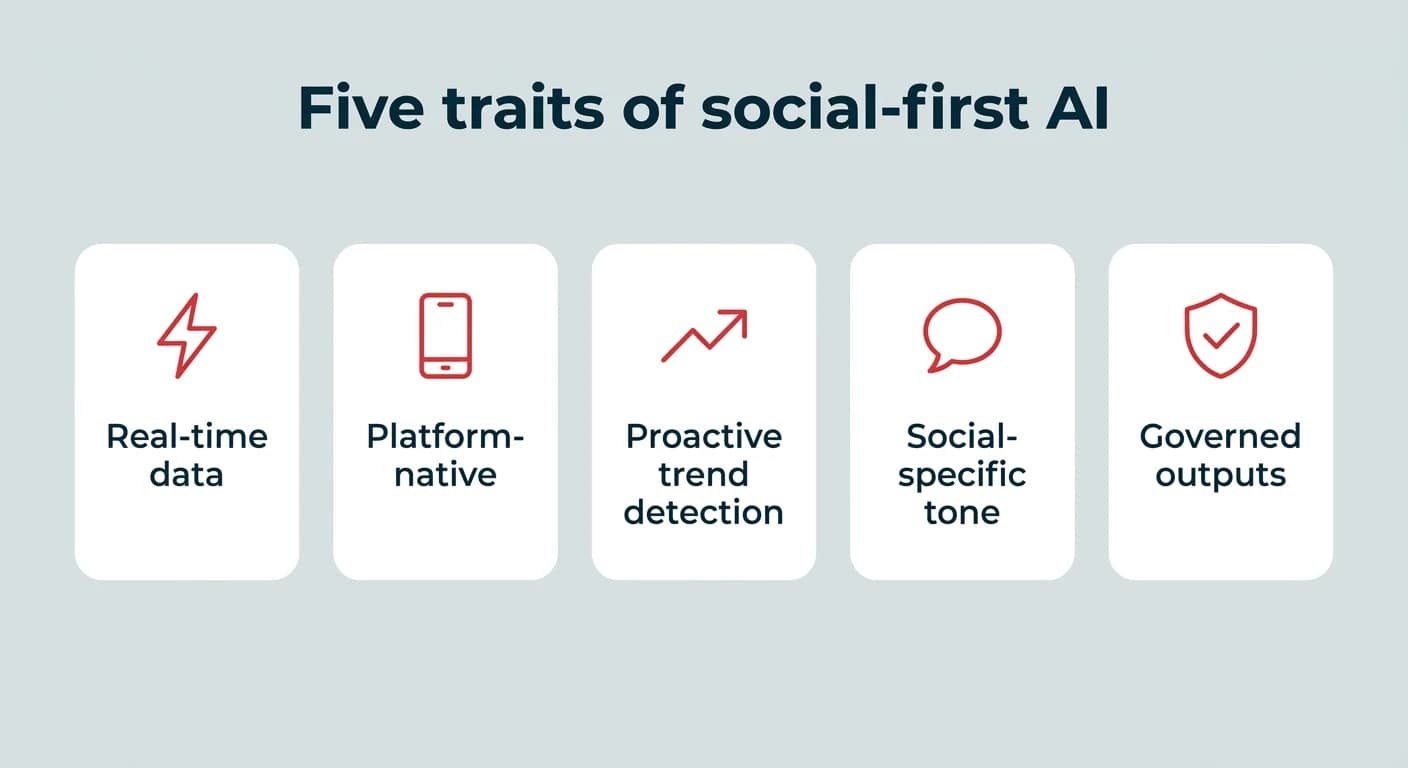
Most social-first AI systems share a few defining characteristics:
- Real-time data foundation: Insights come from live social conversations, not static training data with a knowledge cutoff.
- Platform-native understanding: It recognizes that a LinkedIn post, a TikTok hook, and an Instagram caption are different jobs with different norms.
- Proactive trend detection: It surfaces emerging topics while there’s still time to act, rather than summarizing what already happened.
- Social-specific tone and context: Outputs reflect how people actually talk online, including the references and formats native to each channel.
- Governed outputs: Answers are traceable to sources, and content moves through approval workflows before it goes live.
Put simply, social-first AI treats social as the primary data source and the primary workflow, not an afterthought bolted onto a general marketing tool.
Five traits of social-first AI
The clearest way to see the difference is side by side. Both approaches use large language models, but what they’re grounded in, and what they’re optimized for, diverges sharply.
Dimension
General-purpose AI
Social-first AI
Data source
Static web crawls and training data with knowledge cutoffs
Live social signals across platforms
Timeliness
Days to months behind
Real-time or near real-time
Content tone
Generic, often formal or blog-like
Platform-native, matches how people actually talk
Trend detection
Reactive or absent
Proactive, surfaces emerging trends
Platform understanding
Treats all channels the same
Understands platform-specific formats, audiences, and norms
Governance
Limited or bolt-on
Built-in compliance and approval workflows
The core difference comes down to grounding. General-purpose social media AI tools are strong at language and weak at timing. Social-first AI is built so that timing, tone, and platform context are part of the answer, not something your team has to add afterward.
General-purpose AI fails social teams because it wasn’t designed for the pace or style of modern social. The problem isn’t that AI lacks potential, or that its underlying algorithms are flawed.
These tools promise automation but require micromanagement. This is unsurprising when only 16% of marketing work is currently AI-automated. They surface information but lack context, and they’re trained on data that rarely reflects what people care about right now.
If we zoom out more, a clear disconnect emerges between how leaders think AI is performing and how it’s actually landing on the front lines. 64% of senior marketers believe their tools use real-time data, but only 39% of social media managers agree.
Marketing leaders are far more confident in their AI’s real-time data than the practitioners using it daily.
As AI budgets rise and expectations grow, the cracks are starting to show. The people closest to the work, closest to the platforms, the conversations, and the trends, know the truth: most AI-powered tools can’t keep up.
And when your tools can’t keep up, neither can your team. Instead of solving problems, most AI-driven tools are actually creating more work for already busy social teams. Here are three reasons AI is falling short, and what needs to change for social strategies to actually benefit.
Is AI actually saving social teams time?
For most teams, no. AI is adding hours rather than saving them. It was pitched as the time-saver social teams have been waiting for, but in practice, it’s become a big time sink.
43% of social media managers now spend more than 11 hours a week using AI tools. That’s a full third of their time spent coaxing content out of tools that were supposed to eliminate busywork.
More than two in five social media managers now spend over 11 hours a week working inside AI tools.
All of this effort might be worthwhile if the outputs were dependable, but they’re not. Most tools don’t handle trend discovery either, so teams end up spinning their wheels on the exact problem proper AI trend detection is supposed to solve.
Instead of being freed up to focus on strategic decision-making, content strategy, or brainstorming, marketers are stuck justifying outputs or reverse-engineering performance from tools and chatbots that can’t explain themselves.
The impact climbs the ladder. 59% of senior marketers say their campaigns are launching after the trend window has closed. In other words, teams aren’t getting the right signals soon enough to act.
Nearly six in ten senior marketers say their campaigns go live after the moment has passed.
AI tools promise scale, but they just create more layers to manage. What’s supposed to be automation turns into another review cycle. Teams are trading one kind of work for another, often with less confidence and slower results.
If your team spends double-digit hours each week on AI but still misses the moment, you don’t have a workflow; you have a workaround.
Does your AI actually understand social media?
Often, it doesn’t. Most marketing AI tools, including popular options like ChatGPT, were never built for social. They pull from outdated, generic content that doesn’t reflect how people actually talk.
43% of social media managers say the content they get from AI seems based on general web data rather than social-specific sources. The language feels off, the insights are shallow, and it reads like it was written by someone who’s never scrolled through TikTok before.
When AI has a knowledge gap like this, teams have to compensate for that mismatch.
This disconnect erodes trust. Only 28% of social media managers trust their current tools to reflect what’s happening on social media in real time.
Just over a quarter of social media managers trust their AI to reflect what’s happening on social right now.
That’s staggeringly low, given that these tools are being used every single day by teams that know they can’t fully rely on them.
If your AI is drawing from stale sources, no amount of prompt engineering or internal upskilling will close the gap. You’re not working with bad AI. You’re working with blind spots. The fix is grounding outputs in real-time social data instead of generic web content.
This is where frustration starts to look like failure, especially for marketing teams under pressure to move fast, create social content at scale, and hit performance benchmarks.
The solution isn’t to pull back on AI. It’s to demand better from it.
Billy Jones, Head of Marketing at Hootsuite, leads the team behind this research.
Are rising AI budgets delivering results?
Not consistently. 40% of senior marketers say they’ve wasted over 10% of their AI marketing budget on tools that didn’t deliver.
That’s not just disappointing. It’s career-risking in a climate where CFOs are scrutinizing every line item.
Two in five senior marketers report wasting at least a tenth of their AI budget on underperforming tools.
The risk here isn’t just a missed KPI. It’s the erosion of credibility. When executives can’t show clear wins from their AI investments, the perception shifts: not that the tools failed, but that their team did.
Teams were promised automation, scale, and speed. What they’re getting instead is a tangle of half-useful tools that often fail at the one thing they’re supposed to do: make social easier to execute and measure.
That’s why simply increasing AI spend won’t solve the problem. Only 30% of CMOs report the readiness capabilities to scale AI, even as budgets keep climbing.
If your AI doesn’t understand what makes content resonate on social, or can’t help you move fast enough to capitalize on a trend, then every additional dollar spent just adds pressure to prove ROI without giving you the tools to achieve it.
This is the inflection point.
Marketing leaders have invested. 83% of senior marketers say their AI budgets have increased. Nearly half now spend over 10% of their total marketing budget on AI tools, and one in five (20%) are spending more than 20%. Now they need tools that can deliver.
AI budgets keep climbing, which raises the bar for what social teams are expected to prove.
If the data above describes your experience, the answer isn’t fewer AI tools. It’s better criteria for choosing them. Here are six things worth checking before you sign anything.
- Real-time data access: Ask where the insights come from and how often the data refreshes. If the vendor can’t answer clearly, assume there’s a knowledge cutoff.
- Platform-specific content understanding: Test the same brief across three channels. If the outputs read identically, the tool doesn’t understand social.
- Trend detection speed: Look for tools that flag emerging conversations early, not ones that summarize last month’s performance.
- Workflow integration: The AI should live where you already plan, publish, and report. Every extra tab is another place work gets lost.
- Governance and compliance controls: Approval routing, permissions, and audit trails need to be built in, especially in regulated industries where an unapproved post carries legal exposure.
- Transparent, cited sources: You should be able to see what an answer is based on. Without citations, you can’t defend a decision to your leadership team.
Score any tool you’re evaluating against all six. The ones that fail on data freshness or governance are the ones most likely to end up in that wasted-budget statistic.
Six criteria for choosing social AI tools
Social-first AI changes the workflow in a few specific, measurable ways. Here’s what that looks like day to day for a social team.
Catching trends before they peak
Social listening AI continuously monitors conversations across platforms and flags topics gaining momentum, rather than reporting on what already happened. That’s the direct counter to the finding that 59% of senior marketers see campaigns launch after the trend window closes.
In practice, it means a social team gets an alert about a rising conversation on day one instead of discovering it in a weekly report on day seven. The creative work stays human. The detection gets automated.
Creating content that matches the platform
Because outputs are grounded in live social conversations, social-first AI drafts copy that reflects current formats, references, and tone for each channel. This is the gap behind the 43% of social media managers who say AI content feels pulled from general web data.
The practical benefit is fewer edit cycles. Drafts arrive closer to publish-ready, so your time goes into judgment calls rather than rewriting robotic copy.
Monitoring brand health in real time
Real-time intelligence also works defensively. Sentiment shifts, spikes in mention volume, and competitor moves surface as they happen, which gives teams a head start on crisis response and competitive positioning.
For enterprise teams, this is often the clearest ROI case: the cost of noticing a problem 12 hours late is usually much higher than the cost of the tool.
Most AI tools weren’t built for the social front lines. Hootsuite Social OS is. It’s an AI-first social operating system, which means intelligence, content creation, customer care, and governance are connected rather than stitched together from separate tools.
The apps inside Hootsuite Social OS each handle a different part of the social-first AI workflow:
- Wisdom: The AI orchestration layer. Ask questions in plain language and get cited answers grounded in live social data.
- Lumen: Real-time social intelligence and listening, covering trend detection, sentiment, and competitive insight.
- Perch: Content creation and publishing, tuned to the formats and norms of each platform.
- Nest: Customer care, bringing inbound messages and conversations into one place.
- Vigil: Governance and compliance, including approval workflows and oversight controls.
- Parliament: Collaboration and coordination across teams and stakeholders.
Together, they close the gap between intelligence and execution, which is where most social media management AI falls down. You spot the signal and act on it in the same system instead of exporting a report and starting over.
From signal to post in one system
Wisdom: AI orchestration that connects insight to action
Wisdom is the conversational AI layer inside Hootsuite Social OS, unifying what used to be two separate assistants (OwlyGPT and Yeti) into a single agent. You ask a question in plain language and get an answer grounded in live social data, with citations you can trace.
Wisdom Studio lets teams build custom agents for recurring tasks, and MCP connectors make it possible to bring social intelligence into other tools your organization already uses. The point isn’t novelty. It’s removing the friction between a question and a decision.
Lumen: real-time social intelligence across millions of sources
Lumen is the integrated insights and listening app inside Hootsuite Social OS. It monitors conversations across more than 150 million sources in 187 languages, covering sentiment analysis, trend detection, and competitive intelligence.
Social-first AI pulls platform-native insights in real time, like how your audience engages on Instagram or LinkedIn.
Lumen also includes LLM Insights, which tracks how your brand appears in AI search results. As more buyers start their research inside AI assistants, that visibility becomes part of the measurement picture. 49% of US adults now use AI chatbots.
Irina Novoselsky, CEO of Hootsuite, guides the vision behind Hootsuite Social OS.
How do you keep social-first AI governed and trustworthy?
You keep social-first AI trustworthy by pairing it with clear controls and human oversight. Speed without governance is how brands end up with an unapproved post, a compliance breach, or a statistic they can’t source.
Vigil is the governance layer inside Hootsuite Social OS, and it handles the controls enterprise teams need most. Whatever platform you use, these are the governance considerations worth getting right:
- Cited, traceable sources: Every AI-generated insight should link back to the data behind it so decisions can be defended.
- Approval workflows: Content routes through the right reviewers before publishing, with permissions set by role.
- Compliance controls: Industry-specific rules are enforced inside the workflow, not in a separate document nobody reads.
- Audit trails: A record of who approved what, and when, which matters in regulated sectors where posts can create legal exposure.
- Human review on sensitive topics: Crisis, legal, and regulated content should always have a named human owner.
Governed workflows are what make social-first AI usable at enterprise scale. Without them, speed becomes a liability rather than an advantage.
The next phase is less about generating content and more about coordination. Early AI adoption focused on drafting captions and summarizing reports. The shift underway is toward systems that connect intelligence to action across teams, so a signal picked up by listening can trigger a brief, a draft, and an approval without a handoff getting lost.
Agentic workflows are part of that. Instead of prompting a tool every time, teams configure agents to handle recurring tasks like competitive monitoring or weekly performance synthesis, with humans reviewing the output.
MCP connectors are the other piece. They let social intelligence flow into the other systems your organization runs on, which means social data starts informing decisions outside the social team.
The direction is consistent: social-first AI is moving from a content tool to the connective layer between what’s happening on social and what your organization does about it.
Frequently asked questions
What is social-first AI and how is it used in social media marketing?
Social-first AI is artificial intelligence designed specifically for social media, built on real-time social data rather than static web content. Teams use it to monitor conversations, catch trends early, and create content that fits each platform. In Hootsuite Social OS, Wisdom handles the conversational layer, returning cited answers grounded in live social signals.
How is social-first AI different from general-purpose AI like ChatGPT?
Social-first AI differs from general-purpose AI by using real-time social data as its foundation rather than static web crawls with knowledge cutoffs. That changes the output in three ways: insights reflect current conversations, content matches how people actually talk on each platform, and trends surface while there’s still time to act.
How do brands use AI to create, optimize, and manage social content at scale?
Brands use AI to speed up content production and make better decisions at scale. Perch handles platform-native content creation and publishing, while Wisdom synthesizes performance data and identifies what’s working. The combination lets teams keep improving their social media strategy without adding headcount.
What are the benefits and risks of using AI in social media strategy?
The benefits of using AI in social media strategy include faster trend detection, deeper audience insight, and the ability to scale content production, while the risks include inaccurate outputs, missing cultural context, and brand misalignment. Governance tooling such as Vigil reduces those risks by routing content through approvals and keeping an audit trail.
How do companies implement social-first AI while maintaining brand voice and compliance?
Companies implement social-first AI by pairing it with clear guidelines and human oversight. That means defining brand voice, setting approval workflows, and reviewing content before it goes live. Governed workflows inside Vigil enforce those rules in the system rather than relying on people to remember them.
What tools support social-first AI workflows for enterprise teams?
Hootsuite Social OS supports social-first AI workflows for enterprise teams by connecting real-time intelligence (Lumen), AI orchestration (Wisdom), content creation (Perch), customer care (Nest), and governance (Vigil) in one system. Because the apps share the same data, insights move into action without exports or handoffs.
What is an AI-first social operating system?
An AI-first social operating system is a platform where AI is built into every layer of the social workflow, from intelligence and content creation to customer care and governance, rather than added as an afterthought. The practical difference is that insight, execution, and oversight happen in the same place.
Can AI replace social media managers?
AI cannot replace social media managers, but it can remove significant friction from their workflows. By handling trend detection, content drafting, and data synthesis, it frees practitioners to focus on strategy, creative judgment, and the community work that requires a human.
How do you measure ROI on AI tools for social media?
You measure ROI on AI tools for social media by tracking time saved on manual tasks, speed to publish on trending topics, content performance improvements, and reduction in wasted tool spend. That last metric matters: 40% of senior marketers say they’ve wasted over 10% of their AI budget on tools that didn’t deliver.
What should you look for when choosing AI tools for social media teams?
When choosing AI tools for social media teams, look for real-time data access, platform-specific content understanding, fast trend detection, integration with your existing workflow, built-in governance, and transparent, cited sources. Tools that fail on data freshness or governance are the ones most likely to go unused.
Save time managing your social media marketing strategy with Hootsuite. Publish and schedule posts, find relevant conversions, measure results, and more â all from one dashboard. Try it free today.
The #1 social media tool
Create. Schedule. Publish. Engage. Measure. Win.
Sarah is the Creative Director at Hootsuite, where she leads the content, design, video, and social teams driving the brand’s global creative vision. From industry-leading trend reports and integrated campaigns to bold social storytelling, she ensures Hootsuite shows up with work that’s both strategic and unforgettable. Over her ten years at Hootsuite, she’s shaped the brand voice, led award-worthy content programs, and inspired teams to think bigger (and have fun while doing it). When she’s not busy pushing creative boundaries, you’ll probably find her deep in a book — or wondering if it’s too early to eat lunch.
The #1 social media tool
Create. Schedule. Publish. Engage. Measure. Win.