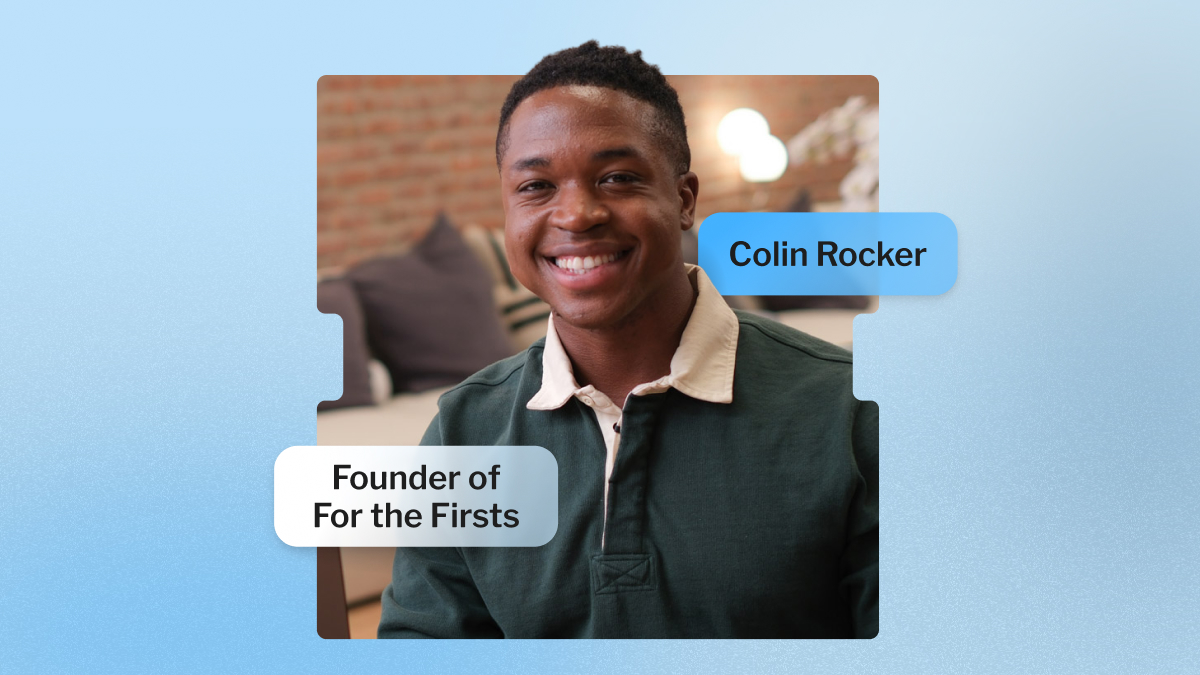
Creator Colin Rocker, founder of For the Firsts, used Kit’s Subscriber Signals to see where his nearly 10,000 subscribers live, earn and engage, so he can choose event cities based on data instead of instinct.
In its first year, Colin Rocker’s community had already outgrown New York. For the Firsts is a monthly in-person gathering of 60 to 80 professionals who are the first in their family to hold a corporate job. People in eight or ten other cities wanted to run their own chapter. All he had to do was say yes.
He didn’t.
“I think for me it was really important to understand what I was actually building and kind of do the whole adage of making it better before you made it bigger,” he says.
That instinct, to grow on purpose instead of as fast as demand allowed, runs through everything Colin has built since a layoff in 2024 turned a side project into his only job.
From layoff to For the Firsts: building an in-person community for first-generation professionals
Colin spent his early career in management consulting, most of it at Deloitte. Content was something he did on the side, simply offering up advice for people navigating corporate life without a roadmap. Then the job disappeared.
“I had just become a new parent,” he reflects. “I think it was a week between me losing my job and the birth of my son. I was in Manhattan, in New York City, with this kid, and I had to figure something out.”
What got him through it wasn’t a content strategy. It was community, the same thing his content had always been about.
“Being in New York, it’s such a privilege,” he says. “You have communities you can reach out to, you have events going on, individuals here in the city who are also carving out their own unique creative business lane.”
That’s where For the Firsts came from.
Why build an email list when you already have 450,000 followers?
Email gives Colin revenue opportunities that don’t depend on posting another video.
Between Instagram, LinkedIn, TikTok, and other platforms, he has more than 450,000 followers. His email list is a fraction of that, at nearly 10,000 subscribers. He builds it anyway, for two reasons.
1. He values deeper connections
“Through email, I found you can have a much longer conversation with people about what you want to share,” he explains. “In a 60 to 90 second video, especially one that’s a sponsored post, there’s only so much of me you’re getting.”
2. How he thinks about the business itself
“You’re the definition of keyman syndrome,” he says. “Everything stems from you.”
Every video, every post, every appearance depends on him personally showing up. Email is the one part of the business that doesn’t.
“When I have that email list, and I’ve got a workflow and automation already running, it’s allowed me to add revenue opportunities to the business that aren’t dependent on getting another video out,” he says.
How Colin’s comment-to-subscribe loop grows his email list from videos and events
Colin’s email growth loop runs without him touching it. Here’s how:
- A viewer comments “first” on one of his Instagram or LinkedIn videos.
- An automated message sends two links at once: one to his newsletter and one to his next event.
- Event registrants are added to his list automatically through a Kit automation, whether or not they separately subscribed.
- Attendees become returning members, and the newsletter keeps them coming back month after month.
This loop allows him to focus on creating content that resonates with his audience and hosting IRL events, all while growing his email list, all of which helps him work toward his goal of growing For the First.
The problem: choosing where to expand without data
How do you decide which city to expand a community to? How do you know what your audience will be eager to pay for?
These are questions Colin asks himself. Before Signals, he knew intuitively that some cities, some segments of his list, and some sponsor conversations were stronger bets than others.
He just didn’t have a way to prove it.
What Subscriber Signals revealed about Colin’s audience: 21 million reach, income, and location
When Colin first opened Subscriber Signals, one number stopped him.
“The very first thing was just immediately getting an understanding of how powerful the extended reach of my audience was,” he says. “My number was like 21 million people, which to me is just a mind-boggling number.”
That 21 million is the combined follower count of his subscribers across their own social platforms, an estimate of how far his list’s influence extends. Beyond that topline reach, Signals broke his list down in ways he’d never had access to before.
Results: How Colin uses subscriber location and income data to choose his next event city
Colin now has something he’d never had for expansion decisions: a way to see where his highest-value audience was actually concentrated, instead of expanding toward whoever asked loudest.
Of his email list, about 3,500 live in New York City and are earning over 100k. “Maybe we could do an event specifically that serves them,” Colin shares.
The difference now is that the decision doesn’t have to rest on instinct alone. Instead of greenlighting chapters wherever someone volunteers to run one, Colin can check whether a city already has enough engaged, high-fit subscribers to build an event around before he commits.
How to find your next city or segment in Kit
- Open Subscriber Signals in your Kit account.
- Filter subscribers by location to see where your list is concentrated.
- Layer in estimated income and engagement level to narrow down to your highest-fit subscribers.
- Save the result as a segment so you can email that group directly, like an invite to a local event.
Results: How Colin sponsor pitches with real audience data
The data has already changed how Colin’s team pitches partnerships. Where a sponsor conversation used to run on follower counts and vague list size, his management team can now bring specifics.
“It’s allowed us to pitch with so much more color and detail, especially on an email list, than I think people or brand partners would expect or ask of us, which is always nice.”
What to include in a creator media kit
List size alone doesn’t tell a sponsor much. Subscriber-level data does. If you’re building a creator media kit, like what Colin does to pitch partners, include:
- Where your subscribers live (top countries and cities)
- Estimated income or professional mix
- Engagement, not just list size
- Combined social reach of your subscribers
The data also turned up business ideas Colin didn’t know were sitting in his own list
“If there are 400 to 800 people inside that 9,000 who are making a certain amount of money or in a certain part of the country, have a certain level of engagement with the stuff I’m already posting, that’s a whole other business,” he adds. “That could be a whole other product I didn’t know was just kind of sitting there.
Beyond the data: the thank-you texts and the First Round card deck
Not every action Colin took after seeing Signals was about revenue. Looking at who was most engaged on his list, he recognized names: fellow creators and longtime supporters he hadn’t realized were reading and clicking on everything he sent.
“I fired off a few texts and just said: hey, I really appreciate the engagement and the excitement you have for what I put out,” he says. “That was an immediate action, not necessarily a business-growing action, but I think just sharing a little gratitude always goes a long way.”
That instinct, to build from connection rather than chase every opportunity in front of him, runs through how Colin thinks about the business overall.
It’s why, when For the First grew beyond events, he built a physical product instead of a generic digital one. First Round is a deck of 40 conversation starters drawn directly from years of in-person conversations at his events.
“I have a desire to monetize my mission, not monetize my audience.”