Key takeaways
- Employee advocacy is when employees share company content or their own work-related posts on personal social media, extending brand reach through trusted personal networks.
- Programs that succeed start with leadership buy-in, a small group of engaged employees, and clear goals tied to business outcomes.
- Employee-shared content consistently outperforms brand channels because audiences trust real people over logos, and social algorithms prioritize personal profiles.
- Track success through participation rates, engagement lift, earned media value, and recruitment impact, then use those numbers to prove ROI to leadership.
What is employee advocacy?
Employee advocacy is the practice of employees promoting their employer on their own social media accounts, either by resharing company content or posting their own perspective on the work, products, and culture they’re part of.
Most of it happens on LinkedIn and its 1 billion members, but advocacy also shows up on X, TikTok, Instagram, and in industry Slack communities. It can be completely organic, where people share because they want to, or structured, where a formal employee advocacy program gives them curated content, guidelines, and a platform to make posting easy.
Download a free employee advocacy toolkit that shows you how to plan, launch, and grow a successful employee advocacy program for your organization.
How is employee advocacy different from influencer marketing?
Employee advocacy is different from influencer marketing because it relies on your own people sharing the brand voluntarily, while influencer marketing partners with external creators (usually paid) to promote it.
One is internal and built on genuine connection to the company, the other is external and usually paid. Both can work, they just serve different goals.
How is employee advocacy different from brand advocacy?
The key difference is who’s doing the advocating: Employee advocacy comes from your own team, while brand advocacy comes from customers and fans who promote you on their own.
Both matter, but employee advocacy gives you a lot more consistency and control. Let’s take a closer look at how they differ:
Employee advocacy
Brand advocacy
Who does it
Internal staff (employees and leadership)
External supporters (customers and fans)
What they talk about
Company news, culture, events, job openings, and work wins
Recommendations, reviews, and use cases
Motivation
Often motivated by company pride, professional visibility, or incentives such as rewards or contests
Often motivated by positive experiences, loyalty, community belonging, or incentives such as discounts, loyalty points, or referral rewards
Main value
Humanizes the company, increases reach, builds credibility and trust, and supports recruitment
Offers credibility and social proof that drives referrals and purchases
Example
An employee reshares a company product announcement on LinkedIn with a short personal comment
A customer posts a product recommendation on X (Twitter)
How does employee advocacy work?
Employee advocacy works by turning your people — already part of the most trusted institution globally at 78% — into trusted voices for your brand. Usually by having them reshare company content like blog posts, product updates, or event highlights or create their own posts about your products, values, and culture.
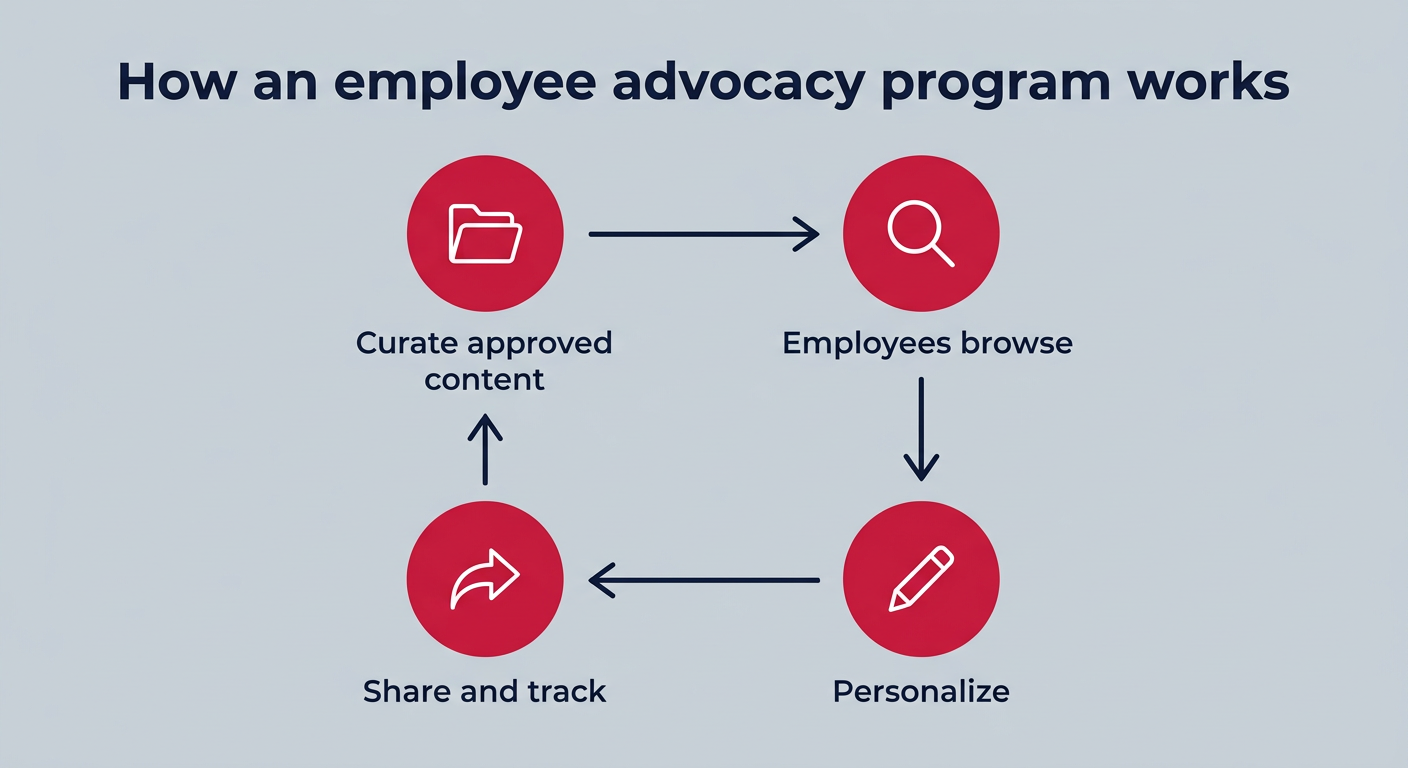
In practice, most programs run on a simple loop. The social or communications team curates approved content in one place, employees browse it, personalize it, and post it to their own networks. A platform handles the distribution and tracking so nobody has to chase down links or screenshots.
What makes employee advocacy more effective than brand channels?
Employee advocacy is more effective than brand channels because audiences trust individuals more than logos. In fact, a recent study found that 60% of consumers trust what a creator says about a brand more than what the brand says about itself.
So, when your employees speak, people pay attention.
Social algorithms know this, too. Posts from personal profiles get prioritized in feeds, which means employee-shared content often travels farther than anything from a brand page.
In short: When your employees show up online, your brand becomes a lot harder to ignore.
At Hootsuite, we’ve seen this firsthand.
Results from Hootsuite’s own advocacy program
Our own team uses Parliament to share content every single week, from thought leadership to industry news and company announcements.
Here are some results (based on Hootsuite internal data) to help put your own employee advocacy program performance into perspective:
Metric
Result
Active users
40–50% of Hootsuite employees
Average posts shared per employee
1.2 per week
Average reach per post
21,920
Average shares per post
8.8
Top-performing post reach
207,786
Top-performing post shares
115
What are the benefits of employee advocacy?
The main employee advocacy benefits are increased reach, greater credibility, easier talent attraction and retention, and a more connected company culture. Here’s how each one plays out:
- Increases reach and brand visibility: Employee-shared content gets in front of new audiences and makes your brand impossible to scroll past.
- Builds trust and credibility: A brand backed by real people feels more human and credible.
- Attracts and retains talent: Employees give job seekers an authentic look at your culture while keeping current employees more engaged.
- Strengthens company culture: Advocacy brings people together, builds belonging, and turns employees into culture ambassadors.
The payoff from employee advocacy isn’t one big win, it’s a lot of smaller ones stacking up across marketing, human resources, and culture.
How does employee advocacy increase reach and brand visibility?
When employees share content, they introduce your brand to an entirely new audience you wouldn’t reach on your own. And here’s the wild part: employee networks are, on average, 10x larger than their company’s follower base. Yep, ten times.
That’s like giving your brand a megaphone in every employee’s feed. IT solutions provider Carahsoft saw exactly that after launching Parliament by Hootsuite, with 8,700 new website visits coming from employee posts (more on that in the examples section below).
This is proof that when you hand the mic to your people, your message can travel farther.
Why do employees build more trust than branded accounts?
Employees build more trust than branded accounts because they show up as real people, not marketing messages.
When an employee shares something genuinely insightful or relatable, it doesn’t read like another corporate post. And it doesn’t feel like marketing, either. Instead, it comes across as a real conversation. Athletico Physical Therapy proved the point when they handed the mic to their therapists and trainers, growing reach by 40%.
How can advocacy help with recruitment and employer branding?
Employee advocacy helps attract top talent by giving potential hires a real look at your culture, way beyond your careers page. In fact, companies with socially engaged employees are 58% more likely to attract top talent, according to LinkedIn’s advocacy research cited above.
When employees share their experiences online, it paints a more authentic picture of your culture. It’s the kind of content that makes people think, “Hmm, I could see myself there.” Healthcare company DaVita used that approach to lift job applications from social by 27%.
Can employee advocacy strengthen company culture?
Employee advocacy can absolutely strengthen company culture. When people feel proud of their work — and trusted to share it — they become culture ambassadors. That builds pride, connection, and belonging, and it shows the world what your culture looks like in action.
There’s a feedback loop here too: sharing makes employees feel more invested, which strengthens the culture they’re showing off in the first place.
What are the benefits of employee advocacy for employees?
Employee advocacy isn’t just good for the company, it helps employees grow their own professional presence, networks, and careers. Here’s what’s in it for them:
- Greater sense of purpose and belonging: Championing work you actually believe in feels good, and it pulls employees closer to a company’s mission.
- Builds their personal brand: The more employees share their insights and expertise, the more they stand out as someone worth following.
- Expands their professional network: Showing up on social puts employees in front of the right people, and advocacy gives them a reason to connect with peers, customers, and industry leaders.
- Establishes them as thought leaders: When employees “own” a topic, people start seeing them as an authority.
When employees see advocacy as something that benefits them too, participation stops feeling like a favor to the company and starts feeling like a smart career move.
What are some employee advocacy examples that drive results?
These three employee advocacy examples show what happens when real people start sharing on behalf of the brands they work for. Each one used Parliament by Hootsuite to make sharing simple, and each one has the numbers to show for it.
Carahsoft: 8,700 website visits from employee-shared content
IT solutions provider Carahsoft saw this in real time after launching Parliament by Hootsuite. When employees started sharing partner and event content, reach exploded.
We’re talking 8,700 new website visits and up to 35% of event registrations from employee posts alone.
Athletico Physical Therapy: 40% reach growth through therapist advocacy
Athletico Physical Therapy empowered their team of therapists, athletic trainers, and recruiters to share their own stories online.
To keep things running smoothly, the team planned content around key moments (like National Physical Therapy Month) when engagement was already high. They also made it easy for their people to share brand content directly through the Parliament dashboard.
As a result, Athletico built stronger connections with their communities, boosting engagement and growing reach by 40%.
DaVita: 136% increase in LinkedIn careers page traffic
DaVita, a global healthcare company, uses employee advocacy to attract top talent.
Their recruitment and social teams teamed up to empower employees to share their experiences at DaVita — what it was like to work there, how they grew, and why it mattered. Using Parliament by Hootsuite, employees could easily post approved stories that highlighted their work.
And it worked. DaVita saw a 136% increase in traffic coming from LinkedIn to its career site and a 27% year-over-year lift in job applications from social.
How do you start an employee advocacy program?
You start an employee advocacy program by securing leadership buy-in and starting small.
Get leadership on board early to show advocacy is a real priority, not just a nice-to-have. Then rally a small group of employees who are active (or excited to be) on social media. These early advocates will help shape your program, test what works, and lead by example.
Once you’ve got leadership support and a few passionate champions, you’re ready to build momentum and roll it out company-wide.
What steps are involved in launching an employee advocacy program?
Starting an employee advocacy program comes down to setting clear goals, creating share-worthy content, and making it easy for employees to participate. Here’s what to do, step by step:
- Set goals
- Identify your employee advocates
- Curate content employees actually want to share
- Make sharing easy
- Build momentum
- Measure and grow
Step 1: Set goals
Decide what you want to get out of your employee advocacy program. Maybe it’s to expand brand awareness, attract new talent, boost engagement, or all of the above. Setting clear goals will shape what content employees should share, how success is measured, and how advocacy fits into your wider social media strategy.
Step 2: Identify your employee advocates
Employee advocacy works best when people actually want to be part of it. Look for your natural brand ambassadors. These are the people who already post on social media and bring good energy online.
Start small with this group, then expand. When people see peers leading the way, they’re more likely to jump in too.
Step 3: Curate content employees actually want to share
Those overly polished corporate posts that use words like “synergy” and “optimize”? Yeah, those won’t fly. People want real stories, not buzzwords.
Think about what would make someone proud to post. Content that spotlights your people, celebrates wins, and shows genuine behind-the-scenes moments always performs better than a polished press release.
Step 4: Make sharing easy
Starting an employee advocacy program isn’t about adding another task to everyone’s plate. The simpler it is to share, the more likely people are to join in.
This is where an employee advocacy platform like Parliament by Hootsuite comes into play. Employees can browse pre-approved posts, visuals, and links, then share to their own feeds in seconds.
And because Parliament connects with tools your teams already use — like Slack and Microsoft Teams — employees can also personalize and post content right from their daily workspace.
Step 5: Build momentum
Host a kickoff session or quick demo to show employees how it works. Encourage everyone to share their first post in the same week to create some buzz.
As your program grows, use Parliament’s leaderboard to spotlight your most active brand advocates and spark a little friendly competition between teams.
You can even sweeten the deal by offering a prize to the person or team who earns the most impressions or engagement over a set period of time.
Step 6: Measure and grow
Track participation and performance to see what resonates most. Then keep fine-tuning your approach.
Parliament makes it easy to spot your top sharers, see what content lands, and keep your program running like a well-oiled (and highly social) machine.
#1 Social Media Tool
Create. Schedule. Publish. Engage. Measure. Win.
How do you motivate employees to participate?
To motivate employees to participate in advocacy, make it simple, rewarding, and part of their daily routine.
Eileen Kwok, Former Social & Influencer Marketing Strategist at Hootsuite, has a simple but effective habit:
I’ve found that encouraging employees to begin their workday by sharing a post through Parliament helps make it a natural part of their daily routine. As a best practice, I recommend aiming for everyone to share at least one post per week to build consistent engagement.
I’ve found that encouraging employees to begin their workday by sharing a post through Parliament helps make it a natural part of their daily routine. As a best practice, I recommend aiming for everyone to share at least one post per week to build consistent engagement.
The stats speak for themselves (based on Hootsuite internal data):
- Nearly half (40–50%) of Hootsuite’s workforce are active Parliament users
- On average, they share 1.2 posts per week
When advocacy feels natural, participation follows.
What guidelines should you set for employee advocacy?
To keep employee advocacy authentic and compliant, create clear guidelines so people know what’s safe to share. This typically starts with a basic social media do’s and don’t list. For example:
Do:
- Disclose your role with the company when it’s relevant.
- Keep things positive and aligned with company values.
Don’t:
- Copy and paste content word-for-word. Personalize it to make it your own.
To make posting even easier, give employees access to pre-approved content in Parliament. It takes the stress out of posting and helps everyone show up confidently online (no more second-guessing).
In regulated industries, guidelines alone aren’t enough. Sharing confidential client or patient information can carry real legal consequences, so larger programs need governance at scale: documented approval paths, role-based permissions, and an audit trail. Vigil, the governance layer in Hootsuite Social OS, supports those governed workflows so approvals and permissions stay consistent as your program grows.
As your program grows, you may notice new needs pop up, like teams asking for extra help with storytelling or design.
That’s a good sign. It means your people want to level up. When that happens, consider offering a few extra resources to guide them, like:
- A personal branding guide
- A thought leadership guide
- A style guide for images and graphics
These tools help employees show up consistently and confidently while still keeping their authentic voice.
What types of content work best for employee advocacy?
The content that works best for employee advocacy is authentic and personal. That’s because LinkedIn is overrun with polished posts, which is exactly why authenticity wins.
“Real experiences, expert insights, and innovative marketing approaches are the types of stories people want to see more of on LinkedIn,” shares Kwok.
And when it comes to format, simple works best.
“I believe users still naturally gravitate towards what LinkedIn was originally known for, which leaned primarily into either text or image posts,” she adds.
That said, your employees have their own preferences too. Giving them the freedom to share what feels natural helps them feel confident hitting “post,” and keeps their engagement authentic. If you can, keep editing permissions flexible so employees can customize their posts in a tool like .
Should employees share brand content or create their own?
Both work, but it’s most effective when employees put their own spin on brand content.
Kwok recommends starting with ready-to-share posts from your brand, then giving employees room to make them personal on LinkedIn and elsewhere.
“To make Parliament content feel more personal, focus on small but meaningful adjustments. Write copy in the first person, give team members opportunities to customize their posts, and avoid overly rigid branding or logo-heavy visuals,” she says.
Those tweaks let people show up in their own voice, not through a corporate megaphone.
“Once employees feel more confident sharing, you can continue to encourage deeper personalization in their content,” Kwok adds.
Can employees share external or third-party content?
Absolutely, and they should. Sharing industry news, insights, and thought leadership turns your people into trusted voices, not just brand messengers. Plus, it keeps their content balanced. Not every post should feel like a promo.
Top-performing employee advocacy programs tend to pull from a mix of sources:
- Social media posts
- Company blogs
- Industry news
- Employee-generated content
- Podcast episodes
A healthy mix of brand, employee, and industry content helps employees build their personal brand and boost your company’s visibility.
How do you repurpose content for employee advocacy?
You repurpose content for employee advocacy by turning your existing social posts, blogs, and campaign assets into ready-to-share updates for your team. You don’t need to reinvent the wheel, just make use of what you already have.
With a quick refresh (like swapping a CTA for a personal takeaway), old content feels new again.
Parliament by Hootsuite makes this even easier. It curates content from multiple sources (like social posts, blogs, and videos) into one simple feed your employees can browse, personalize, and share.
Most employee advocacy challenges show up after launch, not before it. Here are the five that derail programs most often, and how to get ahead of each one.
- Participation drops off after launch: Enthusiasm spikes at kickoff, then fades. Build sharing into an existing routine (like the first five minutes of the workday) and use leaderboards or small incentives to keep it visible.
- Content fatigue sets in: If every post is a product announcement, employees stop sharing. Mix in industry news, employee stories, and third-party insights so their feeds still feel like theirs.
- Scaling beyond the pilot group stalls: What works for 15 volunteers rarely works for 1,500 people. Recruit champions in each department, localize content for different teams and regions, and lean on integrations with Slack or Microsoft Teams so people don’t have to learn a new habit.
- Compliance concerns hold people back: In regulated industries, an unapproved post can create real legal exposure. Pre-approved content, clear guidelines, and documented approval workflows remove the guesswork.
- Proving ROI to leadership is hard: Anecdotes don’t survive budget season. Track earned media value, referral traffic, and recruitment impact from day one so you can prove social’s business impact when someone asks.
None of these are dealbreakers, but ignoring them is usually what turns a promising pilot into a program nobody remembers.
How is AI changing employee advocacy in 2026?
AI is mostly changing the unglamorous parts of advocacy: finding content worth sharing, adapting it for different audiences, and spotting what’s actually working.
Instead of a social team manually building a content queue each week, AI-powered insights can surface the posts, blogs, and news items most relevant to a given team or region. AI can also help employees draft and share posts conversationally, which lowers the biggest barrier to participation: not knowing what to say.
Inside Hootsuite Social OS, Wisdom acts as the AI orchestration layer, helping teams surface contextual intelligence about what content is resonating and coordinate sharing across programs. The human judgment still matters. AI just removes the friction that keeps good programs small.
What employee advocacy tools can help scale a program?
To scale a program, look for employee advocacy tools that centralize content, automate scheduling, and measure participation all in one place. When you’re comparing platforms, these four criteria matter most:
- Ease of use: If sharing takes more than a few clicks, adoption drops. Employees should be able to find, personalize, and post content in under a minute.
- Integrations: The platform should connect to the tools your teams already live in, like Slack, Microsoft Teams, and your social accounts, so advocacy fits existing habits.
- Analytics and reporting: You need participation rates, reach, clicks, and earned media value in one view, plus the ability to export for leadership reporting.
- Governance and permissions: Role-based access, approval workflows, and an audit trail keep things safe as your program expands across teams and regions.
Parliament by Hootsuite covers all four. It curates approved content into a single feed, connects to Slack and Microsoft Teams, tracks participation and performance in real time, and gives program leaders permission controls as the program grows.
Between managing content, scheduling posts, and tracking who’s actually sharing, things can get messy fast, which is exactly the kind of friction the right platform removes.
How do you measure employee advocacy success?
You measure employee advocacy success by tying it back to the goals you set, then tracking the metrics that map to them (think: reach, recruitment results, and employee engagement).
It starts with knowing what you want out of the program. Maybe it’s growing reach, attracting talent, or building a stronger culture. Whatever the goal, it shapes what you track. Are more people discovering your brand? Are better candidates applying? Are employees more engaged?
It also helps to benchmark. Comparing your participation rate and average reach per post against industry averages (or against the Hootsuite figures shared earlier) tells you whether a 30% adoption rate is a win or a warning sign. Parliament’s analytics feed into Hootsuite Social OS reporting, so advocacy performance sits alongside the rest of your social results instead of living in its own silo.
Once you’re clear on that, dig into the specific KPIs that tell the story.
What KPIs show employee advocacy is working?
Participation metrics
- Number of active participants