Strategy
Key takeaways
- The core formula is simple: your brand mentions divided by total industry mentions, expressed as a percentage.
- Brands whose share of voice exceeds their market share tend to grow over time, which makes share of voice a leading indicator rather than a vanity metric.
- Social listening tools like Lumen in Hootsuite Social OS can support share of voice tracking across channels and competitors.
- Measuring share of voice is only half the job. Growing it comes down to consistent posting, conversation-worthy content, fast responses, smart budget decisions, and employee advocacy.
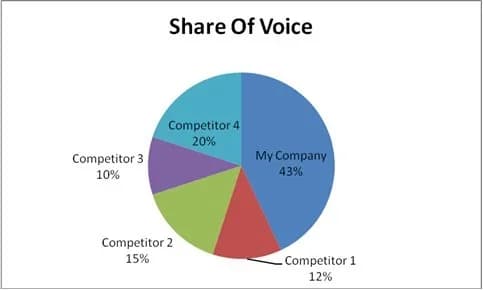
This pie chart shows how share of voice splits among four competitors.
In the past, share of voice was used to measure the success of your paid advertising. Now the definition covers overall online visibility: social media mentions, news and blog coverage, where you show up in organic search, and how often your ads appear.
It’s also more than a visibility score. Research from Les Binet and Peter Field, published by the IPA in The Long and the Short of It, popularised the idea of “excess share of voice,” which holds that when a brand’s share of voice is higher than its share of market, the brand tends to gain market share over time. The reverse is also true. That relationship is why marketing leaders treat share of voice as an early signal of where the business is heading, not just a snapshot of who is loudest.
In short: share of voice tells you what percentage of the total conversation in your category belongs to you.
What about social share of voice?
Social share of voice is a way to measure how much people are talking about your brand on social media. It’s usually measured as a percentage of total mentions within an industry or among a defined group of competitors.
In other words, traditional share of voice tracks what brands say about themselves, and social share of voice tracks what people say about brands. You can also think of it as when social listening meets competitive analysis.
For example, if your brand sells running shoes, you should expect to show up in conversations about running, running shoes, and sneakers. Share of voice will give you an idea of how often your brand comes up compared to other brands in the same space.
Understanding your social share of voice puts all of your other social media analytics into context.
The useful part is the gap between them. Share of voice moves first, share of market follows. If your share of voice is well above your share of market, you’re building the kind of awareness that usually converts into sales later. If it’s below, competitors are buying attention you’ll likely have to win back at a higher cost.
Dimension
What it measures
Brand visibility and conversation volume
Percentage of category sales or revenue
Data source
Social mentions, media coverage, search visibility, ad impressions
Sales data, revenue reporting, industry market research
Indicator type
Leading
Lagging
Example metric
22% of all industry mentions last quarter
14% of category revenue last quarter
Channels it applies to
Social, organic search, paid search, earned media
Whole business
How often to review
Weekly or monthly
Quarterly or annually
Track both together. Share of voice tells you whether your marketing is working; share of market tells you whether it paid off.
Tracking share of voice helps you understand how visible your brand really is, and a higher share usually travels alongside stronger brand awareness and sales. Here’s what measuring it gives you:
- Competitive analysis: See how you stack up against rivals, not just against your own past performance
- Budget and resource allocation: Put money where your visibility gap is widest
- Campaign effectiveness: Benchmark before and after a launch to see if it landed
- Customer engagement and sentiment: Understand not only how often you’re mentioned, but how people feel about you
How does share of voice provide competitive advantage?
Real-time listening makes that useful rather than academic. If a competitor’s share spikes in a single week, you can usually trace it back to a specific launch, partnership, or PR moment, then decide whether to respond, counter-program, or leave it alone.
How does share of voice help with budget allocation?
From there, the spending decision gets easier. Channels where you’re already strong often need less paid support, while channels where competitors dominate may need creative investment, community management, or a different content format altogether.
How does share of voice measure campaign effectiveness?
Record your share of voice in the weeks before a campaign launches so you have a clean baseline, then compare it against the weeks after. That single comparison is often more persuasive to leadership than impression counts.
How does share of voice relate to customer engagement and sentiment?
Tracking and measuring share of voice can also help you attribute value to social media efforts in terms of leads, customers, and conversions. That data is what you take into budget conversations when you need to secure spend or make the case for more resources.
The share of voice formula is the same no matter which channel you’re measuring. Only the inputs change.
Your brand mentions / total industry mentions x 100 = share of voice
Here’s a worked example. If your brand received 2,000 mentions last month and total mentions across you and your competitors came to 10,000, your share of voice is 20%. Swap “mentions” for impressions, clicks, ranking visibility, or article counts and the math holds.
How to calculate share of voice
Before you calculate anything, decide two things: which competitors count as your set, and which keywords define your category. A set that’s too broad will flatten your numbers; one that’s too narrow will flatter them. Keep both consistent so your month-over-month comparisons mean something.
If you’re calculating this for social, you can gather the data using Hootsuite’s listening tools. They pull mentions from a range of platforms, including X, Facebook, Instagram, TikTok, YouTube, and more.
Once you have a dataset of all industry mentions, try segmenting it to get unique insights. For instance, you could segment mentions by location to see how your brand stacks up against competitors in different regions.
You can also apply other demographic filters, such as gender, age, or occupation. This can help you see if you have a larger social share of voice among one particular group. Use those insights to tailor content where you’re behind.
Analyzing social share of voice by sentiment and topic is also important. Your brand may have a high social share of voice, but if people aren’t saying good things, you’ll want to address that.
How do you measure social media share of voice?
You measure social media share of voice by tracking everything people say about your brand and your competitors on social platforms. This metric shows how well you’re connecting with your audience and participating in the conversations that matter to them.
To set up social share of voice tracking:
- List your brand name plus common misspellings, product names, and branded hashtags
- Do the same for three to five direct competitors
- Add the category keywords your buyers actually use, like “running shoes” or “project management software”
- Set a consistent time window, usually monthly, and exclude your own owned posts so you’re measuring earned conversation
- Layer in sentiment and topic filters once the baseline is stable
Setting up social share of voice tracking
A high social media share of voice can help you:
- Win new customers
- Increase brand awareness
- Boost sales
Use Hootsuite to compare your brand’s social media share of voice to that of your competitors.
This graph compares media share of voice among major global airlines.
How do you measure share of voice for SEO?
To calculate it, you’ll need a list of relevant industry keywords. Focus on the terms your buyers search before they know which brand to pick, plus the keywords tied directly to your product or service. A tracked set of 100 to 300 commercially relevant keywords is usually enough to see real movement.
You can use share of voice tools like Ahrefs’ Rank Tracker to compare your website’s visibility on these keywords to that of your competitors. The Competitors tab will show you how often your website is shown in search engine results pages (SERPs) compared to your competition.
Read the trend line, not the daily number. If your SEO share of voice climbs while your organic traffic stays flat, the issue is usually titles and snippets rather than rankings.
A high share of voice on organic search can help you:
- Attract more website visitors
- Get more leads and sales from your website
- Build brand awareness and equity
How do you measure share of voice for PPC?
For example, a 50% impression share means your ad appeared half as often as it was eligible to appear. The missing half is usually lost to budget or to ad rank, and Google splits that out for you so you know which lever to pull.
If you want to find your paid advertising share of voice, go to your Google Ads account, open Campaigns, then choose Columns from the top of the table.
The Columns button sits at the top of the campaign table in Google Ads.
Choose Competitive metrics, then select the impression share columns you want to track. Search impression share, search lost impression share (budget), and search lost impression share (rank) are the three worth watching together.
The Competitive metrics tab lets you add the impression share columns to your report.
Improving your PPC share of voice can help you:
- Get more clicks and impressions
- Improve your Quality Score
- Lower your CPC
How do you measure share of voice for media?
Your media share of voice is the number of times your brand is mentioned across news websites and blogs. For example, if your brand is mentioned in 40 articles and total industry mentions come to 100 articles, you have a 40% share of voice for that period.
Social listening tools double as share of voice tools here. Lumen, the insights and listening app inside Hootsuite Social OS, monitors news sites and blogs alongside social platforms, so you can set up searches for your brand mentions and competitor names and watch how the split changes over time. If you want a walkthrough of building searches, Hootsuite Academy’s social listening course covers the fundamentals.
Weight your results by publication reach rather than treating every mention equally. Twenty mentions in trade press often matter more to a B2B brand than two hundred in aggregator blogs.
Understanding your media share of voice can help you:
- Build relationships with key publications
- Generate earned media coverage
- Improve your SEO
Most teams use two or three tools to measure share of voice, because no single tool covers every channel. Here’s what to use where.
- Social listening platforms: Lumen in Hootsuite Social OS tracks brand and competitor mentions across social platforms, news sites, blogs, forums, and review sites, then breaks the results down by share of voice, sentiment, and topic. Listening is available on the Enterprise plan.
- SEO visibility tools: Ahrefs Rank Tracker and Semrush both calculate organic share of voice from tracked keyword rankings, weighted by search volume.
- Paid search reporting: Google Ads has impression share built in, with no extra tooling needed. Microsoft Advertising reports the same metric for Bing.
- Media monitoring: Dedicated PR monitoring tools track article-level coverage and publication reach, which is useful if earned media is a major channel for you.
If you only have budget for one, start with social listening. It covers the widest range of sources and gives you sentiment alongside volume, which the other categories generally don’t.
Once you have a good understanding of how your brand stacks up, you can focus on improving. Six tactics do most of the work:
- Maintain an active presence
- Spark conversations
- Create shareable content
- Respond to customers
- Allocate budget strategically
- Invest in employee advocacy
1. Maintain an active presence
A tried and true way to earn your brand’s piece of the pie is to stay active on all your social media channels. Customers will be more likely to reach out and engage if they know someone is there.
A good first step is to create a social media content calendar. Many important dates have higher social traction, and you don’t want to miss out. Use the calendar to make sure you have content ready when you need it and don’t end up repeatedly posting the same thing.
As well, try to post at times when your audience is most active on each network. This will ensure your content gets the greatest reach and potential pick-up.
Accounts known for consistent, in-the-moment posting, like Merriam-Webster on X, show what reliability buys you: people start tagging the brand in conversations it didn’t even start.
2. Spark conversations
Since social share of voice represents brand mentions, giving people a reason to talk is one of the fastest ways to move the number.
Taking a firm stand on a topic your audience cares about will reliably lift mentions. Nike’s partnership with Colin Kaepernick and Gillette’s #TheBestMenCanBe campaign are still the textbook examples, and both show the trade-off: a large share of voice gain alongside polarised sentiment. Decide which of those two numbers you’re optimising for before you publish.
Brands don’t have to go near controversy to spark conversation, though. Bell’s annual Let’s Talk campaign has positioned the telecommunications company as a leader in the mental health conversation for well over a decade, generating a predictable annual spike in mentions.
Simpler prompts work too. Question posts, polls, and open calls for ideas cost nothing and routinely out-perform polished brand announcements on reply volume. Fenty Beauty launched with 40 foundation shades, turning a product fact into an invitation for customers to talk about their own match. Asking your community what to build next tends to do the same.
3. Create shareable content
Another good way to increase social share of voice is to post content that people will want to share. The more original or meme-worthy, the better.
Three formats do the heavy lifting right now:
- Short-form video: A strong format for shares and re-posts across TikTok, Reels, and Shorts
- Carousels: Strong on LinkedIn and Instagram for saves and sends, which extend reach quietly
- Interactive posts: Polls, quizzes, and “pick one” formats invite a reply rather than a scroll
Brands with a distinctive voice, like Netflix’s regional accounts or No Name’s deliberately plain product posts, get shared because the content is recognisable without the logo. That recognisability is what turns one post into hundreds of mentions.
4. Respond to customers
Joining conversations about your brand is a good way to build customer relationships and make them feel good about your company.
Showing empathy and a touch of humanity can also go a long way. A Harvard Business Review study of airline accounts on Twitter found that when a customer service agent added their name or initials in their first reply, a customer’s willingness to pay for a future flight on that airline increased by $14 compared to those who received an unsigned response.
Speed matters as much as tone, which is where AI-assisted replies help. Hootsuite’s inbox can draft suggested responses and route conversations to the right person, so a growing mention volume doesn’t turn into a growing backlog.
5. Allocate budget strategically
For example, if your voice is thin on X but healthy on Instagram, that might mean setting up a dedicated X profile for support questions rather than pouring ad spend into a channel where nobody is talking about you yet.
Having an informed social media strategy will allow you to focus on growing your share of voice where you need it the most.
Remember: social share of voice is ultimately about tracking conversations, and conversations inspire conversions. Plus, not all conversations take place on social media. Many happen in DMs, private channels, and offline, where they can’t be counted. So don’t rely on social share of voice alone to determine your success against your competitors.
It’s also important to measure what people say against what people do. Track social share of voice alongside other metrics that matter to your business.
6. Invest in employee advocacy
Employee advocacy is the quietest lever on this list and often the most effective. When your team shares company content from their own profiles, it reaches networks your brand account never touches. Employees hold roughly 10x more connections than a company page has followers, and the content arrives from a person rather than a logo.
To build a program that actually moves share of voice:
- Give employees a ready-made library of posts, with suggested copy they can edit in their own words
- Focus on the people closest to customers, like sales, support, and recruiting
- Make sharing optional and easy, and set clear guidelines on what can and can’t be posted
- Measure the lift by tracking mentions and reach attributed to employee shares, then compare it against your brand-only baseline, since personal profiles generate 63% higher engagement than company pages
Parliament, the employee advocacy app in Hootsuite Social OS, handles the distribution and governance side of this: curated content for employees to share, plus reporting on reach and engagement so you can see the contribution to your overall share of voice.
Hootsuite Social OS brings share of voice measurement and the work of growing it into one connected system, so the insight and the action don’t live in separate tools.
- Lumen: The insights and listening app that tracks your brand and competitor mentions across social platforms, news, blogs, forums, and review sites, with share of voice, sentiment, and topic breakdowns
- Perch: Helps you keep the consistent publishing cadence that share of voice depends on, including scheduling and best times to post
- Parliament: Extends reach through employee advocacy, with curated content and reporting on what your team’s shares contribute
- Wisdom: Lets you ask questions about your data in plain language, so you can check how your share of voice shifted after a campaign without building a report
Lumen is available on the Enterprise plan. Standard starts at $99 per user per month and Advanced at $249 per user per month, both of which include competitor benchmarking if you want a lighter starting point.
Frequently asked questions
How do you define share of voice?
How do you calculate share of voice?
You calculate share of voice by dividing your brand’s mentions (or impressions, clicks, or rankings) by the total across all competitors, then multiplying by 100 to get a percentage. For example, 2,000 brand mentions out of 10,000 total industry mentions equals a 20% share of voice.
What does 50% share of voice mean?
A 50% share of voice means your brand accounts for half of all the visibility, mentions, or impressions in your market or competitive set. In paid search, it means your ads appeared half as often as they were eligible to appear.
How do you check share of voice?
You can check share of voice using social listening tools like Lumen in Hootsuite Social OS, SEO tools like Ahrefs Rank Tracker, or the impression share columns in Google Ads for paid search. Most teams combine two or three, since no single tool covers every channel.
What is the difference between share of voice and share of market?
The difference between share of voice and share of market is that share of voice measures brand visibility and conversation volume, while share of market measures the percentage of actual sales or revenue a brand holds in its category. Share of voice is a leading indicator and share of market is a lagging one, which is why tracking both together is more useful than tracking either alone.
What is a good share of voice percentage?
A good share of voice percentage depends on your industry and the size of your competitive set, but the more useful benchmark is your own share of market. If your share of voice sits above it, you’re generally positioned to grow.
How often should you measure share of voice?
You should measure share of voice monthly, with more frequent checks during campaigns, product launches, or competitive shifts. Monthly gives you enough volume to spot real trends without reacting to normal week-to-week noise.
Can share of voice predict market share growth?
Yes, share of voice can act as a predictor of market share growth. Research by Les Binet and Peter Field, published by the IPA, popularised the “excess share of voice” principle, which holds that brands with a share of voice higher than their share of market tend to gain market share over time.
What is the best tool for measuring share of voice?
The best tool for measuring share of voice depends on the channel. For social and earned media, a listening platform like Lumen tracks mentions, sentiment, and competitor comparisons in one place; for organic search, use a rank tracker; for paid, Google Ads reports impression share natively.
Does share of voice include paid media?
Yes, share of voice includes paid media, where it’s typically measured as impression share. That figure shows how often your ads appeared compared to the total impressions available for your keywords, along with how much you lost to budget versus ad rank.
Save time managing your social media marketing strategy with Hootsuite. Publish and schedule posts, find relevant conversions, measure results, and more â all from one dashboard. Try it free today.
The #1 social media tool
Create. Schedule. Publish. Engage. Measure. Win.
Hannah Macready is a freelance writer with 12 years of experience in social media and digital marketing. Her work has appeared in publications such as Fast Company and The Globe & Mail, and has been used in global social media campaigns for brands like Grosvenor Americas and Intuit Mailchimp. In her spare time, Hannah likes exploring the outdoors with her two dogs, Soup and Salad.
The #1 social media tool
Create. Schedule. Publish. Engage. Measure. Win.