As Liebherr continues to advance toward software‑defined, virtualized, and safety‑critical systems, embedded software plays an increasingly strategic role across its product portfolio. From excavators and cranes to fully connected industrial platforms, the evolution of control systems is reshaping how engineering teams design, validate, and deploy complex applications.
In this interview, Tobias Knostmann, who is responsible for graphical design environments for embedded software at Liebherr, shares insights into the company’s journey from mechanical control systems to Industry 4.0-ready, virtualized architectures. He reflects on how the Ansys SCADE embedded software product collection transformed the embedded software development culture at Liebherr, why the transition to the Ansys Scade One model-based embedded software development solution is a natural next step, and how modular architectures, application programming interfaces (APIs), and hardware abstraction layers are enabling long‑term scalability. He also offers a forward‑looking perspective on the role of artificial intelligence (AI) and model generation in the future of safety‑critical software development.
Can you introduce yourself and your role at Liebherr?
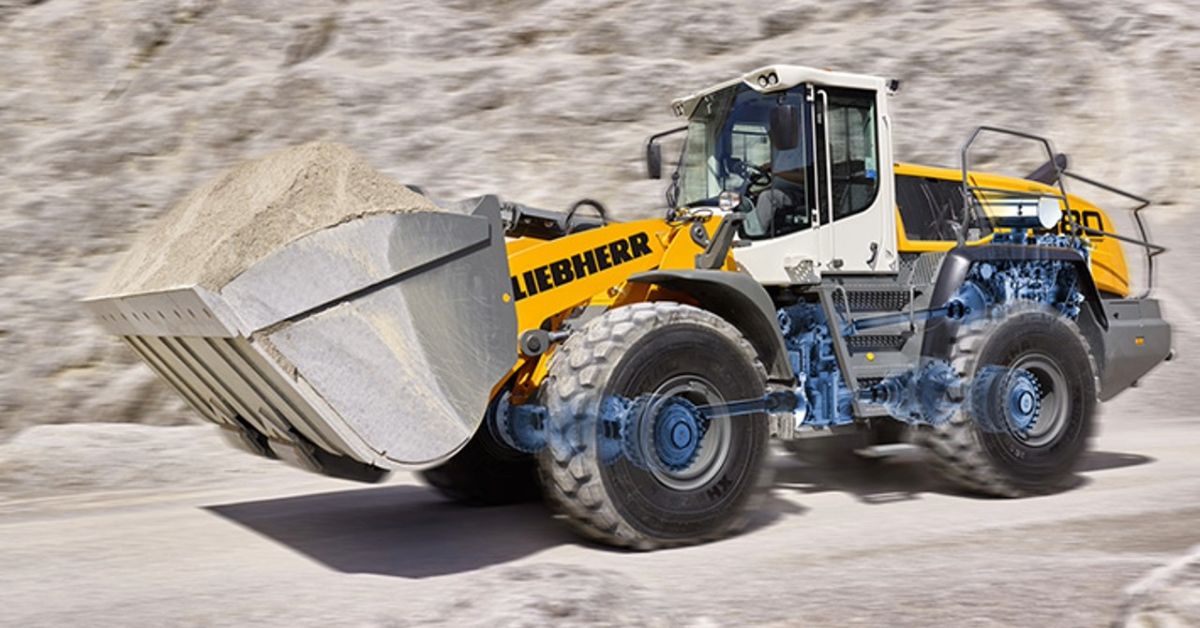
My name is Tobias Knostmann. I work at Liebherr in a department that provides control systems to our internal customers, such as the Earthmoving and Cranes divisions. Specifically, I am responsible for graphical design environments for embedded software.
How has Liebherr evolved toward virtualized applications?
Liebherr is a company with a long history. The company started in the 1950s with purely mechanical systems, which were obviously quite simple from a control perspective. Over time, Liebherr has gone through the full evolution of control systems — from programmable logic controllers (PLCs) to more complex microcontroller-based systems — and is now entering the era of what we call Industry 4.0. This involves heavily connected systems, compartmentalized across different domains, and an evolution toward fully virtualized environments that allow applications to be developed independently from one another.
How did SCADE software transform embedded software development at Liebherr?
The introduction of SCADE software was a total game changer for the way Liebherr develops embedded software. For the first time, we introduced an entirely new paradigm for software development across multiple departments. Before that, development was quite segregated, with each department following its own style.
This represented a huge cultural change in how software is developed at Liebherr. From a technical perspective, it allowed us to move from very simple control mechanisms — previously implemented mainly on PLCs — to much more complex embedded software algorithms. It also enabled the creation of modular applications, giving us far greater freedom in terms of reusability and exchangeability of software modules across departments. Overall, it was truly a game changer for us.
How will the migration from SCADE “classic” to Scade One software support operations in the future?
Regarding the impact of Scade One software, this is clearly a forward-looking topic for us. We are currently evaluating Scade One software as a good successor to SCADE software. The good news is that not much will change in the foreseeable future because the fundamental approach remains the same. We really appreciate the stability that this evolution of the tooling provides.
That said, the increasing complexity of our application software has also meant that the graphical designs we relied on in SCADE software have reached a certain ceiling. Scade One software allows us to overcome that ceiling and move toward even more complex designs simply because it enables simpler and more expressive graphical modeling of software.
The API introduced with Scade One software is also much more capable than what SCADE software offers. This allows our middleware to evolve as well, both in terms of complexity and in what we can provide to users through automation. Overall, it is a very positive step for us.
How does the hardware abstraction layer, plus SCADE architecture, support future modular applications?
The concept of having a hardware abstraction layer with a SCADE application on top is essentially enforced by using SCADE software — it’s the core paradigm. This is a given when using a SCADE-based approach. What this gives us is the ability to support any hardware generation we currently have or even virtualized environments we may adopt in the future.
More importantly, it allows us to preserve our core knowledge and intellectual property, which reside in the SCADE models. Those models can be transferred to new environments with minimal changes, ensuring that the real value we deliver through our software algorithms remains intact across multiple generations of hardware.
In short, the impact of moving from current or past platforms to future ones is basically zero when using this approach, where the application layer is clearly separated from the hardware abstraction layer, as mandated by SCADE software.
What future trends will influence and support Scade One software in the future?
If we look at the impact that the AI wave may have on an industry like ours — one that is strongly focused on stability rather than rapid innovation due to safety-critical requirements — it’s a very interesting area. What we are particularly interested in — and what we see Scade One software enabling — is the generation of models from high-level requirements.
The Scade One language is relatively simplified in terms of its internal structure, which makes it well suited for model generation. In fact, it is quite approachable for large language models to generate such models. As a result, we see significant potential in coupling AI with model generation, and we are confident that Scade One software will be able to deliver on this promise in the future.
Discover what Ansys, part of Synopsys, and Scade One software can do for your teams. Request a personalized Scade One demo to see how model‑based design helps develop, validate, and scale embedded software with confidence.