What do solar sails, vertical takeoff and landing (VTOL) aircraft, and nanosatellites with agricultural applications have in common? Behind each innovation is a team using simulation to turn ambitious ideas into functional designs that can accelerate progress in aerospace.
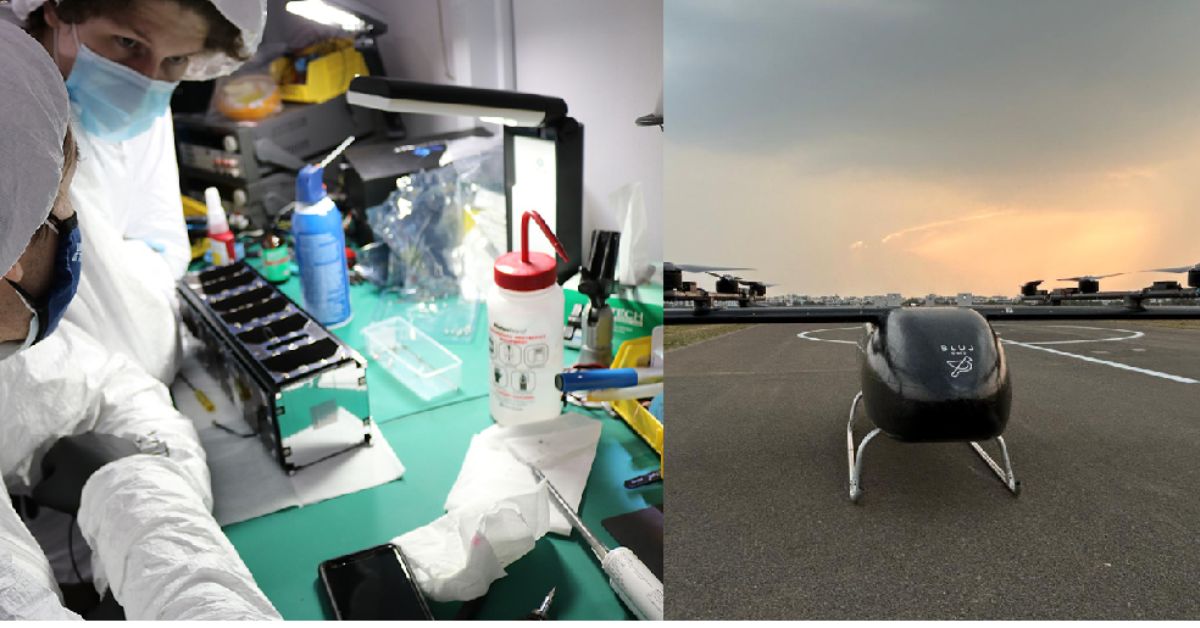
Let’s start with BluJ Aero, which is dedicated to making aviation simple and sustainable through its novel electric and hydrogen-electric VTOL aircraft. As part of this work, BluJ focuses on designing modular and sustainable heavy-payload architectures.
“We are proving that unmanned logistics can operate cleanly and efficiently right now,” shares Utham Kumar Dharmapuri, co-founder and CTO of BluJ. With applications in a variety of industries, BluJ shows the “untapped versatility of the advanced air mobility (AAM) sector,” he says.
The BluJ vertical takeoff and landing (VTOL) in flight.
Moving from cityscapes to the stars, Imperial College London’s Project Svarog aims to be the first student team to develop a spacecraft capable of leaving the solar system. To achieve this goal, the team focuses on solar sail technology.
Project Svarog helps advance aerospace by providing “a platform for students to gain experience on a real aerospace engineering team,” says Matthew Acevski, Project Svarog’s mission leader. This includes invaluable experience that supports finding jobs and internships in the field, as well as publishing team research in academic journals.
The University of Toronto Aerospace Team (UTAT) Space Systems group is also empowering the next generation of students via their Field Imaging Nanosatellite for Crop residue Hyperspectral mapping (FINCH) project.
“Teaching new students about various aspects of satellite and aerospace engineering is what UTAT Space Systems does best,” says Iliya Shofman, chief payload engineer at UTAT Space Systems. This group is focused on developing their nanosatellite and eventually hosting their own hyperspectral imaging payload in addition to a secondary payload from an academic research partner.
Despite their differences, all three groups face a similar challenge: achieving demanding technical goals while managing cost and time constraints. By integrating simulation solutions from Ansys, part of Synopsys, into their development processes, startups and student teams are optimizing complex designs, reducing costly prototypes, and preparing the next generation of aerospace technology and talent.
Three Ways That Simulation Helps Aerospace Innovators Redefine the Future
1. Optimizing the Mechanical Design Process
The mechanical subteam at Project Svarog relies on “Ansys simulation solutions for every step of the design process,” says Acevski. This includes using simulation to determine mechanical hardware reliability, which will help them become one of the first student teams with a solar sail demonstrator, before moving on to the manufacturing and launch stages.
Specifically, the team used Ansys Mechanical structural finite element analysis software, Ansys Composite PrepPost (ACP) software, and Ansys Discovery 3D product simulation software to build lightweight and deployable custom composite carbon fiber booms for solar sail deployment. The work involved using Ansys solutions to model booms and determine optimal prepreg layers (ready-made composite sheets), relative orientations for the load cases, and whether the cured layup would be sufficient for the loading the booms would experience on launch and deployment.
As a result, the team was able to develop booms that “are a fraction of the weight of our previous spring steel design, with a comparable strength ratio,” says Acevski. “These booms also allow for closer packing, allowing longer booms and hence larger sails in the same CubeSat volume, and haven’t been demonstrated by any other student teams. Hence, Ansys (software) has been instrumental in helping us push the boundaries of lightweight deployable space technology, especially as a student team with limited resources.”
Not only were these simulation solutions helpful during the early boom design cycle, Acevski mentions that Ansys solutions can also be used to validate booms after they have been manufactured for testing.
Project Svarog’s analysis of carbon-composite booms in Ansys Mechanical structural finite element analysis software.
Project Svarog also used Ansys solutions for essential prelaunch tests. “Being able to verify a lot of the load-related tests beforehand using Ansys (software) really took the stress out of these tests, no pun intended, as we could know beforehand how likely our chassis was to withstand the shock or load and make adjustments accordingly,” says Acevski. “In the end, our CubeSat passed all the tests with a great safety factor.”
2. Performing Complex Multiphysics Analyses
BluJ uses “Ansys simulation tools to tackle highly complex, multiscale challenges that would otherwise require prohibitive amounts of physical prototyping and time,” explains Dharmapuri.
For example, take the process of designing BluJ’s Type IV hydrogen storage tanks. This “presents the challenge of optimizing the composite overwrap for high-pressure containment and minimum weight while accurately capturing the complex stress distribution and interactions between the liner, composite layers, and polar boss regions,” Dharmapuri says.
To help tackle this challenge, BluJ used ACP software to design its Type IV composite pressure vessels for hydrogen storage. “Because certifying and operating these tanks is a demanding multiphysics challenge, we used Ansys structural simulation software to solve our models seamlessly,” he says. “To push the boundaries of our design, we performed a complete structural and progressive failure analysis on the composite pressure vessel to predict its maximum pressure capacity and specific failure points.”
BluJ burst test
After that, the BluJ team ran a hydrostatic burst test on a physical prototype and found that the real-world results closely aligned with its Ansys predictions. “Achieving this tight correlation between our virtual analysis and the physical burst test gives us the immense confidence needed to optimize our tanks for both maximum weight savings and uncompromising safety without relying on endless physical iterations,” he adds.
Of course, this is only one example of how BluJ applies simulation solutions to its work. Other applications include using Ansys Fluent fluid simulation software to build out certification-grade aerodynamic studies and evaluate aerodynamic loads to ensure that BluJ’s structural integrity holds up under dynamic, multivariable physical conditions.
3. Designing Compact Space-Rated Lenses
Working with nanosatellites is not an easy task. For instance, at UTAT Space Systems, while the team’s small satellite platforms enable rapid revisit times, they also struggle to achieve the spatial resolution level of large satellite missions.
“To overcome this, we’ve developed a monolithic catadioptric lens that folds the optical path in order to achieve long focal length, and hence a fine spatial resolution, in a limited volume,” says Shofman. “The innovation in this work was enabled by using Ansys Zemax OpticStudio optical system design and analysis software for lens design and optimization.”
To learn more about this work, which was recently presented at the SPIE Optics and Photonics 2026 conference, read the paper “Design of a Compact Monolithic Catadioptric Lens for CubeSat.”
A ray-tracing diagram of the optical payload (top), and the spot size diagram after optimization (bottom left) and tolerancing (bottom right).
This is only one of the Ansys solutions the team has used to, as Shofman says, “find innovative solutions for our application.” Others include Ansys HFSS high-frequency electromagnetic simulation software, Ansys Systems Tool Kit (STK) digital mission engineering software, Ansys Thermal Desktop thermal-centric modeling software, and Mechanical software. In addition, the team is exploring using Synopsys’ FPGA-based design solutions.
“We continue to rely on Ansys simulation software on a near-daily basis for our engineering design and teaching work,” Shofman adds.
Exploring the Benefits of the Ansys Startup Program and an Ansys Student Team Partnership
None of the innovative groups featured in this article had to approach their simulation journey alone. Like other emerging aerospace innovators, these groups leveraged support through either the Ansys Startup Program or an Ansys Student Team Partnership to help them achieve success.
For BluJ, the Ansys Startup Program helped the team rapidly iterate on complex designs and validate concepts before committing to costly physical development. As Dharmapuri explains, “the Ansys Startup Program remains an absolute necessity for our workflow.”
For the UTAT Space Systems team, simulation tools support both project development and student learning. According to Shofman, working with industry-standard technology and having access to an Ansys Student Team Partnership helps students strengthen their engineering skills while gaining practical experience they can carry into future careers.
At Project Svarog, this collaboration will help to consistently integrate simulation into the design process. “This will give Project Svarog a much stronger verification workflow, and it will give our team real experience with industry-standard tools ahead of our low Earth orbit (LEO) launch,” says Acevski.
What’s Next for These Aerospace Innovators
These innovators have already made great progress in their respective areas and they’re showing no signs of stopping.
For Project Svarog, success has not been without challenge. Although the Balloon Experiments for University Students (BEXUS) launch in October 2025 failed, the team has pivoted to a new approach and continues to make progress toward their goals, including a second attempt at launching their CubeSat with BEXUS. As Acevski puts it, ingenuity and being able to pivot and find a “quirky but reliable end solution” is part of the beauty of student projects.
Recent progress has been defined by developing their next LEO launch test, mission plan document, and core LEO team. Continued growth in the upcoming year will involve completing feasibility and system requirements for the launch as well as developing a functional demonstration of a FlatSat — a satellite distributed flat across a lab bench or tabletop for testing. Here, Ansys simulation solutions will assist with space-grade hardware development for their integrated systems and standardizing their process for manufacturing composite boom sections. Through simulation, the team will be able to “fine-tune the boom laminate and geometry while cutting down on the number of expensive physical prototypes we need to make,” Acevski explains. The team also plans to combine thermal and structural analyses ahead of their LEO mission.
For BluJ, they have now successfully completed the first flight of their second-generation aircraft, the proto-LITE. “Seeing the proto-LITE aircraft achieve a flawless first flight was a massive win for the entire team,” says Dharmapuri. “Equally significant on the engineering side was finalizing the Iron Bird testing for our second-generation architecture, which confidently validated our electrical and propulsion integration at full scale.”
Looking ahead, BluJ plans to work on heavier payload goals and continue using the high-fidelity engineering data generated by Ansys solutions to summarize and quantify its engineering manpower and structural safety margins for certification and compliance. “Our business momentum is matching our engineering strides,” says Dharmapuri. “We are working toward a commercial pilot with our customer and are also in advanced talks to close our fundraise.”
As for UTAT Space Systems, they have substantially expanded their team and developed a coordinated organizational structure that will support seamless knowledge transfer between students. In doing so, UTAT Space Systems will be able to more efficiently develop their nanosatellite hyperspectral imaging payload and de-risk their mission while forming key partnerships with other student teams and the Canadian Space Agency (CSA). Through this work, UTAT Space Systems is expecting a 2030 launch.
These groups show how emerging aerospace teams are proving that ambitious ideas do not require unlimited resources. They require the right solutions, a willingness to iterate, and the confidence to test what once seemed impossible.
Whether you're launching a startup or leading a student team, access to the right simulation technology can help turn ambitious ideas into reality. Learn more about the Ansys Startup Program or Ansys Student Team Partnerships to see how simulation can support your next breakthrough.
Just for you. We have some additional resources you may enjoy.
TAKE A LOOK
“Simulation must be your foundation for design. You simply cannot rely solely on physical testing to uncover structural flaws or aerodynamic inefficiencies. Ground your designs in mathematical modeling early, validate your control laws virtually, and let the software handle the heavy lifting of initial trial-and-error.”
— Utham Kumar Dharmapuri, co-founder and CTO of BluJ