Artificial intelligence (AI) research spans two areas: the published findings of AI researchers and the practical application of AI to help with research across different domains.
The first section of this article is a timeline of major AI research milestones. It also includes the most important recent papers and a rundown of the institutions at the forefront of the field.
The second is a step-by-step guide to using AI as a research tool effectively, with a ranking of the best tools and an honest breakdown of the pros and cons.
A timeline of major AI research papers and milestones
It’s practically impossible to map out all the important AI research papers published so far. The field has grown at an unprecedented rate in the last decade. According to the 2026 AI Index report from Stanford University, 257,890 AI publications were published worldwide in 2024 alone.
However, there are several historical foundational milestones, along with a number of highly important recent publications.
A concise timeline: 12 foundational AI research papers
- 1943: McCulloch and Pitts publish “A Logical Calculus of the Ideas Immanent in Nervous Activity,” in which they present the first mathematical model of how a nervous system works. The model treats neurons as functions that receive inputs and produce outputs according to logical rules.
- 1950: Alan Turing publishes “Computing Machinery and Intelligence” in the journal Mind. The paper introduces the imitation game (commonly called the Turing Test) as a way to define machine intelligence.
- 1956: The Dartmouth Summer Research Project, the “Dartmouth workshop,” formally establishes artificial intelligence as a research field. The original 1955 proposal was reproduced in AI Magazine in 2006.
- 1958: Frank Rosenblatt publishes “The perceptron: a probabilistic model for information storage and organization in the brain.” He presents a foundational learning model based on a “hypothetical nervous system called a perceptron.”
- 1986: Rumelhart, Hinton, and Williams publish “Learning representations by back-propagating errors” in Nature. They outline an algorithmic method called backpropagation for training multilayer neural networks. The method refined how parameters are adjusted.
- 1997: Hochreiter and Schmidhuber publish “Long Short-Term Memory” in Neural Computation. It describes a neural network architecture that allows for information to be retained (by the network) over much longer periods.
- 2009: Researchers publish “ImageNet: A large-scale hierarchical image database,” formally introducing ImageNet, a database of millions of labeled images for training and evaluating AI systems.
- 2014: Ian Goodfellow and colleagues publish “Generative Adversarial Nets.” It outlines a framework that enables AI systems to generate realistic content, particularly images.
- 2016: DeepMind researchers publish “Mastering the game of Go with deep neural networks and tree search” in Nature. AlphaGo, the artificial intelligence system presented in the paper, goes on to beat Lee Sedol, a top professional Go player.
- 2017: Google researchers publish “Attention Is All You Need,” which lays out the transformer architecture that underpins most modern large language models today.
- 2020: OpenAI researchers publish “Language Models Are Few-Shot Learners.” They prove that scaling language models (increasing the size of foundational components without changing code) improves their ability to perform an array of tasks effectively.
- 2022: OpenAI launches ChatGPT on 30 November, bringing conversational generative AI into widespread use.
Six important recent AI research developments (2025–2026)
- 2025: Deepseek researchers publish “DeepSeek-R1: Incentivizing Reasoning Capability in LLMs via Reinforcement Learning.” It demonstrates that advanced reasoning capabilities can emerge from reinforcement learning (RL).
- 2025: Researchers publish “s1: Simple Test-Time Scaling.” It shows that it’s possible to improve reasoning performance using relatively modest training resources.
- 2025: Google DeepMind researchers publish “AlphaEvolve: A coding agent for scientific and algorithmic discovery.” AlphaEvolve is a Gemini-powered system that autonomously develops and improves complex algorithms.
- 2025: Google DeepMind announces Genie 3, a world model capable of generating navigable virtual environments.
- 2026: Google DeepMind researchers publish “Advancing regulatory variant effect prediction with AlphaGenome” in Nature. It introduces AlphaGenome, an AI model that predicts how changes in DNA sequences affect gene functioning, and is expected to have significant medical applications.
- 2026: Researchers publish “Accelerating scientific discovery with Co-Scientist” in Nature. The paper presents a multi-agent AI system that can generate and refine scientific hypotheses to help scientists “discover new original knowledge.”
An overview of the main AI research institutions
Research outputs are spread across a wide range of corporate and public organizations. Dedicated research institutes, many of which are associated with top universities, account for a large portion of new research. However, corporations and their associated AI labs play an important part.
Corporate AI laboratories
AI-focused companies
Google DeepMind
Microsoft Research
Meta AI (FAIR)
NVIDIA Research
IBM Research
OpenAI
Anthropic
DeepSeek
Mistral AI
SpaceXAI
University research centers
Independent research institutes
Stanford University (SAIL)
MIT (CSAIL)
Carnegie Mellon University
UC Berkeley (BAIR)
Tsinghua University
Allen Institute for AI (Ai2)
The Alan Turing Institute
Mila (Quebec Artificial Intelligence Institute)
Vector Institute
Max Planck Institute for Intelligent Systems
How widespread is AI as a research tool?
Both mainstream AI chatbots (Perplexity, ChatGPT, Claude, etc.) and dedicated platforms built around major models are widely used across many research-heavy disciplines.
A large study by Microsoft of 5.5 million Copilot sessions revealed an array of research-related tasks across discovery, synthesis, and analysis.
Here are the four main ways in which professionals use AI for research:
- Information retrieval: Early-stage discovery (general questions); finding relevant research; assistance with technical questions.
- Analysis: Content summarization; aggregation, interpretation, and presentation of data.
- Decision-making and strategizing: Using AI to compare options (such as software); finding supporting information to assist decisions.
- Evaluation and diagnosis: Gathering evidence about a system or program that requires troubleshooting.
Keep in mind that these tasks aren’t limited to the academic world. Journalists, market researchers, lawyers, financial analysts, healthcare practitioners, and others are all examples of professionals that regularly use AI for research.
Benefits and drawbacks of using AI in research
While there is no doubt that there’s widespread adoption of AI as a research tool, there has been serious debate about its pros and cons. Much of the criticism has centered around the seemingly insurmountable problem of hallucinations.
Given the fact that research is often a high-stakes task, it’s important for professionals of all stripes to understand where AI research tools excel and where they fall short.
Benefits
- Repetitive research tasks like literature screening and data cleaning can be partially or fully automated.
- Non-specialists can access technical information that sits outside of their domain.
- Researchers can quickly test early-stage research hypotheses by running AI simulations.
- AI is useful for challenging assumptions and presenting evidence-backed alternatives to even well-developed positions.
Drawbacks
- Hallucinations remain a significant issue, and guardrails do not fully solve it.
- Informational nuance can be very important for higher-level research, and LLMs often oversimplify complex topics.
- It has been demonstrated that overreliance on AI erodes critical thinking and independent analysis skills.
- While AI is a good aggregator, it is not exhaustive and may miss important sources of information and studies.
Example of AI as a research tool with Perplexity’s Academic Search feature
Let’s have a look at what a basic research flow might look like. Perplexity is a favored tool among researchers because it provides access to multiple third-party models, each of which has its own strengths, along with in-depth web and academic research tools.
In this example, I prompt GPT 6.1-Sol to help me with market research for a Gen Z-focused product launch. It gives me a summary of recent research, along with a link to sources and a trustworthiness indicator.
I then prompt it to generate a graph of Gen Z marketing preferences using data that it sources from the web. I also have the option of uploading my own data if I wish.
These outputs require review and fact-checking. However, this simple example demonstrates how a process that could easily have taken several hours can be compressed into minutes.
Best AI for research: Top tools for researchers
AI research tools can be split into two broad categories: general-use chatbots with research features and dedicated platforms for assistance with academic research.
Most professionals doing non-academic research will find that a general-purpose AI tool suits them best. For academics, there are strong similarities between the major providers. Which tool you choose will likely come down to task scope and preferences around task small features.
General-purpose AI tools
- Perplexity: Provides access to multiple models from third-party providers and integrations with a wide set of external services. Features include academic research, deep research, source attribution, and data analysis.
- ChatGPT, Claude, and Gemini: As the leading mainstream AI tools with professional and enterprise features, these all offer a similar set of research tools. Features include web search, deep research, document analysis, data analysis, and multimodal capabilities. They also offer integrations with external applications and services.
Dedicated research tools
- Semantic Scholar: This is a free academic search engine developed by the Allen Institute for AI (Ai2). It is very similar to Google Scholar but incorporates more AI features. It is the underlying academic source of academic literature for many AI tools but is not a specialized tool in itself.
- Elicit and SciSpace: These tools assist with the discovery phase of academic research and have received praise for their screening and synthesizing features. Researchers use them to extract structured information and summarize findings across large sets of studies. SciSpace is available as an integration with ChatGPT.
- ResearchRabbit and Connected Papers: Both of these are literature review tools that are highly regarded for their visual mapping features. They are designed for longer-term projects and literature reviews, where finding similar research and mapping relationships between papers is the priority. They require heavy human input and oversight.
- Scite and Consensus: Tools like ResearchRabbit and Connected Papers are geared towards discovering relevant literature and developing an overview of a topical area. Scite and Consensus, on the other hand, focus on focused evaluation: they help users determine whether or not a specific claim is supported by current evidence. They often include broader literature review features, but these aren’t the primary focus.
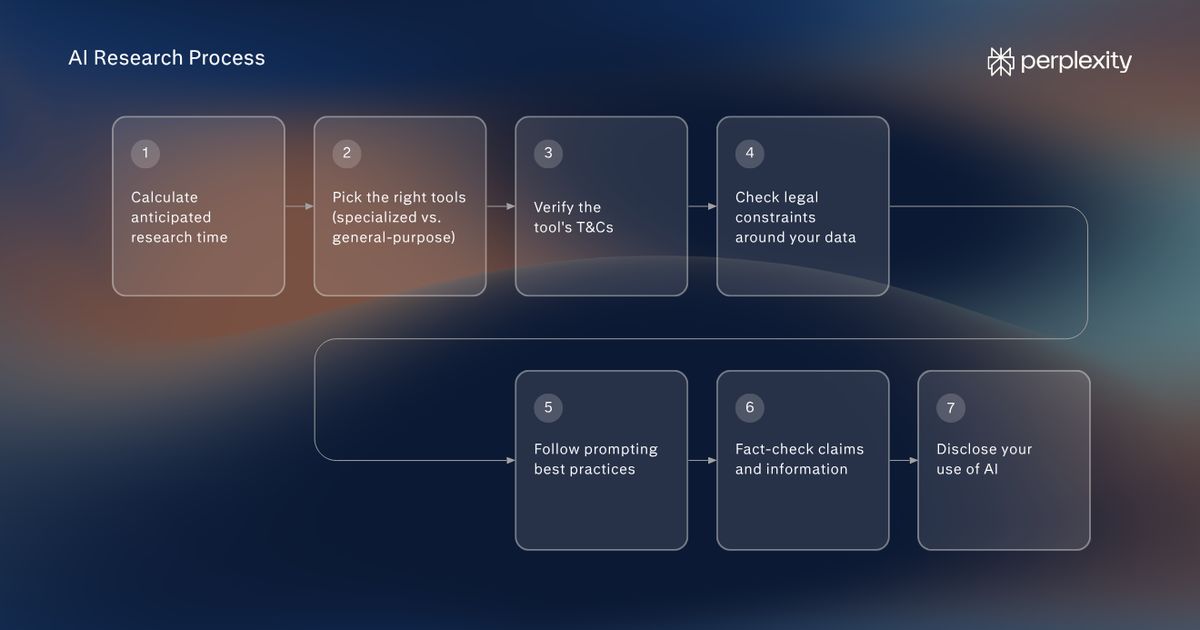
How to use AI as a research tool: 7-step framework
The key to using AI effectively as a research tool is to approach it as a supplement to rather than a replacement for your existing processes. It is also important to account for legal constraints, particularly when uploading sensitive data.
1. Calculate anticipated research time
Plan out your research process using conventional methods. Then ask where AI might be able to handle discovery, synthesis, and analysis tasks.
Calculate the time it will take to write prompts and verify findings. AI can easily save hours or days on large literature reviews. But for smaller, focused questions, there is little advantage to a manual search.
2. Pick the right tools (specialized vs. general-purpose)
Determine whether a specialized research platform offers any benefits over a general-purpose assistant like Perplexity. Pay attention to individual research features and coverage in your domain.
If you go for a dedicated tool, pick one that’s designed for your specific tasks. Tools like Elicit support structured literature reviews, for example, while Scite analyzes how academic papers are cited.
3. Verify that a tool's T&Cs allow for your intended use
There are two things to pay attention to when looking at a provider’s terms and conditions. First, the use of your data and whether or not it is kept entirely confidential. Second, conditions covering ownership of outputs.
Don’t assume that a paid tier automatically confers data confidentiality or unrestricted usage rights.
4. Check for any legal constraints around your data
Will your inputs include sensitive data, copyrighted documents, confidential business information, or unpublished findings?
It is important to check that you can feed these to an LLM. Various restrictions may be in place, from data regulations in your jurisdiction to internal company policy. You may need to find out how a particular tool provider stores data and for how long. Use of an approved enterprise platform may be necessary.
5. Follow best practices when writing prompts
There’s an art to putting together good research prompts. Clearly articulate your research question, provide relevant context, and define the output format. For complex research tasks, you may need to break the question down into sub-prompts.
Ask for clear references to all sources used, even if they are not labelled in the output. This is important, as an AI-generated response may not include citations for all sources used.
6. Fact-check all data, technical claims, and current information
It is essential to verify claims against original sources. These may be research papers, original research, official statistics, or technical documentation. Pay special attention to numerical data, dates, quotations, and time-sensitive information that may be out of date.
When doing research, you shouldn’t assume that because a source is cited that the resulting claim is correct or even that the source exists. For complex research, this stage is where you verify that the nuance of claims and summaries is correct.
7. Disclose your use of AI
Consult the disclosure requirements of your employer, academic institution, or relevant professional body. You will find details about the extent to which you need to disclose AI use.
Fields with strict regulations and codes of practice tend to require more detailed disclosure. Keep records of AI-assisted activities (platforms will usually keep an audit trail).
Is using AI for research ethical, and what comes next?
Research assistance has become one of the primary use cases for AI, and it’s easy to see why. It can handle large volumes of complex information, automate time-consuming repetitive tasks, and act as a thinking partner for early-stage ideas and hypotheses.
However, issues remain. In particular, the ethical use of AI in research is currently one of the most active and contested debates among academic institutions.
Hallucination rates correspond to topical complexity, and many leading engineers view them as a hard problem that can’t be fully solved. In addition, AI use is known to erode thinking skills, which are of paramount importance to professionals involved in complex research.
Organizations may also prohibit AI use on privacy and intellectual property grounds or over concerns around sensitive data. And disclosure remains important so that reviewers and peers can understand how AI was used in the research process.
AI will only continue to become a normal part of daily life in both the private and public spheres. As such, it is highly likely that clearer rules around research integrity and attribution will continue to evolve and gain nuance.