
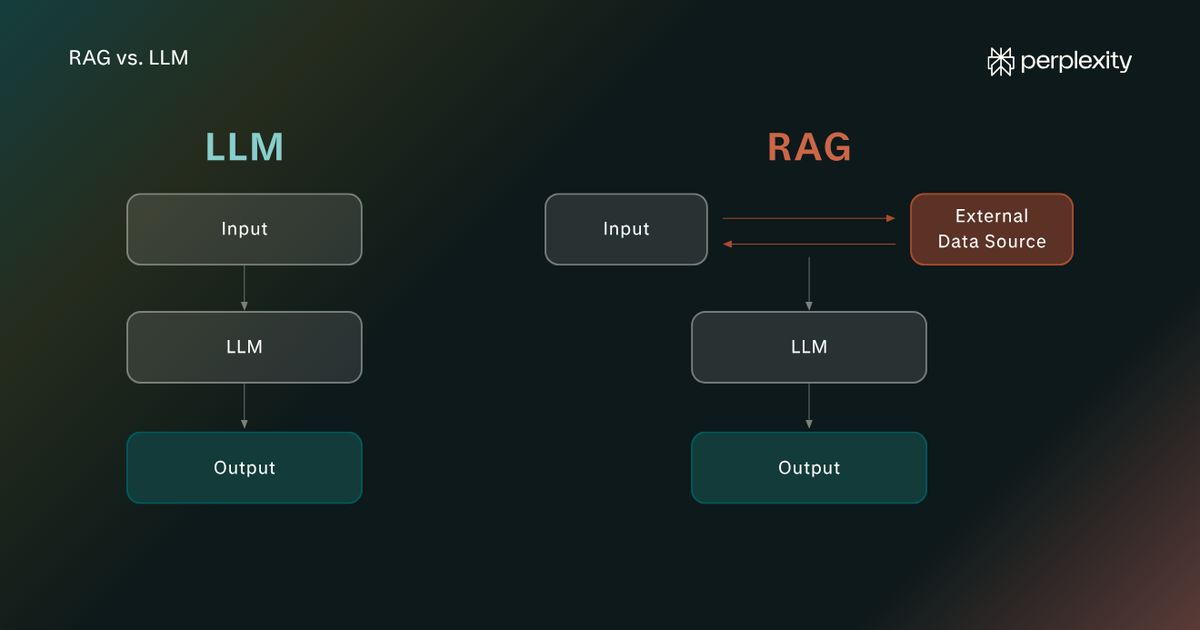
LLMs generate responses using parameters learned from patterns in their training data. Because those parameters may not reflect recent or complete information, RAG, which stands for retrieval-augmented generation, supplements the process by adding data from external sources to the LLM’s input context. An AI tool retrieves outside information to augment the LLM’s generation process.
In reality, your choice isn’t between RAG or an LLM. It’s between a hybrid approach and one that only uses an LLM.
RAG is necessary when an LLM requires access to company documentation, databases, or quick-changing information. An LLM-only approach is suitable for certain administrative, data processing, and content creation tasks where all inputs can be supplied by the user.
RAG vs. LLM: What are the key differences?
- RAG and LLMs are complementary systems. You can use an AI model without RAG (where it relies exclusively on its existing parameters), but you can’t use a RAG system without a model.
- RAG was introduced to overcome three key issues with LLMs: out-of-date information, hallucinated responses, and a lack of verification against third-party sources.
- RAG makes AI much more effective in real-world business situations because it connects LLMs with verified internal documentation, databases, and API endpoints.
- Top RAG use cases include customer support chatbots, queries based on fast-changing data (like industry news), and specialized fields, like medicine and law, where accuracy and source fact-checking are important.
- There are three main types of RAG: naive RAG, modular RAG, and advanced RAG. Naive RAG is best understood as straightforward information retrieval, while modular and advanced RAG add additional functionality like query rewriting and chunk optimization.
What is a large language model (LLM)?
An LLM, or large language model, is a system that generates content using fine-tuned parameters. These parameters determine the probabilities assigned to all the tokens in an LLM vocabulary, indicating which token is most likely to come next in a given sequence.
To better understand how RAG works (and differs from) LLMs, it’s helpful to look at how generative AI works on a basic level:
- Tokenization: A user's prompt is split into tokens, which may be words, parts of words, or single characters.
- Embedding: Tokens are converted into embeddings, numerical representations (strings of numbers) called vectors, that the neural network, which includes a decoder, can process.
- Decoding: The layers of the decoder (which make up a large part of the LLM’s neural network) manipulate these vectors, using a process called attention to capture meaning. This process determines how strongly each token should relate to other tokens in the sequence.
- Scoring: The model assigns a compatibility probability to every token in its pre-existing vocabulary and selects a likely next token for the sequence.
The important point is that an LLM can only produce outputs based on its existing parameters and the tokens in its context window. During training, an LLM is prompted to finish portions of incomplete text billions of times, and its parameters are adjusted until it assigns probabilities to tokens (and thus completes the text) reliably.
Imagine, for example, you ask an AI model the question, “What does our company’s 2026 refund policy say?” The LLM can only predict next tokens based on its existing parameters, which haven’t been fine-tuned using your support documentation. If you ask it this question without any additional context, it will simply be unable to respond in a meaningful way or will hallucinate an incorrect answer.
What is retrieval-augmented generation (RAG)?
RAG (retrieval-augmented generation) is the process by which information from external systems is included in an LLM prompt.
The underlying LLM process, involving embedding and probabilistic token matching, remains the same. RAG introduces a preliminary step in which the user prompt is expanded with additional data.
Here’s an overview of how RAG works:
- Knowledge preparation: A knowledge source is prepared. This may be a set of documents, a vector database, a knowledge graph, or a live index (such as for AI search).
- Prompting: A user enters a prompt, such as, “Should I go for a walk in London today?”
- Retrieval: The external information source is queried by the AI tool’s retriever. It may embed the prompt, turning it into a vector, and then query a vector database. Alternatively, it can use an alternative method, such as an API call, keyword matching, or knowledge graph traversal.
- Insertion: This information is added to the user's original prompt. In the example of the question about walking in London, this could include weather information in London and the current accessibility of popular walking routes.
- Answer generation: The LLM generates a response in the usual way using the expanded prompt.
Behind the scenes, the retrieved text is added to the input context, tokenized, and embedded. The model then processes that additional context through its decoder, which changes the output token probabilities.
Broadly speaking, RAG can be split into three sub-types. Naive RAG follows the basic RAG process, retrieving information and feeding it into the prompt. Advanced RAG adds additional functions like query rewriting and multiple query passes. Modular RAG refers to a type of architecture in which different advanced functionalities can be treated as components and combined as required.
RAG vs. LLM: Overview of use cases
RAG provides users with access to up-to-date data. This results in LLM outputs that are less likely to have hallucinations and information gaps. If you need to see the sources of the information used in an output, RAG is also essential, as ungrounded LLM answers don’t come with attributions.
RAG use cases
- Requests for time-sensitive information: Any queries for information that quickly goes out of date, which can be something as simple as a weather forecast or as complex as detailed analysis of an emerging news story, need to be based on validated third-party sources.
- Company documentation: Internal or customer-facing AI chatbots in which users ask questions related to company or product documentation should be RAG-enabled, especially if documentation is often updated.
- Customer support: Customer chatbots need access to current, detailed support documentation to provide accurate answers.
- Specialized fields (medicine, law, finance, etc.): LLMs that haven’t been trained on domain-specific corpora (especially mainstream models) typically struggle with the nuance of specialized prompts.
LLM use cases
- Administrative tasks: LLMs can complete basic tasks with a minimum of latency. RAG is unnecessary for basic writing and admin tasks, such as spell-checking or summarization, where external information isn’t required.
- Creative tasks: Some creative tasks, like generating a short story or an image, need only the information supplied in the original prompt.
- Reasoning and data-based tasks: If you’re working with a large dataset, an LLM doesn’t need access to external information to apply reasoning and analysis functions.
- General coding: While a coding workflow may require access to a private codebase or documentation, LLMs are very capable at executing general coding tasks, like fixing bugs and creating functions, without recourse to external sources.
RAG vs. long-context LLM, agentic AI, and grounding
There are three related concepts that are relevant to the distinction between RAG and LLMs. These are long-context LLMs, agentic AI, and grounding.
Long-context LLMs can sometimes be used in place of RAG-enabled systems, while agentic AI and grounding are synonymous with or work alongside them.
Long-context LLMs
These are models with large context windows, with some widely available commercial models running up to one million tokens.
If relevant material can fit into a model’s context window and is available in a text format, there are some benefits to using an LLM-only approach. It can reduce the chance of retrieval errors, provide more comprehensive context, and eliminate the need for extensive RAG architecture setup.
Agentic AI
An agent is a system that draws on multiple tools, including RAG capabilities to perform complex tasks. RAG is one component of agentic AI, and an agent will often use different types of retrieval methods (e.g., web search vs. vector search) depending on the content of a prompt.
Grounding
Grounding refers to the broader process of using evidence or data to improve the accuracy of (or ground) an LLM’s response. RAG is one form of grounding, but adding a technical document to a context window would also count as grounding.
RAG vs. LLM: Real-world examples
To better understand how RAG works compared to LLM use without RAG, we can look at a simple real-world example using Perplexity and a hypothetical enterprise case where a vector database is consulted.
RAG vs. LLM with a simple prompt
Here’s the output (limited to two sentences) when Perplexity is asked, "Should I go for a walk in London today?” with AI web search (a form of RAG) turned off:
Yes—if the weather is reasonably dry and you have the time, a London walk today could be a refreshing change of scene. Pick a route along the South Bank, Regent’s Canal, or through Hyde Park, and bring a light waterproof just in case.
Compare this to the prompt when the LLM can check external sources:
Yes, it’s a good day for a walk in London: the forecast calls for mild temperatures around 19–21°C with sunny intervals and only a very low chance of rain. With partly cloudy skies and a gentle breeze, conditions are comfortable for exploring parks or riverside routes like the South Bank.
There are similarities between the two, as the LLM uses the same underlying token scoring process. However, the second example includes detailed weather information, which makes it far more useful.
RAG vs. LLM with an enterprise vector database
Imagine that a user asks an in-app chatbot for a banking app the following question: “Where can I download my most recent statement?”
The bank that manages the app has created a database containing embeddings of its up-to-date product documentation and connected it to the chatbot’s RAG pipeline. The documentation consists of around 1,000 source documents, which are split into smaller chunks and have been converted into vectors for retrieval.
The user’s query is sent to an embedding model, and the application sends that vector to the database, which returns the relevant chunks.
The embedding model would receive a request like this:
json
The embedding model returns the following vector embedding:
json
The vector database then receives a request like the following:
json
In this (much simplified) example, the database returns the five chunks that are most relevant to the user’s query, which are sent to the application and included in the LLM prompt.
When to pick RAG vs. an LLM, and when to combine
LLMs and RAG are complementary systems. As such, the question, “When should I choose an LLM and when RAG?” is misplaced. Rather, you should ask, “When will an LLM suffice and when is RAG optimal?”
When to use an LLM without RAG enabled
- Your chosen AI model has a large context window: If it is easier to include all information or data necessary for an accurate answer in your prompt, such as by uploading a document, doing so can reduce latency and prevent retrieval-related issues.
- Reasoning and data analysis workflows: Analysis and reasoning workflows that reference only the data provided in a prompt do not need RAG capabilities.
- Code generation: RAG is typically not needed for general coding work, though it is usually employed for project-specific tasks, such as retrieving previous fixes or vendor APIs and documentation.
When to use an LLM with RAG enabled
- You require access to up-to-date information: If an AI application needs to access external sources of up-to-date information to generate an accurate answer, always ensure RAG capabilities are enabled.
- You’re working in a specialized field: For domains like medicine, law, education, and so on, where accuracy, detail, and source checking are important, LLM-only use will often be insufficient.
- Outputs should reference internal company files: If you are using AI, either internally or in a customer-facing app, to generate content based on internal company documents, whether data, a brand kit, documentation, or files, RAG provides access to that information.
RAG and LLMs are complementary, evolving technologies
RAG signified major innovation in the evolution of AI. It addresses three major issues: outdated information, limited model memory, and information gaps due to a lack of relevant training data, which often resulted in hallucinations. Of course, LLMs haven’t overcome these entirely, but their incidence has significantly reduced with the advent of RAG.
RAG isn’t a static technology. It’s expected to improve across a range of areas, including reranking, latency during retrieval and token usage, security defenses against dangerous data sources, integrating retrieved data from multiple sources, and more. As LLMs and agentic AI continue to develop, so will the RAG systems that support them.






![Scrunch vs. Peec AI: Choosing the right AEO tool [2026]](https://cdn.pixabay.com/photo/2013/04/22/00/50/screw-106361_1280.jpg)