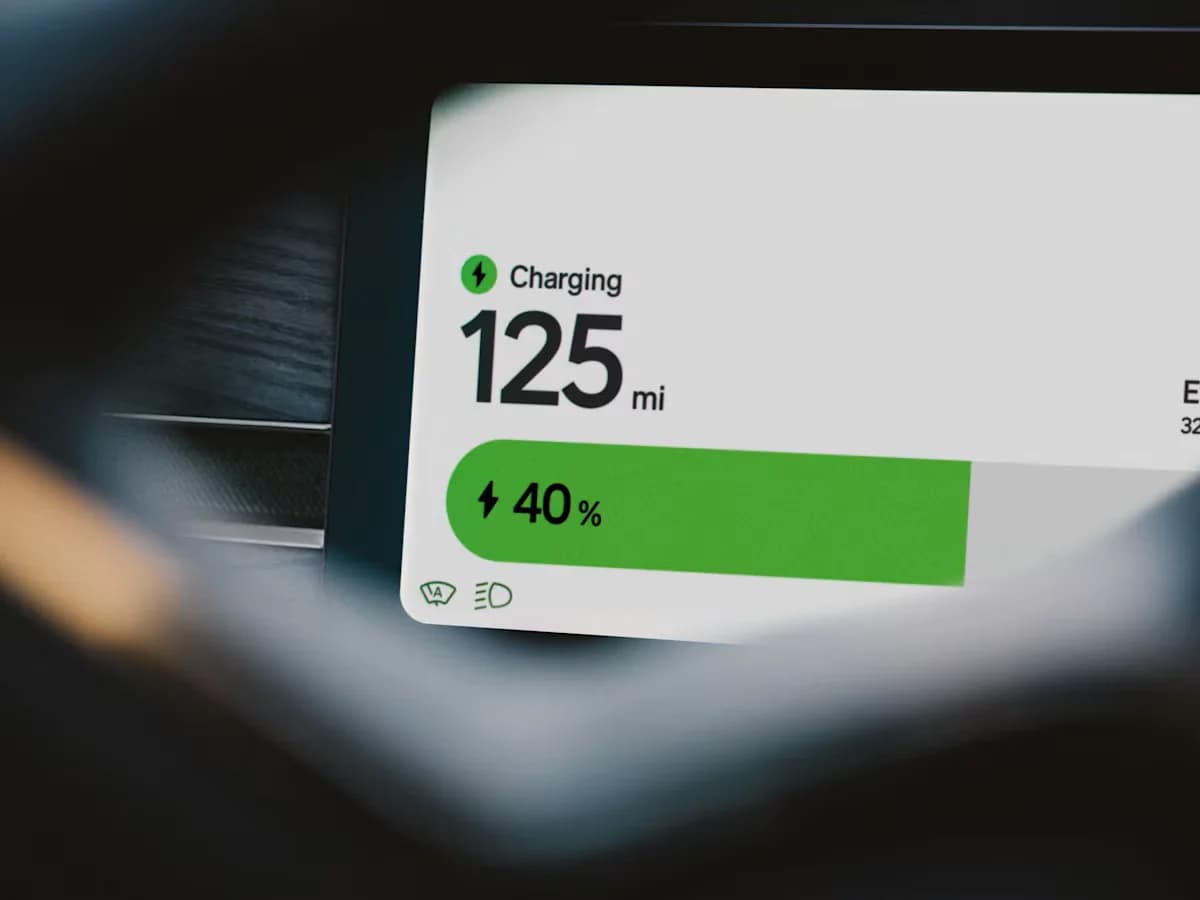
You know you have enough range to make it to your cabin for the weekend, but you’re not sure you’ll have enough to cover everything planned for the next day. There’s no dedicated EV charger nearby, just a household outlet by the driveway.
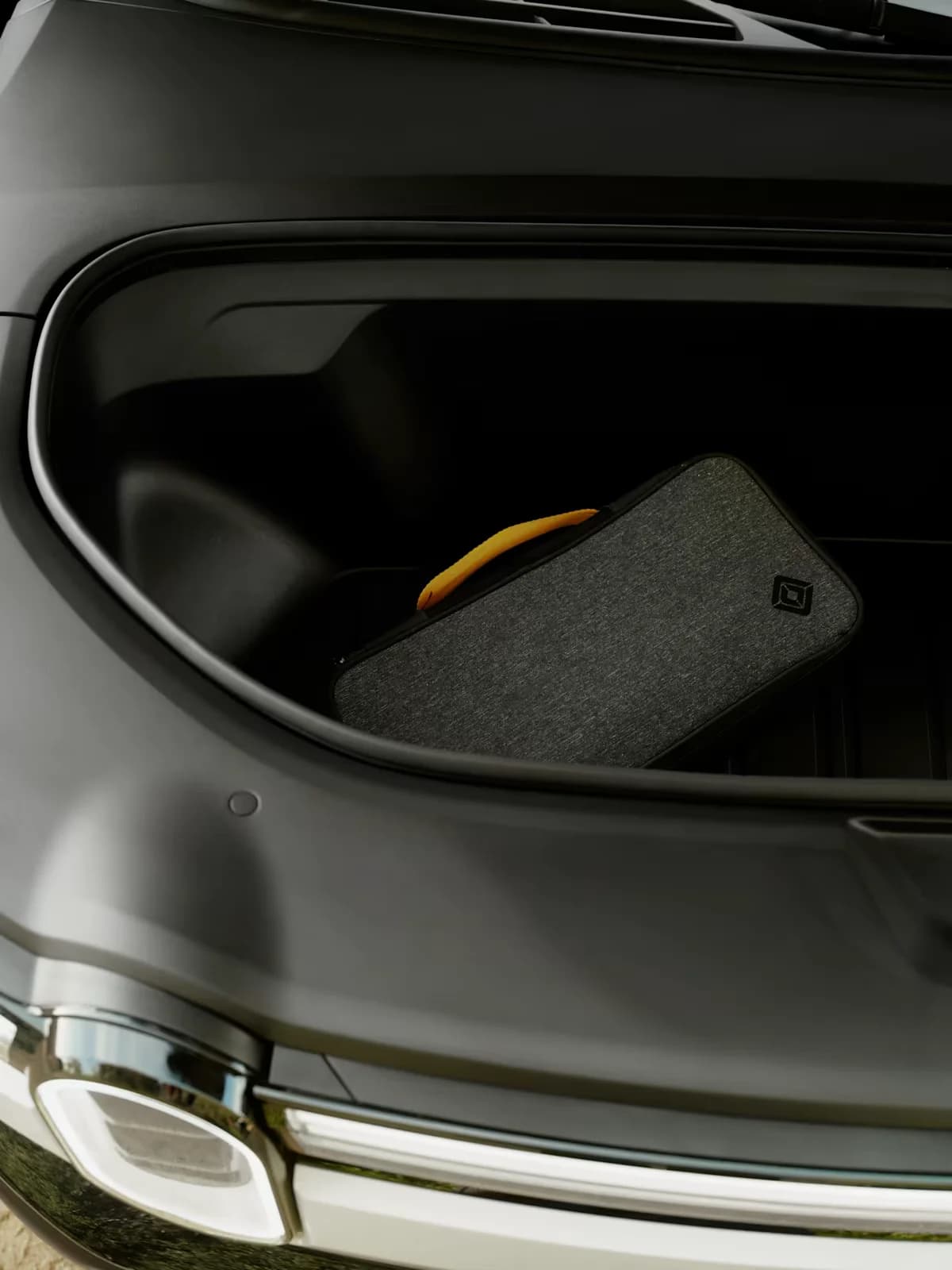
With a portable EV charger in the front trunk, you can plug in overnight instead of trekking to a public charging station. And once you're homeOpens in new tab, it’s still useful for everyday charging. Connect it to a compatible 240V outlet, and you can replenish your battery overnight without installing a dedicated wall charger.
Below, we explore the advantages of portable chargers, how they compare with wall chargers and what to consider when making a purchase.
How portable EV chargers work
A portable charger is designed to make charging convenient at home or on the go. Plug one end of the EV charging cable into an outlet, the other into your vehicle, and your EV receives power.
The Rivian Portable Charger has a maximum charging speed of 7.6 kilowatts (kW), compared with 11.5 kW from the Rivian Wall Charger. But, if you have a NEMA 14-50 outlet, the Portable Charger may be all you need for regular home charging, depending on the range you use each day.
What to look for when choosing a portable EV charger
When choosing a charger, it’s important to consider compatibility with your vehicle and habits. Factor in where you usually charge your car, and check that the charger can provide enough range within the time you have to charge.
Compatibility with your vehicle and outlets
When choosing a charger, check that its vehicle-side connector matches your EV’s charging port. If it doesn’t, you need a compatible adapter.
For the part that plugs into the wall, some portable chargers have interchangeable outlet adaptors that allow them to switch between 120V and 240V charging. The Rivian Portable Charger includes both: a NEMA 5-15 for a standard 120V household outlet and a NEMA 14-50 for compatible 240V charging.
Power, speed and electrical limits
A matching plug doesn't guarantee that an outlet can safely support the charger. Higher EV charger amperage means more range per hour, but the outlet and circuit must be able to handle that draw for hours at a time, not just in short bursts.
For example, the Rivian Wall Charger delivers up to 48A with an 11.5 kW charging speed, depending on factors that impact charging speeds, e.g., weather and battery type. But if you want to get the full range at home, you need a dedicated 60A circuit.
Not every garage is wired for it. Homes without the right electrical setup need a new 240V outlet, a new circuit or other upgrades. An electrician can install or modify your outlet according to local requirements. When you compare the two setups, consider the installation cost along with the price of the charger.
Durability and ease of use
When choosing a charger, ensure it’s long enough to reach your car whether you’re at home or on the go. You want enough slack to reach the charge port comfortably, without dragging the cord across a walkway or pulling it tight.
When you’re outside, you need a charger that can withstand the elements. A weatherproof EV charger may be fine under most conditions, but make sure to check the manufacturer's recommendations before leaving it exposed..
Cost and long-term fit
Rivian currently prices the Portable Charger at $400. The NACS and J1772 models are rated at up to 32A and 7.6 kW and include NEMA 5-15 and NEMA 14-50 outlet adapters.
Prices and availability can change, so make sure to check Rivian’s product page before ordering.
Types of portable EV chargers
Portable chargers are categorized as Level 1 or Level 2 chargers.
Level 1 chargers use a standard household 120V outlet. They charge more slowly, but after a short day of driving, that’s not necessarily an issue. Plug in before bed, and you may replenish the range you used during the day by morning.
Portable Level 2 chargers use 240V outlets, such as NEMA 14-50 outlets. They’re useful when you have less time to recharge your battery.
With the Rivian Portable Charger, you can switch between Level 1 and Level 2 charging by changing the outlet adapter.
The Rivian NACS Portable ChargerOpens in new tab is compatible with eligible 2026 and newer vehicles. The J1772 Portable ChargerOpens in new tab works with 2022-2025 R1T and R1S models. Regional availability varies. Be sure to choose the version compatible with your Rivian vehicle model.
Connector and plug formats
A portable electric car charger has two connection points: one at the outlet and one at the vehicle. They use different types of plugs so it helps to know which side you’re looking at.
The wall-side connection joins the charger to an electrical outlet. This is typically a NEMA 5-15 setup for standard 120V outlets or NEMA 14-50 for 240V outlets.
On the vehicle side, the charger connects to the EV’s charge port. J1772 and NACS are the two standard types of plugs in the U.S.
As mentioned, the Portable Charger version you need depends on your Rivian model. NACS works for 2026 models and J1772 is compatible with 2022–2025 R1T and R1S models.
Some Rivian owners use an approved NACS DC adapterOpens in new tab to access Tesla SuperchargersOpens in new tab for fast charging on the road.
How charging speed changes
A portable charger can only add range as fast as the outlet, circuit and vehicle can handle. If you have a short commute every day, you may only need Level 1 overnight. Level 2 provides faster recharging after a long drive since it uses a higher-voltage outlet.
You won’t necessarily hit the advertised maximum every time you plug in. Charging speed variesOpens in new tab based on numerous factors, such as battery capacity, air temperature and vehicle age.
Do you need a portable EV charger?
A portable charger isn’t essential for every EV owner. Depending on your driving habits, a home charger and access to public charging stations may be all you need.
If you don't know what to choose, start by looking at your daily mileage, electrical capacity and travel habits. A week of short commutes and local errands is fairly easy to replenish overnight from a reliable 240V outlet. Rivian owners can choose between the Portable ChargerOpens in new tab and Wall ChargerOpens in new tab for home charging.
The Rivian EV road trip planning guideOpens in new tab can help you plan charging stops along longer routes. When you arrive at a remote destination, a portable charger can prove invaluable. Just make sure there’s a compatible, properly installed outlet waiting at the other end. Keep in mind that a portable charger won’t work during a power outage unless the outlet is supplied by a suitable backup power source.
Common portable EV charger mistakes to avoid
If you decide to invest in a portable charger, it’s important to confirm compatibility with your model and the outlets you plan to use. Outlet adapters, car-side AC adapters, and DC fast-charging adapters each do a different job, so you can't swap them around.
Be sure to use the charger with an outlet designed to handle its amperage; trying to force an outlet match can introduce a risk of fireOpens in new tab or electric shock.
How Rivian fits into your charging setup
The Portable Charger offers peace of mind on long trips and provides a convenient option for home charging, too. Plug into a 120V outlet with the NEMA 5-15 adapter or use 240V for faster charging. You get up to 16 miles of range per hour (R1) or up to 25 (R2), depending on the vehicle and conditions.
The Wall Charger delivers faster home charging, while road trips call for a different approach. Plan charging stops along your route using the Rivian Adventure NetworkOpens in new tab, other compatible fast chargers and the Rivian trip planner.
With the Rivian Portable ChargerOpens in new tab for even more flexibility, you can spend less time worrying about charging and more time enjoying your adventure.
Informational purposes only. The information provided in this article is intended for general informational purposes only. It does not constitute professional advice or expert guidance. Where appropriate, seek professional assistance. Where appropriate, consult the relevant operating manual and seek professional assistance before engaging in the activity described. While we strive to ensure accuracy, we do not assume any responsibility or liability for any inaccuracies, omissions or errors in this content.