Most enterprise AI agent projects look impressive as a demo but never reach production. When these projects stall out, the usual explanation is that the model underperformed, the prompts were wrong, or the use case was too ambitious. But often, the real problem lies deeper. It’s the data layer.
An AI agent that can’t remember what it did in a previous session, that can’t be audited when it makes a consequential decision, and can’t access live operational data without calling three separate APIs doesn’t have a model problem. It has an infrastructure problem. And the Couchbase AI Data Plane™ is built to solve it.
Why do AI agents fail between pilot and production?
According to Gartner, organizations will abandon 60% of AI projects unsupported by AI-ready data through 2026. In most cases, the model isn’t the problem. A pilot looks good in a demo environment, then breaks down in production because the organization lacks a unified data plane built for agent speed. Agents end up reaching across disconnected systems for memory, context, and tools, and every hop adds latency, cost, and risk.
Three specific failures account for most of what goes wrong.
Agent amnesia – the memory problem
An agent that can’t remember what it did last session, what a user told it two minutes ago, or what it already tried in a multi-step workflow is not a production agent. It’s a stateless function that happens to use an LLM. Every session starts from scratch, users repeat themselves, and the agent repeats mistakes it already made.
Agent amnesia occurs when an agent’s memory is fragmented across separate caches, vector databases, session stores, and in-context window state, with no unified layer to manage them as a coherent whole. The agent technically has access to information in pieces, but it can’t maintain a consistent, personalized understanding of a user or a task over time.
The governance gap – the observability problem
In regulated industries, “the agent decided” is not a defensible explanation for a consequential decision. For every agent action, the engineering team must be able to answer the questions: What data did the agent access? Which tools did it invoke? What prompt was it operating from? Which version of that prompt?
If the engineering team can’t answer those questions, then the security and legal teams can’t trust the agent in production.
Tracing and auditing agent behavior isn’t a model problem. It’s a data problem. When tools, prompts, and agent function calls aren’t logged in a structured, queryable format, auditing agent behavior becomes a manual reconstruction effort rather than a straightforward query. Teams need the observability infrastructure to trace each action, understand how the agent reached a decision, and produce an auditable record when compliance, security, or legal teams need answers.
Integration cost – the point-solution problem
A production AI agent typically needs access to a vector store for semantic retrieval, a cache for fast context lookup, a session store for short-term memory, a document store for operational data, and a tool registry for governed function calls. When each is a separate system, integration overhead is significant. You deploy five systems, maintain five APIs, manage five sets of credentials, and face five potential points of failure on every agent inference call.
Each point solution was probably the right decision when you added it. But together, they become a fragmented infrastructure that causes the agent to fail when one component falls behind, goes down, or drifts out of sync with the others.
What is the Couchbase AI Data Plane?
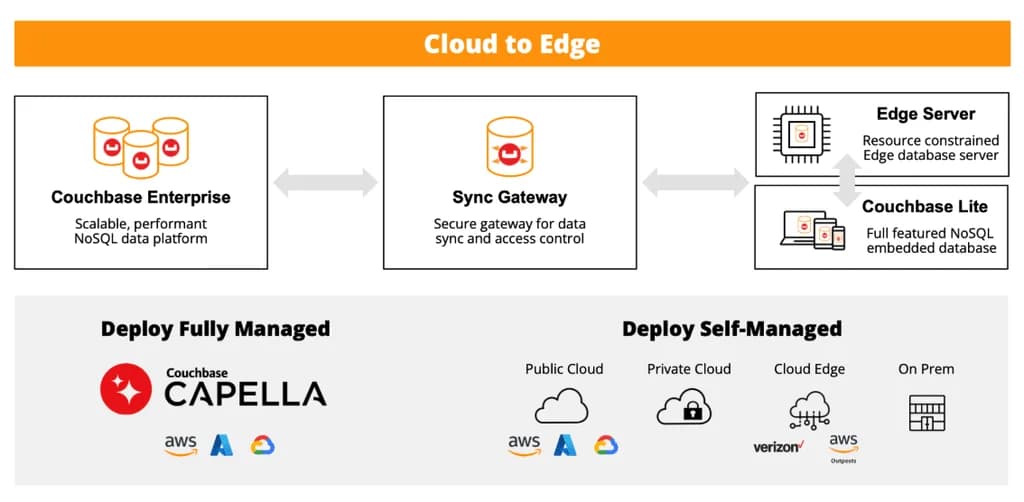
The Couchbase AI Data Plane is the governed data and memory layer that gives production AI agents persistent memory, governed access to data and tools, and consistent context from the cloud to the edge. It collapses the five separate point solutions described above into one platform that’s built on Couchbase Capella and is available across cloud, self-managed, hybrid, and edge deployments.
The AI Data Plane has these three core components that directly address the three potential failure areas discussed above:
Agent Memory
Agent Memory gives AI agents persistent recall across sessions, users, and frameworks. Memory is structured across three levels that work together. Short-term memory holds the current conversational context and active task state. Long-term semantic memory stores observations and facts as vector embeddings for cross-session retrieval. Profile memory stores structured user attributes (like preferences and permissions) for deterministic, low-latency lookup.
When an agent with proper memory asks, “What did we discuss last time?” or “Does this user prefer metric or imperial units?” it retrieves a real answer from a governed store rather than generating a hallucinated one. Over time, the agent becomes more personalized because its memory reflects each user’s actual interaction history, not a fresh context window.
Memory in the AI Data Plane is not a bolted-on vector store. Every memory block is a JSON document containing an embedding vector, a natural language summary, a structured context object, a timestamp, and a configurable time-to-live for retention compliance. The system stores, retrieves, and governs these memory blocks alongside the agent’s other operational data.
Agent Catalog
The Agent Catalog is the governed registry where every tool, prompt, and agent function used in a production application is stored, versioned, and made inspectable. It gives regulated enterprises the visibility they need to trust agents in production.
When an agent makes a decision, the Agent Catalog records which tool it called, which prompt version it used, what data it accessed, and the result. Those records are vectorized and indexed so that teams can search agent behavior semantically. “Show me all sessions where the agent invoked the payment tool without user confirmation” is a real query, not a hypothetical.
The Agent Catalog also makes development faster. Instead of each team building a new agent from scratch, the Agent Catalog makes existing tools and prompts discoverable. With semantic search over the catalog, a team can find and reuse a tool another team already built.
Governed data access via MCP Server
The Couchbase MCP Server implements the Model Context Protocol (MCP), the open standard that defines how AI models connect to external tools and data sources at runtime. MCP gives agents a governed, discoverable interface to invoke capabilities without hardcoding an integration for every tool.
Rather than giving the agent direct database credentials, the MCP Server enforces role-based, tool-level access control. The agent can query what it’s authorized to query, invoke the tools it’s authorized to invoke, and nothing more. The AI Data Plane’s audit infrastructure logs every invocation.
How unified data infrastructure changes what agents can do
The difference between an agent running on fragmented point solutions and one running on the Couchbase AI Data Plane isn’t primarily a performance difference. It’s a capability difference.
An agent with unified memory, governed tool access, and fast semantic retrieval in one layer can do things that a fragmented agent can’t. It can recognize a returning user across channels without the user identifying themselves, resume a complex multi-step task from exactly where it left off after a session interruption, refuse a request that falls outside its authorized scope and explain why, and surface the exact prompt and tool invocation that produced a specific output when a compliance team requests an audit.
None of these capabilities require a better model. They simply require a data layer designed for agent workloads, not one assembled from systems designed for something else.
The AI Data Plane also runs where production workloads actually run. For enterprises with edge deployments, field service applications, or always-on requirements, the same data layer available on Couchbase Capella extends to self-managed, hybrid, and edge environments. Couchbase Lite and Couchbase Edge Server support these deployments with bidirectional sync and consistent governance across every tier.
What this looks like in practice
The value of the AI Data Plane becomes clear when you see how its components work together in a real application. Consider a customer service agent that needs to deliver personalized support while keeping its actions secure, consistent, and auditable.
A customer service agent powered by the Couchbase AI Data Plane opens every interaction with the customer’s preference profile from Agent Memory, retrieves semantically relevant context from prior sessions using vector search, invokes authorized tools through the MCP Server to look up orders or update records, and logs every action through the Agent Catalog for compliance review. When the session ends, it writes the outcome back to the customer’s long-term memory so the next interaction builds on it.
Compare that to the same use case on fragmented infrastructure. This time, the agent has no memory of prior sessions unless the developer has pre-loaded a summary into the context window (which has a token cost, a latency cost, and is limited by window size). Tools are invoked through hardcoded API calls with no centralized audit trail. And compliance teams requesting a review of a specific interaction have to reconstruct what happened from logs spread across five systems.
The agent in the first scenario gets smarter over time. The agent in the second scenario starts from the same point on every call, regardless of how many interactions it has handled.
FAQs
What is the Couchbase AI Data Plane? The Couchbase AI Data Plane is the governed data and memory layer for production AI agents. It provides persistent agent memory across sessions, governed tool access through MCP Server, a centralized Agent Catalog for prompt and tool governance, semantic caching, and vector search, all on one platform available across cloud, self-managed, hybrid, and edge deployments.
Why do AI agents fail between pilot and production? The most common causes are fragmented agent memory (agents that can’t remember prior sessions or maintain personalized context), lack of observability (no structured log of which tools and prompts the agent used and why), and point-solution sprawl (five separate systems for vector search, caching, session state, operational data, and tool registries). These are data infrastructure problems, not model problems. You can watch this on-demand webcast to learn more about the difference.
What is Agent Memory in Couchbase? Agent Memory is the persistent memory layer in the Couchbase AI Data Plane. It stores agent state at three levels: short-term memory for the current conversational context, long-term semantic memory as vector embeddings for cross-session retrieval, and profile memory for structured user attributes. Every memory block includes a JSON document with an embedding, a natural language summary, a structured context object, a timestamp, and a configurable retention TTL.
What is the Agent Catalog? The Agent Catalog is the centralized registry in the Couchbase AI Data Plane where tools, prompts, and agent functions are stored, versioned, and made inspectable. It records every tool invocation, prompt version, and data access event in a structured, queryable format, enabling compliance audits and making existing tools discoverable and reusable for teams building new agents.
Does Couchbase AI Data Plane support edge and always-on deployments? Yes. The AI Data Plane is available on Couchbase Capella and extends to self-managed, hybrid, and edge environments through Couchbase Lite and Couchbase Edge Server. They provide bidirectional sync and consistent governance at every tier.
What is MCP and how does it relate to the AI Data Plane? MCP is the Model Context Protocol, an open standard that defines how AI models connect to external tools and data at runtime. The Couchbase MCP Server implements MCP as part of the AI Data Plane, giving agents a governed, auditable interface for tool invocation with role-based access control enforced at the server layer rather than in application code.