Strategy
Social CRM turns comments, DMs, and mentions into CRM context. Discover a step-by-step workflow, AI routing and sentiment, plus a tool list.
Key takeaways
- Social CRM connects social media interactions (comments, DMs, mentions) to customer profiles in your CRM, giving teams a complete view of every relationship.
- It helps customer service, sales, and marketing teams respond faster, nurture leads, and create more relevant content based on real social data.
- Common challenges include data overload, cross-team adoption, and keeping up with new platforms, so a clear strategy and the right tools matter.
- AI is reshaping social CRM in 2026, with intelligent routing, real-time sentiment analysis, and conversational AI making it faster to act on social signals at scale.
Social CRM, short for social customer relationship management, is a way to use social media data to better understand your customers, prospects, and leads.
That data covers more than follower counts. It includes comments, direct messages, brand mentions, sentiment signals, and the wider conversations your social listening tools pick up.
By adding social media data to a traditional CRM, customer-facing teams can do their jobs more effectively. Everyone has the context they need, right when they need it.
With social CRM, brands can:
- Offer better customer support on the social channels customers already use
- Find new customers and leads through social conversations
- Build and grow relationships over time, not just at the moment of purchase
- Learn what their audience cares about and create more relevant content
Bonus: Get a free, easy-to-use Customer Service Report Template that helps you track and calculate your monthly customer service efforts all in one place.
How does social CRM differ from traditional CRM?
Traditional CRM focuses on past customer actions like emails and purchases, while social CRM adds real-time conversations to the mix. Together, this creates a more complete picture of each customer.
Here’s a quick look at how they compare.
What are the types of social CRM?
There are three main types of social CRM:
- Built-in social features within a traditional CRM
- Standalone social CRM platforms that connect to your CRM
- Hybrid social operating systems
All three bring social listening and engagement into your customer data, but they work a little differently.
Built-in options add social tools directly to a CRM you already use. These features live alongside your contacts and deals, which keeps everything in one system but can offer less depth on the social side.
Standalone social CRM platforms like Hootsuite specialize in social media management, then sync that data back to your CRM through integrations. This approach gives you stronger social capabilities while still keeping your customer records up to date. For many teams, CRM social media integration is the easiest way to get the best of both worlds.
A third, hybrid approach is becoming more common. Social operating systems like Hootsuite Social OS sit between the two categories: they handle listening, publishing, and engagement natively, add AI-powered insights on top, then feed that intelligence back into connected systems like Salesforce or Microsoft Dynamics 365. The line between “social tool” and “CRM” gets blurry, which is generally good news for the teams using both.
Social CRM matters in 2026 because social platforms have become a primary contact point, not a secondary one. People ask questions, complain, compare brands, and make buying decisions in comments and DMs, and they expect you to be there.
The expectations gap is real. Forrester’s Global Customer Experience Index found that the gap between the experience brands intend to deliver and the one customers actually get is widening. Social is often where that gap becomes visible, publicly, in front of everyone.
Responsiveness is a big part of it. In Hootsuite’s Social Media Consumer Report, 53 percent of respondents said the most appealing thing a brand can do on social media is quickly respond to direct questions and comments. Silence, meanwhile, costs followers: 32% will unfollow a brand that fails to interact with its community.
Volume has also changed the math. A social media CRM setup that relied on someone manually copying notes into a CRM field could just about work when mention volume was low. At today’s scale, that approach breaks. Connecting social data to customer records automatically is what makes it usable.
Social CRM tools bring customer conversations together in one place. This helps marketing, sales, and customer service stay on the same page, respond consistently, and avoid duplicate work.
The payoff shows up first in speed. Since 37% of consumers expect a response sometime that same day, giving teams instant context is often the difference between a resolved issue and a lost customer.
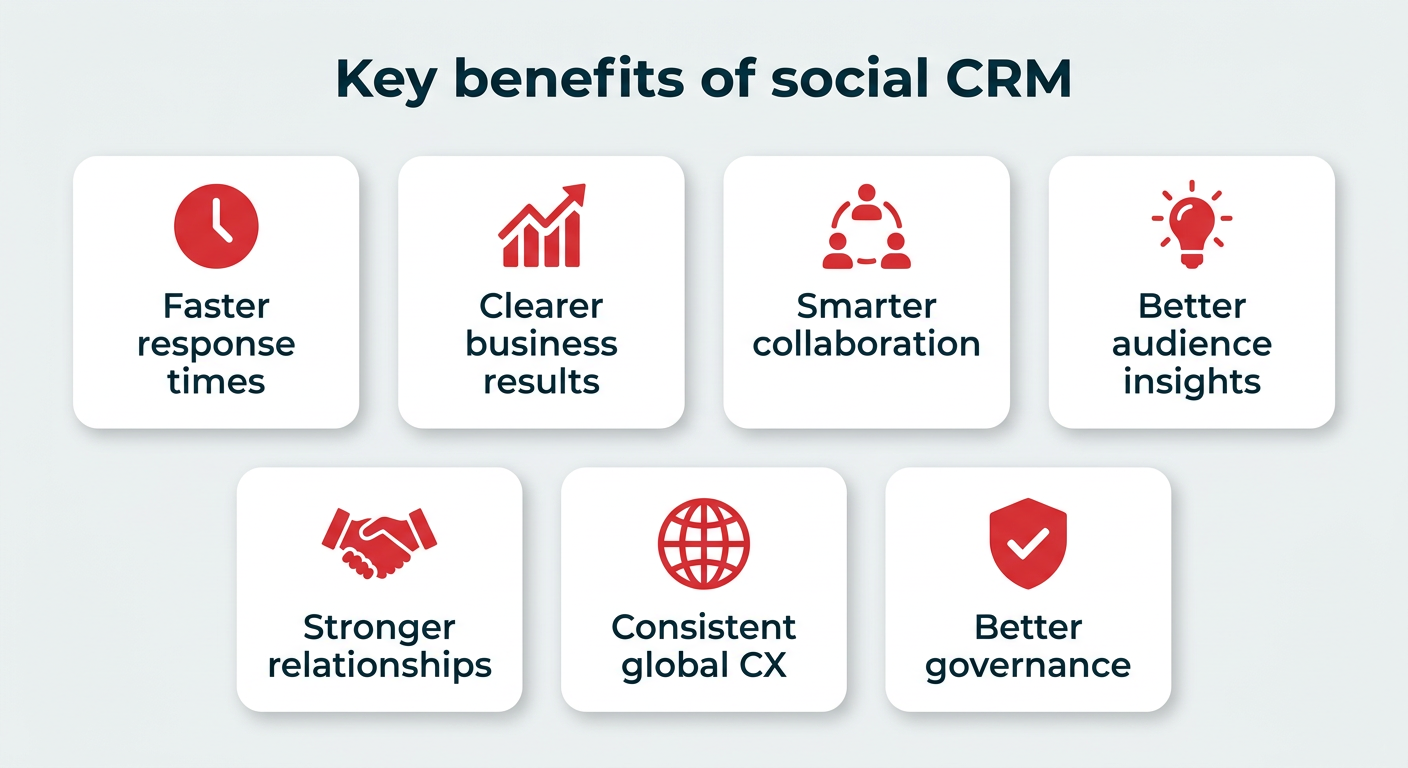
Here’s what the benefits of social CRM look like in practice:
- Improved response times: Social CRM routes conversations to the right team to streamline responses across teams. It also gives everyone the context they need to get up to speed quickly.
- Clearer connection to business results: By linking social conversations to CRM data, teams can see how engagement turns into leads, sales, or customer retention.
- Smarter cross-team collaboration: Marketing, sales, and customer service all work from the same customer view, so nothing gets missed or repeated.
- Better audience insights: Social CRM turns everyday comments and feedback into actionable insights teams can use to improve messaging, products, and customer experiences.
- Stronger relationships with customers: Ongoing conversations on social media help current and potential customers feel heard, which builds trust, loyalty, and even customer advocacy.
- Consistent experiences across regions: For enterprises with global teams, social CRM helps keep messaging and service quality consistent no matter where a customer reaches out.
- Better governance and oversight: A shared system makes it easier to track who responded, maintain approval workflows, and keep social activity aligned with brand and compliance standards.
Before we get into use cases, it’s worth being honest about the obstacles. The biggest social CRM challenges come down to managing volume, getting teams on board, and keeping pace with change. None of them are dealbreakers, and the right tool can help you work through each one.
- Data overload and noise: Social channels generate a huge volume of mentions and messages, especially as 37% of adults visit Facebook several times daily. Without filtering and prioritization, important conversations can get lost. Social listening tools help surface what matters most.
- Cross-team adoption: Social CRM only works when marketing, sales, and support actually use it. Clear workflows and training make it easier for everyone to adopt the system.
- Keeping up with new platforms: Social media changes quickly, and new channels emerge often. A flexible platform that adds new integrations helps you stay current.
- Measuring ROI accurately: Tying social activity to revenue can be tricky. Linking social data to CRM records makes attribution far more reliable.
- Data privacy and compliance: Handling customer data across channels carries real legal and regulatory obligations. Choose tools with strong governance and compliance controls, including permissions and security settings, to meet those requirements.
A social CRM works by pulling in social media activity and linking it to customer profiles in your CRM. This includes comments, messages, mentions, and other interactions from platforms like Instagram, X, Facebook, and LinkedIn.
The data flow usually follows four steps. First, social interactions are captured from your connected accounts. Next, those interactions are matched to existing customer profiles or used to create new ones. Then, each profile is enriched with context like past purchases, support tickets, and previous conversations. Finally, that complete view is made available to everyone who needs it.
For example, if a customer sends a direct message on Instagram, that message shows up alongside their past emails, calls, or support tickets. Teams can see the full picture in one place and respond with the right context.
AI is changing social CRM by handling the sorting, reading, and prioritizing that used to eat up most of a team’s day, a shift so fundamental that Gartner now defines CRM sales platforms as AI-driven systems. The customer data was always there. AI social CRM is about making it usable in the moment a reply is needed, not a week later in a report.
Here’s where AI is having the biggest practical effect:
- Sentiment and intent detection: AI reads incoming messages and flags whether someone is frustrated, curious, or ready to buy, so the right conversations get attention first.
- Intelligent routing: Messages are matched to the team or individual best placed to answer, based on topic, language, account, or urgency.
- Conversational AI for front-line care: Common questions get instant answers, while anything nuanced escalates to a human with the full conversation history attached.
- Content and outreach recommendations: Patterns in social CRM data point to the topics, formats, and timing most likely to land with a given audience segment.
- Trend detection at scale: Spikes in mentions, emerging complaints, and shifting language get surfaced automatically rather than being noticed by chance.
In practice, this changes the shape of a typical workflow. Instead of an agent opening a queue of 400 unsorted messages, the queue arrives already triaged: urgent complaints at the top, known customers flagged with their CRM history, repeat questions already answered.
Inside Hootsuite Social OS, Lumen handles the intelligence and listening side, Nest brings social conversations into one governed inbox, and Wisdom, the AI agent layer, connects those signals to the next action across your connected systems.
The point isn’t to remove people from customer relationships. Forrester predicts 30% of firms will damage CX growth in 2026 by getting that balance wrong with poorly implemented AI self-service. It’s to make sure the people doing the work have context before they start typing.
How does AI-powered social listening strengthen social CRM?
AI-powered social listening strengthens social CRM by turning unstructured conversation into signals your CRM can actually use. Manual monitoring catches what someone happens to search for. AI models catch sentiment, sarcasm, emotional drivers, and topic clusters across languages and markets at once.
Lumen analyzes conversations across multiple languages, which matters for any team supporting customers across regions. A frustration trend building in one market shows up before it becomes a global problem.
Those insights feed back into customer records and audience segments. A customer whose sentiment has shifted negative gets flagged before renewal. A topic gaining traction with your best-fit audience becomes next month’s content. That’s the difference between listening as a reporting exercise and listening as part of a social listening CRM workflow.
Social CRM software gives your care team a more meaningful way to have conversations with your customer base, no matter which platform they choose to make contact.
Here’s what social CRM can do for your customer service team.
How does social CRM increase relationship quality?
Recent research shows that using social media for CRM can improve customer relationship quality. That’s not too surprising, since social CRM helps brands respond in more personal and timely ways.
Responsiveness matters in both directions. 28% of Hootsuite Consumer Report respondents will unfollow a brand that ignores negative or challenging comments, and 32% will unfollow a brand that fails to interact with or respond to the community.
Take Starbucks, for example. The brand gets plenty of positive comments, but also negative feedback. When that happens, the team responds quickly and publicly, offering help right away or moving the conversation to DMs when follow-up is needed.
Starbucks demonstrates social CRM by responding quickly to negative feedback on Instagram.
How does social CRM enable faster and smarter responses?
Sometimes your social and customer support teams may interact with the same customer on multiple channels.
Social CRM tools connect messages to people, not just profiles, so everyone can see a customer’s full history in one view. With that context, teams can give consistent, personalized replies without duplicating work or asking customers to repeat themselves.
Social CRM also improves response time and accuracy. Incoming contacts and requests can be auto-routed to the best team member for the job. In Nest, Hootsuite’s care inbox, that routing happens automatically based on topic, sentiment, and account, so urgent issues don’t sit in a shared queue waiting to be noticed.
Your first contact with someone on any social media platform is generally not the best time to go in with a hard sell. But social connections can absolutely become real, qualified leads.
What social CRM adds is signal. A prospect who comments on three product posts, saves a comparison Reel, and DMs a pricing question is telling you something a contact list never could. When those signals sit next to CRM records, reps can prioritize outreach by intent instead of working down a list alphabetically.
Here’s what social CRM can do for your sales team:
How does social CRM turn conversations into leads?
Social CRM helps fill your funnel. By focusing on relationships first, teams can connect with people and slowly build interest over time. The idea is to work toward a sale over the longer term.
For instance, after KiwiCo tested ads on Instagram Reels, Lisann Arndt at KiwiCo said: “We’ve seen that Reels can be a significant acquisition lever if we engage audiences in an authentic way that reflects an understanding of their needs.”
How does social CRM help qualify and nurture leads?
Social CRM adds social activity to lead profiles, giving sales teams more context right away. Instead of starting from scratch, they can see past interactions and better understand what someone is interested in.
AI adds another layer here by scoring leads based on engagement patterns and intent signals, so reps can see which social conversations are worth following up on first.
Of course, social leads still need nurturing. Offers like opt-in newsletters, drip campaigns, or helpful resources keep the relationship warm as teams work toward a sale.
How do you measure the value of social leads?
A full picture of how social interactions convert to sales gives you a true understanding of the value of a social lead. This will help you plan your social media budget, especially the amount you plan to spend on social ads.
The practical step is tagging social-sourced leads in your CRM so they flow into standard pipeline reporting. Once social leads appear alongside every other source in win rate, deal size, and sales cycle reports, the value conversation gets a lot easier.
Connecting CRM and social media provides a fuller picture of who your customers are and what they expect from your brand. That picture has practical uses, from sharper content to building lookalike audiences for social ads based on real buyers rather than followers.
Your marketing team can use these insights in a couple of key ways.
How does social CRM help create targeted content?
Social CRM makes it easier to create content that feels relevant and personal. Instead of guessing, your team can speak directly to the needs and interests your target audience has already shared.
Forty percent of respondents to the Hootsuite Consumer Report said they would unfollow a brand that posts boring content that doesn’t appeal to them. Social CRM helps you better understand what type of content will appeal, making it easier to keep those hard-earned followers.
Say you happen to sell filled doughnuts. You suspect your customers want to see what’s inside those doughnuts before they buy. So, you create a series where you rip them open on Instagram.
That’s exactly what dohhut does. They’ve hit a nerve with their target audience. One recent tear-open Reel got more than 1,300 likes and 57 comments.
It’s a simple example of how content that matches audience interest can drive tons of engagement.
How does social listening work with social CRM?
Social CRM helps teams look beyond the people they already engage with. Social listening tools can track:
- Brand mentions
- Influencer mentions
- Customer sentiment
- Industry trends
This wider view makes it easier to understand what people really think and care about. You can spot early feedback, optimize marketing campaigns, see how conversations are changing, and pivot your marketing strategy in real time.
Lumen speeds that up considerably. Rather than checking dashboards and hoping to catch a shift, teams get AI-powered insights that surface emerging topics and sentiment changes as they happen, across markets and languages.
All of this feeds into smarter content planning, stronger messaging, and better customer engagement. The teams that get the most out of it treat listening as an input to the content calendar, not a monthly report nobody reads.
How does social CRM connect activity to business results?
Finally, social CRM helps you understand the true impact of your social marketing efforts. In Hootsuite’s 2024 Social Trends Report, 33 percent of respondents said they were facing an unsatisfactory connection between social metrics and business metrics.
By linking social activity to CRM data, actions like comments or clicks can be tied to outcomes like purchases or subscriptions. This makes it easier to prove social ROI and improve it over time.
A strong social CRM strategy starts with understanding what you already have, then building toward clear goals with the right tools and team alignment. Here’s a simple framework to follow.
- Audit your current social and CRM setup
- Define your goals and KPIs
- Choose the right tools and integrations
- Align your teams on workflows
- Monitor, measure, and iterate
Here’s a closer look at each step.
1. Audit your current social and CRM setup. Start by mapping out which social channels your customers use and what data already lives in your CRM. This shows you where the gaps are and where social data could add the most value.
2. Define your goals and KPIs. Decide what success looks like before you build anything. Whether your focus is faster support, more qualified leads, or stronger content, clear goals and KPIs help you choose the right metrics to track.
3. Choose the right tools and integrations. Look for a platform that connects social conversations to your CRM with minimal manual work. Hootsuite, for example, brings social listening, engagement, and reporting together and integrates with leading CRMs like Salesforce and Microsoft Dynamics 365.
4. Align your teams on workflows. Social CRM works best when marketing, sales, and support agree on who handles what. Set clear routing rules and response guidelines so nothing slips through the cracks.
5. Monitor, measure, and iterate. Review your KPIs regularly and adjust as you learn. AI-driven insights can shorten that loop by flagging what’s shifting before it shows up in a monthly report. Social moves fast, so treat your strategy as something you refine over time, not a one-time setup.
What metrics should you track for social CRM?
The right social CRM metrics connect day-to-day social activity to business outcomes. Here are the key KPIs to keep an eye on:
- Response time: How quickly your team replies to messages, comments, and mentions.
- Resolution rate: The share of customer issues resolved through social channels.
- Social lead conversion rate: How many social interactions turn into qualified leads or customers.
- Sentiment score: Whether conversations about your brand trend positive, neutral, or negative over time.
- Customer lifetime value from social: The long-term revenue tied to customers acquired or retained through social.
- Engagement-to-revenue attribution: How comments, clicks, and shares connect to actual sales or subscriptions.
Tracking these together gives you a clearer view of how social CRM drives real business value.
How does social CRM integrate with your existing tech stack?
Social CRM integrates with your existing tech stack through native connectors and APIs that move social data into the systems your teams already work in. Nobody should be copying DM content into a CRM field by hand.
In practice, that usually means three types of connection:
- CRM systems: Salesforce and Microsoft Dynamics 365 connections create or update contact records from social conversations, so reps and agents see social history without leaving their CRM.
- Collaboration tools: Slack and Microsoft Teams notifications push urgent mentions or escalations to the people who need to act on them.
- Analytics and internal systems: Exports and API access let you join social data to your own reporting, which is what makes attribution credible to a finance team.
Hootsuite offers 100+ apps and integrations, plus MCP connectors that let AI tools query your social data directly. The test for any integration is simple: does it reduce the number of places your team has to check before replying to a customer?
The best social CRM tools let businesses do the following in one place:
- Manage customer profiles
- Listen to online conversations
- Analyze sentiment
- Drive social selling efforts
- Efficiently manage multiple social media management platforms
Here’s a quick comparison before we dig into each one.
Here are our top picks.
1. Hootsuite
Hootsuite centralizes social CRM conversations from every connected channel in one inbox.
Hootsuite is a comprehensive social CRM software option. Hootsuite Social OS is an all-in-one platform that lets brands monitor social media conversations, engage with customers, and analyze results with clear, efficient reporting.
The pieces work together: Lumen handles listening and insights, Nest brings all social conversations into one governed inbox, Perch supports content creation and planning, and Wisdom connects those signals to action across your connected systems.
Hootsuite also integrates with leading traditional CRM platforms. So, you can keep using the tools that already work for your business as you transition to social CRM.
Key benefits:
- Track trends, hot topics, popular keywords, brand mentions, and social sentiment to understand what your customers want from you and how they feel about your brand.
- Manage all social conversations in Nest, a single social inbox, and share information between your social inbox and your CRM so all conversations are fully up to date and complete.
- Measure and analyze your social results across all your social accounts in one place, so you can understand social ROI.
- Connects with Slack, Monday.com, and dozens of other tools your team already uses.
Pricing: Hootsuite plans start at $99/user/month for the Standard plan, with Advanced at $249/user/month and custom Enterprise pricing available.
#1 Social Media Tool
Create. Schedule. Publish. Engage. Measure. Win.
2. HubSpot
HubSpot is a CRM platform designed to manage contacts at every stage of the pipeline. It integrates marketing, sales, and customer service functions to improve customer experience and maximize leads. Each functional area gets its own hub, and they are all connected to a Smart CRM.
Key benefits:
- Create lead-generation forms, landing pages, and email campaigns
- Detailed contact tracking and management
- Solid analytics
- Cross-department collaboration features
- CRM social media integration though Hootsuite supports contacts and tickets from X (Twitter), Facebook, LinkedIn, and Instagram
Pricing: HubSpot offers free basic tools. Starter Customer Platform plans start at $20/month per seat (billed annually), and Professional Customer Platform plans start at $4,700/month (includes 8 seats).
3. Salesforce
Key benefits:
4. Microsoft Dynamics 365
Key benefits: