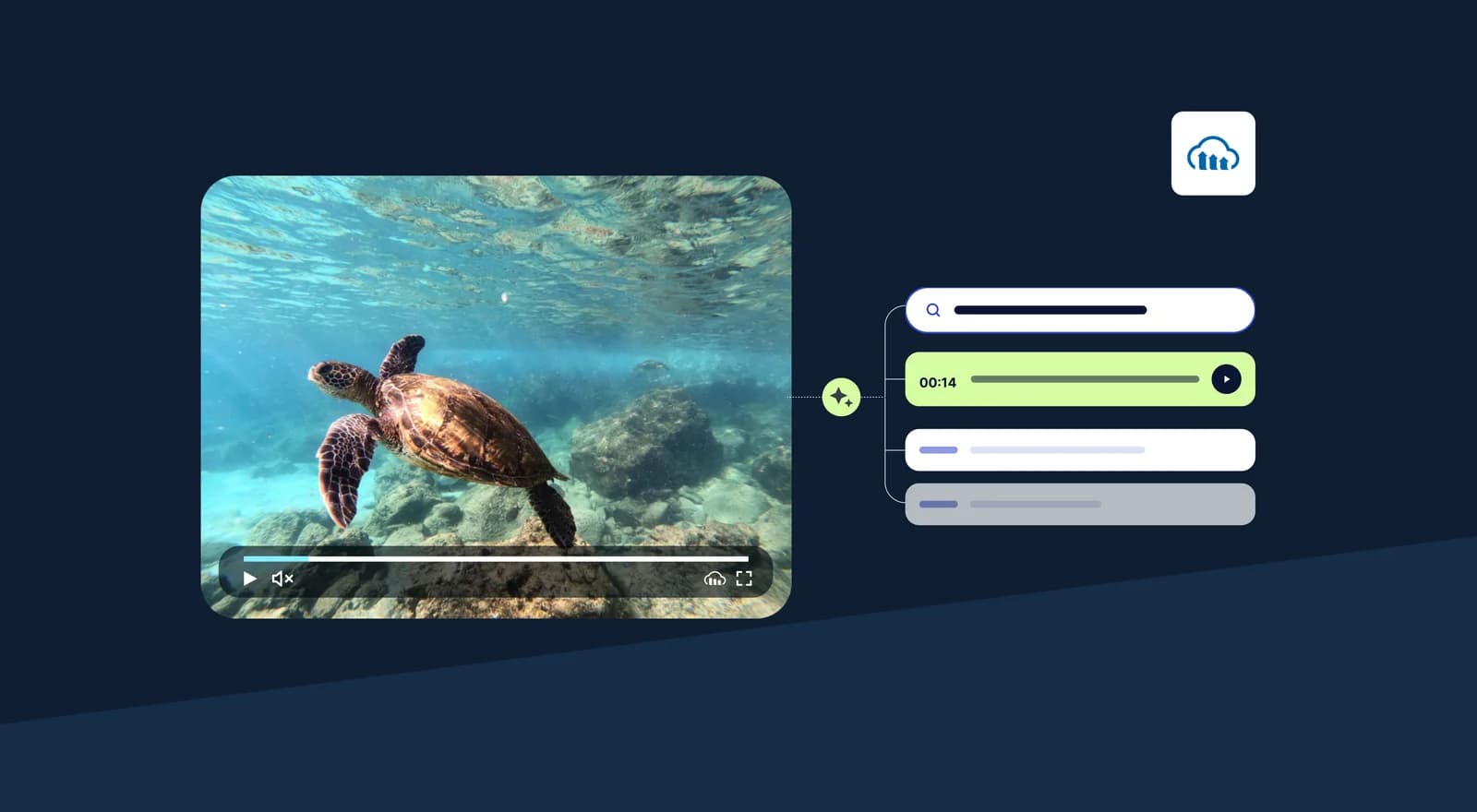
AI can search a video with no speech by converting each visual scene into timestamped text, embedding those scene descriptions, and retrieving the closest scene for a natural-language question. The answer can then cite the scene’s exact start and end times and seek the video player directly to that evidence.
In this tutorial, you will build that retrieval pipeline with Next.js, Cloudinary AI Video Analysis, Gemini embeddings, Supabase pgvector, and the Cloudinary Video Player.
- Live demo: https://build-visual-rag-for-video.vercel.app/
- Github repo: https://github.com/musebe/Build-Visual-RAG-for-Video
The finished application is the retrieval layer of Visual Retrieval-Augmented Generation (RAG). It returns ranked, timestamped evidence rather than asking a language model to invent an answer. You can add generation later, using only the retrieved scenes as grounded context.
The application follows this pipeline:
A visitor can load the included sea-turtle demo or upload an MP4, MOV, or WebM file. Cloudinary describes visually distinct scenes and assigns timestamps. The application embeds those descriptions, stores them in Postgres, and returns results such as 0:04.5–0:08.5. Selecting a result seeks the player to that moment.
The demo also includes a reproducible 30-question benchmark. That proof matters because an attractive search interface does not tell you whether the expected scene was retrieved.
Speech transcription answers questions about what was said. It can’t reliably answer questions such as:
- When does the turtle swim toward the camera?
- Which moment shows the subject from below?
- When does an object leave the frame?
- Where does visible text or a color change appear?
Those answers exist in pixels, not audio.
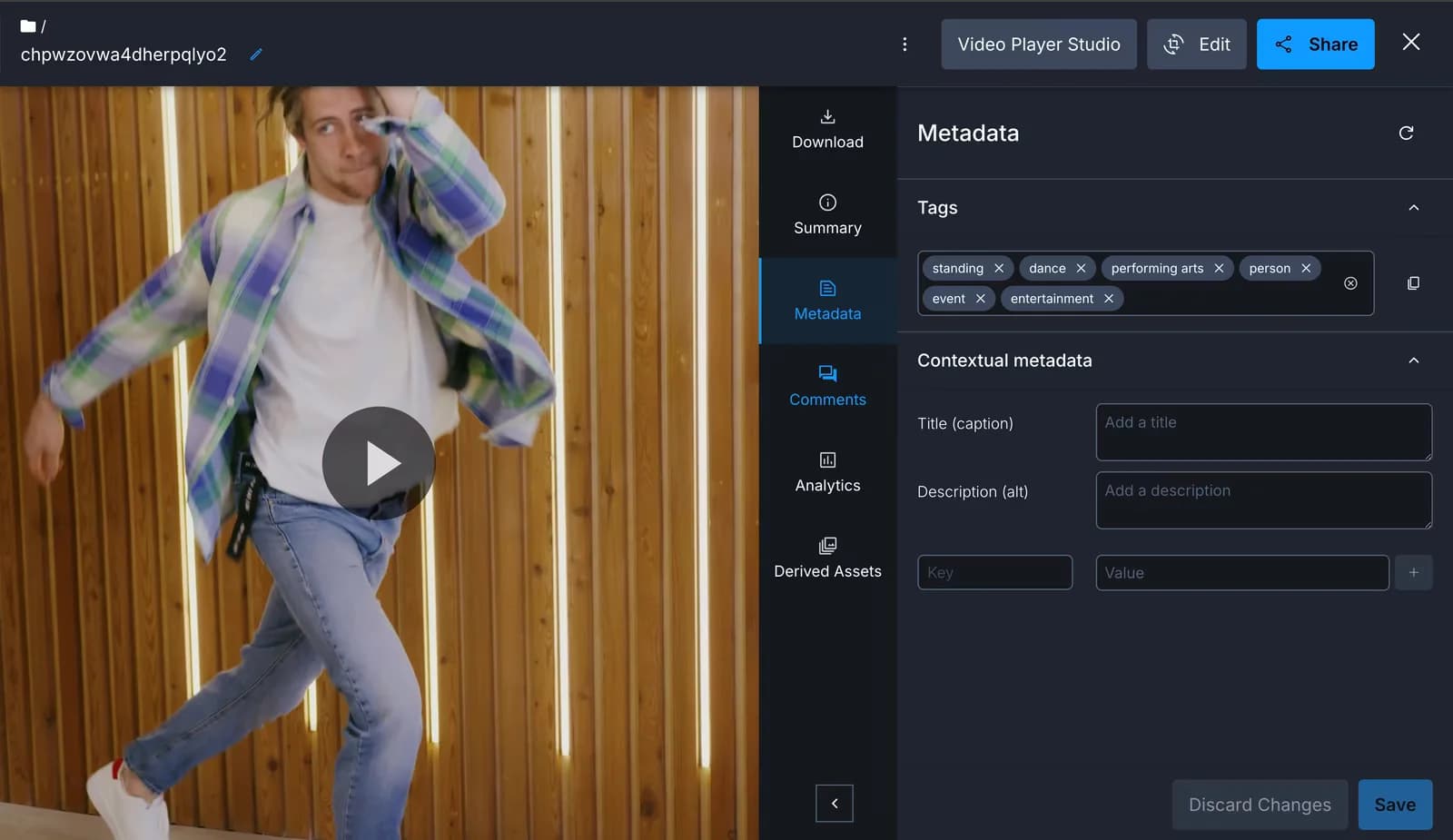
Cloudinary AI Video Analysis generates a visual transcript for a video already stored in your Cloudinary product environment. Each segment contains a description plus start_time and end_time. The feature is currently Beta, so confirm access in the product environment you will use and recheck the current API contract before production deployment.
This gives the retrieval system two things that a normal speech transcript cannot provide: semantic descriptions of visible events and source-aligned time ranges.
The original RAG paper combines retrieval with generation so a model can answer from external evidence. In a visual-video workflow, the evidence must first be made searchable.
This project separates that process into four stages:
The architecture deliberately keeps timestamps attached to descriptions throughout the pipeline. If text is embedded without its source range, search may find a relevant description but cannot produce a verifiable video citation.
You’ll need:
- Node.js 20 or later.
- A Cloudinary account and product environment with AI Video Analysis Beta access.
- A Supabase project.
- A Gemini API key from Google AI Studio.
- A Vercel account only if you want to deploy the application.
The project uses Next.js 16, React 19, TypeScript, next-cloudinary, the Cloudinary Node.js SDK, shadcn components, and Vitest. It was scaffolded from create-cloudinary-next.
Clone the finished project and install its dependencies:
Cloudinary is responsible for the original video, the visual analysis job, the generated transcript asset, and playback.
In the Cloudinary Console:
- Create or select a product environment.
- Open Settings, then API Keys.
- Copy the cloud name, API key, and API secret.
- Confirm that this product environment has access to the AI Video Analysis API (Beta).
- Upload a demo video to the Media Library if you want a reusable one-click example.
- Open that asset and copy its immutable asset ID for DEMO_VIDEO_ASSET_ID.
AI Video Analysis is an API capability, not one of the similarly named Marketplace tagging or transcription add-ons. Access and commercial terms can change while the API is in Beta.
Create .env.local from the template:
Add placeholders for your own credentials:
Only the Cloudinary cloud name is public. Keep the Cloudinary API secret, Supabase secret key, and Gemini API key in server-only variables. Rotate a secret immediately if it appears in a screenshot, chat, log, or Git commit.
The 100 MB value is this demo’s application limit, not a statement about Cloudinary’s platform limit. Adjust it for your threat model and deployment environment.
Apply all files in supabase/migrations in filename order with the Supabase CLI or SQL Editor.
The first migration enables pgvector, creates the workflow tables, and stores each scene with its original time range:
The complete visual RAG schema also records Cloudinary asset identifiers, analysis jobs, transcript assets, processing states, and timestamps. Later migrations add search, benchmark storage, indexes, and server-only permissions.
Row-level security is enabled without browser policies because the application accesses these tables only through trusted Next.js routes. The Supabase secret key never reaches the client.
Large video bytes should not pass through the Next.js server just to reach Cloudinary. Instead, the browser requests constrained signed parameters from the server and uploads directly to Cloudinary.
The signing engine fixes the public ID, accepted formats, tags, context, overwrite behavior, and timestamp before generating a signature:
See the complete signed-upload implementation and signature route. Cloudinary’s upload-signature guide explains why the signature must be created in a trusted environment.
The browser validates the declared MIME type, byte size, and file header before requesting a signature. It then uses XMLHttpRequest so the UI can report upload progress. Read the full browser upload client.
Client checks improve feedback, but they are not a security boundary. After upload, the server reads the asset through the Cloudinary Admin API and verifies its immutable asset_id, generated public-ID namespace, ingestion context, decoded format, and actual byte size.
The live application offers a Load demo video button so a reader can test search without uploading duplicate content. POST /api/videos/demo reads DEMO_VIDEO_ASSET_ID, checks whether it was already indexed, and reuses the existing database record.
If it is new, the route reads the Cloudinary asset by ID and starts the same analysis pipeline used for uploads:
See the complete demo-video route. Using the immutable asset ID avoids relying on a changeable filename or public ID as the application’s identity key.
The analysis endpoint accepts a Cloudinary video asset ID and an optional visual-transcription prompt. The project asks for concrete, visible evidence and tells the service not to infer speech:
The full AI Video Analysis client sends credentials in the server-side authorization header, applies a timeout, validates the response, and avoids logging credentials.
Analysis is asynchronous. The initial request returns a job_id, which the application persists before polling. A status request can return pending, completed, or failed. Persisting the job ID means the process can continue across requests instead of keeping one HTTP connection open.
When the job completes, Cloudinary returns a raw visual-transcript asset. The application accepts only HTTPS URLs on res.cloudinary.com, bounds the download size, and validates every segment with Zod:
See visual-transcript.ts for the response-envelope and transcript parsers.
See for the response-envelope and transcript parsers.
For the 15.215-second sea-turtle demo, Cloudinary generated three scenes:
One Cloudinary segment becomes one retrievable scene. This keeps the generated description, scene index, and source timestamps together. More elaborate chunking can merge or split scenes, but it must preserve the mapping back to the original time ranges.
The project uses gemini-embedding-2 and explicitly requests 1,536 output dimensions to match the Postgres vector column.
Google’s current Gemini embeddings documentation recommends distinguishing retrieval documents from retrieval queries in the input. The project prepares them like this:
The embedding client bounds each input, requests the expected dimensions, validates every returned number, and processes scenes with limited concurrency. See gemini.ts and retrieval-input.ts.
Documents and queries must use the same embedding model and dimension. Changing models requires re-embedding the scene corpus. The application stores the model name beside each vector and rejects search when the indexed model differs from the configured model.
Once the transcript is ready, POST /api/videos/:videoId/index claims the video for indexing, embeds every scene description, upserts the vectors, and advances the workflow to ready.
Read the complete index route and repository.
Read the complete index route and .
The workflow states uploaded, analyzing, transcript_ready, embedding, ready, and failed make partial processing visible. Conditional updates also stop two requests from claiming the same indexing step.
For production workloads, move long analysis and embedding stages into a durable background workflow with retries, idempotency, and observability. A browser polling loop is suitable for this focused demo, not for high-volume ingestion.
Supabase ranks vectors with cosine distance. The SQL function first restricts the search to the requested ready video and matching embedding model, then orders those scenes by similarity:
Read the complete scene-search migration. Pushing the video filter into the database function follows Supabase’s semantic-search guidance and avoids retrieving unrelated rows before filtering them in application code.
The demo uses exact cosine search because each indexed video has a modest number of scenes. As the corpus grows, evaluate a vector index such as HNSW and measure recall with your real filters. Supabase documents the available tradeoffs in its vector-index guide.
POST /api/videos/:videoId/search validates the question, embeds it as a retrieval query, calls the Supabase function, and converts each database match into a public citation:
The response includes the scene description, similarity, start time, end time, and display citation. See the complete search route and citation formatter.
A language model is not required to produce this result. If you add one, give it only the retrieved descriptions and timestamps, require citations, and keep the source scene results visible. Retrieval quality and answer quality should be evaluated separately.
The UI renders CldVideoPlayer from next-cloudinary. Because the player depends on browser APIs, it is dynamically imported with server-side rendering disabled. When a visitor selects a result, the component seeks to the cited start time and begins playback:
Cloudinary’s Video Player API exposes currentTime() and play() for this interaction. The complete video-search component also includes upload progress, processing states, accessible result buttons, and three example searches that readers can paste with one click.
Try these questions in the live demo:
- When is the turtle viewed from below?
- When does the turtle swim close to the camera?
- When does the turtle swim away?
The benchmark tests two distinct claims:
- Did retrieval rank the human-labeled scene first?
- Did the top citation overlap the human-labeled time range?
The sea-turtle-v1 dataset contains exactly 30 questions, with ten labels for each of the three scenes. Labels were created by watching the source video before retrieval, not by copying wording from Cloudinary’s generated descriptions.
Each run stores its dataset version, Cloudinary analysis prompt, embedding model, threshold, result count, ranked results, and aggregate metrics. This makes the result reproducible and prevents a tuned threshold from silently hiding difficult matches.
The benchmark reports:
You can inspect the browser workbench at /benchmark?video=<video-id> and the full benchmark protocol.
The verified run completed on August 23, 2026 against Cloudinary’s 15.215-second samples/sea-turtle video. It used three Cloudinary scenes, gemini-embedding-2 at 1,536 dimensions, cosine similarity, no tuned retrieval threshold, and three returned results.
Four questions labeled for the opening scene ranked a later scene first. The misses used phrases such as “turn,” “before it approaches,” and “angled across the frame,” which also describe movement in later scenes. In all four cases, the expected scene ranked third.
This is a controlled demo result, not a general accuracy claim. Because the corpus contains one short video and exactly three indexed scenes, returning three results makes top-3 recall a weak metric. A stronger evaluation needs longer silent videos, more scenes, independently reviewed labels, diverse visual domains, and per-video results.
Add the same environment variables to the Vercel project, keeping every secret server-only, then deploy the application. Run this health check after deployment:
The endpoint reports whether Cloudinary, Supabase, and embeddings are configured without returning credential values. The verified public deployment returns HTTP 200 with all three services enabled.
Test the complete proof after local setup or deployment:
- Open the live SceneSeeker demo.
- Select Load demo video.
- Wait for Ready to search.
- Select one of the example searches.
- Submit the question and open a result.
- Confirm that the Cloudinary Video Player jumps to the cited scene.
For production traffic, add authentication, request quotas, rate limits, asset-retention rules, durable jobs, retry controls, and abuse monitoring.
Visual transcription also does not replace speech transcription. A production video-search system can index visual scenes, spoken words, on-screen text, and structured asset metadata as separate evidence channels, then compare their contribution in evaluation.
Silent video becomes searchable when visual evidence is converted into timestamped descriptions and those descriptions remain linked to their source scenes. Cloudinary stores the video, generates the visual transcript, and plays cited moments. Gemini creates retrieval embeddings, while Supabase pgvector ranks the matching scenes.
The most important design choice is not the search box. It is preserving provenance from the Cloudinary transcript through vector storage to the final player action. That is what turns a plausible semantic match into a timestamped, verifiable citation.
Ready to start building with Cloudinary? Sign up for a free account today.