A new listing comes in from a seller. The product photo is clean, well-lit, and compelling. Is it a real photo of the item? A real photo retouched with generative fill? Or an image no camera ever took?
For many marketplace teams, the honest answer is that nobody knows, and they find out after the listing goes live. A buyer complains, a return comes back marked “not as pictured,” or another seller reports that their photo was lifted. By then the damage to the listing, and to buyer confidence in the platform, is already done.
That gap matters more now that regulators are paying attention to synthetic media. The EU AI Act’s transparency provisions introduced disclosure obligations for some AI-generated and AI-manipulated content. Even where the law doesn’t apply, the expectation is the same: platforms should know what they’re publishing.
Answering the question before an image goes live is the job of AI-generated content detection. Building that capability is the easy part. Keeping it accurate is the hard part.
Image generation tools ship updates on a cadence measured in months, sometimes weeks. Each release changes the telltale artifacts detectors learn to spot: skin texture, the way light falls on metal, the text printed on a label. A model trained on last year’s outputs is looking for fingerprints that this year’s tools no longer leave.
That turns AI content moderation into a maintenance problem rather than a one-time build. A script or classifier trained once and left alone degrades quietly. Accuracy drops and nobody notices until synthetic images are slipping through at volume.
Provenance standards like C2PA help where they exist. A C2PA manifest carries a tamper-evident record of where an image came from and how it was edited. But most seller-submitted photos arrive without content credentials, and anyone passing off a synthetic image has no reason to add them. For third-party content, detection still does the heavy lifting.
“Is it AI-generated?” is only one question a seller photo raises. A useful detection layer checks several at once, because each represents a different way an image can mislead a buyer. At minimum, that means four checks:
- AI-generated images. Detection models flag visuals that appear synthetic, so a rendered product shot doesn’t pass as a photo of the real item.
- Web-sourced images. Reverse image search catches photos copied from another retailer, a manufacturer’s site, or a competitor’s listing — a sign the seller may not have the item in hand.
- Watermarks and promotional badges. Flagging stock-photo watermarks, sale stickers, and other overlays keeps listings within guidelines, and these marks often reveal an image was lifted from another source.
- Duplicates and near-duplicates. Spotting the same image, or a lightly cropped or recolored version, across listings stops one photo from standing in for many items or sellers reusing someone else’s inventory shots.
Together these cover the common failure modes: fabricated, borrowed, branded, and recycled. A detector that only answers the first question leaves the other three open. Cloudinary Moderation includes built-in checks for all four.
A flag is not a decision. Once an image is marked as possibly AI-generated or web-sourced, there needs to be a way to decide what comes next: approve it, reject it, or send it to a person.
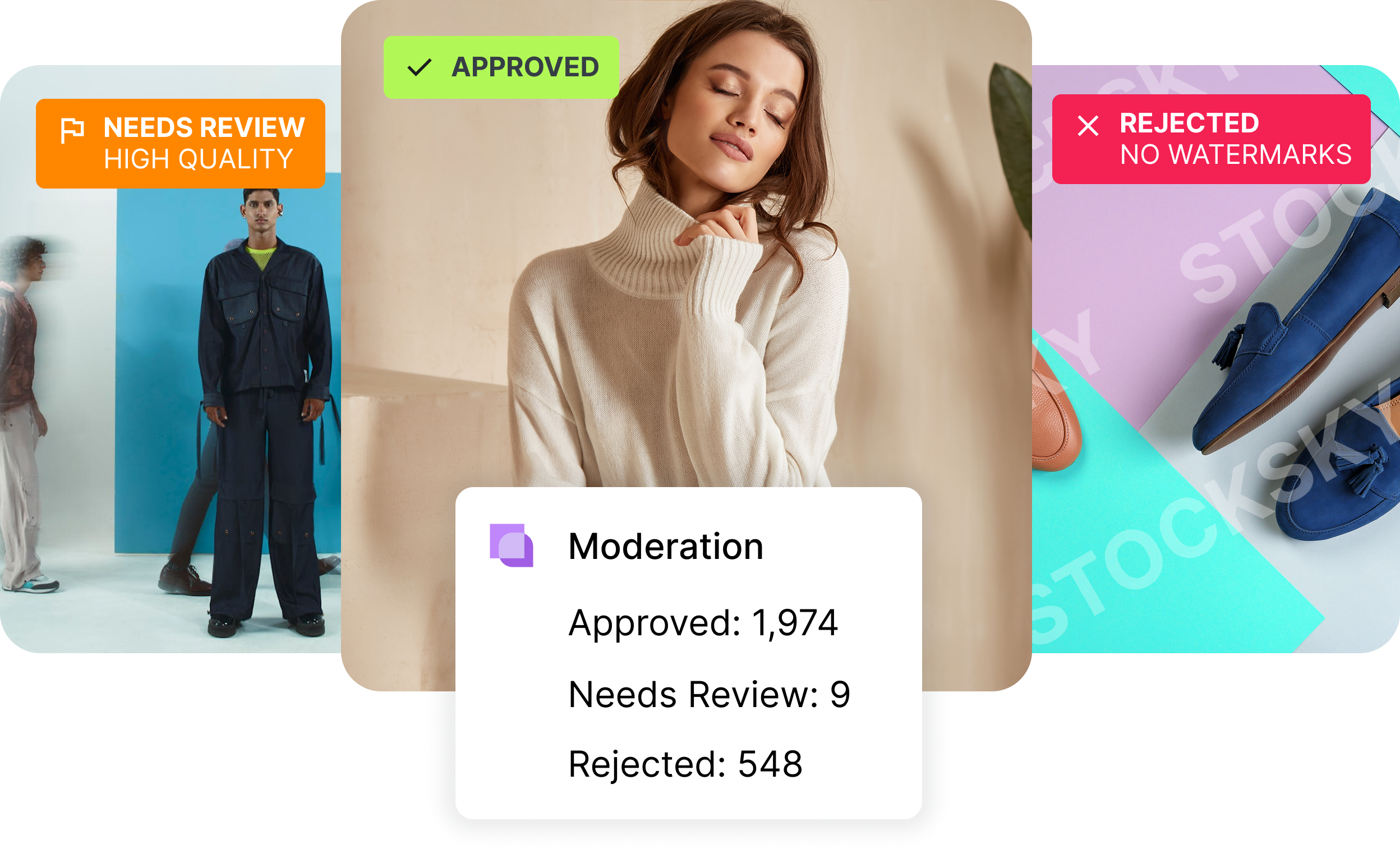
Good AI content moderation makes that routing explicit. Cloudinary Moderation sorts incoming images and videos into approved, rejected, or needs review, with a clear reason attached to each result. Clear-cut cases resolve automatically. Ambiguous ones, like a genuine product photo with a generated background, go to a reviewer who can weigh the context.
AI handles the first pass at a volume no team could match; humans make the final call where judgment matters. Because Moderation is configured against your own guidelines, your policy decides what counts as acceptable, not a vendor default.
The record matters as much as the flag. When a seller disputes a rejection, or a compliance team asks why an image went live, you need to show what was checked, what was found, and who decided. An audit trail makes every moderation decision one you can explain and defend.
Consider a restaurant platform that gets negative reviews with photos of poorly made food attached. If those photos were generated by AI or copied from another site, they aren’t evidence of anything. To every diner scrolling the reviews, though, they look like proof. The restaurant takes the reputational hit, and the platform’s reviews become a little less believable for everyone.
Marketplaces face the same dynamic. Swap the dish for a product listing: a synthetic photo that oversells an item drives returns and complaints, and a copied photo misrepresents what a seller actually has. Either way, the cost lands on the platform’s credibility, not just one listing.
The fix is catching these images at upload, before publication. It’s the difference between a quiet rejection and a public trust problem.
Most content ops teams could build a first version of an AI image detector. Few want to staff the work of keeping one accurate: tracking new generative models, collecting fresh examples, retraining, revalidating, and starting over when the next release lands.
That’s the real case for a maintained moderation stack. Every vendor can demo a detector that works today. What matters is who keeps it working as AI image generation tools change. When detection lives inside your media platform, updates happen upstream, and your team spends its time on policy and edge cases instead of model upkeep.
It also keeps moderation in the same workflow as everything else you do with seller images. Flagged assets can be reviewed and fixed without switching tools, and approved ones move straight into transformation and delivery.
Cloudinary Moderation reviews images and videos submitted by sellers, suppliers, partners, and customers against your guidelines before they go live. It can:
- Detect AI-generated, web-sourced, watermarked, and duplicate content.
- Route every asset to approve, reject, or human review with a clear reason.
- Where possible, suggest or apply fixes using Cloudinary transformations.
Generative tools will keep changing, and your moderation should keep pace. See how Cloudinary Moderation checks every user-submitted photo before your buyers see it.
AI content authenticity is the practice of confirming where an image or video came from and whether AI created or altered it. For marketplaces, it means knowing whether a seller’s photo shows the real item before buyers see it. Cloudinary Moderation runs those checks as images enter your pipeline.
Detection models analyze an image for patterns that generative tools leave behind and return a confidence level. Results are probabilistic, so the strongest approach pairs detection with reverse image search and human review for uncertain cases. Cloudinary Moderation includes rules for AI-generated images and originality.
C2PA is an open standard for Content Credentials, a tamper-evident record of an image’s origin and edit history. Most seller-submitted photos arrive without credentials, so platforms still need detection for third-party content. Read how Cloudinary supports the C2PA standard.
The EU AI Act’s Article 50 transparency obligations took effect on August 2, 2026. They set marking and disclosure duties for providers and deployers of certain AI systems. Check with your legal team on how the rules apply to your platform.
Check for four things: AI-generated images, images copied from the web, watermarks or promotional badges, and duplicates. Add quality and composition rules such as resolution and background to keep listings consistent. See how Cloudinary handles third-party visual content.
Your team does. AI handles the first pass, and every asset receives an outcome of Approved, Needs Review, or Rejected with an explanation. Reviewers can override any result. The Cloudinary Moderation launch post walks through the review flow.
Cloudinary Moderation includes a free plan for evaluating it on your own content. AI-generated detection, web-sourced image detection, and automatic moderation on upload are available on advanced plans. Try Moderation in the Cloudinary Console or compare plans.