Key takeaways:
- The research community reached quantum advantage in 2026, running computations beyond classical methods with results that can be rigorously verified.
- IBM Quantum Nighthawk r2, its fastest processor yet, supports accurate circuits with more than 7,500 quantum operations on 120 programmable qubits, and delivers up to 100,000 samples per second, a 25x gain over Heron.
- Progress toward 100 million operations and IBM Quantum Starling, the fault-tolerant computer IBM plans to deliver in 2029, is backed by detailed plans guiding parallel co-design of memory, l-couplers, decoders, and cryogenics.
- The directed execution model and new managed workflows on IBM Quantum Functions scale hybrid quantum-classical workloads across billions of samples.
- New tools—Qiskit Fermions, Qiskit Bosons, optimization mappers—and 39 client projects turn verified advantage into practical applications.
Two years ago, we predicted that the first demonstrations of quantum advantage would arrive by the end of 2026, if the quantum and high-performance computing communities worked together. This year, together, we did it. Researchers ran computations beyond purely classical methods, and did so with results that can be rigorously verified. That combination of performance and trust makes this the year of advantage.
But advantage is a milestone, not a destination. We’ve shown quantum computers can outperform classical methods, and now the race is on to make them useful. We build these tools to solve challenging problems in fields ranging from sustainable energy and materials science to drug discovery and financial optimization—problems that demand far more than a single benchmark-beating result.
That’s why, at IBM Quantum Developer Conference 2026 (QDC 2026), we’re tracking our progress across the four pathways that carry us from advantage to useful applications: (1) advantage with frontier circuits, (2) the path to IBM Quantum Starling, (3) the path to integrations, and (4) the path to practical applications.
Progress across these pathways gets us to our ultimate goal: a quantum computing platform informed by real workflows. Below, we look at each in turn, starting with the foundation: processors built for speed.
Advantage with frontier circuits
The foundation of a useful quantum supercomputing platform is hardware built for speed, making frontier circuits not just possible, but also cost efficient.
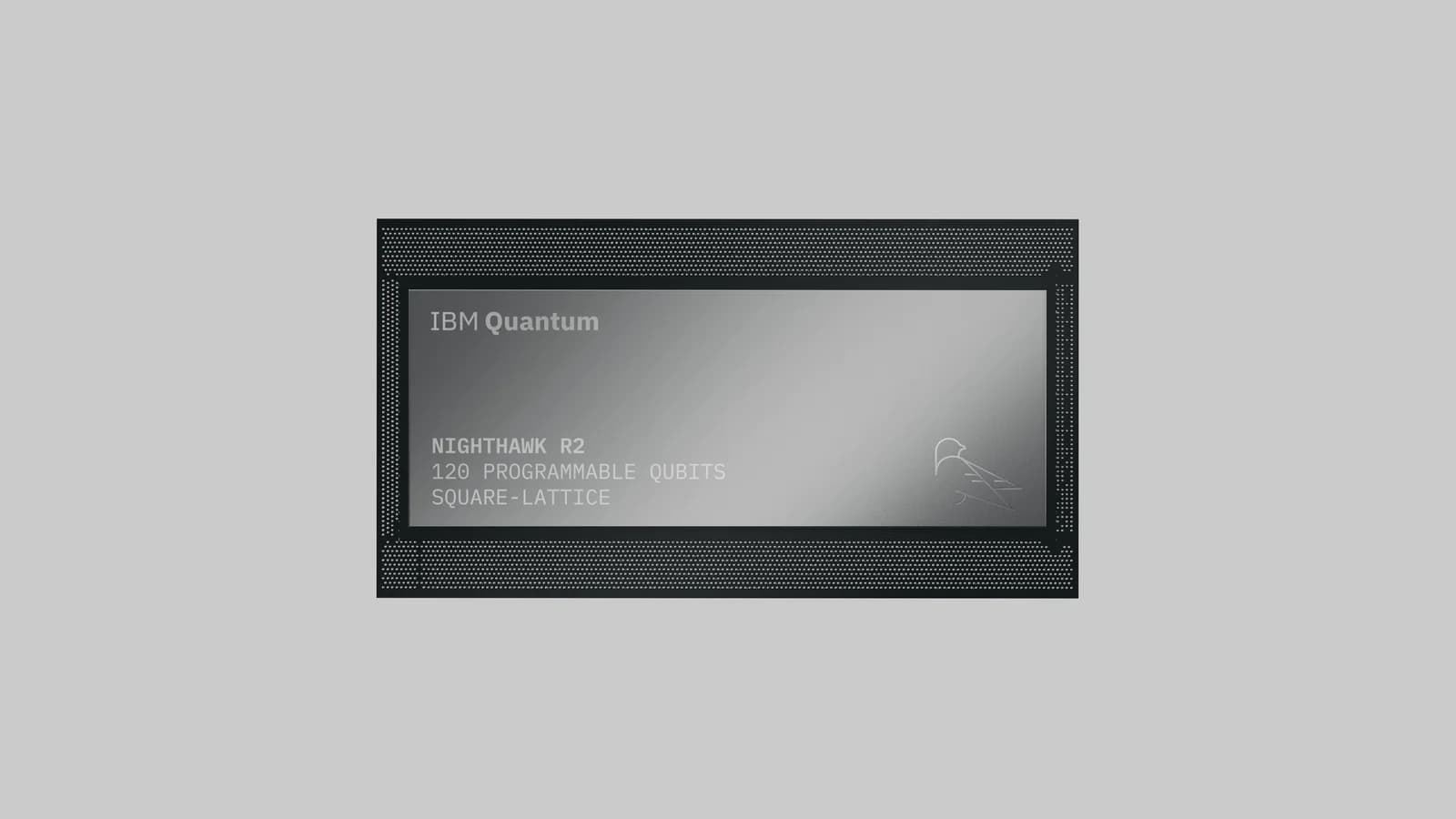
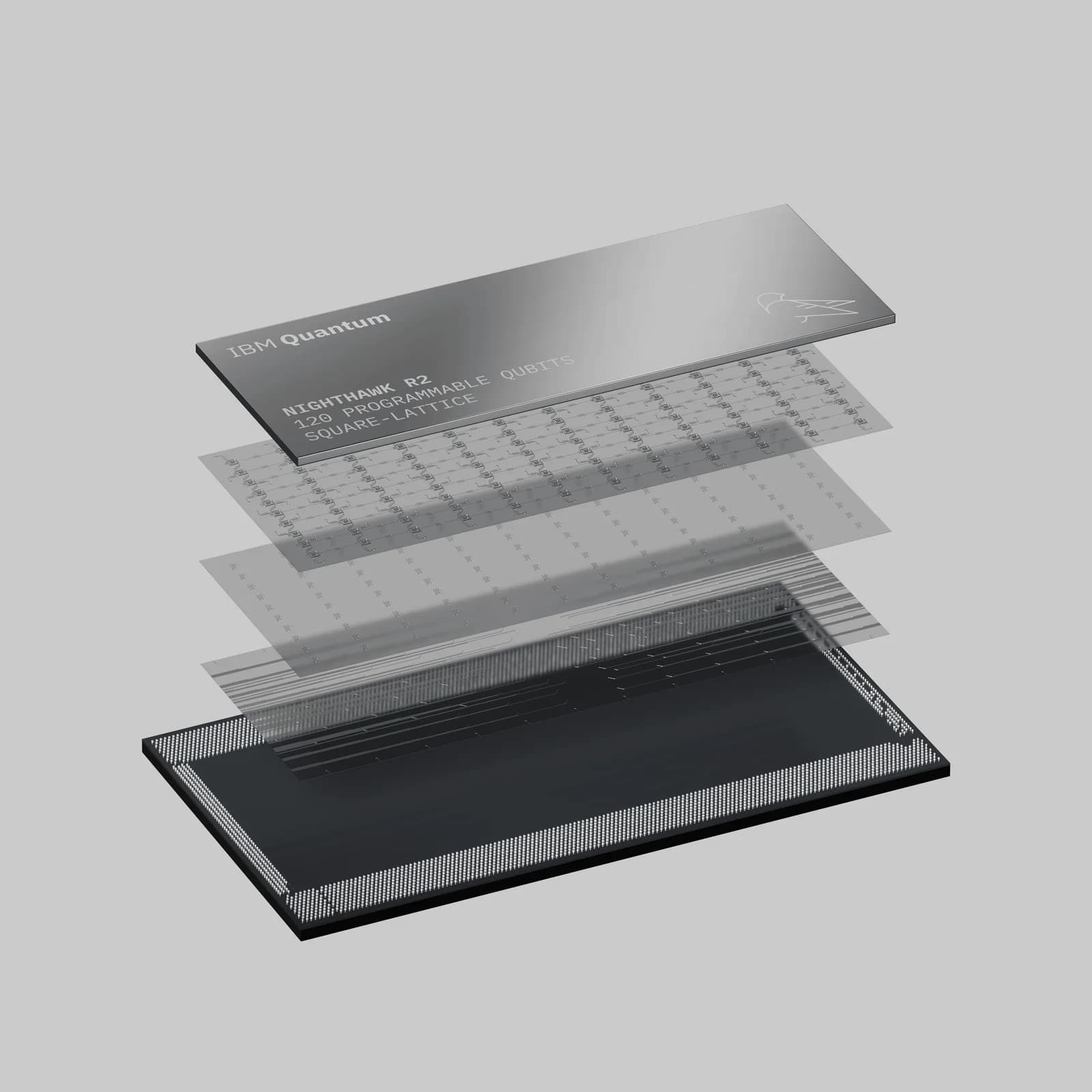
This year, we introduced IBM Quantum Nighthawk r2, our most advanced processor yet, built to run accurate circuits with more than 7,500 quantum operations. Its square-lattice connectivity across 120 programmable qubits (458 physical qubits) allows it to run circuits that are far more challenging for classical methods to simulate. And, as our fastest processor yet, its high-speed qubit reset architecture reaches up to 100,000 samples per second—a 25x throughput gain over IBM Quantum Heron.
We’ve already begun using Nighthawk r2 to replicate this year’s advantage demonstrations, and users are putting it to work as well.Run frontier circuits with our hands-on tutorials, which include a 64-qubit ergodicity experiment and a 96-qubit classical shadows analysis. Explore the tutorials: Onset of ergodicity and Classical shadows.
In fact, clients and partners including E.ON, Algorithmiq, and Q-CTRL have now run more than 34 billion circuits on Nighthawk r2 according to our team’s calculations, reporting performance improvements of up to 19x beyond previous IBM Quantum processors.
The IBM team saw the same pattern in its own research. One simulation experiment studying real magnetic materials run earlier this year with Oak Ridge National Laboratory delivered a 12x speedup, producing outputs consistent with neutron scattering experiments. Meanwhile, an Algorithmiq experiment simulating the quantum dynamics of a heterogeneous material, first demonstrated on IBM Quantum Heron as part of this year's quantum advantage results, now executes 8x faster on Nighthawk r2.Read the full Nighthawk r2 announcement on the IBM Quantum blog.
By taking advantage of Nighthawk r2's square-lattice connectivity, the extended Algorithmiq experiment also enables circuits that are significantly more demanding for leading classical tensor-network methods to simulate. At fixed accuracy, those classical methods would require an estimated 240x more memory than for the original heavy-hex implementation, even as the quantum computation itself runs 8x faster.
The pattern is consistent: gains in processor throughput and connectivity can simultaneously accelerate quantum workloads and extend them deeper into regimes that challenge classical computation.
The speed and quality of Nighthawk r2 have enabled important progress on the IBM Quantum Roadmap. The processor’s increased throughput brought us to a 100 kHz reset rate. Doing so, without sacrificing quality, enabled us to reliably execute circuits with more than 7,500 quantum operations using probabilistic error amplification. With that, two key milestones come off our Development Roadmap.See where these milestones sit within the broader IBM Quantum Development Roadmap.
Since deployment, AI-driven tuning of our devices has further enhanced device quality, improving high-error two-qubit gates by up to 7x. These newer advances will extend the reach of demonstrations on Nighthawk r2.
Nighthawk is also proving to be an exceptional testbed for error correction. By pairing the pulse-level capabilities this research depends on—mid-circuit measurement, fast classical feedback, real-time control—with its speed and square-lattice connectivity, Nighthawk r2 lets researchers exercise those capabilities at the scale real codes demand. Early demonstrations are already running many rounds of syndrome measurement end to end using Qiskit’s loop functionality via IBM Quantum Platform.For a deeper look at how you can get started exploring Nighthawk r2’s error correction capabilities on IBM Quantum Platform, read the QDC practitioner blog.
To accelerate that research, we're co-locating Nighthawk r2 with Oak Ridge National Laboratory's Umbra system, a high-performance computing platform powered by AMD Instinct™ MI355X GPUs and 5th Gen AMD EPYC™ CPUs.
Bringing the two systems together lets researchers co-design quantum error correction algorithms across quantum and classical resources rather than in isolation, working toward capabilities that will ultimately enable valuable applications in fields like chemistry and materials science. We built this new co-design platform for quantum error correction in collaboration with AMD and the U.S. Department of Energy’s Quantum Science Center headquartered at Oak Ridge National Laboratory.Read the full ORNL, IBM, and AMD co-design platform announcement on the IBM Quantum blog.
This work aligns with the broader goals of the U.S. Department of Energy's Genesis Mission, which aims to reach 100 logical qubits running 100,000 hard operations by late 2028.
Taken together, these advances show that speed is more than a specification. It is an essential capability that makes frontier circuits cost-efficient and turns Nighthawk into a proving ground for the error correction to come.
The path to Starling
Reaching quantum circuits at the scale of 100 million operations will require a fault-tolerant quantum computer—one that runs valuable circuits in minutes, not months. The first such computer will be IBM Quantum Starling, targeted for 2029.Get a more detailed breakdown of this year's progress towards IBM Quantum Starling in our Path to Starling blog post.
Building a first-of-its-kind system means co-designing its components in parallel, where a lesson learned on one component reshapes the design of another. For Starling, that co-design effort is taking place across six essential areas: device physics, QPUs, modular decoders, inter-module connectivity, modular cryogenics and wiring, and modular control electronics.
No matter how we go about the journey, however, our destination remains the same: modular logical memories paired with logical processing units, joined by l-couplers and incorporating magic states to realize design that needs roughly 10x fewer physical qubits than other fault-tolerant architectures.
Let’s start with the memory that will store Starling’s logical qubits. Our IBM Quantum Loon processor, first showcased at QDC 2025, now brings the ingredients of an error-correcting qLDPC processor together on a single chip, with measured performance comparable to Nighthawk r2.
Design improvements cut Loon’s hardest-to-yield elements—its Josephson junctions—by more than half, from about 5,000 to 2,000. The decrease was enabled by an improved qLDPC code that needs only five qubit connections instead of six, as well as new coupler innovations. Fewer components mean a simpler chip that is easier to build and less prone to error, thanks in large part to denser on-chip connections known as c-couplers.Explore the device physics behind c-couplers and our fault-tolerant architecture in our video on the IBM Research YouTube channel.
Just as important is joining these modules together reliably, since Starling will need more than 100 chip-to-chip interconnects, which we call l-couplers, working in concert. A recent demonstration showcases our ability to now reliably link two Nighthawk processors using four l-couplers at 99% average state transfer fidelity, with a best result of 99.3%. This is a level of repeatability that makes modular scaling realistic, and it’s an early proof point for the connectivity Starling will depend on.Read more about the recent l-coupler demonstration.
The rest of our error correction stack has kept pace. Decoders that catch and correct errors in real time now meet the performance Starling needs, and we’re developing a dedicated decoder chip to push further. On the control side, our latest cryogenic control ASICs now match the gate performance of room-temperature electronics.
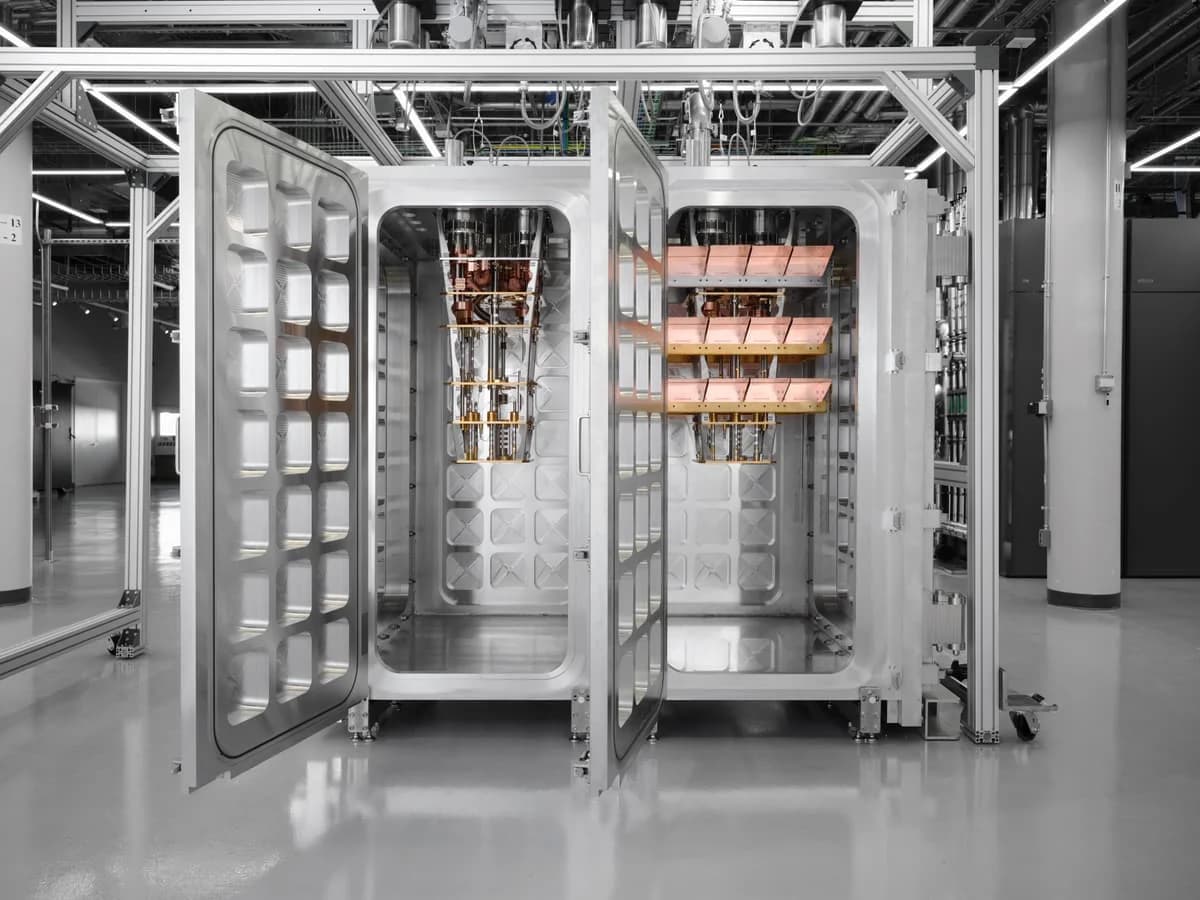
Underpinning it all is a new design built on modular cryogenics that keeps the whole system cold enough to operate and now forms the backbone of future systems. This year, we connected two cryogenic modules into a single system for the first time, reaching operating temperature in under five days and cooling below 15 millikelvin.Discover our modular cryogenic architecture, which forms the backbone of future quantum systems.
Progress on each component shapes the design of the others, which is why building Starling in parallel—not as a sequential checklist—is the right approach for a system this complex.
The path to integrations
Scaling advantage to practical applications means moving beyond a landscape of single circuits. The workloads ahead require hundreds of millions if not billions of samples spread across quantum and classical resources.
Demonstrations like operator Loschmidt echo estimation on Nighthawk r2 illustrate this point. Their sample counts and runtime show that running one circuit at a time is nowhere near enough. The challenge is to give researchers more control over how a workload runs without giving up the speed that makes it viable. In other words, we need to move beyond single circuits.
Our answer is the directed execution model, the foundation of the integrations pathway. Rather than treating a quantum computer as a black box that runs one circuit and returns a result, it gives researchers more control and transparency over the whole computation without sacrificing performance. It achieves this through a seamless, composable set of open-source Qiskit tools.Read the recent directed execution blog to get the full picture of how workloads scale and explore related tools for directed execution.
Two advances build on that model for developers. First, Backend v3—coming in 2027—evolves the backend interface to express a full quantum program. It frames classical pre-processing, quantum execution, and classical post-processing as a coherent unit rather than focusing on isolated circuit runs.
We’re also introducing new profiling tools that let developers estimate a workload’s cost and usage before they run it, inspect its timing, and analyze noise locally. Better visibility means better optimization and lower cost, checking another roadmap milestone off our list.Our practitioner blog discusses the new profiling tools in more detail. To see them in action, work through the profiling tools tutorial, which estimates usage, inspects circuit timing, and previews error mitigation before committing QPU time.
Giving developers control also means meeting them in the tools they already use. This year we opened an official, open-source repository of Qiskit agent skills—packaged instructions that ground an AI coding assistant in the latest Qiskit best practices.
The first skills take on exactly the kind of work that slows developers down, covering tasks like code migration and selection of error mitigation techniques for a given circuit. And an open repository means the community can build on these skills and contribute their own.Explore and contribute to the open-source Qiskit agent skills repository on GitHub.
All of this comes together in the pathway’s headline release: managed workflows, a new capability in the IBM Quantum Functions (formerly Qiskit Functions) technology stack.Explore pre-built functions from across the ecosystem in the IBM Quantum Functions catalog.
Instead of stitching together compute environments by hand, teams can now run and reuse their quantum-classical workflows on managed infrastructure. That infrastructure delivers high-memory and GPU-accelerated classical compute, parallelism to run parameter sweeps from a single deployment, persistent storage that outlives any one workflow, and usage-based billing in the platform.
These capabilities underpin the large-scale hybrid workflows we’re exploring with our partners today, including experiments involving millions of samples and distributed execution across quantum and HPC resources. Together, they turn a bespoke pipeline into a reusable resource, something a team can deploy repeatedly and scale without rebuilding it each time, while laying the groundwork for a more collaborative workflow experience over time. They also bring us to another checkpoint on our Development Roadmap.Deploy your first managed workflow with this step-by-step walkthrough on IBM Quantum Platform.
The impact is already visible at scale. Our quantum-classical workflows for sample-based quantum diagonalization (SQD) have evolved from open-loop execution to closed-loop, parallel, and distributed workflows designed for large-scale hybrid computing environments.
For example, IBM and RIKEN scientists executed their original SQD workflow roughly 5x faster while performing 100x more computations than in the original study. Cleveland Clinic and RIKEN also leveraged these integrated platform capabilities to automatically process approximately 608 million samples for modeling biologically relevant structures, around 33x faster than without workflow automation.Put workflow automation to work with this SQD tutorial, which combines quantum and distributed classical computing to find a molecule’s ground-state energy. Alternatively, try our QCSC Prefect tutorial, which orchestrates an SQD workflow across quantum and classical HPC resources.
Composed together, these pieces form a single, high-performance layer for hybrid quantum-classical workflows—the integration story behind running billions of samples at speed.
The path to practical applications
This is where advantage meets the real world. The same verifiability that made this year’s quantum advantage demonstrations credible is also what transforms a quantum result into something businesses can act on.
That transition is already underway across chemistry, materials, energy, and finance. In 2026 alone, we have 39 projects active or completed with industry clients. Many of those projects now operate at scales measured in millions of samples, reflecting a shift from proof-of-concept demonstrations toward workflows designed around real computational demands.Discover real-world client explorations and results via our case studies page.
To make that progress systematic rather than anecdotal, we ground it in the application areas where quantum computing can provably help: Hamiltonian simulation, optimization, quantum machine learning, and partial differential equations. Each is motivated by algorithms with provable guarantees, and heuristic quantum methods let us start exploring the white space between today’s hardware and those algorithms now, across all four computational areas.
Optimization is the clearest test case, with well-defined problems and solutions that are easy to verify. Last year the Quantum Optimization Working Group—one of several community-led research groups we’re proud to take part in—produced the open-source Quantum Optimization Benchmarking Library. That work has since matured into a peer-reviewed paper in Nature Computational Science and a public tracker.Browse the Quantum Optimization Benchmarking Library and contribute via its public repository.
Increasingly, these benchmarking efforts are being complemented by large-scale industry experiments. For example, E.ON reported a 15x speedup on Nighthawk r2 over the previous-generation Heron processor in experiments applying quantum machine learning to energy grid optimization. In separate work, E.ON and Qoro distributed a 1,710-variable optimization problem across multiple quantum processors using spectral partitioning and circuit packing, a workflow that consumed roughly 20 million samples.
Experiments at this scale highlight just how large practical optimization problems can get, and show why throughput, cost per sample, and workflow orchestration are becoming essential measures of progress.
Rigorous, community-driven benchmarking like this is what we hope to see take hold across the less-mature computational domains. New working groups for Hamiltonian simulation, quantum machine learning, partial differential equations and more are doing exactly that.Explore the quantum working groups and find out how to get involved.
To turn targets into results, we’re expanding our application tooling. Our Qiskit optimization mapper is now in use by clients like Allstate, with more optimization tools on the way.In the meantime, try the optimization mapper yourself in our Warm-start QAOA tutorial, which maps a max-cut problem to a quantum Hamiltonian and solves it with warm-start QAOA.
On the simulation side, these methods are already tackling industrially relevant chemistry. To simulate protein-ligand complexes of up to 12,635 atoms relevant to drug-protein interaction, for example, Cleveland Clinic, RIKEN, and IBM ran circuits generating 1.75 billion samples in 139 hours.Read the full protein-ligand study from Cleveland Clinic, RIKEN, and IBM on arXiv.
Sample-based quantum diagonalization keeps evolving to support work at this scale, and a new pair of Qiskit agent skills now guides the hardest design choices involved in simulating fermionic systems. These include a skill for Qiskit Fermions, which helps you choose an encoding and validate it with ffsim, as well as a skill for Qiskit SQD, which chooses the classical eigensolver best suited to your problem. Together with Qiskit Fermions itself and the alpha release of Qiskit Bosons, these advances check off the utility mapping tools milestone on our roadmap and expand our growing suite of simulation tools.Learn more about Qiskit Fermions, Qiskit Bosons, ffsim, and the new Qiskit agent skills in the QDC practitioner blog.
Finally, we’re growing the ecosystem with new application functions backed by real research and built with partners across the quantum ecosystem. These include optimization functions, a function that returns quantum feature vectors for any classical model, and a function for simulating Fermi-Hubbard dynamics. Launching across the fall, all of them are available in the IBM Quantum Functions Catalog.Browse the latest application functions and ecosystem partners in the IBM Quantum Functions Catalog.
Across this pathway, clear targets with built-in verification and a growing suite of tools are doing for applications what speed did for advantage: turning results that can be trusted into applications that researchers can use and scale.
We met the goals we set, and we’re raising them.
This year we checked milestones off our roadmap across every pathway—from Nighthawk’s gate and speed targets to managed workflows, optimization benchmarking, and new utility mapping tools—and moved every component of Starling forward in parallel. Today we’re extending the roadmap that has guided this progress.
The updated IBM Quantum Roadmap is led by IBM Quantum Nighthawk r3, our next processor designed to run 10,000 quantum operations on 520 programmable qubits. In 2027, leveraging the same strategies that enabled our recent l-coupler demonstration, we plan to link two Nighthawk r3 processors into a single 1,040-qubit system. Explore what comes next on our updated Development Roadmap.
We made it faster to run frontier circuits; advanced every component on the path to a fault-tolerant Starling through parallel co-design; built an integration layer that runs billions of samples at speed; and expanded the tools that carry verifiability from advantage into practical applications.
We’ve solved some of the hardest problems on the path to useful quantum computing, and the ones that remain are exactly the kind this community solves best. The demonstrations that made this the year of advantage were never ours alone, and neither is what comes next. This is the year quantum advantage became real—now, help us make it useful, and start building with us on IBM Quantum Platform.