The IDE for professional development in Go
GoLand
Every year, the JetBrains Developer Ecosystem survey gives us a snapshot of how developers work. This year, 28,945 developers took part between May and July 2026, and 1,836 of them named Go as one of their primary programming languages.
To celebrate Go’s 17th birthday, in this post, we look at who those Gophers are, which tools they rely on, how AI is changing their day-to-day work, and what the most significant events of this year were for the Go community.
TL;DR:
- Go developers are among the most experienced in the survey: 66% have six or more years of professional coding experience, compared with 49% of all respondents.
- The standard library has caught up with Gin: net/http is now used by 46% of Go developers for web development, up from 32% last year.
- Gophers are heavy AI users, especially in the terminal: 86% use AI coding agents in the CLI at least once a week, compared with 74% of all respondents.
- They keep humans in charge: 79% often or always review AI-generated code before accepting it.
- The language took one of its biggest steps since generics, with generic methods, encoding/json/v2, and the Green Tea garbage collector arriving this year.
Who are Go developers in 2026?
Backend first, full-stack on the rise
Web services are still Go’s home turf: 80% of Go developers use Go for backend web development, and 49% use it to build CLI utilities and small tools. The biggest shift is in full-stack work, which grew from 30% in 2025 to 40% in 2026 – a trend that matches the rise of TypeScript as Go’s favorite companion language (more on that below).
In relative terms, the fastest-growing task is deploying and managing AI models, which doubled from 3% to 6%. It’s still a niche, but the tooling is maturing. Community projects like Ardan Labs’ Kronk, led by Bill Kennedy, bring hardware-accelerated local inference directly into Go applications.
Go developers · 2025 vs. 2026
Tasks Go developers use Go for
Which tasks do you usually use Go for? (Multiple answers allowed)
- 2025
- 2026
Backend web service development
82%
80%
CLI utilities and small tools
48%
49%
Full-stack web service development
30%
40%
Libraries and frameworks
29%
27%
Deployment and configuration management
22%
23%
Kubernetes controllers and extensions
23%
21%
Data processing
18%
19%
Serverless architecture (AWS Lambda, etc.)
14%
16%
Deploying and managing AI models
Other infrastructure platform development
Other
Polyglots that love TypeScript
Go developers rarely live in Go alone. Only 46% name Go as their single main language. Among their other primary languages, Python (35%), TypeScript (27%), and Java (22%) are the most common.
This holds true even more so for individual projects. Just 27% of Go developers use no other language alongside Go in the same project, down from 35% in 2024. TypeScript has become Go’s most common project companion, jumping from 24% in 2024 to 43% in 2026 and leaving Python (27%) and JavaScript (24%) far behind. A Go backend with a TypeScript frontend is turning into the default stack for a growing share of teams.
Go developers · 2024–2026
Languages Go developers use alongside Go in the same project
Which languages do you use along with Go in the same project? (Multiple answers allowed)
- 2024
- 2025
- 2026
TypeScript
24%
31%
43%
Python
23%
23%
27%
JavaScript
29%
25%
24%
C++
Rust
Other
None – Go only
35%
33%
27%
Go developers · 2024–2026
Other primary programming languages of Go developers
What are your primary programming languages? Languages Go developers name alongside Go.
- 2024
- 2025
- 2026
Python
35%
31%
35%
TypeScript
18%
23%
27%
Java
21%
27%
22%
JavaScript
17%
14%
12%
SQL
10%
10%
11%
Rust
10%
Shell scripting languages
C++
PHP
Kotlin
HTML / CSS
Swift
Dart
Ruby
Objective-C
<1%
<1%
Scala
<1%
Lua
<1%
<1%
Elixir
<1%
Groovy
<1%
<1%
<1%
Assembly
<1%
<1%
Delphi
<1%
<1%
<1%
Ada
<1%
Clojure / ClojureScript
<1%
COBOL
<1%
<1%
CoffeeScript
<1%
<1%
Haskell
Julia
<1%
LabVIEW (G dataflow)
MATLAB
Perl
Platform-specific language (Apex, ABAP, 1C, etc.)
<1%
<1%
Visual Basic
Other
Happy where they are – with a soft spot for Rust
Most Go developers aren’t looking to move: 70% don’t plan to adopt or migrate to another language in the next 12 months, up from 64% in 2024 and higher than the 63% we see across all respondents of the Developer Ecosystem 2026 survey.
Among those who do plan to learn something new, Rust dominates. Chosen by 16% of Go developers, the share has been holding steady for three years now. We see that they don’t just stop at admiring the language; they actively adopt it – the share of Go developers who used Rust in the last 12 months grew from 14% in 2019 to 25% in 2026, so one in four Gophers now has at least some experience with Rust.
That doesn’t mean Go services are being rewritten, though. Rust is the most desired language across the whole survey, and many developers may be using it for side projects or for narrow, performance-critical components.
Go developers · 2024–2026
Languages Go developers plan to adopt or migrate to in the next 12 months
Do you plan to adopt or migrate to other languages in the next 12 months? If so, which ones?
- 2024
- 2025
- 2026
Not planning to adopt or migrate
64%
66%
70%
Rust
17%
15%
16%
C++
Java
Swift
Kotlin
TypeScript
Python
Elixir
Ruby
JavaScript
PHP
<1%
SQL
Dart
Lua
<1%
Shell scripting languages
Scala
Haskell
<1%
Assembly
<1%
HTML / CSS
<1%
<1%
<1%
<1%
<1%
Julia
<1%
<1%
<1%
MATLAB
<1%
<1%
<1%
Perl
<1%
<1%
Platform-specific language (Apex, ABAP, 1C, etc.)
<1%
Groovy
<1%
<1%
Ada
<1%
Clojure / ClojureScript
<1%
<1%
COBOL
<1%
CoffeeScript
<1%
Delphi
LabVIEW (G dataflow)
<1%
Objective-C
<1%
Visual Basic
<1%
<1%
Other
Gophers by choice
Go isn’t just something developers are forced to use at work. While 82% use Go professionally, 70% also use it for personal or side projects, and 40% use it for hobby projects. When that many developers reach for a language in their free time, it’s a good sign that they actively choose Go rather than merely tolerate it.
Go developers · 2026
Types of projects Go developers use Go for
Which types of projects do you use Go for? (Multiple answers allowed)
Work
82%
Personal / side projects
70%
Hobby
41%
Other
Experienced and well paid
Go remains a language of experienced engineers. Two-thirds (66%) of Go developers have six or more years of professional coding experience, compared to an average of 49% of all respondents. At the other end of the scale, only 3% have less than a year of professional experience or none at all, compared with 13% overall.
That seniority is reflected by salary bands as well. 17% of Go developers earn more than USD 120,000 a year, compared with 13% of all respondents, and the share earning more than USD 180,000 is almost twice as high (9% vs. 5%).
Go developers vs. all respondents · 2026
Years of professional coding experience: Go developers vs. all respondents
How many years of professional coding experience do you have?
6+ years of experience: 66% of Go developers vs. 49% overall
- Go developers
- All respondents
10%
20%
30%
4%1%9%2%15%9%22%22%28%22%18%12%20%16%
None<11–23–56–1011–1516+
Years of professional coding experience
Go developers vs. all respondents · 2026
Annual salary in USD: Go developers vs. all respondents
Annual salary, converted to USD and grouped into bands
More than USD 120K: 17% vs. 13%
More than USD 180K: 9% vs. 5%
- Go developers
- All respondents
10%
15%
20%
15%10%14%11%14%12%11%10%9%9%13%13%17%12%8%8%9%5%
Up to 12K12–24K24–36K36–48K48–60K60–84K84–120K120–180KOver 180K
Annual salary, thousand USD
Tools and libraries
The standard library catches up with Gin
Go’s standard library has always been one of its strongest selling points, and external frameworks struggle to compete. This year, net/http usage among Go developers rose to 46% (from 32% in 2025), putting it practically level with Gin (48%), which held steady.
Among the other options for web development frameworks, chi (15%), Echo (13%), and Fiber (13%) are the most popular, and only 12% of Go developers don’t use any web framework or router at all.
We can’t measure the reasons directly, but there are a few factors that may contribute to the rising popularity of the standard library’s net/http. Since Go 1.22, the standard ServeMux supports method matching and wildcards in route patterns, which covers much of what developers used to pull in a third-party router for. Meanwhile, the original gorilla/mux, which dominated for a long time but was archived in 2022, is likely slowly being replaced in production projects. Finally, with agentic development on the rise, one of Gin’s primary advantages – handling repetitive tasks – no longer seems relevant, since AI can handle the boilerplate on its own and will favor the standard library to avoid dependency resolution.
Testing frameworks and mock libraries follow a similar stdlib-first pattern: 35% of Go developers don’t use any external frameworks, followed by Testify at 31% and GoMock at 25% – a noticeable rise from 17% in 2024. Interestingly, the share of Go developers who don’t write unit tests dropped to 14% in 2026, from 21% in 2025. This might be because they can now use AI to help with this task; in fact, we see that 84% of Gophers use AI to generate tests weekly or more often – an increase of 20 p.p. compared to 2025!
The starkest contrast is in build systems: 86% of Go developers use go build, while 46% also rely on Makefiles. Other tools (Gradle – 6%, Bazel – 4%) lag far behind.
Go developers · 2025 vs. 2026
Go web frameworks Go developers regularly use
Which Go web frameworks do you regularly use, if any? (Multiple answers allowed)
- 2025
- 2026
Gin
48%
48%
net/http
32%
46%
gorilla/mux
17%
15%
go-chi/chi
12%
15%
Echo
16%
13%
Fiber
11%
13%
Beego
Buffalo
Revel
Other
None
15%
12%
Go developers · 2024–2026
Build systems Go developers regularly use
Which build systems do you regularly use, if any? (Multiple answers allowed)
- 2024
- 2025
- 2026
go build
90%
88%
86%
Makefile
42%
44%
46%
Gradle
Bazel
Other
None
Go developers · 2024–2026
Testing frameworks and mock libraries Go developers regularly use
Which testing frameworks or mock libraries do you regularly use, if any? (Multiple answers allowed)
- 2024
- 2025
- 2026
I write unit tests but don’t use any frameworks
37%
35%
35%
Testify
28%
27%
31%
GoMock
17%
21%
25%
Ginkgo
go-sqlmock
Godog
Gomega
GoConvey
Other
I don’t write unit tests for Go
19%
21%
14%
IDEs – a more crowded field
With the rise of AI, the editor landscape for Go has diversified. GoLand (49%) and VS Code (48%) are each used by about half of Go developers. Zed nearly tripled its share (5% to 14%) in a year, Cursor held steady at 14%, and Neovim edged up to 10% at the expense of Vim.
But we don’t see developers abandoning the IDE. As the AI section below shows, more Go developers say the time they spend in their IDE has increased over the past year than say it has shrunk, and IDE-based coding agents are part of their daily routine. The question is no longer whether developers use an IDE, but how it fits into a workflow that also includes agents running in the terminal and in the cloud.
Go developers · 2025 vs. 2026
IDEs and editors Go developers use for Go development
Which IDEs or editors do you use for Go development? (Multiple answers allowed)
- 2025
- 2026
GoLand
58%
49%
Visual Studio Code
45%
48%
Zed
14%
Cursor
14%
14%
Neovim
10%
IntelliJ IDEA
Vim
Visual Studio
Sublime Text
Windsurf
Emacs
Atom
<1%
Other
AI – Gophers are all in
In August, Cameron Balahan and Richard Seroter from Google argued that Go is an ideal language for AI-assisted software engineering. Their case rests on Go’s design for team-based engineering: a single toolchain, enforced formatting, static types, fast compilation, a batteries-included standard library, and a compatibility promise that keeps old code building. All of these give humans and agents fast, deterministic feedback.
Our data can’t tell us whether AI output in Go is actually better than in other languages. What it does show clearly, though, is that Go developers have built AI into their work more deeply than almost anyone else.
Go developers out-use other developers
Of the 23 AI-assisted tasks we asked about, Go developers report significantly higher weekly usage than the overall developer population for 16 of them, and do not report significantly lower usage for any of them. The biggest gaps are visible in higher-level tasks:
- Editing code across multiple files: 89% (83% across the general population).
- Agentic development of features or programs: 84% (76% across the general population).
- Generating tests: 83% (72% across the general population).
- Generating code comments or documentation: 83% (76% across the general population).
- Brainstorming new ideas: 82% (73% across the general population).
- Performing code reviews: 80% (72% across the general population).
For everyday tasks like code completion (79% for both groups) or generating boilerplate (82% to 80%), Go developers are on par with everyone else.
Go developers vs. all respondents · 2026
Weekly AI use for coding tasks at work: Go developers vs. all respondents
How often do you use AI tools for each of the following tasks at work? Share answering once a week or more often.
- Go developers
- All respondents
Generating code
94%
93%
Editing code across multiple files
89%
83%
Explaining bugs and offering fixes for them
87%
84%
Checking code for potential issues
85%
81%
Agentic development of features or programs
84%
76%
Asking questions about software development and coding
84%
80%
Generating tests
84%
72%
Generating code comments or code documentation
83%
76%
Generating chunks of boilerplate, repetitive code
83%
81%
Brainstorming new ideas
83%
74%
Improving or optimizing code
81%
80%
Performing code reviews
80%
72%
Explaining code
80%
76%
Code completion
79%
79%
Debugging code
76%
74%
Learning new things about coding and software development
75%
73%
Summarizing recent code changes
71%
68%
Generating commit messages
70%
63%
Generating user documentation
65%
59%
Generating internal documentation
64%
59%
Natural-language search for code fragments
64%
58%
Refactoring code
62%
61%
Converting code to other languages
23%
26%
Terminal agents are the Gopher’s tool of choice
The clearest difference is in how Go developers use AI coding agents. 86% run agents in the CLI or terminal at least once a week, compared with 74% of all respondents, and only 5% never use them (general population – 14%).
Our first guess as to why that happens was seniority – it stands to reason that experienced developers tend to feel more at home in the terminal. But the gap holds when we compare like with like: Among developers with six or more years of experience, 87% of Go developers use CLI agents weekly, compared to 75% of the general population.
A more likely explanation is the nature of Go work itself. Go developers build CLI tools, infrastructure, and services that live in the terminal, so it’s natural for their AI tools to live there too. And the Go toolchain – go build, go vet, go test, go fmt, and go fix – gives terminal agents a fast, predictable feedback loop, which aligns with the point the Go team made.
That doesn’t mean the IDE is left behind. Gophers actually use coding agents inside their IDE every day more often than average developers – 61%, compared with 51% of all respondents.
Go developers vs. all respondents · 2026
Weekly use of AI assistance types at work: Go developers vs. all respondents
How often do you use the following types of AI assistance for your coding and development-related tasks at work? Share using each at least once a week.
Never use CLI agents: 5% of Go developers vs. 14% overall
- Go developers
- All respondents
AI coding agents in the CLI or terminal
86%
74%
AI coding agents in (plugins for) IDEs or code editors
82%
78%
AI chat (not in agent mode)
82%
83%
AI code completion in the IDE or code editor
78%
79%
Remote cloud AI coding agents (e.g. on GitHub, GitLab)
45%
42%
More code is fully generated by AI
Go developers also hand more of their code over to AI. 55% say that more than 60% of the code they produced for work in the last month was fully generated by AI coding agents, compared with 43% of all respondents. Only 6% say none of their code was fully AI-generated (compared with 10%).
However, that doesn’t translate into riskier habits. Go developers run agents in “YOLO” (full permission) mode about as often as everyone else: 10% do so almost always (compared with 8%), and 14% in most cases (compared with 13%).
Go developers vs. all respondents · 2026
What percentage of the code that you produced in the last month for work was fully generated by AI coding agents?
More than 60% fully AI-generated: 55% of Go developers vs. 43% overall
- Go developers
- All respondents
10%
20%
30%
10%6%15%11%15%13%15%14%23%18%25%19%8%6%
0%1–20%21–40%41–60%61–80%81–99%100%
Go developers vs. all respondents · 2026
How often developers use AI coding agents in full-permission mode
How often, if at all, do you use AI coding agents in a “full permission” mode (e.g. Brave and YOLO modes) for your work tasks?
- Almost always
- In the majority of cases
- In about half of the cases
- In the minority of cases
- Almost never
Go developers
10%14%15%22%38%
All respondents
8%13%15%23%40%
But humans still own the review
When AI writes more of the code, reviewing it becomes an increasingly more important part of the job. Gophers take that job seriously – 79% review AI-generated code often or always before accepting it, and only 8% rarely or never do. They look well beyond whether the code compiles. In our survey, they declared checking:
- Functional correctness: 79%
- Code quality: 75%
- Architecture of the generated solution: 69%
- Security: 64%
- Readability: 62%
- Adherence to project standards: 59%
- Performance: 56%
- Style: 43%
Most of that review happens in the IDE (65%), followed by the AI coding agent itself (50%), pull/merge request review on GitHub or GitLab (42%), and the terminal (40%). Dedicated AI code review tools, such as CodeRabbit or Cursor Bugbot, are used by 16%.
Go developers use AI to help with reviews, but they want to keep the final call to themselves. When we asked which activities they would hand over to AI, code review had the highest share of devs saying they’d still do it themselves (34%), compared with just 9% for writing tests or boilerplate code.
Go developers · 2026
What Go developers check when reviewing AI-generated code
What do you pay attention to when reviewing code generated by AI agents for your work tasks? (Multiple answers allowed)
Functional correctness
79%
Code quality
75%
Architecture of the generated solution
69%
Code security
64%
Code readability
62%
Adherence to project standards
59%
Code performance
56%
Code style
43%
Other
Go developers · 2026
Tools Go developers use to review AI-generated code
What kind of tools, if any, do you use to review the code generated by AI agents for your work tasks? (Multiple answers allowed)
IDEs or code editors
65%
AI coding agents (e.g. Claude Code, Codex, Junie)
50%
PR / MR review on GitHub or GitLab
42%
CLI / terminal
40%
AI agent UI clients (e.g. Claude desktop app, Codex app)
24%
Dedicated AI code review tools (e.g. CodeRabbit, Cursor Bugbot)
16%
Git UI clients (e.g. GitHub Desktop, GitKraken)
13%
Agentic development environments (e.g. Air, Conductor)
Agent platforms for cloud agents (e.g. Ona, Oz)
Other
Go developers · 2026
How often Go developers review AI-generated code
How often, if at all, do you review code generated by AI agents for your work tasks?
Often or always: 79%
Rarely or never: 8%
Always
42%
Often
37%
Sometimes
14%
Rarely
Never
Go developers · 2026
Activities Go developers would delegate to AI
How likely is it that you would delegate the following activities to AI tools for coding and development?
- I would still do it myself
- I am not sure yet
- I would delegate it
Performing code reviews
34%23%43%
Understanding recent code changes
33%14%53%
Writing application logic code
30%19%51%
Debugging
29%28%43%
Refactoring
23%21%56%
Prototyping solutions
17%22%61%
Creating project-related content (tasks, comments, descriptions)
17%21%62%
Checking code for potential issues
17%27%56%
Improving or optimizing code
17%28%55%
Writing tests
9%14%77%
Writing boilerplate, repetitive code
9%13%78%
Heavy users, healthy skeptics
Heavy use doesn’t mean blind trust. 29% of Go developers rate AI-generated solutions as worse than code they write themselves, slightly more than the 25% of all respondents. In other words, Gophers don’t rate AI output more highly than other developers do. The case for Go in the AI era rests on how well its tooling supports AI-assisted workflows, not on AI writing better Go.
At the same time, Go developers are more likely to think AI will eventually take over coding entirely: 33% agree, compared with 22% of all respondents.
Go developers vs. all respondents · 2026
Quality of AI-generated solutions compared to code written without AI
How would you rate the quality of solutions generated by AI coding agents compared to code fully written without any AI assistance by…?
Rate AI solutions worse than their own code: 29% of Go developers vs. 25% overall
- Much worse
- Somewhat worse
- About the same
- Somewhat better
- Much better
- I don’t know
…yourself
Go developers
24%18%35%17%
All respondents
20%19%36%18%
…your average colleague
Go developers
18%23%34%17%
All respondents
16%23%31%19%7%
…an average developer
Go developers
15%23%32%22%
All respondents
14%23%31%21%8%
Go developers vs. all respondents · 2026
Agreement with statements about the future of AI in coding
To what extent do you agree with each of the following statements? Share who agree.
- Go developers
- All respondents
Developers will be able to onboard in new domains much more quickly with AI
83%
77%
Employers will expect every developer to be proficient with AI tools
82%
78%
AI tools for developers will make developers more efficient
81%
75%
AI tools will radically change the software development job market
81%
76%
I expect employers to provide me with AI tools for coding
79%
76%
AI will do tactical tasks while developers focus on strategic work
75%
70%
Developers will orchestrate systems of AI coding agents
66%
68%
I am ready to use cloud-based generative AI services for work
65%
61%
Most software development will turn into spec-driven development
57%
56%
Development will become more enjoyable because of AI
55%
54%
AI coding will decrease the demand for professional developers
41%
38%
AI will eventually take over coding, fully replacing human developers
33%
22%
The IDE isn’t going anywhere
Despite all the talk of agents replacing editors, more Go developers say the time they spend in their IDE has increased over the past year (44%) than decreased (33%). The picture is somewhat polarized, though. Go developers are at the same time more likely than average to report a significant decrease in use (15% vs 10%), which suggests that some have moved large parts of their workflow to terminal agents, while many more use the IDE as the place where they guide, review, and refine AI-generated code – 61% of Go developers run coding agents in their IDE daily.
Go developers vs. all respondents · 2026
Change in time spent in the IDE or code editor over the last 12 months
Has the time you spent in the IDE or code editor increased or decreased over the last 12 months?
Increased: 44% of Go developers
Decreased: 33% of Go developers
- Decreased significantly
- Decreased somewhat
- No change
- Increased somewhat
- Increased significantly
Go developers
15%18%23%19%25%
All respondents
10%17%28%21%24%
Go developers vs. all respondents · 2026
How often developers use AI coding agents in the IDE and the terminal
How often do you use AI coding agents operating on your machine for your work tasks?
Use IDE agents every day: 61% of Go developers vs. 51% overall
- Every day
- Several times a week
- Once a week
- Less often
- Never
In (plugins for) IDEs or code editors
Go developers
61%17%10%7%
All respondents
51%22%12%10%
Via the CLI or terminal
Go developers
64%18%9%
All respondents
48%20%13%14%
As agents take on more of the execution, the bottleneck shifts from producing code to understanding, verifying, and owning it. JetBrains Air in IDEs makes that work faster by putting the agents Go developers already use right next to the code intelligence they rely on to verify the result.
The future of Go – stable and getting more experienced
What’s new in Go – highlights from Go 1.26 and Go 1.27
Syntax updates
Generic methods (Go 1.27)
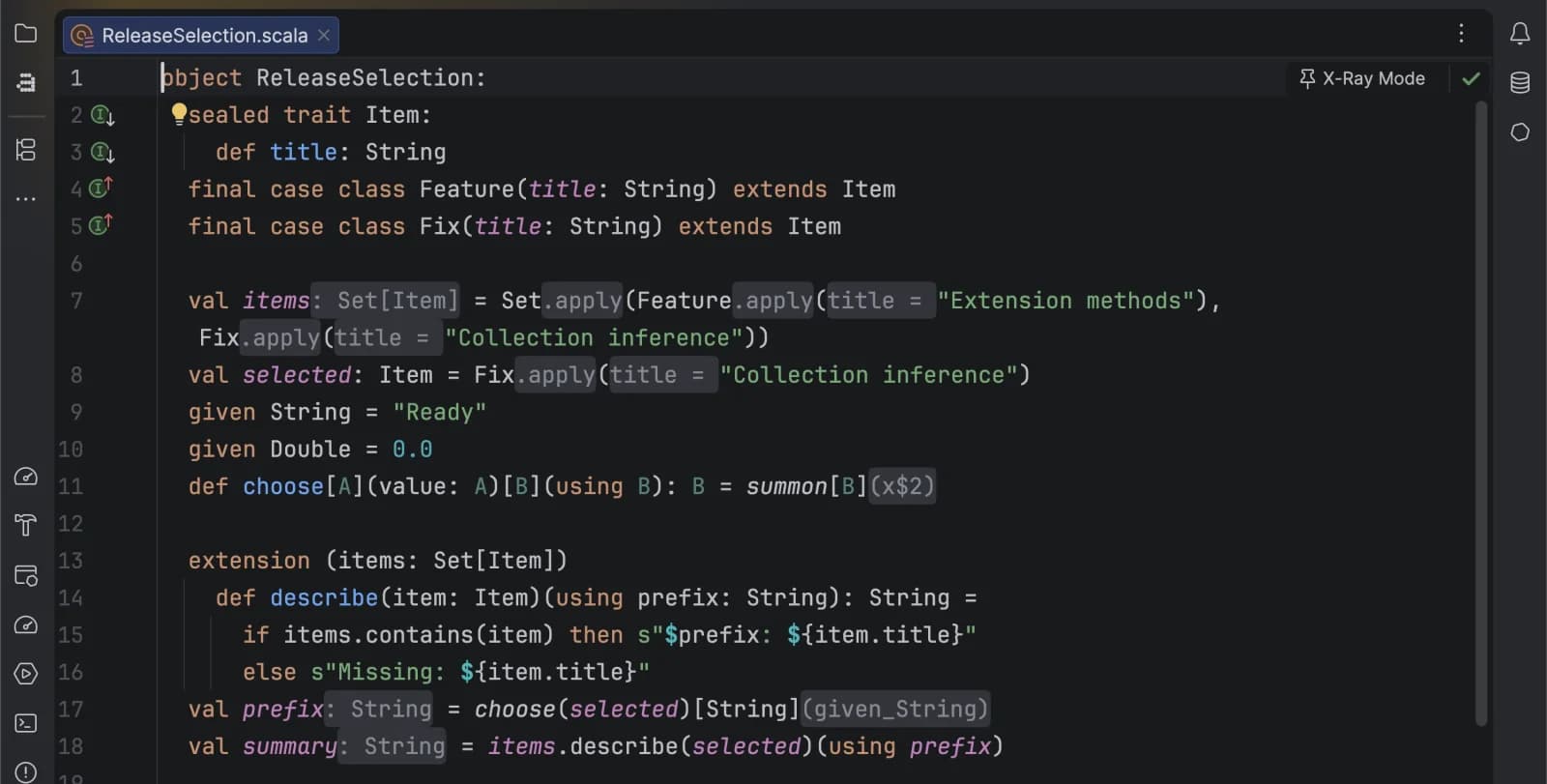
Go 1.27 also lets struct literals set promoted fields of embedded structs directly and extends function type inference to all assignment contexts.