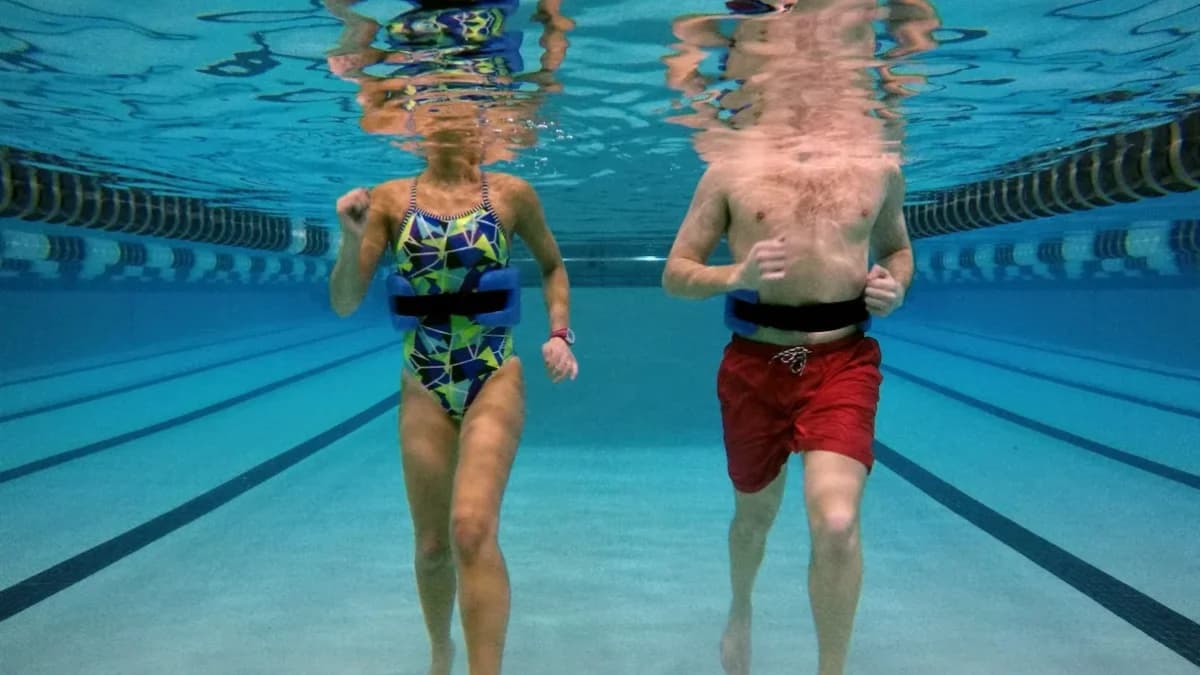
For many runners, the thought of aqua jogging is often an unpleasant one. It conjures up thoughts of boredom, ineffectiveness, and feeling awkward. But when performed correctly, with proper form and intensity, deep-water running is anything but easy or ineffective. And with a structured workout, it doesn’t have to be boring, either.
What is aqua jogging?
Aqua jogging, also known as deep-water running, is a zero-impact form of running performed in deep water. An aqua jogging belt keeps the runner buoyant, allowing them to mimic land-running mechanics without touching the bottom of the pool.
The resistance of the water challenges the muscles and cardiovascular system, while hydrostatic pressure changes how the heart and lungs respond to exercise.
For injured runners who have been cleared to exercise, deep-water running can help preserve fitness without the impact. For healthy runners, it’s an opportunity to reduce the pounding on their bodies without giving up a running workout.
How aqua jogging benefits injured runners
When an injury threatens weeks or months of training, the thought of losing hard-earned running fitness can be devastating. Yet one of the most running-specific alternatives available is often overlooked.
Sixteen years ago, I got injured six weeks before the Chicago Marathon. Told by my doctor that I could not run on land, I took to the pool and completed the final six weeks of my marathon training exclusively in deep water, running five to six days a week. That included all my remaining long runs, even a three-hour session to replace my 20-miler.
I not only finished the marathon but qualified for Boston. That experience helped shape what has become my passion ever since: helping runners get to the start and finish lines both healthy and strong.
Aqua jogging is a legitimate training tool that deserves a place in every runner’s toolbox.
The science: Can aqua jogging maintain your running fitness?
One of the biggest concerns injured runners have is how quickly they’ll lose the fitness they’ve worked so hard to build. Fortunately, research suggests that deep-water running can help preserve not only cardiovascular fitness, but running performance as well.
In a 1997 study published in Medicine & Science in Sports & Exercise, researchers led by Barbara Bushman studied 11 competitive runners who replaced all their land running with deep-water running for four weeks. Training five to six days per week, the runners showed no statistically significant changes in their 5K performance, VO2 max, or lactate threshold.
In a 1996 study in the same journal, researchers led by Randall Wilber divided 16 trained runners into two groups. One continued running on land, while the other replaced all land running with deep-water running. Both groups trained five days a week for six weeks, alternating moderate- and high-intensity workouts.
At the end of the study, researchers found no statistically significant changes in VO2 max, ventilatory threshold, or running economy in either group, and no significant differences between the groups. The runners training exclusively in water maintained their aerobic fitness comparably to those who continued running on land.
Case study: From injury to PR
Danny Kilrea, a three-time All-American cross country and track and field distance runner at the University of Notre Dame, was sidelined from land running for approximately three months due to a knee injury.
Rather than stop training, he spent up to two hours a day deep-water running. After less than seven weeks back on land, Danny ran a 28:23 10K, setting both a personal best and a Notre Dame school record.
Danny’s experience goes beyond simply maintaining fitness. It shows that incorporating deep-water running doesn’t have to mean compromising performance. It can be a valuable part of a serious runner’s training program.
Neuromuscular specificity: why deep-water running is more than just cross-training
Cycling, swimming, and the elliptical are all excellent cross-training methods for runners to maintain cardiovascular fitness while reducing impact. But deep-water running offers something different: the opportunity to train using a movement pattern that closely resembles running on land.
When performed with proper form, deep-water running requires an upright posture, alternating leg drive, coordinated arm swing, and continuous engagement of the hip flexors, glutes, hamstrings, and core.
Unlike cycling, where the legs move through a fixed circular motion, or swimming, where the body is horizontal, deep-water running allows athletes to practice a running-specific movement pattern.
That distinction matters because running isn’t just about cardiovascular endurance. It’s also about the coordination and muscular endurance required to repeat a particular movement thousands of times.
Another important difference is the resistance of the water itself. Water is approximately 800 times denser than air, creating substantial resistance as runners move their arms and legs through it. And the faster they move, the greater the resistance they encounter.
Of course, running in water isn’t identical to running on land. Without ground contact, runners aren’t developing the same impact tolerance or push-off mechanics. But they can continue practicing important elements of the running motion while giving their bodies a break from pounding.
Deep-water running challenges the whole body. Beyond cardiovascular endurance and running form, it also builds:
- The upper body: On land, our arms swing through air with relatively little resistance. In water, every arm swing meets resistance, giving the shoulders and arms additional muscular work.
- The core: Maintaining an upright position in deep water requires continuous engagement of the abdominal, back, and other stabilizing muscles that support good running posture, especially when fatigue sets in.
Once runners get the technique down and start pushing themselves, they’re often surprised by just how hard they can work in the water.
The physiology of pool running: heart rate and perceived effort
Decrease in heart rate
Heart ratewill typically be lower when deep-water running than when running on land, even when you’re working just as hard.
Here’s why: When you’re immersed vertically in water, hydrostatic pressure pushes blood from your arms and legs toward your chest and heart. This increases the amount of blood returning to the heart, allowing it to fill with more blood between beats.
As a result, the heart can pump more blood with each contraction. This is called stroke volume.
A 2003 review published in the Journal of Sports Sciences reported that stroke volume increased by approximately 35% during resting water immersion compared with rest on land. The review also described higher stroke volumes during exercise in water than during comparable exercise on land.
Think about that: Your heart can pump more blood with each beat, allowing it to deliver the same amount of blood with fewer contractions.
During deep-water running, heart rate is often approximately 10-15 beats per minute lower than during comparable exercise on land. Research supports this difference. A 1992 study by Svedenhag and Seger found heart rates 8-11 beats lower at the same oxygen consumption, while a 1997 study by Hamer and Slocombe found an average difference of 17 beats at comparable levels of perceived effort.
This is critical for runners to understand: A lower heart rate in the water doesn’t necessarily mean you’re working less hard.
When coaching runners, I typically have them add approximately 10 beats to their water heart rate during lower-intensity aerobic workouts and 15 beats during higher-intensity efforts to help compare their effort with running on land.
For example, if your heart rate is 130 during an easy deep-water run, that might correspond to approximately 140 on land. During a harder workout, a water heart rate of 145 might correspond more closely to 160 on land.
These are coaching guidelines, not exact physiological conversions. Water temperature, exercise intensity, technique, and individual differences all influence heart-rate response. That’s why I also encourage runners to pay attention to their rating of perceived exertion (RPE), or how hard the workout actually feels.
Increase in breathing effort
But hydrostatic pressure does something else that’s particularly interesting. It presses against the chest wall, creating resistance as your lungs expand and making you work harder to breathe. Research on the physiology of deep-water running explains this increased breathing effort.
I’ve sometimes compared the sensation to altitude training, although the physiology is different. At altitude, reduced oxygen availability creates the challenge. In deep water, it’s the external pressure on the chest.
The takeaway? Your body responds differently to exercise in water. A lower heart rate doesn’t necessarily mean an easier workout, which is why understanding perceived effort is so important.
Proper aqua jogging technique: form, cues, and common mistakes
Simply moving your arms and legs through the water isn’t the same as running; you need proper form to get the most out of deep-water running.
Dr. Barbara Bushman, who led the 1997 study on deep-water running discussed earlier, recently shared her thoughts with me about the importance of proper technique and intensity.
“Without attention to form, the activity is more like treading water rather than running.”
She also emphasized the importance of cadence in creating the intensity needed for an effective workout, explaining that deep-water running requires more “intentionality” than running on land because covering distance isn’t the focus.
The goal is to mimic your natural running motion as closely as possible, even though your feet never touch the ground.
My 4-step teaching method for proper form in the water
1. Start with posture.
Keep your body upright with your chin parallel to the water. Your shoulders should be relaxed and stacked over your hips, with your shoulder blades gently drawn back. Engage your core to maintain this position. Avoid leaning too far forward or backward.
2. Next, focus on your leg motion.
This is where I see some of the biggest mistakes. Many runners instinctively bring their knees up toward their chest or move their legs as though they’re riding a bicycle. When I see this, I ask, “Who runs outside like this?”
Instead, think about driving your leg forward, not upward, keeping the movement underneath your body rather than exaggerating the knee lift. Your lower leg should swing forward and then back, mimicking your natural running stride.
There’s another reason this matters: water resistance. Moving more of your leg through the water, rather than simply pedaling with your feet, can create a greater muscular challenge. The resistance depends on the position, surface area, and speed of your limbs as they move through the water.
One of my favorite ways to teach this motion is through a series of visual cues.
First, imagine kicking a soccer ball with the top of your foot. Then imagine scraping something off the bottom of your shoe as you bring your leg back. Next, imagine kicking a soccer ball backward with your heel.
Once you put these movements together, imagine your foot is a paintbrush, painting the bottom of the pool as it moves back and forth. This helps runners develop a more natural, continuous running motion.
3. Don’t forget your arms.
Keep your elbows comfortably bent at approximately 90 degrees and swing your arms forward and backward from the shoulders, like a pendulum.
I sometimes call it a “Lego arm swing” because the elbows should maintain roughly the same angle throughout the movement, rather than a “boxing” motion. Keep your hands relaxed, as though you’re gently holding a robin’s egg. Avoid crossing your arms in front of your body. And remember, unlike running on land, every arm swing meets the resistance of the water.
4. Finally, close your eyes and imagine you’re running outside.
When they’re safely positioned, I have runners briefly close their eyes and imagine themselves running on land. I want them to focus on perfecting their form and really feel like they’re running.
Essential gear for deep-water running
One of the great things about deep-water running is that you don’t need much equipment to get started, but a few key items can make a significant difference in the quality of your workout.
An aqua jogging belt (flotation belt)
This is the most important piece of equipment for deep-water running, and I recommend using one regardless of your fitness level or experience.
Without a belt, even very fit athletes may compromise their running form as they struggle to keep their heads above water. Instead of mimicking a natural running stride, they begin kicking their legs and arms outward to stay afloat.
And here’s something I always emphasize: You don’t need to take the belt off to make the workout harder. You just need to run faster and with greater intensity.
Waterproof headphones and guided workouts
Let’s face it, staring at the same spot in a pool for an hour can make even the treadmill seem exciting! Waterproof headphones and structured audio workouts help runners stay focused, motivated, and engaged.
Having a “coach in your ear” keeping track of time and calling out sets and intensities makes the time go by so much faster. That’s why I’m such a fan of the coached audio workouts we’ve created at Fluid Running. Yes, I’m a little biased!
A tether
A tether (think bungee cord) isn’t necessary, but it can be convenient, especially when sharing a lap lane with swimmers. You can thread it through the strap on the back of your flotation belt and secure it to the lane line to stay in one place and out of swimmers’ paths. It also makes it easier to concentrate on your running form and intensity without worrying about drifting.
High-yield aqua jogging workouts for every effort level
Structured workouts make all the difference in deep-water running. Just like running on land, whether you’re doing an easy recovery run, a tempo workout, or challenging intervals, every workout should have a purpose.
One of the things I love about deep-water running is that you can adapt virtually any type of land-running workout to the water. If your training plan calls for a 45-minute easy run, you can spend 45 minutes running at an easy effort in the pool. If it’s a speed workout, use timed intervals that match the intensity and purpose of your planned session.
Instead of focusing on distance or pace, match the time and effort of your land run, accounting for your naturally lower heart rate in the water.
Sample 60-minute deep water speed workout
Think you can’t do a serious track workout in the pool? Think again!
Here’s a 60-minute deep-water running speed workout using timed intervals to simulate 800s, 400s, and 200s on the track.
- 80%: comfortable and conversational
- 90%: hard, breathing through your mouth
- 95%: very hard, but not a sprint
- 100%: all out
Note: In deep water, 800M, 400M, and 200M is gauged by running the same time it would take you to run this on land matching the effort suggested.
How to add pool runs to your training log
I count my deep-water runs toward my weekly running mileage based on time and comparable effort. For example, if my training plan calls for an easy six-mile run that normally takes me 60 minutes at a heart rate of 140, I’ll run for 60 minutes in the pool at approximately 130 beats per minute.
In my training log, that counts as six equivalent miles. I’m not claiming I’ve physically covered six miles in the pool, but I’ve completed a comparable aerobic training session. Because of the water’s resistance, your cadence will typically be slower than on land, making distance and pace poor measures of the workout you’re actually getting.
Training tip → Build a structured aqua jogging session in TrainingPeaks using the Indoor Run Sport Subtype, and choose % Threshold Heart Rate (or RPE) and Duration rather than Pace and Distance.
Integrating aqua jogging into your routine
Whether you’re training for a race, managing an injury, or simply looking to reduce the pounding on your body, there are several ways to incorporate it into your weekly schedule.
In the fourth edition of his book Advanced Marathoning, co-author and two-time Olympian Pete Pfitzinger describes deep-water running as an excellent way for injured runners to maintain fitness and acknowledges its value on recovery days during marathon training, even when a runner isn’t injured.
Here’s how to get started, depending on your injury status:
- When you’re injured: If your healthcare provider has cleared you for deep-water running, you can replace all your land runs with structured pool workouts, matching duration and intensity as your injury allows. The goal is to maintain your running fitness while giving your injury time to heal.
- When you’re returning from injury: Deep-water running can help bridge the transition back to land. Gradually reintroduce land runs while continuing pool workouts on alternate days, as appropriate for your recovery, allowing your body to rebuild its tolerance for impact while maintaining aerobic fitness.
- When you’re healthy: Try replacing one run each week with a deep-water run. You’ll maintain an aerobic training session while reducing your weekly impact. It’s a simple way to incorporate zero-impact running into your training without giving up a run.
Case study: How aqua jogging helped a healthy runner PR
Doug Ginsberg is a 27-year-old marathoner and former American Ninja Warrior athlete. He runs three days a week on land and four days in the pool, including his speedwork.
Using this method, Doug ran a personal best of 2:44 at the 2026 Boston Marathon.
His experience illustrates that deep-water running can be an integral part of a serious training program, even when you’re healthy and chasing a personal best.
Protect your long run, for the long run
Running on land is important. It builds the strength and resilience our bodies need to handle impact. But we don’t need to absorb that impact with every single run to become better runners.
When an injury forced me into the pool six weeks before the Chicago Marathon, I thought I was simply trying to salvage my race. I had no idea that experience would completely change how I thought about training.
After years of working with runners of all ages and abilities, I believe more strongly than ever that deep-water running deserves a place in a runner’s training plan, not just when something goes wrong, but before it does.
We all want to keep running for as long as possible. Sometimes, the smartest way to do that is to take a little of the pounding out of the equation.
FAQs
Do you need specialized footwear for aqua jogging?
You don’t need shoes for deep-water running because your feet never touch the bottom of the pool. If you’re also doing shallow-water running, aquatic shoes may provide additional traction and comfort.
Do you need to travel through the water during deep-water running?
Not when I teach it. I encourage runners to stay relatively stationary, which allows them to work against the water’s resistance in both directions, challenging the quadriceps and hamstrings equally and engaging the core to maintain an upright position. This equal push/pull keeps you in one place.