- Blog
November 13, 2026
Constant Contact is a platform for small businesses getting started with email marketing. It’s easy to use, familiar, and well suited to sending newsletters or simple campaigns. But for many teams, there comes a point where “easy to use” starts to mean “hard to grow.”
As marketing strategies evolve, simplicity can quickly turn into a limitation. Teams often find themselves doing more manual work, struggling to build more advanced customer journeys, or hitting limits with segmentation, automation, and performance tracking.
There are plenty of Constant Contact alternatives that could be a better fit for your business. Realized it’s time to graduate from basic email campaigns? Or starting out and looking for a platform that can grow with you? This guide will help you choose the platform that fits not just where your marketing is today, but where it’s headed next.
Why are you leaving Constant Contact? Depending on the reason, you might choose a different Constant Contact alternative. Here are the six Constant Contact alternatives in this guide and what each one is best for.
- ActiveCampaign: best for growing businesses that need great automation, personalization, and a platform that can support full customer journeys (but is still easy to use because of AI)
- Moosend: best for growing small businesses that like the simplicity of Constant Contact but want more automation and targeting without a major jump in complexity
- Mailchimp: best for small businesses that want a more modern, flexible email platform than Constant Contact, with better automation and design tools
- Brevo: best for SMBs that want a broader communication toolkit, including WhatsApp, SMS, and live chat
- HubSpot: best for growing, sales-first teams that want a full CRM-driven platform across marketing, sales, and service
- GetResponse: best for businesses that want built-in webinars, funnels, and stronger lead generation workflows
The most common reason people start looking for a Constant Contact alternative is that they’ve outgrown it.
In 6,887 ActiveCampaign sales calls with people looking to switch email platforms, those leaving Constant Contact were:
- 1.9x more likely than average to start looking because of a deliverability problem
- 1.6x more likely than average to start looking because they had outgrown their platform
- 1.6x more likely than average to bring up the editor and email design
- 1.2x more likely than average to bring up automation
Deliverability problems stand out as very important when people are switching!
As you evaluate the best Constant Contact alternative for your business, it’s important to look beyond surface-level features and focus on the limitations that typically drive teams to switch.
Constant Contact is widely appreciated for its simplicity and ease of use, especially among small businesses and beginners. But across review platforms like G2 and Capterra, a consistent theme emerges: as marketing becomes more sophisticated, users begin to feel constrained by limited automation, basic segmentation, and a lack of flexibility.
While Constant Contact offers a solid feature set, it can be a bit pricey compared to some competitors, especially as your contact list grows. The automation features are effective but somewhat limited when compared to more advanced platforms like ActiveCampaign or HubSpot.
While Constant Contact offers a solid feature set, it can be a bit pricey compared to some competitors, especially as your contact list grows. The automation features are effective but somewhat limited when compared to more advanced platforms like ActiveCampaign or HubSpot.
Here are the key areas to evaluate when choosing an alternative that can support your next stage of growth:
- Automation that reduces manual work (not just basic autoresponders): Constant Contact supports simple automations, but lacks the flexibility for multi-step, behavior-driven journeys. Teams often switch when they need dynamic workflows that adapt across the full customer lifecycle—without repetitive setup.
- Segmentation and personalization that go beyond static lists: Constant Contact’s segmentation is largely list-based and campaign-level, which makes it difficult to build audiences from real-time behaviors like site activity, engagement patterns, or purchase intent. Look for platforms that support dynamic segments, event-based triggers, and reusable audience logic—so personalization updates automatically as customer behavior changes, rather than requiring constant manual rebuilds.
- Cross-channel orchestration, not just email campaigns: Constant Contact is primarily designed for one-channel execution, with limited ability to coordinate messaging across SMS, CRM actions, or on-site experiences. As strategies mature, teams often need a platform where the same automation logic can trigger and adapt campaigns across multiple channels—without managing separate tools or disconnected workflows.
- A clear path to CRM and revenue alignment: Constant Contact’s CRM functionality is minimal and not deeply integrated into campaign workflows, which makes it harder to track how marketing drives pipeline or revenue. A stronger alternative should allow marketing and sales to operate from shared data without requiring a separate system. Fit with the CRM and other tools a business uses was a main reason to switch on 47% of the calls in ActiveCampaign’s sales-call study.
- Pricing that holds up as you grow: Look for a platform where the price reflects a real increase in value, not just a bigger contact database or more sends. Many users move on from Constant Contact because it can feel expensive for what it offers—especially once you factor in added costs for a comprehensive CRM or other systems needed to support more advanced marketing.
Constant Contact is a strong starting point, but it’s not always built for what comes next. As your marketing evolves, the right alternative should not only solve today’s limitations, but also give you a clear path to scale—without forcing you into more manual work or another platform switch down the line.
Your priorities will depend on how your business operates and where you’re headed next. For example:
- Growing SMBs or startups may prioritize stronger automation and better value as their contact list expands.
- B2B businesses may look for CRM functionality that connects marketing with sales activity.
- Ecommerce brands may want deeper automation for customer journeys like abandoned cart, post-purchase, and re-engagement campaigns. Store features matter even more to them. ActiveCampaign’s sales-call study found ecommerce businesses 11.6x more likely than average to raise online store features.
- Lean teams or solo marketers may prioritize tools that reduce manual work and make it easier to scale without adding complexity.
The goal isn’t to replace Constant Contact with a like-for-like tool. It’s to choose a platform that matches the kind of marketing you want to run next—and gives you the flexibility to grow into it.
ActiveCampaign
ActiveCampaign is a strong Constant Contact alternative for businesses that want to move beyond basic email campaigns and build more sophisticated, results-driven marketing. It’s designed for teams that need deeper automation, better personalization, and a clearer path to revenue—without stitching together multiple tools.
For businesses that have outgrown Constant Contact’s limitations, ActiveCampaign offers a more advanced and integrated system that scales with your strategy, not just your contact list.
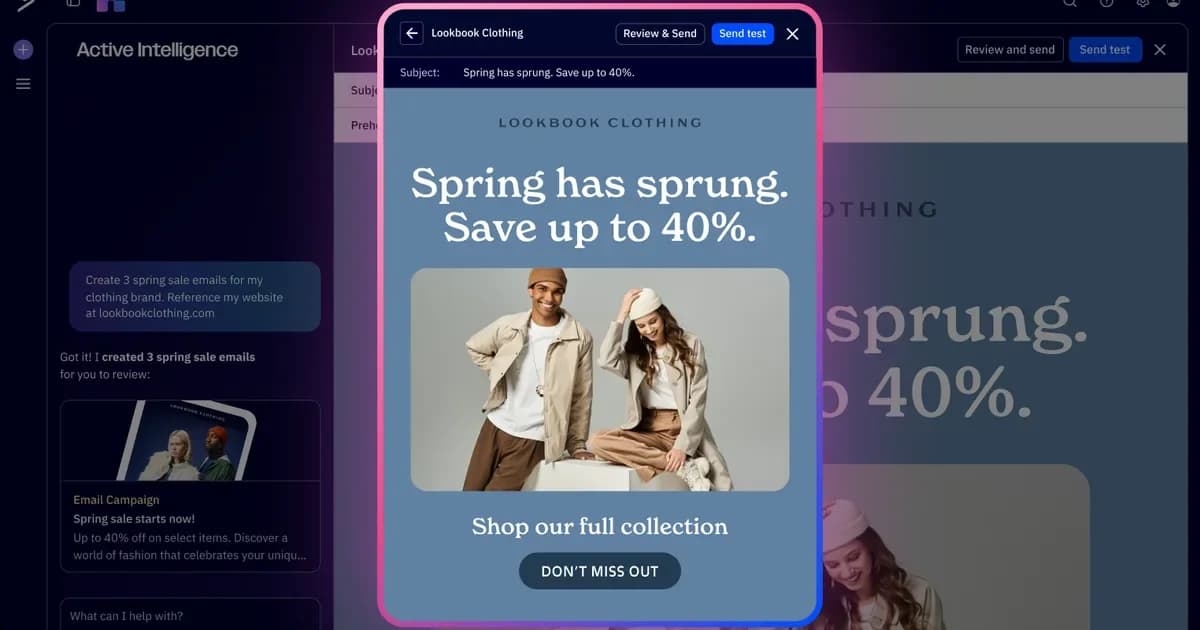
- AI that executes, not just assists: ActiveCampaign is an AI-native platform. Active Intelligence is a smart automation engine designed to support the full marketing lifecycle. It builds multi-layered campaigns, finds the right audiences, improves timing, and surfaces insights and optimizations automatically. Compared to Constant Contact’s lighter AI assistance, it plays a much bigger role in helping marketers scale output with less manual work.
- Automation and segmentation built for real lifecycle marketing: ActiveCampaign is an autonomous marketing platform, prioritizing accessible, responsive, behavior-driven campaigns that adapt and personalize as customers move through the funnel. Reusable logic and dynamic segments replace the manual rebuilds and static list management that teams often outgrow in simpler platforms.
- A built-in CRM and cross-channel engine in one system: ActiveCampaign connects marketing directly to sales with a native CRM, pipeline automation, and lead scoring built into the same platform. It extends journeys and CRM actions across email (including transactional), SMS, WhatsApp, and extensive integrations, making it easier to move beyond email-only campaigns without stitching together separate tools.
- Deliverability and analytics that improve performance over time: ActiveCampaign is built to help campaigns land in the inbox and show what happens next. With domain verification tools, dedicated IPs, and automated list hygiene, it gives teams stronger control over performance and clearer visibility into what drives conversions and revenue.
Constant Contact rates pretty well for deliverability, with a 91.7% deliverability score from EmailToolTester’s latest data. It’s beaten only by ActiveCampaign, which holds a score of 94.2%.
Deliverability still pushes some people off Constant Contact. In ActiveCampaign’s sales-call study, people leaving it raised deliverability 1.5x more often than average. On ActiveCampaign, customers’ 2025 campaigns averaged a 39.26% open rate and a 6.21% click rate (2026 email benchmarks).
- Pricing that scales with capability and long-term value: ActiveCampaign provides access to core features like automation, segmentation, CRM, and AI from early plans, so as your needs grow, you’re unlocking deeper functionality—not just paying for more contacts. This creates a clearer path to scaling without needing to layer in additional tools.
Explore ActiveCampaign’s capabilities further in the interactive product tours.
While ActiveCampaign offers significantly more depth than Constant Contact, it’s also designed to remain approachable. With a visual automation builder, AI-assisted workflows, and extensive pre-built templates and automation recipes, teams can launch sophisticated campaigns quickly without needing technical expertise.
Across review platforms, ActiveCampaign is consistently praised for its automation capabilities, flexibility, and ability to support more advanced marketing strategies. Many users highlight the shift from manual campaign execution to scalable, automated systems.
For many years, I used Constant Contact. It was a good platform, but as my business needs evolved, CC’s ability to provide more business intelligence did not keep up. I reviewed a wide range of services, and ActiveCampaign stood out for many reasons. A simple but powerful reason for my choice was that ActiveCampaign makes it easy to set up lead scoring. Also, the powerful lead management and filtering tools make it easy to work with your contacts in constructive ways.
For many years, I used Constant Contact. It was a good platform, but as my business needs evolved, CC’s ability to provide more business intelligence did not keep up. I reviewed a wide range of services, and ActiveCampaign stood out for many reasons. A simple but powerful reason for my choice was that ActiveCampaign makes it easy to set up lead scoring. Also, the powerful lead management and filtering tools make it easy to work with your contacts in constructive ways.
Your Therapy Source, which sells therapy resources online, left Constant Contact for a similar reason. Owner and founder Margaret Rice couldn’t see what her weekly newsletters drove. “I wasn’t really getting that information with ConstantContact,” she said.
Now she tracks revenue by email and automation. One abandoned cart email brings in about 30% of her automation revenue, and she reports “over 2,000% return on the money invested in ActiveCampaign.”
Free trial available.
Paid plans start at $15/month for 1,000 contacts.
Core features like automation, segmentation, and AI available from early plans.
Native CRM and cross-channel workflows built-in to the platform.
Free trial available.
Paid plans start at $30/month for 1,000 contacts.
Pricing increases mainly with contacts and sends, with limited gains in feature depth.
Additional tools often required for advanced use cases.
250+ responsive, AI-powered email templates.
1,000+ automation recipes.
To dive deeper into the differences between Constant Contact and ActiveCampaign, read our full ActiveCampaign vs Constant Contact comparison.
For AI features on their own, see how the two platforms’ AI compares.
Moosend
Moosend was acquired by Constant Contact in 2025, but the platforms still operate separately and have significant differences. Moosend is a Constant Contact alternative for small businesses and lean marketing teams that want more flexibility and automation without adding too much complexity. It sits in the middle ground between basic newsletter tools and more advanced marketing platforms.
For businesses that have outgrown Constant Contact’s limitations but don’t need a fully integrated system, Moosend offers a more capable, cost-effective step forward.
- More flexible automation without added complexity: Moosend makes it easier to move beyond simple campaigns with a visual automation builder that supports triggers, conditions, and multi-step workflows. It gives teams more control than Constant Contact’s basic automation, while still being very approachable for beginners and non-technical users.
- Stronger segmentation and campaign optimization tools: Moosend supports more advanced audience targeting and reporting, including behavioral segmentation, A/B testing, and engagement tracking. This helps teams improve relevance and performance without relying on static lists or manual updates.
- Better value for growing contact lists: Moosend’s pricing is typically lower than Constant Contact’s, with plans starting at a lower entry point and billing based on active subscribers. For businesses scaling their audience, this can make it a more cost-efficient option over time.
Moosend keeps the experience focused on email marketing, making it easy to adopt and operate. However, it does not include a built-in CRM or deeper cross-channel capabilities, so teams with more complex lifecycle or sales alignment needs may eventually require a more advanced platform.
ActiveCampaign’s sales-call study didn’t break out Moosend. Across the whole study, outgrowing a tool was the most common reason to start looking (33% of calls).
Across review platforms, Moosend is often praised for its ease of use, affordability, and balance of functionality for smaller teams. Users typically see it as a strong upgrade from simpler tools like Constant Contact, but not a full-scale system for more complex marketing operations.
I like Moosend’s great balance of ease of use, affordable pricing, and solid automation, which makes it ideal for small-to-medium B2B teams looking for powerful email marketing without the complexity or cost of enterprise tools.
I like Moosend’s great balance of ease of use, affordable pricing, and solid automation, which makes it ideal for small-to-medium B2B teams looking for powerful email marketing without the complexity or cost of enterprise tools.
Free trial available.
Paid plans start at $13/month for 1,000 contacts.
Upper tiers add enterprise features and transactional email.
Free trial available.
Paid plans start at $30/month.
Pricing scales with contacts and sends, with limited gains in feature depth.
Mailchimp
Mailchimp is a Constant Contact alternative for small businesses and teams that want a familiar, easy-to-use platform for email marketing with slightly more flexibility and modern tooling.
For businesses that need a tool with better pricing and integrations, but still want a simple, email-first platform, Mailchimp offers an accessible solution.
- More intuitive campaign building and design flexibility: Mailchimp is widely known for its polished interface, drag-and-drop editor, and large template library. It makes it easy to create professional campaigns quickly, with more customization and design control than Constant Contact’s more rigid template system.
- Automation that goes beyond basic email sends: Mailchimp introduces some trigger-based automations that allow for more dynamic campaigns than Constant Contact. It gives teams a clearer path toward lifecycle marketing without needing to rebuild campaigns manually.
- Improved segmentation and audience targeting: Mailchimp offers more flexible segmentation than Constant Contact, allowing users to group audiences based on engagement and behavior. This makes it easier to move beyond static lists and send more relevant campaigns.
- Broader ecosystem and integrations: Mailchimp connects with a wide range of ecommerce platforms, CMS tools, and third-party apps. This makes it easier to extend functionality compared to Constant Contact, which is more limited in how it fits into a broader marketing stack.
Mailchimp still shares some of the limitations that cause teams to move on from Constant Contact over time—particularly around automation depth, segmentation flexibility, and scaling costs—but it offers a more modern and capable starting point.
People leaving Mailchimp say much the same. Their most common reason is outgrowing it. ActiveCampaign’s sales-call study also found them 1.2x more likely than average to bring up data and segmentation.
Sneleentaxi, a Dutch taxi-booking platform, found Mailchimp too thin for its automations. It also got too expensive as the subscriber list grew. Since joining ActiveCampaign in 2017, Sneleentaxi has grown 130% year over year.
Across review platforms, Mailchimp is consistently praised for its ease of use and strong design experience. At the same time, users often note limitations as their marketing becomes more advanced, particularly around automation depth and pricing as contact lists grow.
Mailchimp is a solid email marketing tool with an intuitive interface and a wide range of templates that make it easy to get started quickly. The segmentation and automation features cover the basics well. For teams that have outgrown simple newsletters and need advanced segmentation, behavioral triggers, or tight CRM connectivity, Mailchimp can quickly feel like a limitation rather than an enabler.
Mailchimp is a solid email marketing tool with an intuitive interface and a wide range of templates that make it easy to get started quickly. The segmentation and automation features cover the basics well. For teams that have outgrown simple newsletters and need advanced segmentation, behavioral triggers, or tight CRM connectivity, Mailchimp can quickly feel like a limitation rather than an enabler.
Limited free tier available.
Paid plans from $26.50/month for 1,000 contacts.
Restricted access to automations on lower-tier subscriptions.
Costs increase as lists grow, with more advanced features gated to higher tiers.
Free trial available.
Paid plans start at $30/month for 1,000 contacts.
Pricing scales mainly with contacts, with limited increases in feature depth.
Want to see how Mailchimp compares to ActiveCampaign? Read our deep dive comparison of ActiveCampaign vs. Mailchimp.
For the two side by side, see Mailchimp vs. Constant Contact.
Brevo
Brevo is a Constant Contact alternative for businesses that want to expand beyond email into cross-channel functionality, without moving to a more complex or expensive platform.
Brevo is designed for SMBs that need a broader communication toolkit while keeping things relatively simple.
- Multichannel marketing built into the core platform: Brevo combines email, SMS, WhatsApp, live chat, and transactional messaging in one system. This makes it easier to move beyond email campaigns and start building more connected customer experiences—something Constant Contact does not natively support.
- Automation that extends across channels: Brevo allows users to create workflows triggered by customer actions, similar to Constant Contact—but with the added ability to coordinate messaging across multiple channels. This gives teams more flexibility as their marketing expands, even if the automation logic itself is still relatively simple.
- Send-based pricing that can benefit larger lists: Brevo’s pricing is primarily based on email sends rather than contact count. For businesses with large but less frequently contacted databases, this can be more cost-efficient than Constant Contact’s contact-based pricing model.
- Built-in CRM and communication tools: Brevo includes a lightweight CRM, along with tools like live chat and transactional email. This gives teams a more complete system for managing customer communication without needing separate tools, whereas Constant Contact typically requires additional solutions for CRM or sales workflows.
Brevo offers more breadth than Constant Contact, but not necessarily more depth. While it expands into multiple channels, it is generally less advanced in areas like automation logic, segmentation, and reporting compared to more specialized platforms.
People leaving Brevo feel that gap. In ActiveCampaign’s sales-call study, they were 1.4x more likely than average to start looking because they’d outgrown it. They were 2.9x more likely to start looking because of a deliverability problem.
Online learning company UBITS began looking to replace Brevo in 2021, with low delivery rates and high bounce rates. After a year on ActiveCampaign, its bounce rate had fallen from 2.17% to 1.18%. Enrollment in its new courses rose 30%.
Across review platforms, Brevo is often praised for its affordability and multichannel capabilities. However, users frequently note that automation and reporting can feel limited as their needs become more sophisticated.
The platform makes it easy to create email campaigns and basic automations without a steep learning curve, which is great for small teams and growing businesses. Some advanced automation and segmentation features feel limited compared to more robust platforms.
The platform makes it easy to create email campaigns and basic automations without a steep learning curve, which is great for small teams and growing businesses. Some advanced automation and segmentation features feel limited compared to more robust platforms.
Free tier available.
Paid plans start at $9/month for 5,000 emails.
Pricing is based on sends rather than stored contacts.
Can be more cost-efficient for large lists with lower send frequency.
Free trial available.
Paid plans start at $30/month for 1,000 contacts.
Pricing scales mainly with contacts, with limited increase in capability.
Want to see how Brevo compares to ActiveCampaign? Read our deep dive comparison of ActiveCampaign vs. Brevo.
For Brevo head to head with Constant Contact, see Brevo vs. Constant Contact. The best Brevo alternatives covers more options.
HubSpot
HubSpot is a Constant Contact alternative for businesses that want to move beyond basic email marketing into a full, all-in-one platform that combines marketing, sales, CRM, and customer service.
HubSpot is designed to give teams a centralized system for managing the entire customer lifecycle.
- All-in-one platform for marketing, sales, and CRM: HubSpot brings together email marketing, automation, landing pages, forms, CRM, and customer service tools into a single ecosystem. This makes it easier to manage customer data and coordinate activity across teams—something that requires multiple tools with Constant Contact.
- Stronger automation and inbound marketing capabilities: HubSpot enables multi-step workflows, lead nurturing, and campaign tracking across channels. Compared to Constant Contact’s basic automation, it provides a more structured approach to inbound marketing, with tools for content, lead capture, and lifecycle management.
Limited free plan available.
Free trial available.
Available to users on all plans.