
Most music recognition APIs look alike from the outside: send audio, get back a song. The differences show up later, on your audio, in your bill, and when something goes wrong at 3 a.m. This checklist is grouped the way an evaluation usually runs. Each question says why it matters and what a good answer looks like, and most can be checked yourself in a day without waiting on a sales call.
Where it helps to have a concrete reference point, AudD’s own answer follows in a short note. Ask every vendor the same questions, including AudD.
Coverage
Which music is in the reference database, and how big is it? A song that isn’t in the database can’t be matched, no matter how good the algorithm is. A good answer gives a size, says what kind of music it covers (commercial releases, production music, independent uploads), and admits where coverage is thin. Verify it by building a list of tracks that matter to you, including regional and niche releases, and checking how many come back.
AudD: about 160 million songs of commercially released music.
How quickly do new releases become matchable? If you recognize charting music, a lag between release and matchability shows up as misses on exactly the tracks users care about. Few vendors publish a number. Test it: pick releases from the last few weeks and see whether they match.
What happens when there’s no match? You want an explicit “no match” result, not the closest wrong song. Run clips that you know aren’t in any catalog (your own recordings, silence, speech) and check what comes back.
AudD: no match is result: null, not a low-confidence guess.
Accuracy and testing
Can I test on my own audio before signing? This question matters most. Published accuracy figures are measured on the vendor’s audio. A good answer is a token you can get yourself, today, with enough requests to run a real sample. The one-week pilot plan covers how to build the sample and what to measure.
AudD: a public test token works on the standard endpoint for 10 requests a day; get your own token at dashboard.audd.io for a real sample.
How was the published accuracy figure measured? Ask what audio it was measured on, how long the clips were, and how false matches were counted. A match rate means little without the false-match rate next to it. If the vendor can’t say, measure both yourself.
Is there a confidence score, and what does it mean? A score lets you treat a match differently depending on what a mistake costs: block on high confidence, send the middle band to a human. A good answer explains that the score is a relative signal, not a probability, and that you should set thresholds on your own data. See interpreting the recognition score.
AudD: each match carries a score on a Startup plan or higher.
What doesn’t it recognize? A vendor that can tell you its limits is easier to trust. Ask directly about cover versions, live performances, humming, remixes and edits, heavily pitch-shifted or sped-up audio, and music under loud speech. Then include those cases in your test set.
AudD: recognition matches recordings. It does not detect covers, humming, or interpolations, and does not identify AI-generated or voice-cloned audio.
Inputs and formats
Which audio and video formats are accepted, and are there size limits? Converting files before upload costs engineering time and compute. A good answer lists formats and per-endpoint size caps. Verify by sending your actual files, not a clean MP3.
AudD: the standard endpoint takes files up to 10 MB and analyzes the first 12 seconds; the enterprise endpoint also takes video files. Details in audio formats and quality.
Can I send a URL instead of uploading bytes? If your media already sits in object storage or on a CDN, a URL saves an upload hop.
How does it handle phone recordings, noisy rooms, and music under speech? These are the inputs that break demos. No vendor can give you a meaningful number for your audio, so test it: record the same songs in the conditions your users will be in.
Long files and streams
How do you recognize a two-hour file with many songs in it? A short-clip endpoint returns one song. For DJ sets, podcasts, broadcasts, and video, you need every match with its position in the file. Ask how long files are split, what comes back for each match, and how it’s billed.
AudD: the enterprise endpoint splits files into 12-second chunks and returns every match with offsets; see standard, enterprise, or streams.
Can I control how much of a long file is processed? If you only need to know whether a file contains music, scanning every second is waste. A good answer offers a cap and sampling controls you set per call.
AudD: limit caps the number of chunks; skip and every sample the file. See enterprise cost control.
Can you monitor live streams, and how do results reach me? Ask which stream types are supported (HLS, Icecast, platform channels), whether results are pushed to a webhook or pulled, and how stream failures are reported.
AudD: streams cover HLS, Icecast, m3u/m3u8, Twitch, and YouTube; results go to a callback URL or are read by longpoll. See callback vs longpoll.
Private catalogs
Can I match against my own unreleased or private music? Labels, production-music libraries, and platforms with exclusive content often need to recognize tracks that no public database has. Ask whether a private catalog is available, how tracks are added, how a match from it is reported, and whether it’s priced differently.
AudD: a custom catalog is available with special access (email [email protected]). Matches carry your own audio_id. See custom catalog vs the public database.
Are uploads to the private catalog billed, and are they safe to retry? If uploads are metered, a client that blindly retries can pay twice. Ask how to tell whether an upload went through.
What comes back with a match? Artist and title are table stakes. Reporting, licensing workflows, and catalog deduplication need identifiers. Ask for a sample response and check it against what your downstream systems expect.
AudD: artist, title, album, release date, label, and a song link; ISRC and UPC on a Startup plan or higher; Apple Music, Spotify, Deezer, and MusicBrainz data on request on the standard endpoint. Field list: result fields.
Are identifiers gated by plan? If ISRC or a confidence score sits behind a higher tier, your pilot on a lower tier won’t show what production looks like. Ask, and test on the plan you’ll actually use.
Does the API tell me who owns the rights? Usually not, and a vendor that implies it does is overselling. A label field is not the rights owner. If you need ownership, plan for a separate source. ISRC codes explained covers what identifiers can and can’t tell you.
Policy control: who decides what happens on a match
Does the API act on matches, or do I? Some systems block, mute, or claim content on their own rules. Others return a match and leave the decision to you. Neither is wrong, but you should know which one you’re buying, because it decides who answers user appeals and who can change the rule next week.
AudD: returns which recording matched plus metadata. Blocking, muting, logging, or doing nothing is your code’s decision. AudD does not license music, file royalty reports, or take content down.
Can I apply different rules to different content? A copyright filter and a “now playing” display want opposite thresholds from the same score. If thresholds are set by the vendor, you lose that control.
Can I re-run a decision without re-processing the audio? Store the raw match, not just your verdict. When your policy changes, you can re-decide from stored results instead of paying to scan again.
Pricing model and cost predictability
What is the billing unit for each kind of input? Short clips, long files, and live streams usually bill differently. Get the unit for each and convert every quote to the same terms: cost per thousand typical inputs and cost per hour of audio.
AudD: standard is one request per call; enterprise is one request per 12 seconds of audio processed; streams are priced per stream. Current prices are on audd.io; the reasoning behind each unit is in music recognition API pricing.
What does my peak month cost, not my average one? A product launch or a backlog import can multiply volume. Ask what happens when you exceed a plan: overage billing, a hard stop, or a sales call.
Can I cap what a single call spends? On duration-billed endpoints, one forgotten parameter on a multi-hour file can cost more than a week of normal traffic. A per-call cap is the answer you want.
Is there a minimum commitment? Ask whether you can start on pay-as-you-go and move to volume pricing later, and whether unused volume carries over.
Limits and scale
Are there rate limits? A rate limit decides how fast you can work through a backlog and whether a traffic spike turns into errors. Ask for the number, whether it is per token or per account, and how to raise it.
AudD: the standard endpoint has no rate limits; requests can run in parallel. For a large volume, tell AudD in advance at [email protected]. The enterprise endpoint has a default limit on concurrent requests per account, which AudD raises on request.
What happens when a request fails or is cancelled? Ask which errors are safe to retry and whether a cancelled request is still billed. Then make your client match.
AudD: cancelling mid-flight might still consume requests. Guidance in retry strategy and the error reference.
Is there a status page or incident history? Ask how outages are announced and how quickly support responds during one.
What does a request contain, and is it personal data? If requests carry only audio and settings, the privacy analysis is simpler than if they carry user identifiers. Ask what fields the API accepts and whether the vendor identifies speakers or builds voice profiles.
AudD: a request carries the audio, your token, and recognition settings, with no field for user identifiers. The analysis is in GDPR and music recognition.
How long is the audio kept, and is it used for training? Get the answer in writing if your customers or your counsel will ask. A good answer states retention for audio and for results separately.
AudD: enterprise customers can get an agreement confirming that audio is removed immediately after processing and is not used to train models.
Where is the audio processed, and is a DPA available? Some compliance frameworks require a named list of processing locations or a signed DPA regardless of the legal analysis. Ask early, because contract work takes longer than integration.
Integration: SDKs, docs, test access, support
Is there an official SDK in my language? An official SDK handles uploads, retries, and response parsing for you. Check that it’s maintained (recent releases, open issues answered) and that it exposes the whole API, not only the basic call.
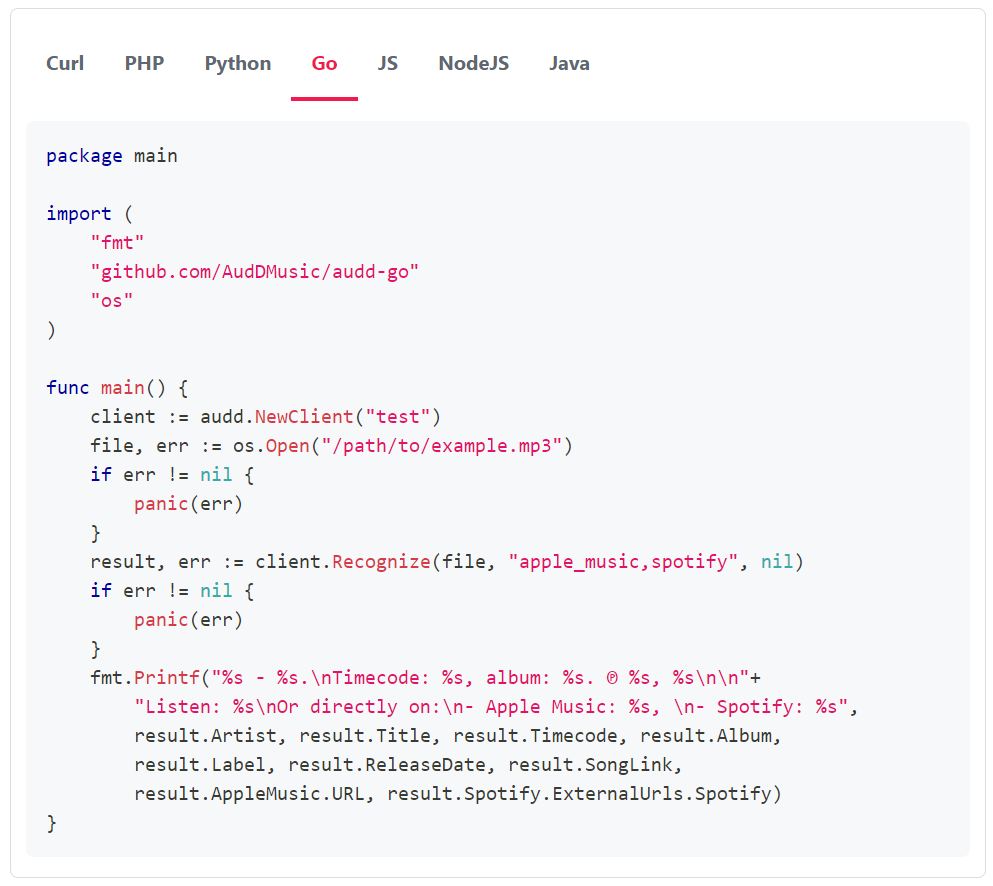
AudD: 11 official SDKs (Python, Node/TypeScript, Go, Rust, PHP, Swift, Kotlin, .NET, Java, C, C++) and a command-line tool. See docs.audd.io/sdks and docs.audd.io/cli.
Can I get a working call in ten minutes? Self-serve signup and a copy-paste example tell you how the rest of the relationship will go. If the first step is a call with sales, ask why.
AudD: get your own token at dashboard.audd.io; the getting-started walkthrough runs a first recognition in a few lines.
Are the docs complete, including errors and edge cases? Look for the full error code list, the response shape for no-match and partial results, and the billing behavior of every parameter. Missing error docs mean you’ll learn them in production.
Who answers when something breaks? Ask whether support is engineers or a ticket queue, which channels exist, and whether you can talk to a person before you’re a large customer. Send a technical question during your evaluation and time the reply.
Turning answers into a decision
Put each vendor’s answers in one table and mark which ones you verified yourself. Weight the verified ones. Then run the same labelled audio through your shortlist; the pilot plan gives a script and a write-up template. For a side-by-side view of the market, see best music recognition APIs.
FAQ
What is the most important question to ask a music recognition vendor? Whether you can test the API on your own audio before you sign anything. Published accuracy figures are measured on someone else’s audio. A self-serve token and a few hundred of your own labelled clips tell you more than any datasheet.
Should I trust a vendor’s accuracy percentage? Treat it as a claim about the vendor’s test set, not your traffic. Ask what audio it was measured on and how false matches were counted, then measure match rate and false matches on a labelled sample of your own audio.
Does a music recognition API tell me who owns the rights to a song? Usually not. A recognition API tells you which recording matched and returns metadata such as artist, title, label, and identifiers like ISRC and UPC. The label field is not the rights owner, and recognition is not a license. Ownership and licensing questions need a rights database or the rights holders themselves.
How do I compare prices between vendors that bill differently? Convert every quote to cost per hour of your audio and cost per thousand of your typical inputs, using your real mix of short clips, long files, and streams. Then check what happens at your peak month and whether overages are billed or blocked.
- Run a one-week pilot on your own audio
- Music recognition API pricing
- Best music recognition APIs
- Standard, enterprise, or streams: how to choose
- Interpreting the recognition score