Executive Summary
NGINX2Root is a set of five nginx vulnerabilities disclosed on November 18, 2026. The lead flaw, CVE-2026-123007, is a memory corruption bug in the way nginx handles HTTP/2 connections. F5, which maintains nginx, rates it 9.2 under CVSS v4.0 and 8.1 under CVSS v3.1. An attacker with no credentials can crash nginx worker processes, and researchers have demonstrated remote code execution with the privileges of the nginx worker. Where the worker runs without root privileges, an attacker would need an additional escalation path to gain root. This could involve chaining the NGINX vulnerability with a suitable local privilege-escalation flaw.
Unpatched builds of NGINX Open Source from 1.9.5 through 1.31.8, and unpatched NGINX Plus builds, are in scope when HTTP/2 is enabled. Fixes shipped in NGINX Open Source 1.30.7 and 1.31.9, and turning off HTTP/2 closes this exposure where patching has to wait. A separate Linux kernel flaw that the researchers used to go from the worker account to root has no patch yet. Start with internet-facing nginx servers that accept HTTP/2, and assign an owner and a deadline to every system still unpatched.
What’s at Risk
A Flaw in nginx Could Hand Attackers the Front Door to Your Applications. nginx is often the first system a web request reaches. It runs as a web server, a reverse proxy (a server that passes requests to the applications behind it), a load balancer, and the entry point to Kubernetes clusters. CVE-2026-123007 is in nginx’s own HTTP/2 code, so no application behind it has to be at fault.
HTTP/2 lets a client tell the server how much data it is allowed to send. nginx can lose count of that allowance when a client cancels requests at the right moment. The bad count later makes nginx copy memory it should not touch.
F5 says the result is typically a crash of the nginx worker, the process that handles live traffic. F5 also says code execution is possible where ASLR, the memory-address randomization that makes exploits harder, is disabled or bypassed. Xint, the team that named NGINX2Root, reports doing exactly that: it leaked memory addresses and then ran commands as the nginx worker over a public HTTPS port.
In Qualys TRU’s assessment, three outcomes matter to the business:
- Exposure of traffic and keys. Code running in the worker can read requests and responses after nginx decrypts them, including passwords and session tokens. It may also expose TLS private keys that are held in software and accessible to the worker.
- A foothold behind the perimeter. Backend systems usually trust the proxy in front of them. An attacker on that proxy starts from a trusted position.
- Outages. A failed attempt can still crash workers and drop connections.
Workers normally run under a restricted account. An attacker gets whatever privileges the worker actually has, so if it already runs as root, no further escalation is needed in that environment. Where it does not, the researchers chained a separate flaw in the Linux kernel’s SCTP code to get root. SCTP is a network protocol, like TCP, that the kernel supports. They report root on the host, including from nginx running inside a Docker container. That kernel flaw has no CVE and no patch yet, so patching nginx removes the remote entry point but not the step to root.
NGINX2Root covers four more nginx flaws. F5 scores all five 9.2 under CVSS v4.0 and 8.1 under CVSS v3.1, and the same nginx releases fix them. Each needs a different configuration:
The rest of this post focuses on CVE-2026-123007, the flaw with the widest reach.
Are You Affected?
A system is in scope only when both conditions are true. For an attack to work, the attacker must also be able to open an HTTP/2 connection to nginx itself.
F5 notes that it did not evaluate versions past End of Technical Support. F5 also lists BIG-IP, BIG-IQ, and F5OS as not vulnerable in its advisory.
The checks below come from the researchers’ write-up. Run them on the nginx host. The first shows whether the build includes HTTP/2. The second shows whether the configuration turns it on.
nginx -V 2>&1 | grep -o — ‘–with-http_v2_module’
sudo nginx -T 2>&1 | sed ‘s/#.*//’ | grep -nE ‘listen[[:space:]].*http2|^[[:space:]]*http2[[:space:]]+on[[:space:]]*;’
Run this one from outside your network. ALPN protocol: h2 means the server accepts HTTP/2 from the internet.
openssl s_client -connect HOST:443 -servername HOST -alpn h2 </dev/null 2>&1 | grep -E ‘ALPN protocol:|No ALPN negotiated’
nginx also ships inside other software. Status as of November 18, 2026:
Three cautions when scoping:
- Do not rely on nginx -v alone. Distributions often fix a flaw without changing the nginx version number. Compare the full package version with the distribution’s advisory.
- Check where the HTTP/2 connection ends. If a CDN or load balancer handles HTTP/2 in front of nginx, an outside test only reaches that device. Test the nginx port directly.
- Use internet exposure to order the work, not to close findings. An internal nginx with HTTP/2 on is still reachable by an attacker who is already inside the network.
Exploitation Status
As of November 18, 2026, we have not seen public confirmation of exploitation in the wild.
Working exploit code is public. The team behind NGINX2Root also reports its own exploit working over public IP addresses on AWS, GCP, and Azure, and is holding back the final steps.
The public exploit is hard to use. It sends a very large number of HTTP/2 control messages over one long-lived connection for several minutes, has to reach nginx directly, and depends on a specific memory-copy routine in the standard Linux C library on 64-bit Intel and AMD processors.
These limits slow mass exploitation. In Qualys TRU’s assessment, they do not protect a specific internet-facing server from a capable attacker, and other techniques may follow.
What to Do Now
Updating nginx is the only complete fix. F5 released fixed builds on November 18, 2026.
Linux distributions publish on their own schedules. As of November 18, 2026, Ubuntu and Debian had not shipped fixed packages. Use your vendor’s advisory to identify the fixed package and confirm it addresses CVE-2026-123007.
Restart nginx after you update. A reload applies configuration changes but keeps the old program running, so the flaw stays in memory until a restart.
If you cannot patch today, turn off HTTP/2 on every affected listener. F5 states the flaw affects only configurations that use HTTP/2, and the researchers recommend this as a temporary measure. For the exact steps, see nginx’s documentation for the http2 directive, CERT-EU’s advisory, and section 3.3 of the researchers’ . Clients fall back to HTTP/1.1. Services that need HTTP/2, such as gRPC, will stop working, so test first. This covers CVE-2026-123007 and CVE-2026-123633 only, and it does not replace the patch.
Advice for Risk and Vulnerability Management Teams
Qualys TRU’s advice for the teams running this response:
- Do not let the score set the deadline: Under CVSS v3.1 this flaw is 8.1, which many remediation policies file as High. Public exploit code and a server that faces the internet matter more than the number. Handle vulnerable nginx deployments with externally reachable HTTP/2 as an emergency.
- Close findings on evidence: A server is done when the fixed build is installed, nginx has been restarted, and the vendor’s advisory confirms the package covers all five CVEs. Report patched, temporarily mitigated, not exposed by configuration, and unknown as separate states, and do not count unknown as safe.
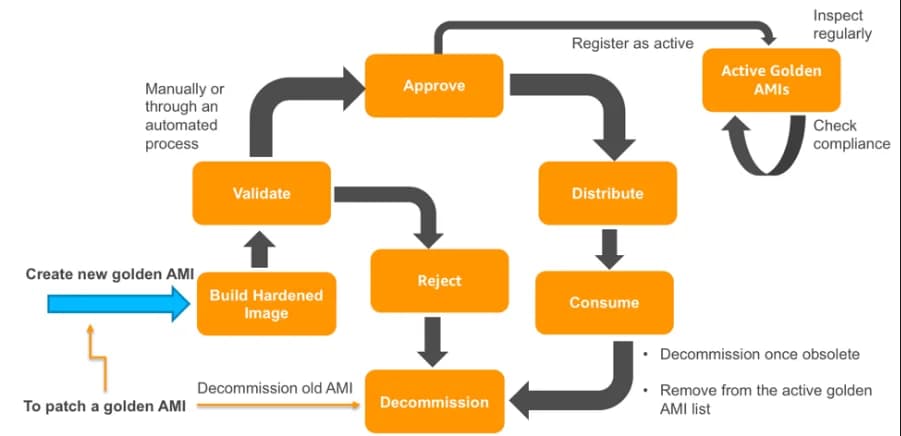
- Fix the template as well as the server: Update container images, Helm charts, machine images, and autoscaling templates. Otherwise the next scale-out or failover brings the vulnerable build back.
- Put an end date on every workaround: Turning off HTTP/2 covers two of the five flaws, and the next configuration push can undo it. Record who owns each exception and when it ends.
- Decide what to do with nginx that will not get a fix: The community ingress-nginx project is archived, and the older NGINX Plus R-series branches have no fixed build listed, although fixed NGINX Plus 37.x releases exist. These need a migration plan or a signed risk acceptance.
- Treat privilege escalation flaws as part of this response: Where the worker runs without root privileges, an attacker would need an additional escalation path to gain root. The newly disclosed SCTP flaw is one such path, and any other local privilege-escalation flaw that can be exploited from the worker’s context could serve the same purpose. Patch known local privilege-escalation flaws on nginx hosts, in the kernel and elsewhere, with the same urgency. A current kernel does not mean the SCTP flaw is fixed, because that flaw has no patch yet.
How Qualys Can Help
Inventory nginx Installations with Qualys CSAM
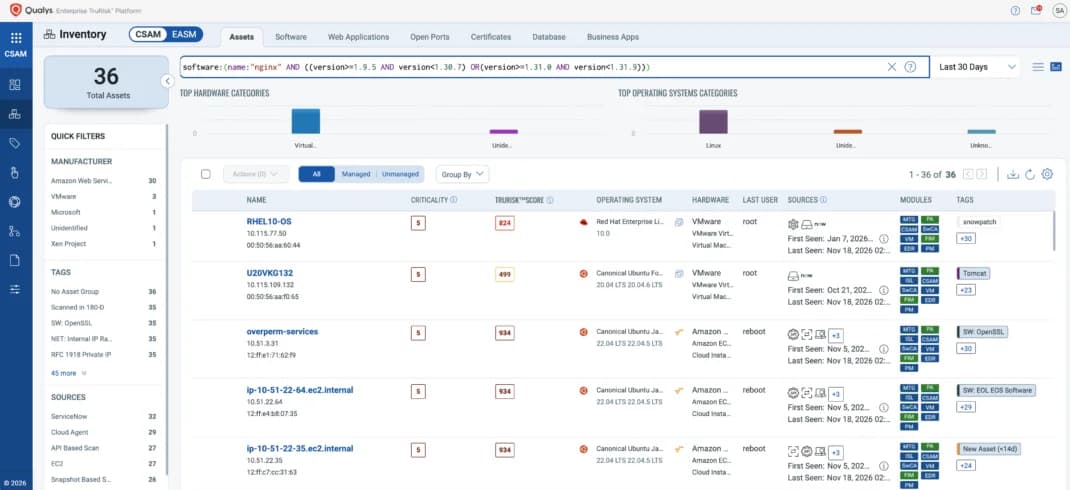
Qualys CyberSecurity Asset Management (CSAM) lists every asset with nginx installed, along with the version of each installation, so teams can quickly scope NGINX2Root remediation. Because NGINX Open Source 1.9.5 through 1.31.8 is affected, the version tells you which installations are in range. It does not tell you whether HTTP/2 is turned on or whether a Linux distribution has backported the fix, so check those separately. nginx bundled in containers, Kubernetes ingress controllers, and appliances may not appear in a standard inventory, so check those separately too.
Assets With nginx in the Affected Range
Use the following CSAM query to identify potentially affected NGINX Open Source installations on the stable, mainline, and older branches for further assessment. It uses two ranges because 1.31.0 through 1.31.8 are affected even though they are higher than the fixed 1.30.7.
software:(name:”nginx” AND ( (version>=1.9.5 AND version<1.30.7) OR (version>=1.31.0 AND version<1.31.9) ))
Detection VMDR QIDs
Qualys is releasing the following detection QIDs. We will add distribution-specific detection QIDs to this blog as they are released.