Weekly highlights
Ocean rates – Freightos Baltic Index
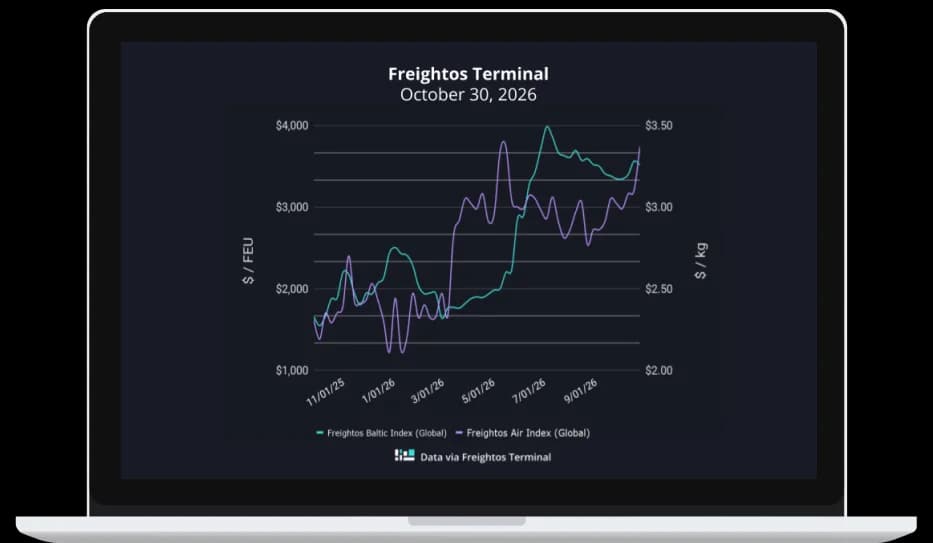
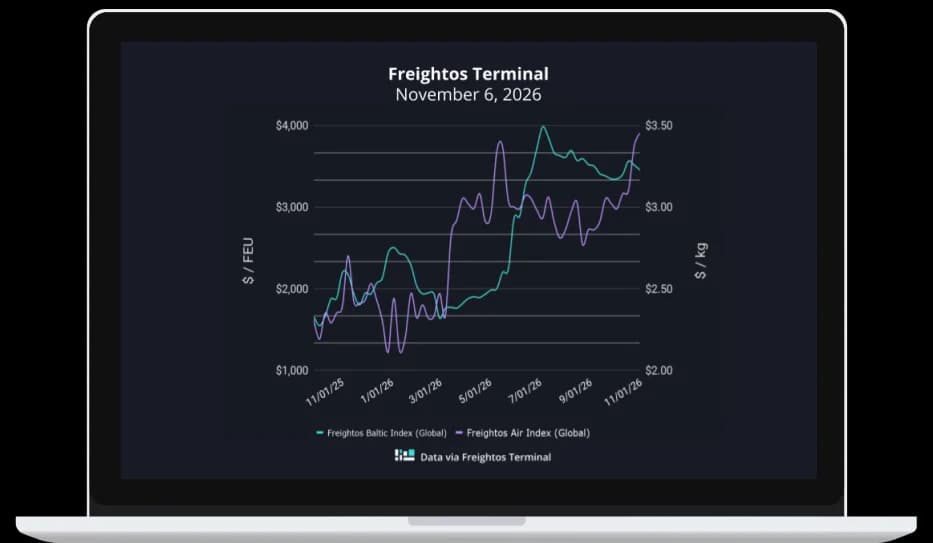
- Asia-US West Coast prices (FBX01 Weekly) decreased 1%.
- Asia-US East Coast prices (FBX03 Weekly) decreased 2%.
- Asia-N. Europe prices (FBX11 Weekly) decreased 5%.
- Asia-Mediterranean prices (FBX13 Weekly) decreased 1%.
Air rates – Freightos Air Index
- China – N. America weekly prices increased 3%.
- China – N. Europe weekly prices increased 11%.
- N. Europe – N. America weekly prices increased 9%.
Analysis
Last week’s US midterm election results saw Republicans lose control of both houses of Congress, raising questions about possible implications for trade and logistics.
On the one hand, the shift, reflecting voter concerns over inflation including from tariffs and energy prices, could mean the White House will seek to avoid introducing new tariffs and aim to deescalate the war in Iran in the hopes of bringing oil prices down. On the other hand, with President Trump likely to face difficulties passing new legislation, the election may embolden the president to focus and act on foreign and trade policy which is less easily influenced by Congress.
In recent months the administration has trended toward deescalation in trade relations with China. And post the election late last week, both sides officially extended the pause on reciprocal port call fees until January 10th, aligning with the extension of the other elements of the interim US-China agreement announced back in September. Presidents Trump and Xi will meet in China next week.
This year’s many trade war twists and turns may have helped drive the unusually early and then unusually long transpacific ocean peak season that has kept US container import volumes elevated since May.
A lower effective tariff regime on many US trading partners including China following the Supreme Court’s IEEPA invalidation in February, and anticipation that duties would increase in July may have spurred some of the frontloading that started in May. But tariffs that stayed about level in July and beyond, IEEPA refunds that infused many importers with unexpected cash, and surprisingly resilient consumer spending may all have helped keep the rally going.
The latest National Retail Federation US ocean import volume report shows container arrivals started climbing in May but continued their ascent through the summer peaking at just below record levels in September at 2.37 million TEU. Volumes are estimated to have eased 5% in October with November volumes projected to be down 14% from the September high. The report estimates that year totals will be 2.2% stronger than in 2025, following earlier expectations of flat volumes or even more modest growth.
Slowing demand may be one factor in transpacific container rates easing slightly last week as significant carrier GRIs failed to materialize. But at $8,200/FEU to the West Coast and $9,700/FEU to the East Coast, prices are still at about peak levels.
The ILWU Local 26 watchmen union has extended its strike deadline to November 20th to allow more time for negotiations with operators at the ports of LA and Long Beach with the aim of averting a potentially disruptive walk out. Though most holiday season merchandise has by now already arrived at the ports, a lot of goods still need to be moved inland, with a serious rail backlog slowing progress for many importers and making the prospect of a strike even more concerning.
Carriers seem to have abandoned November 1st GRI hopes for Asia – Europe lanes as well, as prices dipped 5% last week to $3,400/FEU to North Europe and 1% to $4,300/FEU to the Mediterranean. Though rates aren’t climbing for now, prices are well above last year’s levels with N. Europe rates up 50% year on year and Mediterranean prices up 88%.
Air rates out of the Far East continued to climb last week on peak season demand. China – US prices increased 3% to more than $8.00/kg, already reaching last year’s high that was hit only in mid-December 2025. China – Europe rates increased 11% to $4.87/kg, and are up 23% year on year.
Part of the rate strength is due to a higher floor, propped up by still-elevated jet fuel prices. For some lanes, especially many Far East – N. America routes, strong demand from data center hardware volumes has kept pressure on rates and also helped set the high starting point for peak season spot prices. Some observers speculate however that Democrat control over Congress could mean tighter AI regulations that could slow data center hardware volume growth to the US.
Transatlantic air cargo rates have climbed by 33% over the last month to $2.90/kg as capacity reductions from winter schedules – as well as possible freighter shifts to higher volume lanes – and peak season demand combine to put pressure on rates.
Freightos Terminal™: Real-time pricing dashboards to benchmark rates and track market trends.
Procure™: Streamlined procurement and cost savings with digital rate management and automated workflows.
Rate, Book, & Manage™: Real-time rate comparison, instant booking, and easy tracking at every shipment stage.
Judah is an experienced market research manager, using data-driven analytics to deliver market-based insights. Judah produces the Freightos Group's FBX Weekly Freight Update and other research on what's happening in the industry from shipper behaviors to the latest in logistics technology and digitization.