What 96 Discover-generated articles and 5,686 brand-written blog posts reveal about the role of customer reviews in AI citations
AI engines are increasingly using brand content as a source when answering shoppers’ questions. But what makes one piece of content more likely to get cited than another?
We analyzed how ChatGPT, Gemini, and Google AI Mode cite content across 15 brands, comparing 96 Discover-generated articles against 5,686 existing brand-written blog posts. Within the Discover content, we also compared articles that incorporated verified customer reviews with articles that did not.
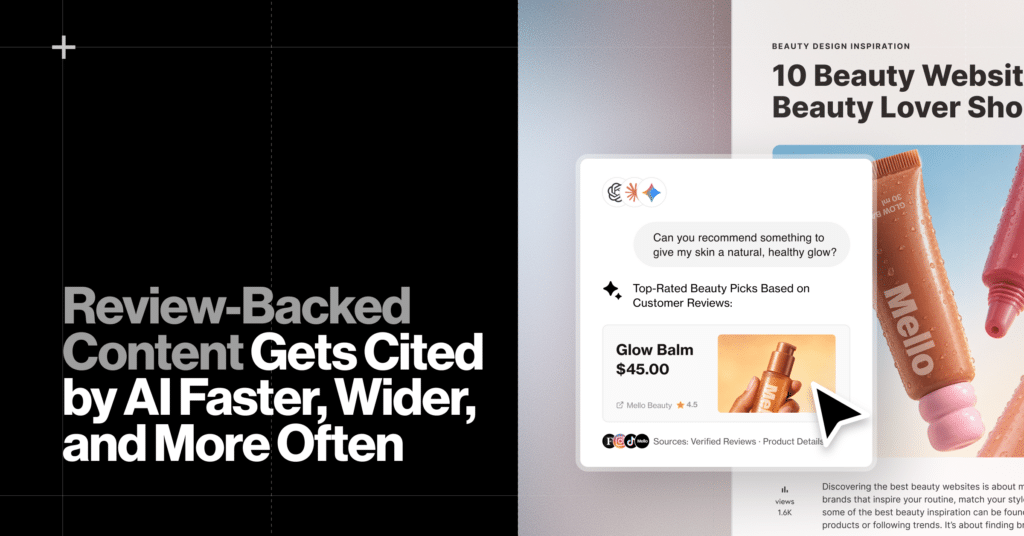
The pattern was consistent: review-backed content was cited faster, earned more citations, and appeared across more AI engines and shopper questions.
The headline findings
- 96% of Discover articles with reviews were cited by at least one AI engine, compared with 40% of brand-written posts.
- 2 days median time from publishing to first citation for review-backed Discover articles, compared with 14 days for brand-written posts.
- 33 citations median citations in the first 14 days for review-backed articles, compared with 1.5 for Discover articles without reviews and 0.5 for brand-written posts.
- 70% of cited review-backed articles were cited across all three AI engines, compared with 27% of Discover articles without reviews and 28% of brand-written posts. reviews-ai-citations-report.
1. Review-backed content gets cited within days, not weeks
The first difference appears in how quickly new content starts getting picked up by AI engines.
Among Discover articles with reviews and a verifiable publish date, 64% were cited within two days of publishing and 77% within the first week. Brand-written posts published during the same tracking window took a median of 14 days to receive their first citation. Only 21% were cited within their first week. Reviews-ai-citations-report
The difference isn’t limited to the first engine that finds the content. 52% of review-backed Discover articles were cited by ChatGPT within 14 days, compared with 20% of Discover articles without reviews and 14% of brand-written posts.
And among articles that earned citations, 70% of review-backed Discover articles reached ChatGPT, Gemini, and Google AI Mode, compared with 27% of Discover articles without reviews. reviews-ai-citations-report
2. They don’t just get cited sooner. They get cited more.
Speed is only part of the difference. Looking at a fixed 14-day window after publication, review-backed Discover articles received a median of 33 citations per article.
Discover articles without reviews received a median of 1.5, while brand-written posts received 0.5.
Review-backed articles also appeared across a wider range of shopper questions. Across all brands, they were cited on a median of 15 distinct prompts, compared with 3 for Discover articles without reviews. reviews-ai-citations-report
And that reach wasn’t concentrated at one point in the shopping journey.
Review-backed Discover articles were cited across awareness, consideration, and decision-stage questions, with consideration prompts representing the largest share. reviews-ai-citations-report.
3. What happens when you isolate the reviews?
Cross-brand comparisons can only tell us so much. Different brands have different domains, audiences, content libraries, and prompt sets.
One brand in the research gives us a closer comparison.
A comfort footwear brand published Discover content both with and without customer reviews, on the same website, within the same product category, using the same content-generation system and tracked against the same prompt set.
To account for age, the analysis compared 10 review-backed articles with 10 articles without reviews published during the same period.
The difference was significant:
While the sample is small, the results provide strong directional evidence that review-backed content performs differently in AI citations. The result is strong directional evidence, not a controlled experiment.
4. A small number of articles can drive a large share of AI citations
The impact also shows up when looking at each brand’s broader content library. For brands with substantial existing blogs, we compared the percentage of the blog made up of Discover articles with the percentage of the blog’s AI citations those articles earned over the last 30 days.
In several cases, a relatively small group of Discover articles accounted for a much larger share of citations:
The pattern isn’t identical for every brand, but it shows how a relatively small number of articles can account for a disproportionate share of a brand’s AI citations. reviews-ai-citations-report
5. One article, five weeks
One furniture brand in the study offers a useful example of what that can look like at the individual article level.
The brand published a single Discover buying guide for dining chairs that incorporated its own customer reviews, including its star average, review volume, and attributed customer quotes.
It received its first AI citation two days after publication.
Over the following five weeks, the article:
- Earned 48 citations – compared with an average of 2.8 for the other 19 cited brand-written posts.
- Was cited across 11 distinct shopper questions – more than any of the brand’s cited blog posts in the measured window.
- Appeared across all three AI engines – ChatGPT, Gemini, and Google AI Mode.
- Reached all three funnel stages – with citations across awareness, consideration, and decision-stage questions. reviews-ai-citations-report
One existing assembly guide received more total citations, 153, but all came from eight decision-stage assembly questions across Gemini and Google AI Mode. The review-backed Discover article reached more questions, all three engines, and all three funnel stages. reviews-ai-citations-report.
What the research tells us, and what it doesn’t
Across the dataset, review-backed Discover content was associated with faster citation, higher citation volume, and broader reach across AI engines and shopper questions.
But this research does not establish reviews as the sole cause.
Discover articles are deliberately created around questions AI engines are already answering, while existing brand-written posts were not necessarily created for those questions. Even the within-brand comparison cannot fully separate the effect of review content from differences in article topic.
There is another important distinction: being cited isn’t the same as being recommended.
A citation means an AI engine used a page as a source in its answer. The analysis did not find a corresponding short-term change in brand mention rate around the time an article was first cited, so this research does not claim that earning a citation immediately increases recommendation share. reviews-ai-citations-report
About the research
Every day, Yotpo Discover runs each tracked brand’s shopper questions through ChatGPT, Gemini, and Google AI Mode and records which URLs those engines cite.
This analysis compares 96 Discover-generated articles with 5,686 brand-written blog posts across 15 brands. Discover articles were further classified based on whether their live pages contained attributed customer-review quotes and/or review statistics from verified reviews.
The data covers February 24 through September 22, 2026, with tracking windows varying by brand. Brands have been anonymized, and all figures come from Yotpo’s AI-visibility tracking database.
.png)