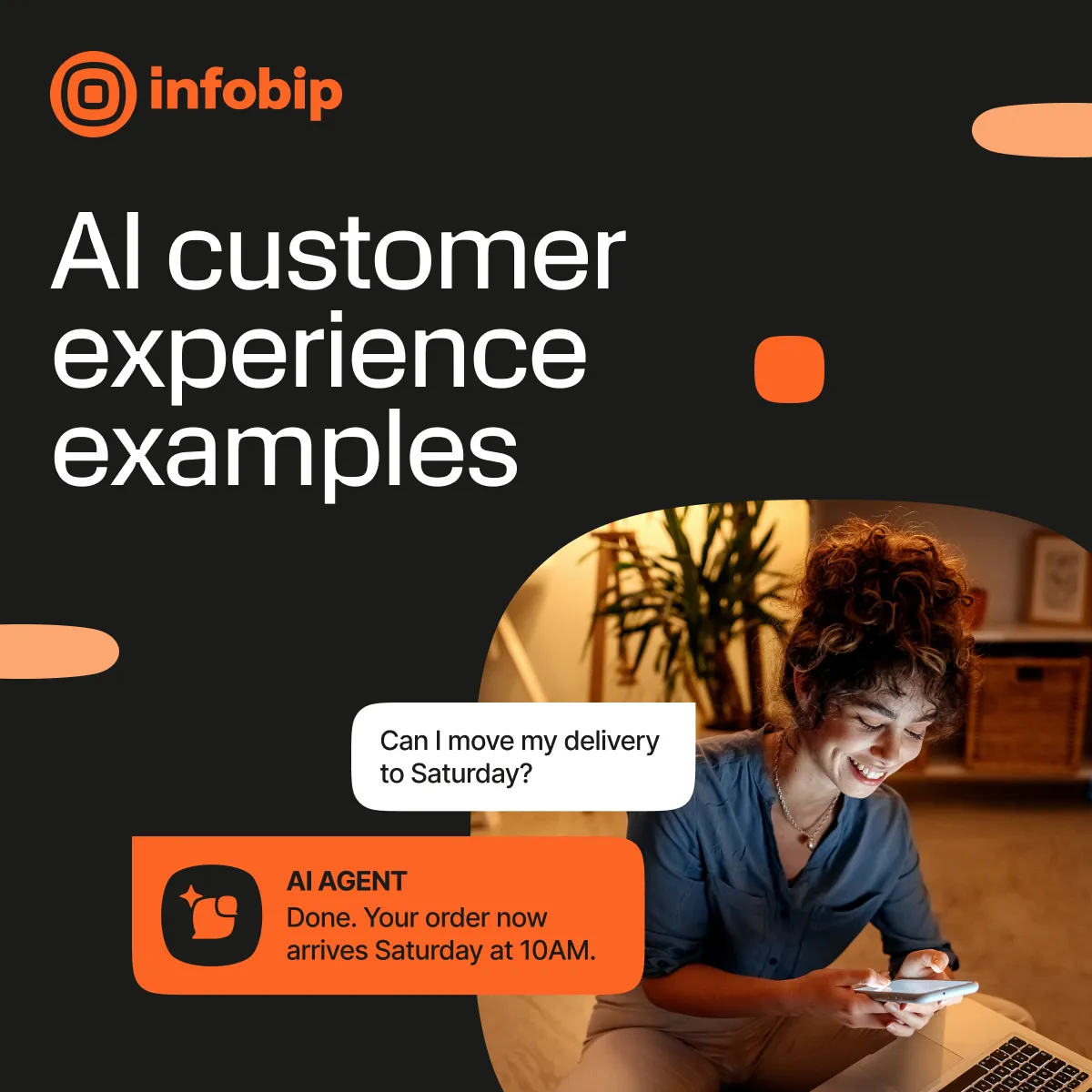
AI customer experience examples often look the same: a chatbot in a box, a website-only automation flow, or a generic list of features with no real business outcome attached. That leaves out the examples enterprise buyers actually need, the ones that show how AI improves conversion, lowers service costs, and makes customer journeys faster and more useful across messaging channels.
That’s where the strongest examples stand out. Bolt used WhatsApp to turn driver sign-up into a guided conversational journey and increased conversion by 40%. Farm Superstores applied AI-led orchestration across customer touchpoints and reduced operational costs by 60%. LAQO Insurance uses AI to resolve 30% of customer queries and hand off smoothly to human agents when needed.
Taken together, these examples show that AI customer experience is not just about deflecting tickets. It is about building connected, channel-aware experiences that work across WhatsApp, SMS, RCS, and contact center.
Before getting into what makes conversation-first AI customer experience different, it helps to start with the examples. Chatbots, personalization, sentiment analysis, intelligent routing, and predictive analytics are common AI customer experience examples that show up across enterprise AI for customer service conversations.
They matter because they establish the foundation of modern CX. Done well, they reduce response times, improve customer satisfaction, increase personalization, and help service teams scale without adding the same level of operational cost.
The sections below cover those foundational AI CX examples first, using real brand examples and measurable business impact, before moving into the messaging-first, omnichannel use cases that set Infobip’s AgentOS apart.
AI chatbots are often the first AI customer experience example people think of when discussing AI customer experience. However, most deployments stop at creating a web chat on a single site, while the more advanced deployments use AI to understand natural language, handle multi-step questions, and learn from every interaction, across the customers’ preferred channels.
For example, LAQO’s AI chatbot resolves around 30% of all customer queries without human involvement, with 90% of conversations completed within three to five interactions, on messaging channels instead of limiting the experience to a support page. When a case needs a person, the handoff to a live agent happens with the full conversation history and customer profile attached, so the customer does not have to start again.
Infobip’s chatbot building platform, native instant messaging channel delivery, and support for more than 130 languages allow enterprises to build AI chatbots that go well beyond basic ticket deflection. Together, those capabilities let enterprises design AI chatbots that are consistent, autonomous front-line help for customer service.
Many enterprises already use AI for personalization, but too often it stops at website recommendations and email subject lines. AI delivers far greater value when it tailors content, offers, and timing across every channel a customer uses.
With unified profiles in a conversational CDP, AI can personalize WhatsApp messages based on recent browsing or purchase history, surface relevant products in RCS rich cards, and trigger follow-up SMS offers at the moment a customer is most likely to respond. McKinsey research links this kind of personalization to up to 40% more revenue, especially when it spans channels instead of living only on web and email.
With unified customer profiles in AgentOS, AI can personalize both content and channel selection in real time, helping enterprises deliver more relevant experiences across WhatsApp, RCS, SMS, and other messaging channels.
Sentiment analysis is often treated as a support-ticket feature, flagging frustrated language after a customer has already had a poor experience. Used properly, it works in real time across text, voice, and social conversations, not just tickets, so signals can trigger action while the interaction is still happening.
When frustration is detected mid-conversation, AI can automatically escalate the customer to a senior human agent instead of leaving them stuck in a queue.
When sentiment is positive, that same signal can surface a timely cross-sell or loyalty offer instead of letting the moment pass. Recognizing frustration during a conversation gives teams a chance to address it before the customer’s experience gets worse.
With Infobip’s AgentOS Insights and Analytics module, these sentiment signals can influence routing and next-best-action decisions across messaging channels, including WhatsApp, Viber, RCS, and SMS.
Traditional skills-based routing sends a customer to whichever agent is next available, matched loosely by department or basic skill tags. Intelligent routing uses AI to assess what the customer needs, how they’re feeling, their value to the business, and their previous interactions. It then determines whether the chatbot can handle the request or which human agent is best suited to help.
It’s particularly important at the moment of escalation. A WhatsApp conversation that starts with an AI chatbot and hits a limit does not need to restart in a queue; it can route directly to the right live agent in the contact center, with the full conversation history, customer profile, and sentiment signal already attached. The agent sees exactly where the conversation left off, so the customer never has to repeat themselves.
Because AgentOS Cloud Contact Center shares the same unified customer profile, routing decisions become a natural continuation of the conversation instead of a disconnected transfer.
AI CX examples often react to problems after they surface. Predictive analytics uses historical and behavioral data to identify customers at risk of leaving, recommend next steps, and estimate a customer’s lifetime value.
In practice, this means a model can flag a customer showing early signs of disengagement and automatically trigger a personalized retention offer on their preferred channel, for example, a WhatsApp message with a tailored incentive, sent before that customer has any reason to complain or cancel. Predictions only matter when they trigger action, such as launching a retention campaign before a customer is likely to churn.
The combination of Conversational CDP and journey orchestration turns these predictions into action, enabling retention campaigns that reach customers through their preferred channels when early signs of disengagement appear.
The following examples show how AI can support more than customer service, helping customers sign up, explore products, and complete purchases through messaging channels such as WhatsApp, RCS, SMS, and Viber. They also show how those conversations can connect with other channels and human agents without losing the customer’s history or context.
No competing platform shows AI customer experience running natively across instant messaging channels like WhatsApp, Viber, RCS, and other instant messaging channels at the same depth as support tickets and web chat. The following examples explore specific business use cases, the results customers have achieved, and the AgentOS capabilities that support these experiences.
AI chatbots are typically positioned as cost-reduction tools, resolving queries so fewer tickets reach a human agent. Here, the focus shifts to revenue, with an AI chatbot on instant messaging channels like WhatsApp, Viber, and RCS improving conversion rather than simply deflecting support volume.
Bolt demonstrates how AI can become a revenue driver rather than simply a customer service tool. A prospective driver taps an ad, lands directly in a WhatsApp conversation, and is guided through onboarding by an AI chatbot that personalizes each step, from initial questions to document submission to final confirmation. The entire journey stays within WhatsApp, with no redirect to an app or web form. That redesign increased conversion by 40%, showing that a well-built conversational journey can function as a growth channel in its own right.
This is possible through Infobip’s AgentOS chatbot builder combined with native WhatsApp Business API integration, which lets enterprises design multi-step, personalized flows entirely within WhatsApp instead of treating it as a simple notification channel bolted onto a separate sign-up process.
Traditional AI customer experience is largely reactive. The customer asks a question, and the system responds. Proactive AI engagement does the opposite, reaching buyers before they ever need to ask, with a message triggered by their own behavior or an upcoming need.
This shows up in practical ways, such as an abandoned cart triggering a WhatsApp message with personalized product recommendations at the moment a customer is most likely to return and complete the purchase. An upcoming appointment triggers an SMS reminder timed using AI-optimized send windows instead of a fixed schedule. A shipment in transit triggers a delivery update on RCS, complete with rich media like a tracking map or product image, instead of a plain text notification.
Infobip’s AgentOS makes this possible through journey orchestration paired with send-time optimization and channel recommendation, both powered by data from the Conversational CDP. Using unified customer profiles, the platform automatically selects the right channel and the right moment for every interaction, helping enterprises reach customers when engagement is most likely.
Many AI agents start every conversation from zero, with no memory of who the customer is or what they need, but Infobip’s AgentOS follows a different route. Its AI agents pull from the full Conversational CDP profile, including product holdings, recent interactions, language preference, sentiment history, and channel preference, before the first message is even sent.
Consider a banking customer opening a WhatsApp chat with their bank. Instead of a generic greeting, the AI agent addresses them by name, references their recent loan inquiry, and offers relevant next steps, all in the customer’s preferred language. That context shift, from a blank slate to a conversation that already knows the customer, is what separates a functional chatbot from one that feels like a continuation of the relationship.
That level of context comes from the integration between AgentOS AI agents and the Conversational CDP, ensuring every AI-led interaction begins with a complete customer profile rather than generic questions.
Handoff is one of the most discussed weaknesses in AI customer experience, yet it is rarely shown working well across messaging channels. The typical failure is a customer explaining their issue to an AI agent, only to be escalated to a human agent who has no context, forcing the customer to explain everything again.
For example, LAQO Insurance’s AI chatbot resolves the majority of each conversation on its own, but when an issue needs human judgment, it hands off to a Cloud Contact Center human agent who receives the full conversation transcript, CDP profile, sentiment score, and an AI-recommended next action, all before responding. The customer does not repeat themselves, and the agent starts with more context than a cold handoff would ever provide.
The integration works because AgentOS Cloud Contact Center is connected directly to the same AI and data layer as the chatbot, so escalation is a continuation of one conversation rather than a transfer between two disconnected systems.
Multilingual customer experience is usually treated as a translation problem. Many CX experts swap out static text, add a language picker, and call it done. That approach breaks down fast in real conversations, where customers do not want to select a language from a menu before they can get help.
Mukuru’s WhatsApp chatbot serves financial services customers across ten languages in multiple African markets by detecting each customer’s language directly from their first message and responding accordingly, with no manual selection required. That real-time detection, working at the individual conversation level rather than the market level, is what makes multilingual AI CX viable at genuine enterprise scale.
AgentOS provides this capability through automatic language detection across more than 130 languages, letting one chatbot serve customers across markets without separate builds or manual configuration per language.
The most effective AI customer experience examples do not live inside a single channel; they follow the customer as they move. Consider a retail journey where a customer browses products on a website, with that activity tracked by a unified CDP. They abandon their cart, which triggers an AI-driven journey rather than a static follow-up email. At the optimal time, they receive a personalized message. They engage with a product recommendation carousel delivered as an RCS rich card, complete the purchase, and receive confirmation by SMS.
Farm Superstores achieved a 60% reduction in operational costs by applying this kind of orchestrated, AI-led journey across its customer experience, rather than treating web, messaging, and service as separate, disconnected channels.
AgentOS journey orchestration brings this together by connecting customer engagement decisions across more than 15 channels, so a single AI-driven journey can move fluidly from web to WhatsApp to RCS to SMS without losing context at any step.
Real examples matter, but enterprise buyers evaluating AI CX also need the benefit case laid out plainly. They need to ask: what does this actually deliver, and how is it measured?
Here are five crucial benefits that matter when AI is connected across channels rather than confined to one.
1. Faster resolution and higher customer satisfaction
Resolving routine queries instantly reduces average handle time and lifts CSAT, a pattern seen across the industry, where AI deployments have deflected thousands of tickets through automation. LAQO Insurance resolves 30% of all queries through AI, with 90% of conversations completed within three to five interactions, on WhatsApp and messaging channels rather than a support ticket queue.
2. Cost reduction without sacrificing quality
AI can significantly lower service and engagement costs without compromising the customer experience. Farm Superstores cut operational costs by 60% using a WhatsApp chatbot – a result that sits alongside a broader industry signal: Forrester’s TEI study of a comparable CDP deployment found 158% ROI with a seven-month payback. Unlike point solutions that only touch support, AgentOS reduces costs across both marketing engagement and customer service from the same platform.
3. Personalization at scale across every channel
AI-driven personalization operates at a scale human teams simply can’t match. According to , faster-growing companies earn 40% more revenue from personalization than slower-growing competitors. AgentOS carries that same intelligence into WhatsApp, RCS, SMS, and 15+ other messaging channels, timing each message and picking the right channel automatically, instead of stopping at email and web the way many competing platforms do.
4. Proactive engagement that prevents churn
One of AI’s clearest advantages is the shift from reactive to proactive engagement, catching signs of dissatisfaction before a customer complains or leaves. AgentOS Conversational CDP powers churn prediction models that automatically trigger retention campaigns on a customer’s preferred channel ahead of time, a capability that reactive, ticket-based support tools were never built to offer.
5. Agent productivity and employee experience
AI benefits are not limited to the customer side; they extend to the humans handling escalations too. A landmark NBER study of 5,000+ customer support agents found AI assistance increased issue resolution by 14% per hour, cut handling time by 9%, and reduced agent turnover by 25%. AgentOS Cloud Contact Center applies this directly through AI-powered agent assist, offering real-time suggestions, conversation summaries, and knowledge retrieval so agents spend less time searching and more time resolving.
85% of customer service leaders plan to explore or pilot conversational AI, according to Gartner. The enterprises getting real value aren’t the ones trying to overhaul every channel at once. They’re starting with a focused rollout and building outward from there.
Start with a high-impact use case on the channel that already carries the most volume (often WhatsApp or SMS) where even a little automation can remove real friction quickly. Trying to launch across every channel simultaneously slows adoption and makes it harder to prove early results.
Human-AI handoff should be included in the strategy from day one. Customers should never have to repeat information they already gave an AI agent, which means routing, context, and conversation history need to carry through to the human agent automatically.
Unified customer data is the foundation everything else depends on. Personalization, intelligent routing, and proactive engagement all break down if customer profiles are fragmented across separate tools, so consolidating that data early pays off across every use case that follows.
Measure outcomes tied to business impact rather than deflection alone. Conversion, cost reduction, resolution speed, and retention all matter more than a simple ticket-deflection percentage and closed-loop analytics make it possible to see which AI-driven interactions actually move those numbers.
Cisco’s research suggests agentic AI will handle 68% of customer experience interactions with technology vendors within three years. Enterprises that start with a connected data foundation, rather than isolated point solutions, will be far better positioned to scale as that shift accelerates.
Infobip delivers AI-triggered messages through its own network of 800+ direct carrier connections across 190+ countries, backed by 40+ data centers and enterprise-grade uptime guarantees. Because messages route through Infobip’s own infrastructure rather than third-party APIs, enterprises get consistent delivery performance regardless of market or channel.
Language coverage extends to 130+ languages with automatic detection, so multilingual AI experiences scale globally without manual configuration per market.
For regulated industries, that reliability is matched by compliance. The platform is certified to SOC 2 Type II and ISO 27001 standards, with GDPR built in. That combination means AI-powered customer experience is not just fast and personalized, but also secure and dependable enough to run at the scale enterprise buyers actually need.
The most useful AI CX examples show what changed for the customer: an easier sign-up, a faster answer, or a handoff that doesn’t require repeating information.
Look for similar opportunities in your own customer journeys. Start with one recurring frustration, such as an incomplete application or a routine service request. Define success before launching, and measure the result—not just how many conversations AI handles.
As you expand, keep customer data, messaging channels, and human support connected so customers can get help without navigating the gaps between your tools.
Infobip’s AgentOS brings together AI agents, customer data, journey orchestration, and cloud contact center capabilities.