Marketplace growth is usually framed as a demand problem or a headcount problem. But a constraint often overlooked comes earlier: the time between a seller signing up and their first listing going live, correctly categorized and in front of buyers.
Every day in that gap is lost revenue, a thinner catalog, and a seller losing interest, or listing with a competitor first. Yet time to first listing rarely makes the growth dashboard. It’s treated as an operational detail, even though it determines how fast supply grows and how much acquisition spend turns into live inventory.
Most of what slows it down traces back to how third-party images and videos get uploaded, reviewed, normalized, and prepared for publishing. Four bottlenecks do most of the damage, and each one can be removed by automating how content is checked, tagged, adjusted, and optimized for delivery.
In most marketplaces, every new seller’s content goes through the same review queue. A seller with flawless product photography waits just as long as one who uploaded blurry phone shots against a cluttered kitchen counter. The queue doesn’t know the difference until a person opens the file.
That ties onboarding capacity to the number of reviewers you have and the hours they work, regardless of how good a seller’s content is. When a promotion, a new category, or a regional launch brings a surge of sellers, the queue gets longer and every seller waits, including the ones who got everything right.
Adding reviewers raises costs in step with volume, and new reviewers take time to train before they judge content the way your experienced team does. Onboarding speed stays tied to headcount, which is the dependency growth-stage marketplaces are trying to escape.
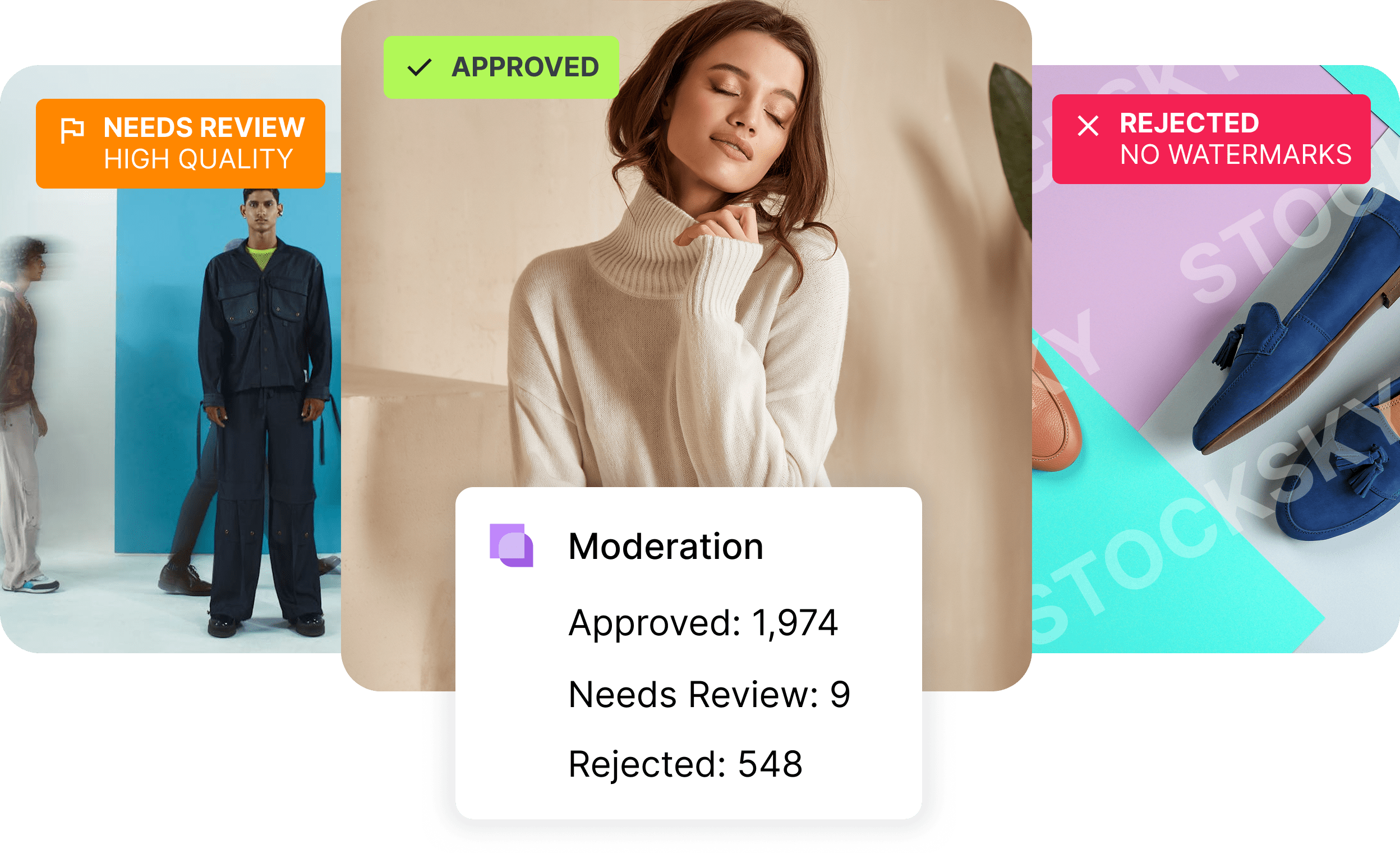
Automated review checks every submission against your standards the moment it’s uploaded. Content that meets the bar moves forward immediately, and only the submissions that genuinely need a second look ever reach a reviewer.
Most sellers aren’t trying to upload bad content. They simply don’t know what your standards are, or the standards were communicated as a vague guideline (“use a clean, professional background”) instead of a specific rule.
The seller submits, waits, gets rejected, guesses at a fix, resubmits, and waits again. Each resubmission adds delays, and when feedback is inconsistent between reviewers, sellers can go several rounds without knowing what “approved” looks like.
Clear, objective criteria fix this. Rivly, a Cloudinary Moderation design partner, defines its image standards in terms a system can check and a seller can act on: a pure white background (HEX #FFFFFF), the product filling roughly 80% of the frame, and no text on the image. Rules this specific can be checked automatically the moment an image or video is uploaded.
When sellers get specific feedback at upload, they can fix issues in one pass instead of several. Many common issues, like a non-white background or a poorly framed product, can also be corrected automatically during normalization so sellers won’t even need to resubmit.
Passing content review and moderation is only one step before a listing can go live. Most marketplaces also need it described: category, product type, color, material, and whatever other attributes power search, filters, and category pages. On many platforms, that work falls to the seller.
For a new seller, this is often where onboarding stalls. Filling in attribute fields for one product is manageable. Doing it for a catalog of hundreds is a project, and it’s the kind of tedious setup that makes new sellers put onboarding off “until later.”
When they do finish, the data is often incomplete or inconsistent. A product gets tagged “navy” instead of “blue,” or filed under the wrong category, and the listing goes back to the seller for correction or into an internal queue for someone to classify. Each correction creates delays until the listing goes live.
Much of this information is already in the content. AI-based tagging analyzes each image as it’s uploaded and applies structured metadata automatically: product type, color, visual attributes, and other characteristics. Sellers confirm what’s already been filled in instead of starting from a blank form, and listings arrive with the consistent, accurate metadata that places them in the right category and makes the product easier to find.
When review capacity is fixed and seller demand continues growing, many marketplaces respond by limiting intake. They use waitlists, invite-only categories, stricter application criteria, or slower approvals. These decisions are usually framed as quality control, and sometimes that’s partly true. Often, though, the review team can’t absorb more volume without scaling headcount or letting standards slip.
In those cases, the review capacity dictates the growth rate, and every seller turned away or left on a waitlist is a seller a competitor can pick up.
The alternative isn’t to lower standards, but rather apply them in a way that doesn’t depend on a person looking at every file. Automated moderation scales with submission volume instead of headcount. The same standards and policies are applied to the thousandth seller as to the first, so you can open intake to every qualified seller without lowering the bar or adding headcount.
Automated onboarding saves human judgment for the cases that need it most. With Cloudinary, the process looks like this:
Define your brand guidelines, content policies, image and video quality requirements, and compliance rules in Cloudinary Moderation, including marketplace-specific rules like Rivly’s white-background and frame-fill criteria. The rules run automatically when content is uploaded and you can also run them on demand across an entire folder or collection, which helps when you make changes to standards or policies and need to recheck existing inventory.
Cloudinary evaluates each image and video against those rules right away as soon as the seller uploads it, then tags it with structured metadata such as product type, color, and visual attributes. Content that meets the bar moves forward with its attributes filled in, and sellers confirm details instead of entering them from scratch. Content that doesn’t is flagged with a specific reason the seller can act on.
AI-powered transformations correct many issues that would otherwise trigger a rejection. Background removal handles a non-white background, cropping corrects poor framing, upscaling improves low resolution, and color correction balances off exposure. The seller’s listing moves forward using automated normalization instead of going back to them.
Cloudinary automatically converts approved assets to the most appropriate format and size for every place the listing appears, from search results to product pages and mobile apps. New listings load fast and display well from day one, without content teams needing to create separate versions by hand.
Your review team moves off routine approvals and focuses on the ambiguous submissions where human judgment adds the most value. Each flagged asset includes an explanation of why it was flagged, so reviewers start with context and can override the call when they disagree.
Review queues, rework loops, manual tagging, and throttled intake each add days between a seller signing up and their first listing going live. Together, they put a ceiling on how fast your marketplace can grow, one most teams never see on a dashboard.
Automating how content is tagged, checked, and fixed removes that ceiling. Time to first listing depends on how quickly your system can apply your standards, not on how many people you have reviewing and normalizing content. Onboarding capacity grows with demand, sellers see results sooner, and you no longer have to choose between protecting quality and growing supply.
As a marketplace, maintaining high-quality and consistent seller images is critical for customer trust and conversion. With Cloudinary Moderation, we’re able to automatically review seller-submitted images, understand any issues, and immediately guide sellers toward better images enhanced with Cloudinary transformations.Daniel Thompson, CEO at Rivly
As a marketplace, maintaining high-quality and consistent seller images is critical for customer trust and conversion. With Cloudinary Moderation, we’re able to automatically review seller-submitted images, understand any issues, and immediately guide sellers toward better images enhanced with Cloudinary transformations.
Stop letting headcount decide how fast you grow. See how Cloudinary Moderation automatically reviews, fixes, and approves seller content so new listings go live faster.
Time to first listing is the gap between a seller signing up and their first listing going live, correctly categorized and visible to buyers. It rarely appears on a growth dashboard, but every extra day in that gap means lost revenue, a thinner catalog, and a higher risk that the seller lists with a competitor first instead.
Standards work best when they’re specific enough for both a system and a seller to act on, such as an exact background color, a minimum percentage of frame fill, or a rule against text overlays, rather than a general instruction like “use a clean background.” Cloudinary Moderation lets marketplaces define these rules once and apply them automatically to every submission.
Yes. AI-based tagging can analyze an image at upload and apply attributes like product type, color, and visual style automatically, with the results stored as structured metadata the seller confirms rather than fills in from a blank form. Cloudinary’s Auto Tagging by Google add-on is one option that powers this kind of automatic classification.
Yes. Many rejection-triggering issues can be corrected during normalization rather than sent back to the seller: background removal handles a non-white background, cropping corrects poor framing, and AI-based upscaling and color correction address low resolution or poor exposure.



.png?w=1200&h=630&fm=jpg&auto=format,compress)