Abandoned carts are an inevitable part of running a B2C brand: 70% of online shopping carts are abandoned, according to a meta-analysis by the Baymard Institute.
That means no matter how attractive your store or how flawless your product, the majority of your customers will likely abandon their online shopping carts.
There are many reasons for this. Some of them are in your control, like shipping fees, website errors, and check-out effort. And some of them aren’t, like readiness to buy, economic conditions, everyday distractions.
Here, we walk you through the basics of the abandoned cart: why people don’t complete a purchase, the importance of abandoned cart emails, and how each component of these emails works to nudge people toward a sale.
If you already have a baseline understanding of abandoned carts, skip to the end to learn some best practices illustrated by real-world examples.
What is an abandoned cart email?
An abandoned cart email is an automated message triggered when an online shopper places an item in their cart and doesn’t complete a purchase. It re-engages shoppers by reminding them about the products in their cart and enticing them to complete their purchase. You can send one-off cart abandonment emails, or create a series of automated emails.
Customers often visit online stores and browse products they like. But when they add a product to their cart, they demonstrate a desire to actually buy it, which reveals a high intent to purchase.
This is extremely valuable information for brands. When you know someone is close to buying, you can not only send them an abandoned cart flow, but also place them in a highly engaged audience segment. Even if they don’t end up buying from your abandoned cart email, you still know they’re close to buying, which means you can send them other offers and promotions down the line.
Note that, for marketing automation and audience segmentation to work, you need to centralize all customer data in one B2C CRM. When you capture all the details about each shopper in a unified customer profile, you can start to send more personalized marketing flows and campaigns by including more of what you know about each shopper in each message.
Abandoned cart emails and data privacy
A common misconception about abandoned cart emails is that they’re illegal and don’t comply with data privacy regulations.
But instead of third-party data—consumer information you collect indirectly from a variety of sources, such as marketplaces and ad networks—abandoned cart emails use first-party data: online behavioral data you observe after someone gives you consent to contact them via email or text message.
Marketing to customers using data you collect with their explicit consent, such as the information they offer up when they sign up to your mailing list, is legal and compliant with data privacy requirements.
Why do people abandon their shopping carts?
The meta-analysis by the Baymard Institute found that nearly 42% of shoppers ditch carts because they’re either “just browsing” or “not ready to buy.” But when they excluded this segment of people, Baymard also found that people don’t buy because:
Shipping and other fees are too high
Online shopping doesn’t jive well with the unexpected. If shipping or other fees are too high, it’s a surprise that triggers extra consideration.
When high shipping and handling fees significantly increase the overall cost of an online purchase, customers may perceive the final price as too expensive compared to the product’s initial cost. This leads to hesitation, which oftentimes leads to cart abandonment.
To prevent this from happening, offer free shipping thresholds or simply fold shipping costs into the price of the product. And if shipping costs are a big reason people are abandoning your carts, consider offering free shipping as an incentive in your abandoned cart email.
The product delivery estimate is too slow
Blame Amazon: people want their products fast. We’re not saying you need to offer same-day delivery to keep abandoned cart rates low, but your delivery estimates do need to be timely so more people complete their purchases.
A slow delivery estimate can outweigh someone’s immediate desire for the item. As a result, shoppers will seek competitive alternatives that can deliver more quickly.
To prevent this from happening, offer a range of shipping options, including, most importantly, expedited services. Sometimes people are willing to pay more for faster delivery, and if they aren’t, you can offer those incentives for free in your abandoned cart email for high-value carts.
They don’t trust the website with their credit card information
Credit card scams are on the rise. According to The Motley Fool, credit card fraud increased 54% YoY in Q3 2025.
Many people are sensitive to this knowledge and are constantly on the lookout for scams that can compromise their credit card. If a website seems to lack security measures, like SSL certificates or trust badges, customers may feel their sensitive information is at risk, leading them to leave without completing their purchase.
Here are a few ways to reduce this kind of cart abandonment:
- Ensure robust credit card encryption, such as requesting CVV number.
- Display security certifications prominently.
- Provide clear information on privacy policies and data handling practices.
They were forced to create an account
On-site customer portals are an important personalization touchpoint for brands that want to develop deep relationships with their customers: according to Klaviyo’s 2026 Omnichannel Benchmark Report, personalized pages inside customer experience hubs see an average add-to-cart click rate of 6.3%.
But it’s vital that these accounts remain optional. Forcing shoppers to create an account in order to move through your check-out experience can give them reason to abandon it altogether. To reduce friction and prevent people from second-guessing their decision to buy, always make sure you’re offering a no-account or guest check-out experience for your customers.
The check-out process was too long
According to Baymard, 17% of customers abandon carts because the check-out process is too long. In 2026, that’s still a lot of room for improvement for a lot of check-out pages.
One of the best ways to speed up check-out is by enabling express wallets, like Apple Pay and Google Pay. One-click payment options like these prevent customers from needing to enter their credit card information, which can be tedious on mobile.
The essential components of an effective abandoned cart email
We’ll get into more detail on what constitutes good for these components in the next section:
- Product details: List key details like price, size, and color, and always include an image of the product.
- Alternative product recommendations: “Sometimes, the best way to turn a missed sale into a conversion is by highlighting items a shopper may have missed,” says Sharon Goldstein, former CEO of LimeSpot. When you include AI’s suggested “next best product” a customer is most likely to buy next as an alternative, for example, they may be more likely to convert on an item they didn’t necessarily put in their cart.
- An incentive or offer: Discounts, free shipping, or a limited-time offer are often the nudges a customer needs to go through with their purchase. Your incentives should address your brand’s most common barriers to completing a sale, like cost of the product or cost of shipping.
- Urgency or scarcity: Consider time-limiting your incentives by offering a personalized discount code, and include a countdown timer that shows when it expires.
- A compelling call to action (CTA): Your CTA should stand out with a distinct color and use action-oriented language, like “Complete your purchase” or “Return to cart,” or maybe “Claim your offer” if you’re offering a good incentive.
1. Start by understanding why your shoppers abandon their carts
Think through your customer’s experience. When they’re shopping on your website, what’s the most likely reason they abandon their cart?
Earlier we mentioned some of the most common reasons why people abandon their carts. You can glean whether some of these reasons apply from website heatmap tools like Contentsquare, which makes it easy to observe user interactions on check-out pages.
You may also want to consider trialing a survey within your abandoned cart flow, and seeing if you can diagnose cart abandonment that way.
Another option is to ask your AI marketing agent to run a flow audit on your abandoned cart sequence. This is an efficient way to identify performance issues, prioritize what needs attention, and get recommendations for how to improve.
All of this can happen in one AI conversation, where your AI agent can create improved versions of your abandoned cart sequence to start testing right away.
2. Write a subject line that stands out in the inbox
A shopper can’t click on your email if they don’t open it. And they’re more likely to open it if you give them a subject line to care about.
Grab attention in crowded inboxes with smart, streamlined subject lines. Abandoned cart emails are a great place to experiment with clever copy and tone, as long as it makes sense for your brand.
Your subject line is the first place personalization comes into play (more on this next). You may want to go with something simple like, “Alex, run faster with the shoes you left behind.” But when someone’s browsing behavior indicates they’re shopping an entire category or they always wait for a discount before buying, you may want to go with something like, “Here’s 10% off all running apparel.”
In this abandoned cart email example, watch how beverage brand Liquid Death gets a shopper’s attention with dark humor.
3. Personalize abandoned cart emails based on purchase history, cart size, and product preferences
It starts with the subject line, but true personalization goes beyond featuring the recipient’s name and their specific abandoned items. Today, that’s table stakes.
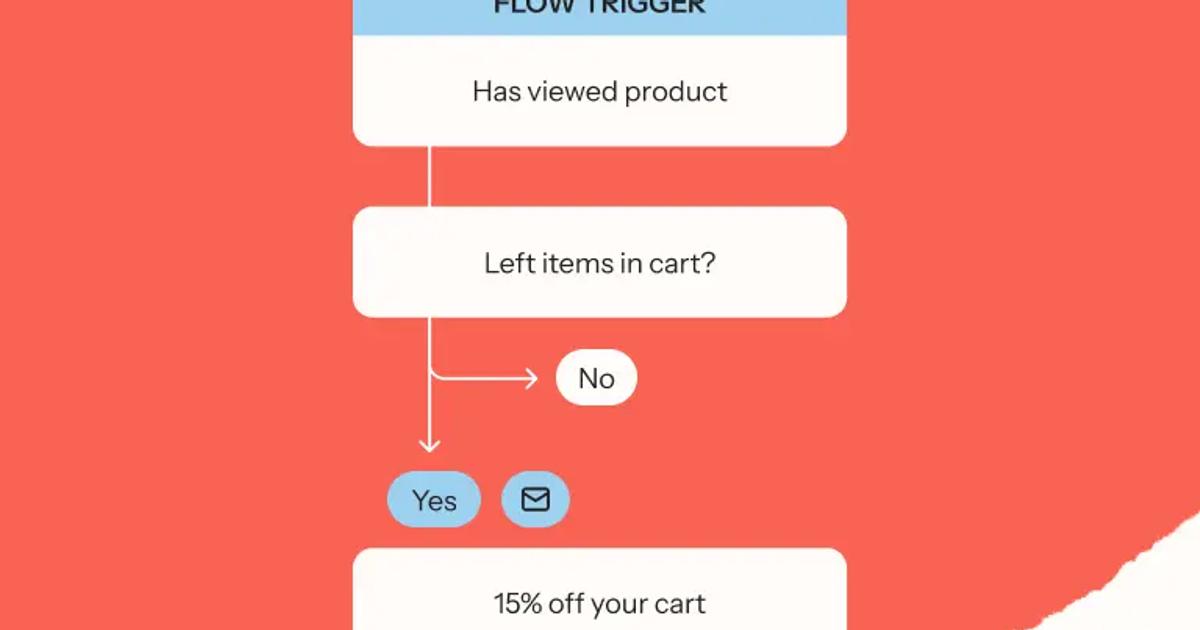
Before you start crafting the content of your abandoned cart emails, make sure you understand and implement trigger splits and conditional splits. Similar to segmenting your campaigns, adding splits to your flows allows you to personalize your abandoned cart email messaging based on event and profile data such as purchase history, cart size, and product preferences.
For example:
- Browse or purchase history: Reference the product pages someone viewed before abandoning their cart, or the products they’ve purchased in the past. For customers who are abandoning high-value carts or who have a high LTV, offer the opportunity to chat with someone on your team if they have any questions.
- Loyalty or rewards points: Instead of offering an incentive to VIPs who might be more likely to buy without one, include someone’s unique points number or tier in the email and encourage them to use their rewards on their purchase.
- Customer support interactions: Exclude customers with open support tickets from receiving an abandoned cart email.
An AI marketing agent built into your CRM can improve and speed up the personalization process. When it’s trained on your product and brand data, the AI agent uses what it knows about your customers and business to not only create abandoned cart emails for you, but also help you personalize their content, offers, timing, and even channels.
In this abandoned cart email example, DTC grooming brand Beardbrand does a great job following this advice. Notice how they not only use personalized copy and a friendly tone to inspire shoppers to “reclaim” their cart, but also keep the product front and center, with distinct CTAs to draw the recipient’s eye.
4. Align your email copy to your brand voice
An abandoned cart email’s objective is to nudge shoppers toward a purchase. Keep your email copy short and limit punctuation, but don’t shy away from your brand’s tone and voice so that customers can get to know you through your abandoned cart email.
If you're using AI to create your abandoned cart sequence, make sure your AI marketing agent is trained on your brand documentation and website. This is how you get messages that actually sound like your brand. Garbage in, garbage out, as they say: your AI-generated abandoned cart sequence is only as good as the data that informs it.
In this abandoned cart email example, sustainable activewear brand Girlfriend Collective uses a minimalistic email template with clever copy: “Looks like you left something cute and sustainable in your cart. Don’t worry, we saved it for you.”
“This abandoned cart email from Girlfriend Collective is *chef’s kiss,*” says Alex McPeak, former content marketing lead at Klaviyo, now senior content manager at Hightouch. “I love the deviation from ‘you forgot something/left something behind’ with ‘you dropped this’ and how they hammer home the sustainability aspect, which is core to their brand.”
Girlfriend Collective
5. Feature high-quality product shots of the abandoned product
By the time shoppers see your email, a million other thoughts could be consuming their mind, and your product won’t be a priority. To entice recipients to engage with your product page again, you’ll need to make it look really good with a high-quality product shot.
You can even build your abandoned cart flow around your product shots if they’re particularly striking. Upload your product shots to your AI marketing agent and ask it to build an offer around them as a starting point, or use an AI photo editor to change the background or color scheme of existing creative.
In this cart abandonment email example, apparel brand Alex Mill uses most of the available real estate to highlight abandoned items with high-quality product images, then complements those with an enticing discount to drive conversions.
Alex Mill
6. Mix in some social proof
Social proof in the form of customer reviews, testimonials, user-generated content, or ratings can influence buying decisions by communicating your products’ value.
More importantly, it can help you earn the trust of shoppers who aren’t familiar with your brand: according to Klaviyo’s 2025 Future of Consumer Marketing Report, customer reviews are the most influential factor when someone is making an initial purchase with a brand.
This abandoned cart email example from clothing brand Flag & Anthem features social proof front and center with a large 5-star rating and 3 rave reviews “about items in your cart.” By reassuring the recipient that “the people love it,” “it” being the item they left behind, the brand is removing doubts about comfort, fit, and quality with the reviews they feature.
7. Offer discount codes…
Personalized and limited-time discounts are a timeless strategy for creating a sense of urgency and increasing conversions in an abandoned cart flow.
And in the face of economic volatility, they’re more important than ever. According to Klaviyo’s Future of Consumer Marketing Report, economic conditions have led 37% of consumers to seek out discounts and promotions from retail and ecommerce brands in the last 6 months.
The added benefit of offering a coupon code to abandoners is that it doesn’t reduce the value of your brand upfront.
A word of caution: Offering discounts to repeat cart abandoners can work against you by training them to wait for a discount before buying. One way to overcome that is by providing one-off discounts, like health and beauty brand Golde does here for new customers.
Golde
And if it really doesn’t make sense for your business economics to be throwing around discount codes for every abandoned cart, consider segmenting high-value carts and only offering an incentive on those where you stand to make more revenue from a single purchase.
8. …or consider offering free shipping instead
According to Baymard, the reason 40% of cart abandoners walk away is that extra costs, like shipping, are too expensive. It stands to reason, then, that offering free shipping may push them over the line to purchase.
Belle Murray, former ecommerce senior strategist at SmartBug Media, suggests this strategy as a way to do more than simply remind your customers that they left without buying: “Introduce a free shipping offer toward the end of your abandoned cart automation.”
“Shipping cost is a very common reason customers leave before completing their purchase,” Murray explains. “A one-time free shipping offer is a great way to give them a nudge to place their first order. Keeping it at the end of your automation with engagement filters will help target engaged subscribers that are still on the fence about purchasing.”
In this abandoned cart email example, hair and bodycare brand Rudy’s offers free shipping to cart abandoners, highlights the offer at the very top, and includes a clear message about the offer’s urgency.
9. Use a convincing CTA
The CTA is one of the most important parts of your cart abandonment email. It gives your customers clear instructions about what they need to do next: return to their cart and complete their purchase.
Some traditional, clear CTAs for abandoned cart emails include:
- Buy now
- Shop now
- Keep shopping
- Return to cart
- Proceed to check-out
- Finish checking out
- Check out now
- Complete your order
If you’re offering a discount or free shipping to get someone back to their cart, consider making that the CTA something like:
- Activate free shipping
- Get my 10% off
- Reveal new price
If your brand wants to come off a little softer, consider a less aggressive CTA for your abandoned cart email:
- Take a closer look
- View cart
- Take another look
If your brand’s voice is cheeky or conversational, now is a great time to have fun with the CTA:
- Let’s do this
- Finish the job
- Seal the deal
- Treat yourself
10. Use AI to experiment with omnichannel abandoned cart flows
If you have consent to send both emails and mobile messages like texts and WhatsApp, don’t assume email is the best way to reclaim a cart. With AI-powered channel affinity, you can automatically follow up with shoppers on the channel they’re most likely to engage with next.
Channel affinity ranks each customer’s top channels in order of preference. With an AI marketing agent, you can build multi-channel abandoned cart flows that automatically start with a customer’s preferred channel, then follow up on their second-most preferred channel next.
11. Send your first email 2–4 hours post-abandonment
Timing your emails correctly is always crucial to success, and nowhere is that more true than the abandoned cart flow.
Don’t send an email too soon after your customer abandons their cart. Whatever distracted them from their purchase might still exist. And if it does, your email might end up buried deep in their inbox or straight in the trash.
Send your first reminder 2–4 hours after abandonment, and keep it simple. You want it to feel organic and friendly.
If your customers don’t engage with your first email, consider sending another reminder 24–48 hours after that. You can make the second reminder a bit more salesy, or work in a personalized offer to amplify its impact.
If shoppers don’t respond to 2–3 emails, they’ve likely completed their purchase somewhere else or abandoned it entirely. At this stage, sending a third sales-oriented email might not help. Instead, send an exploratory email to suggest popular items or related products and lay the foundation for a future sale.
12. Direct shoppers to an AI customer agent
When someone abandons a cart, it can be hard to understand why. You can find out more in aggregate after the fact, but it’s next to impossible to gather a specific reason for each customer. Because of this, your abandoned cart flow is still operating with limited information, despite everything you can do to personalize your messages.
This is where an AI customer agent can come in handy. Shoppers sometimes abandon carts for reasons that are easy to address, like uncertainty about fit or color. Similar to your AI marketing agent, an AI customer agent built into your CRM and trained on your product data can offer personalized assistance that’s actually helpful.
When you direct shoppers to this kind of AI support agent in your abandoned cart flow, you’re hooking them up with a shopping assistant that can answer specific questions about the product they abandoned for the reasons they abandoned it. And that can actually generate revenue that otherwise would have been lost.
Set up an abandoned cart flow in minutes with Klaviyo Composer
Composer is your always-on AI marketing agent. Built into Klaviyo B2C CRM, it knows your brand, your products, and, most importantly, your customers.
Composer helps you uncover opportunities, understand what matters, and decide what to do next. As a next step, audit your abandoned cart flow to identify where customers are dropping off and get suggestions for what to improve. With Composer, you can uncover opportunities you may not have previously thought of.
After that, Composer can help build a better version of your abandoned cart flow, across channels like email and text messaging, using your brand context and customer data throughout the process.
Build better abandoned cart emails with Klaviyo.