If someone at Optimizely mentioned Mark recently and you spent the rest of the meeting wondering which team he’s on, this one’s for you. Mark isn’t a new hire but the new identity of Optimizely’s Agent Platform, and it arrived with a small family in tow: Mark-1, Mark-IQ and Mark-Bench.
Whether you’re brand new to Optimizely or you’ve been using our AI tools for a while and only just noticed the name change, this guide walks you through who’s who and what each one actually does.
The Mark family at a glance
First, a little history lesson (dw, there's no test at the end)
(The OG) Optimizely Opal launched as Optimizely’s AI, built right into the tools marketing and digital teams were already using. At first it mostly helped people with one task at a time. Then we added tons of sources as context and created marketing-specific agents, as well as a platform where customers could create their own... really easily, and with no code required.
So, naturally, customers started building their own agents. Soon they were chaining those agents together into workflows. Then came Virtual Teammates, which pick up work without anyone having to ask.
Somewhere along the way the product grew up (quite a lot), and a name that sounded like a helpful sidekick stopped fitting.
So on October 15, 2026, Opal became Mark. And not because Mark is older and wiser — more because Mark (pronoun: it) encompasses everything a MARKeter could want from AI in their day-to-day to make themselves more productive, more effective, and more oh-my-gosh-I'm-having-fun-doing-marketing-again.
If you were using Opal, you’re already using Mark: same product, same expanding directory of agents, new name. And naturally... still growing as a product (and always growing as a product).
Meet Mark 🤝
Mark is an agent platform built for marketing teams. Its official descriptor is Optimizely Agent Platform, which is more of a mouthful but tells you exactly what it does: it’s where marketers build, run and keep an eye on AI agents, with no code and no waiting in a developer’s queue. You’ll see both names around, and they mean the same thing. Mark is just one syllable.
Here’s what Mark can do for you:
Context: skills, personal files, memory, and more get pulled in dynamically for the highest quality output
Connectors: pull data in and connect to the rest of your tech stack with pre-built tools and MCPs
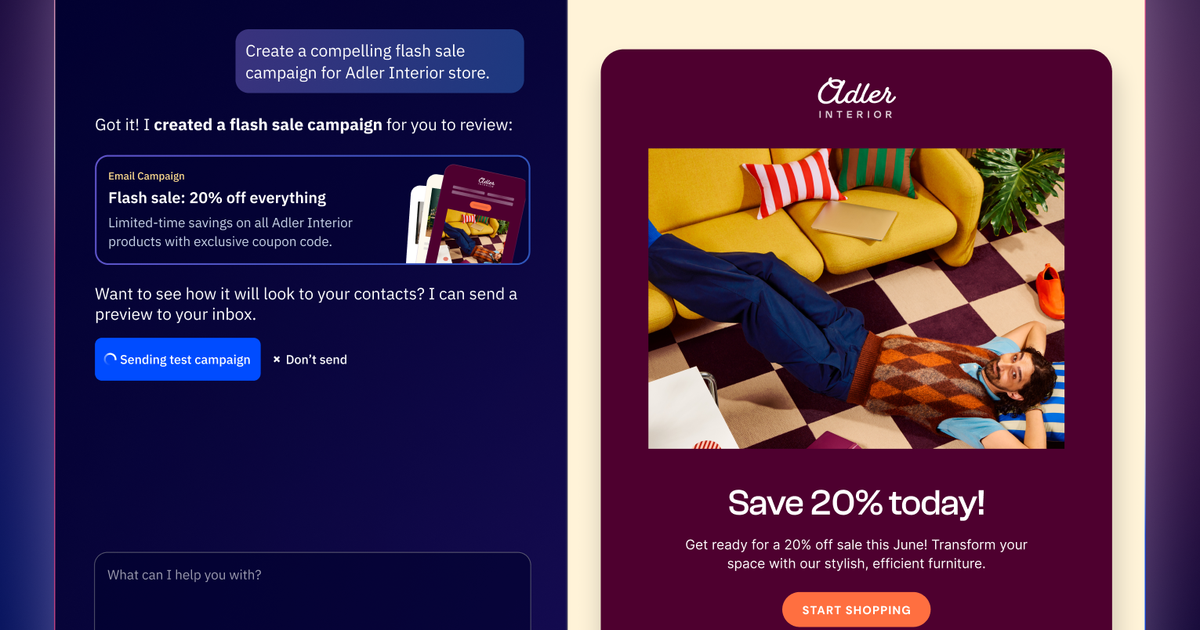
Chat: ask a question, brainstorm an idea or get help with a task, right inside the Optimizely tools you already use (known together as Optimizely One)
Agents: 50+ ready-made agents for marketing and digital work, plus any you build yourself
Workflows: string several agents together so a piece of work moves from research to draft to review in one go
Virtual Teammates: AI teammates that know your brand and keep work moving in the background, with no prompt needed
Guardrails: quality scoring, rules that keep agents on track and approval steps, so a real person signs off before anything goes live
Mark-1: AI that only cares about marketing
The biggest, most advanced AI models (often called frontier models) are brilliant all-rounders. They’ll write you a haiku, debug your code, and explain quantum physics before lunch. But if you’re a marketer drafting your fortieth email variant of the week, most of that brainpower goes unused, and you still pay for it, since AI is typically billed by the token (roughly, small chunks of text).
Mark-1 is Optimizely’s first family of models built for marketing work. They’re post-trained, which means they start from an existing model and get extra training focused on the jobs a marketing agent does all day: writing campaign copy, analyzing experiments and making sense of customer behavior. Everything else gets stripped out.
In early testing by the Optimizely AI Lab, Mark-1 models delivered 10x greater cost efficiency than state-of-the-art LLMs, and they’re coming soon for every Mark customer.
More cost efficiency than state-of-the-art LLMs in early Optimizely AI Lab testing
The best part is that you shouldn’t ever have to pick a model yourself. Mark is designed to match each task to the model that suits it, so a quick question like defining a metric doesn’t get the same (pricier) treatment as planning a multi-step campaign. Not every question needs a PhD, and nobody should have to become a token economist to work out which ones do.
Customers shouldn’t have to think about which model to use, when, or how. They can just trust that our agent platform will apply the right model for the right use case, so their time and their budget go toward the work that actually grows the business.Imran Yousuf|Head of AI Engineering, Optimizely
Customers shouldn’t have to think about which model to use, when, or how. They can just trust that our agent platform will apply the right model for the right use case, so their time and their budget go toward the work that actually grows the business.
Imran Yousuf|Head of AI Engineering, Optimizely
Mark-IQ: The Mark that knows your data and brand (like the back of its hand)
If you’ve ever pasted your brand guidelines into an AI chat for the tenth time (read: every single one of us) and hoped it would stick this time, Mark-IQ is the fix.
It’s the data layer that sits underneath every model, built on your organization’s own context, including your experimentation history and web analytics. That means whichever model picks up a task, it already knows your brand from the start.
How it all fits together
Here’s what happens when you ask Mark for something:
You ask: Tell Mark what you need in plain language.
Mark-IQ adds context: Your brand, experimentation history and web analytics come along automatically, with no re-prompting.
The right model takes the job: Mark is built to match each task to the model that fits it, with Mark-1 joining the lineup soon.
You review and approve: Quality scoring and human sign-off sit between the work and the publish button, so nothing goes live without you.
So what’s this whole "AI harness" thing?
Every AI product runs on a model, the underlying “brain” built by companies like Anthropic (Claude) or Google (Gemini). On its own, a model is a lot of raw horsepower with no idea who you are, what your brand sounds like or which tools your team uses.
Mark is the shell — the AI harness — built around that model, and it comes packed with your context, your tools, your guardrails and your memory. That shell turns out to matter a lot, and we have the numbers to prove it, which we’ll get to in a moment.
What we're calling things at Optimizely
Mark-Bench: The Mark who has the receipts
A benchmark is a standardized test for AI: a fixed set of tasks that every model attempts, so you can compare their scores fairly. Every AI vendor has a slide claiming their model is the best at marketing, but until recently there was no shared test to check any of those claims.
How do you say your model is good, or your harness is good, without any objective way to measure it? It started to feel a little nonsensical to me. So we built one.Shafqat Islam|President, Optimizely
How do you say your model is good, or your harness is good, without any objective way to measure it? It started to feel a little nonsensical to me. So we built one.
Shafqat Islam|President, Optimizely
Mark-Bench is an open-source benchmark that grades AI on real marketing work. It currently covers 297+ tasks and scenarios across 17 marketing functions, scored against 3,564 criteria.
Each scenario is set up like a genuine assignment, with a brief, the source files you’d actually need (brand guidelines, style guides, source data) and an expected output format. Every answer is graded against a checklist of 12 to 30 criteria by several AI judges, both Claude and Gemini, so no single model’s preferences can tip the scales. Real people check the work too:
You can use AI to generate a benchmark, but if you don’t have subject matter experts checking the domains, the tasks, the rubrics, you just end up with more slop.Shafqat Islam|President, Optimizely
You can use AI to generate a benchmark, but if you don’t have subject matter experts checking the domains, the tasks, the rubrics, you just end up with more slop.
Shafqat Islam|President, Optimizely
What the results showed
The toughest score on Mark-Bench is the all-pass rate, where a model only gets credit for a scenario if it clears every single criterion. On default settings, Mark scored 67% against Claude Code’s 60%, at 2x lower cost.
Default settings. Credit only for scenarios that clear every single criterion. Source: Optimizely, Introducing Mark-Bench
The more surprising result came from keeping the model the same and changing only the shell around it. Nikita Bokil, part of Optimizely’s product team, ran one model (Opus 5X-High) in different setups. Calling the raw model directly cost $40.52 per task and scored 65% on quality, while the same model running inside Optimizely’s harness cost $4.91 per task and scored 67%.
Cost per task for Opus 5X-High. Quality: 65% for the raw model, 67% in Mark’s harness. Source: Optimizely, Introducing Mark-Bench
In other words, the same brain in a better shell did slightly better work for 88% less money (...who doesn't love hearing that?).
We know how it looks when a company builds a test and then publishes a result where it comes out on top. That’s exactly why Mark-Bench is open source: the tasks, the grading criteria and the scoring are all out in the open for anyone to check. Run your own model against it, and feel free to grade us back.
We want to be an honest, unbiased voice on what’s actually good for marketing. That only works if the benchmark is as transparent and objective as possible.Shafqat Islam|President, Optimizely
We want to be an honest, unbiased voice on what’s actually good for marketing. That only works if the benchmark is as transparent and objective as possible.
Shafqat Islam|President, Optimizely
The bigger plan is to use these results to decide where work goes. When a new model launches, it runs through Mark-Bench within hours, and Mark learns where that model shines, where it struggles and which marketing tasks to send its way.
So, who the eff is Mark?
Here’s the whole family, one line each to keep things extra simple:
Opal is the name we outgrew.
Mark is the product: chat, agents, workflows and Virtual Teammates, with a human always in the loop.
Optimizely Agent Platform is the same as above, but a does-what-it-says-on-the-tin term.
Mark-1 is the marketing-trained brain, coming soon.
Mark-IQ is the deep knowledge of your data and brand.
Mark-Bench is how we prove any of it works.
If you’ve ever worked somewhere that renamed a product, a team or even a meeting, you know a new name doesn’t land overnight.
For weeks afterward, people say the old one out loud, correct themselves halfway through a sentence and type it into Teams or Slack before backspacing it away. It isn’t stubbornness so much as muscle memory, and most of us here are still catching the occasional “Opal” slipping out mid-call.
So, if you find yourself doing the same, consider yourself in very good company. The name will settle in eventually, and in the meantime you’ve got the cheat sheet. Next time someone asks what happened to Opal, you’ll know the answer, and if they ask whether Mark is on your team, the answer is increasingly yes. Go say hi.