- Blog
October 27, 2026
Most email marketing software comparisons will hand you a checklist and call it a day, but choosing the right software isn't about finding the tool with the longest feature list.
Two platforms can both claim "automation" while delivering wildly different experiences. One might offer simple drip sequences while another orchestrates multi-step behavioral journeys across email, SMS, and web. Feature labels say nothing about depth, so they rarely tell you which platform is actually the best fit for your business.
Instead, you should be searching for the best email marketing software based on three things:
- Feature depth: What the platform can actually do beyond basic campaign sending, and how that meets your team’s email marketing objectives.
- How the platform stands out: Where it excels against the competition, what it’s actually designed for, and where limitations appear.
- Pricing and long-term value: How costs scale as your contact database and marketing needs grow.
To make that decision easier, this guide compares eight leading email marketing platforms based on how they actually work in practice, along with key differentiators, independent review data, and pricing breakdowns that examine real value over time. We’ve also evaluated how each platform approaches a real marketing workflow, so you can see whether each suits your day-to-day marketing operations.
Here's a quick look at how these email marketing platforms stack up against each other:
Prices and features accurate as of March 2026.
Now let’s have a look at how each platform performs in practice.
ActiveCampaign
ActiveCampaign is an AI-driven, autonomous marketing platform offering email marketing software with a first-in-class deliverability rate. It unifies CRM and cross-channel messaging in one system. Rather than forcing you to choose between simple tools that limit growth or enterprise platforms that require dedicated admins, ActiveCampaign delivers enterprise-grade automation with a learning curve softened by AI assistance.
The platform processes billions of customer interactions weekly to feed machine learning models that power everything from send-time optimization to campaign generation. The autonomous marketing platform doesn’t require constant manual adjustment, but instead is designed to get smarter as you use it. Active Intelligence learns from your own sends, engagement, and workflows, so its guidance reflects your account's patterns instead of generic advice.
ActiveCampaign's email marketing features at a glance
ActiveCampaign packs a wide feature set into a single platform to cover the full marketing lifecycle, from initial contact capture through closed deals:
- Active Intelligence for AI-powered campaigns, reporting, and optimization: A full suite of AI tools and agents reduce workload across the entire marketing workflow, from building complete journeys and automations to analyzing and intelligently optimizing performance.
- Visual campaign builders: A drag-and-drop email designer with hundreds of AI-powered templates, plus an AI Brand Kit that automatically imports your brand assets from your website.
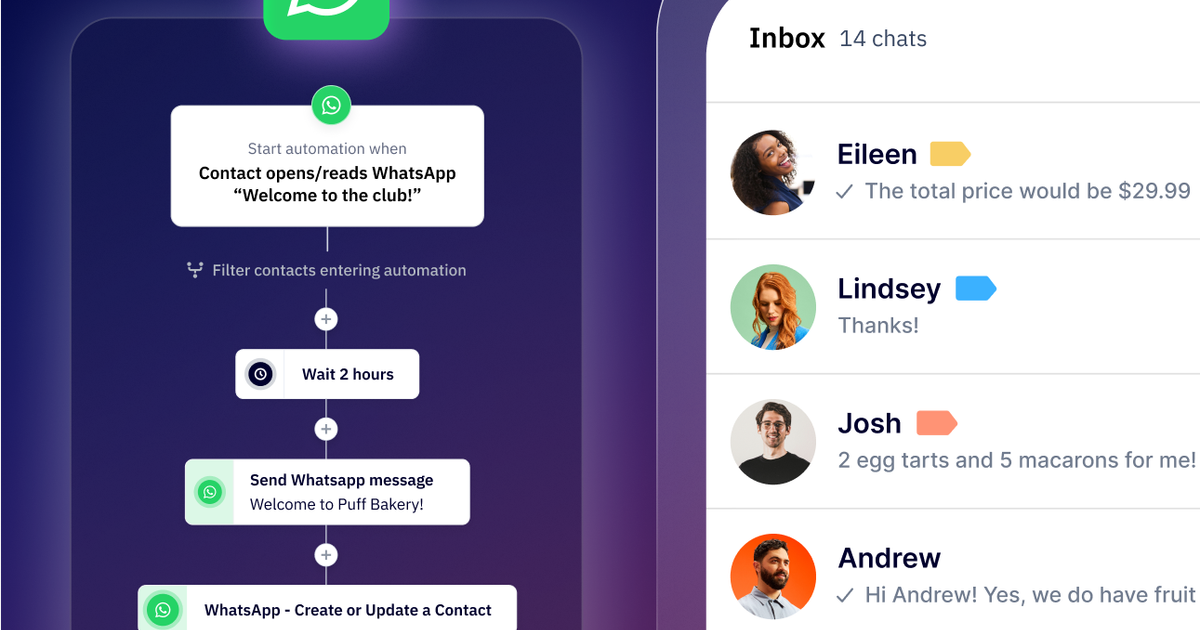
- Cross-channel automation: Build workflows with advanced logic that span email, SMS, WhatsApp, and site messaging, all from one visual automation builder.
- Built-in sales CRM: Kanban-style deal pipelines, behavior-based lead scoring, and automated deal creation keep marketing and sales aligned without a separate tool.
- Deep segmentation and personalization: Behavioral tracking across site visits, email engagement, and app events feeds dynamic content, predictive sending, and AI-suggested segments.
- Transactional email: Send receipts, shipping confirmations, and password resets through a dedicated transactional email infrastructure.
- 1,000+ integrations: Connect ecommerce platforms, SaaS tools, CRMs, and business apps for bi-directional data and event sync without custom development.
- Strong deliverability infrastructure: Tools built to keep your sending reputation secure, including native domain verification tools, dedicated IP options, bounce management, automated list cleanup, and a deliverability consultation service.
Explore more features and see how they work for yourself in ActiveCampaign’s self-guided product tours.
How does ActiveCampaign stand out from other tools?
ActiveCampaign's core advantage is its automation-first architecture powered by AI. Where many platforms bolt automation on top of a newsletter tool, ActiveCampaign was built from the ground up to orchestrate complex customer journeys without requiring a dedicated ops team.
EmailToolTester’s latest email deliverability tests scored ActiveCampaign with a 94.2% deliverability rate, in 1st place out of 15 tools tested.
Let’s take a deeper dive into how the autonomous design of ActiveCampaign’s email marketing software plays out against other platforms.
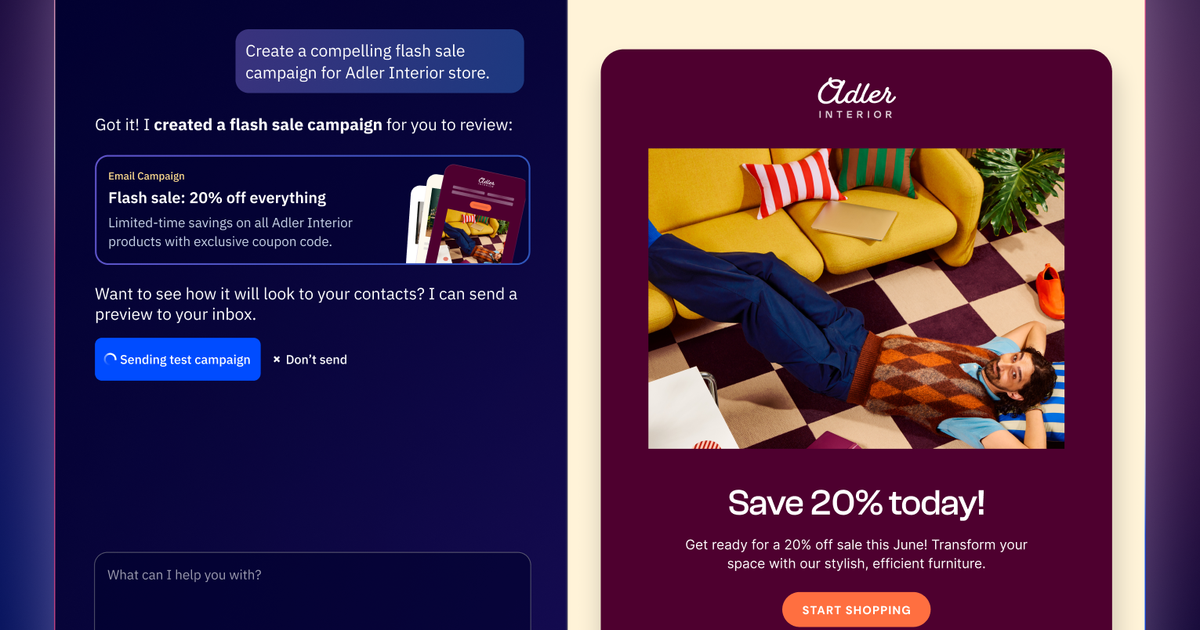
It solves the "time drain" challenge. Small teams lose hours every week on repetitive campaign setup. ActiveCampaign's AI agents generate complete, on-brand campaigns in minutes, with drag-and-drop workflows and deep customization capabilities that don’t require technical expertise.
6.3 billion weekly automated experiences powered by ActiveCampaign.
The platform's 900+ automation recipes let you deploy proven workflows, including welcome sequences, abandoned carts, re-engagement series, with just a few clicks, and then customize from there. This automation is far more advanced than platforms like Mailchimp, Constant Contact, or Brevo, but easier and more marketing-focused than HubSpot's enterprise-level workflows.
Active Intelligence surfaces the insights. I just need to apply the learning and keep the cycle going. I’m steering strategy. I’m not pulling reports. I’m not guessing what to test next. The system does the heavy lifting.
Active Intelligence surfaces the insights. I just need to apply the learning and keep the cycle going. I’m steering strategy. I’m not pulling reports. I’m not guessing what to test next. The system does the heavy lifting.
Marketing teams using ActiveCampaign save an average of 10 hours weekly across tasks like campaign building, content creation, and lead follow-up.
It handles personalization complexity. Behavioral tracking across site visits, email clicks, and app events feeds conditional journeys and dynamic content blocks automatically. Predictive sending analyzes engagement data to find the best send time not just at list level, but for every individual contact.
Don Purdy, Director of the University at Albany's Executive MBA Program, started with basic marketing theory and expanded essential, foundational personalization concepts with ActiveCampaign. With AI-support baked in, he was able to take proven methods to scale, serving tens of thousands of students with personalized content.
I realized that my system was the problem. I didn’t need more people. I didn’t need a smaller list. I needed to go back to Marketing 101. Segment by behavior, send relevant messages, track what works, but execute it with infrastructure that could actually scale. That’s when I switched to ActiveCampaign. I use close to 400 tags. And all the segments, all the tags feed into automations.
I realized that my system was the problem. I didn’t need more people. I didn’t need a smaller list. I needed to go back to Marketing 101. Segment by behavior, send relevant messages, track what works, but execute it with infrastructure that could actually scale. That’s when I switched to ActiveCampaign. I use close to 400 tags. And all the segments, all the tags feed into automations.
c52707tp
AI-suggested segments create smart audiences from behavior and preferences in seconds with no manual filtering required. Targeting is far more advanced than broadcast segmentation tools and rivals Klaviyo in personalization depth, while supporting more diverse business models beyond ecommerce.
It unifies cross-channel marketing. ActiveCampaign orchestrates email, SMS, WhatsApp, and site messaging from a single workflow. Unified reporting ties marketing activity to revenue, so you can see what drives results across every channel.
The integration library connects to 1,000+ tools spanning ecommerce, SaaS, B2B, and service businesses. This provides broader lifecycle orchestration than Constant Contact, GetResponse, or Brevo, with comparable channel depth to Omnisend but far more automation flexibility.
The built-in CRM aligns marketing and sales. Automated lead scoring and deal creation eliminate the need for separate CRM software for most teams. Chrome and Outlook extensions bring CRM context into your inbox, and Slack notifications can alert your team when contacts take key actions.
This is more integrated than Klaviyo, Mailchimp, or Omnisend. It's also far more accessible and cost-effective than HubSpot's full CRM suite.
Revenue and lifecycle reporting goes beyond "what happened" to “what’s next”. AI-powered insights recommend next steps: what to adjust, when to send, and which segments to prioritize. The Business Goals agent maps plain-language goals to proven strategies and tracks progress with real-time performance metrics. Any questions you ask can become a scheduled task, so the weekly summary is ready before you open the dashboard.
So what are the limitations?
ActiveCampaign's feature depth can look overwhelming initially. The platform offers significantly more capabilities than basic send-only tools, which may make it look like there's more to learn. However, extensive resources including AI agents, user-friendly documentation, pre-built recipes and templates, and free migration assistance help teams navigate complexity with confidence.
ActiveCampaign offers significantly more power with much less friction.
Teams with very simple newsletter-only needs might not use the full platform's capabilities. If you're only sending monthly updates with no automation, segmentation, or CRM requirements you can do so easily. Simpler tools might feel like a better fit, but keep in mind that you'll hit their limits quickly if your needs evolve.
ActiveCampaign's pricing and value over time
ActiveCampaign’s pricing structure is based on providing a complete marketing and sales platform from the start. Pricing is based mostly on contact numbers, with plans starting at $15/month for 1,000 contacts, and deep automation capabilities, CRM functionality, and AI features available earlier in tiers than many competitors.
Unlike platforms that gate essential features behind expensive tiers, ActiveCampaign delivers meaningful automation capabilities at accessible price points. You can also add specialist features to any tier when you’re ready to justify the ROI, so there are no all-or-nothing upgrades.
As your contact list and complexity grow, ActiveCampaign's pricing scales with the value you're extracting. Teams consistently report that the time saved through automation and the revenue generated through better personalization justify choosing the platform over basic ESPs.
ActiveCampaign users report significant and measurable productivity gains.
What users have to say about ActiveCampaign
ActiveCampaign scores 4.5 out of 5 stars on G2 based on over 14,500 reviews and 4.6 out of 5 stars on Capterra.
ActiveCampaign users frequently call out the platform as a superior Mailchimp alternative and HubSpot alternative for growing teams that need automation without enterprise complexity.
ActiveCampaign operates as a high-precision orchestration layer, moving far beyond traditional email broadcasting into the realm of “Active Intelligence.” Its visual automation builder is a technical benchmark, allowing for complex, branching logic that responds to granular behavioral triggers in real-time. With a consistently elite deliverability rate of 94%, it ensures that sophisticated segmentation strategies translate into measurable inbox presence and superior engagement metrics.
ActiveCampaign operates as a high-precision orchestration layer, moving far beyond traditional email broadcasting into the realm of “Active Intelligence.” Its visual automation builder is a technical benchmark, allowing for complex, branching logic that responds to granular behavioral triggers in real-time. With a consistently elite deliverability rate of 94%, it ensures that sophisticated segmentation strategies translate into measurable inbox presence and superior engagement metrics.
We’ve discovered that ActiveCampaign strikes the best combination between use and power. It’s a useful tool with a manageable learning curve. It is now a key component of our approach to relationship management and customer acquisition.
We’ve discovered that ActiveCampaign strikes the best combination between use and power. It’s a useful tool with a manageable learning curve. It is now a key component of our approach to relationship management and customer acquisition.
A lot of marketing tools either lean too heavy into complexity or they oversimplify and limit what I can actually build. But ActiveCampaign hits a sweet spot. It balances power with usability.
A lot of marketing tools either lean too heavy into complexity or they oversimplify and limit what I can actually build. But ActiveCampaign hits a sweet spot. It balances power with usability.
ActiveCampaign is the best email marketing software for teams that need automation-driven growth, cross-channel orchestration, and a built-in CRM without the cost or complexity of enterprise platforms. It's versatile across industries: ecommerce, SaaS, B2B, agencies, and service businesses alike.
HubSpot
HubSpot's email marketing lives inside a much larger ecosystem. It sits inside the Marketing Hub, which is one component of a full suite of inbound marketing products—all connected by HubSpot's Smart CRM. For organizations already running their go-to-market motion in HubSpot, email is a natural extension.
HubSpot's email marketing features at a glance
HubSpot approaches email as a CRM-first activity. Standout capabilities include:
- CRM-driven personalization: Email content draws directly from CRM properties, lifecycle stages, and custom objects to personalize messages based on where contacts sit in your pipeline.
- Marketing automation workflows: Triggered based on CRM data, form submissions, and behavioral events.
- Drag-and-drop email builder for easy design of professional layouts.
- Forms, landing pages, and traffic tools: Built-in lead capture and website tools feed contacts directly into nurture workflows.
- Nurture sequences and workflows: Drag-and-drop workflow builder supports conditional logic, delays, and multi-branch paths (available on Professional and above).
- Reporting and attribution: Connect email performance to pipeline movement and revenue.
- AI features: Content generation, send-time optimization, and messaging insights via the Breeze tool.
Email creation integrates with HubSpot's broader content tools. You can reuse images and videos across emails, landing pages, and social posts without re-uploading assets, while the Campaign feature ties multiple touchpoints together for unified tracking.
How does HubSpot stand out from other tools?
EmailToolTester’s latest email deliverability tests scored HubSpot with a 77.7% deliverability rate, in 12th place out of 15 tools tested.
HubSpot's primary strength is unification. The entire go-to-market function—marketing, sales, and service—can live in one platform if you invest in the full suite.
It unifies the entire GTM motion. HubSpot works best when your full go-to-market engine runs inside the platform. Marketing emails, forms, landing pages, lead handoff, pipeline management, and customer service activity all tie back to the same CRM record, giving teams a shared view of the customer across every stage of the funnel.
It creates strong cross-team visibility. HubSpot’s permissions, team structures, custom objects, and reporting layers make it well suited to organizations that need governance across larger teams. It is built for coordinating multiple teams around the same customer record and reporting framework.
It benefits from a mature partner and integration ecosystem. HubSpot has a large number of app integrations that support adoption and expansion. For businesses that want broad internal alignment around a single platform, that ecosystem can be an advantage.
So what are the limitations?
HubSpot’s email automation can be less flexible than platforms designed specifically for lifecycle marketing. Many teams find workflow automation powerful for cross-team processes but more rigid for highly customized behavioral email journeys.
It can also introduce high platform overhead and costs. Because HubSpot is designed as a full CRM and business platform, teams may end up managing more structure, configuration, and pricing complexity than they actually need for email marketing. That may be less appealing for teams that mainly want advanced email automation without the cost and weight of a broader suite.
HubSpot’s pricing and value over time
HubSpot’s Marketing Hub tiers are based on feature availability, HubSpot branding removal, and automation depth. Contact limits and number of seats affect pricing significantly, with a free tier available and paid subscriptions starting at $9/seat/month for HubSpot Marketing Hub Starter. Each tier offers a set number of marketing contacts and once your marketing list hits these limits, there are (significant) additional monthly fees based on volume.
Because the platform is modular, with dedicated hubs for CRM, marketing, sales, and service, you’re likely to be paying for multiple systems to ensure your data is fully integrated.
Common pricing complaints center on the gap between Starter and Professional. Starter looks affordable but lacks workflows—the feature most teams need for real automation. Professional unlocks capabilities like stronger automation and AI functionality, but requires annual commitment and substantial upfront investment.
It’s also worth noting that there is a compulsory one-time fee for onboarding to Professional and Enterprise plans. This ranges from $3,000 for smaller businesses to $7,000+ for larger enterprises.
What users have to say about HubSpot
HubSpot scores 4.4 out of 5 stars on G2 and an average of 4.5 out of 5 stars across its hub profiles on Capterra.
Users consistently praise the intuitive interface and the all-in-one nature for reducing tool sprawl. Criticisms focus on cost and complexity, noting that the spread of the platform can sometimes be confusing.
HubSpot Marketing Hub stands out for its intuitive interface, powerful automation tools, and seamless integration of email marketing, CRM, and analytics in one platform.
HubSpot Marketing Hub stands out for its intuitive interface, powerful automation tools, and seamless integration of email marketing, CRM, and analytics in one platform.
What I like most about HubSpot Marketing Hub is that it lets me centralize all the campaigns we run for customers in one place. It’s relatively easy to use, and there are countless things you can do with it, which makes it a really flexible tool for managing our work. With so many possibilities available, it can be hard to fully understand everything the product can do. I get the sense that there are plenty of options I’m not taking advantage of simply because I don’t know about them yet.
What I like most about HubSpot Marketing Hub is that it lets me centralize all the campaigns we run for customers in one place. It’s relatively easy to use, and there are countless things you can do with it, which makes it a really flexible tool for managing our work. With so many possibilities available, it can be hard to fully understand everything the product can do. I get the sense that there are plenty of options I’m not taking advantage of simply because I don’t know about them yet.
HubSpot is a good choice for organizations that value tight marketing-sales alignment and can justify the investment in a comprehensive ecosystem.
Read our full comparison of ActiveCampaign and HubSpot for a deeper dive into both platforms.
Weighing the cost difference? Find out what teams get when they switch from HubSpot to ActiveCampaign, including what migration looks like and where teams find the most immediate value.
Mailchimp
Mailchimp’s email marketing software is one of the most recognized products in the game and most people who've ever sent a marketing email have at least considered it. But recent pricing and feature changes have shifted its value proposition significantly. What was once the default choice for small businesses has become a more expensive option with automation depth that caps out faster than competitors.
Mailchimp's email marketing features at a glance
Mailchimp's core features center on email creation and basic audience management:
- Intuitive email builder: Use drag-and-drop editing and 100+ templates.
- Customer journeys: Create basic, automated email sequences.
- Audience segmentation: Based on tags, groups, and basic behavioral data.
- Integrations: Including major ecommerce platforms, social media, and business tools.
- AI writing and design: Via Intuit Assist (beta) for content generation and predictive insights.
- Lead capture: Landing pages and forms.
- Basic reporting: Opens, clicks, and engagement metrics.
The platform once offered stronger AI email design through its Creative Assistant feature. But after consolidating AI tools under the Intuit Assist umbrella, many of those design capabilities appear to have been reduced or quietly retired.
How does Mailchimp stand out from other tools?
EmailToolTester’s latest email deliverability tests scored Mailchimp with an 89.5% deliverability rate, in 7th place out of 15 tools tested.
Mailchimp's approachable UX makes it one of the fastest platforms for getting your first campaign out the door.
It is very approachable for absolute beginners. The interface prioritizes simplicity over sophistication. You can create and send your first campaign quickly without technical knowledge or extensive training.
It has strong brand-familiarity. Because of this, abundant third-party content, tutorials, and community resources are also available. For someone who's never used email marketing software, Mailchimp might feel less intimidating than platforms with deeper feature sets.
It has a strong template library and design tools. Mailchimp offers professionally designed templates across various use cases. The email builder includes a Canva integration for creating graphics directly within campaigns. For teams without dedicated designers, these resources provide a reasonable starting point.
So what are the limitations?
Automation depth caps out for complex lifecycle journeys. Mailchimp's Marketing Automation Flows handle basic sequences like welcome series and abandoned cart reminders. But teams needing sophisticated conditional branching, goal tracking, or multi-step behavioral workflows will find the platform restrictive compared to ActiveCampaign or Klaviyo.
The audience and list-based data model creates friction as businesses grow. Mailchimp counts contacts across all lists. The same person in multiple audiences counts multiple times toward your limit—a policy that can inflate costs and frustrate teams.
Mailchimp's pricing and value over time
Mailchimp paid plans start at $26.50/month for 1,000 contacts and pricing scales significantly based on list size. The platform's contact counting methodology, such as charging for duplicates across audiences, creates unexpected cost increases that other platforms avoid.
Recent changes have made the free plan futile for most organizations. The contact limit has dropped from 2,000 to 500 to just 250 contacts now. Monthly sends are capped at 500 with a 250-email daily limit and automation features are no longer available to free users.