Events
The night before AGNTCon + MCPCon Europe, we hosted the Agentic AI Foundation community at the JetBrains office in Amsterdam. The event filled up fast and went to a waitlist, which is not what I expected for a Wednesday evening discussion about how open foundations work.
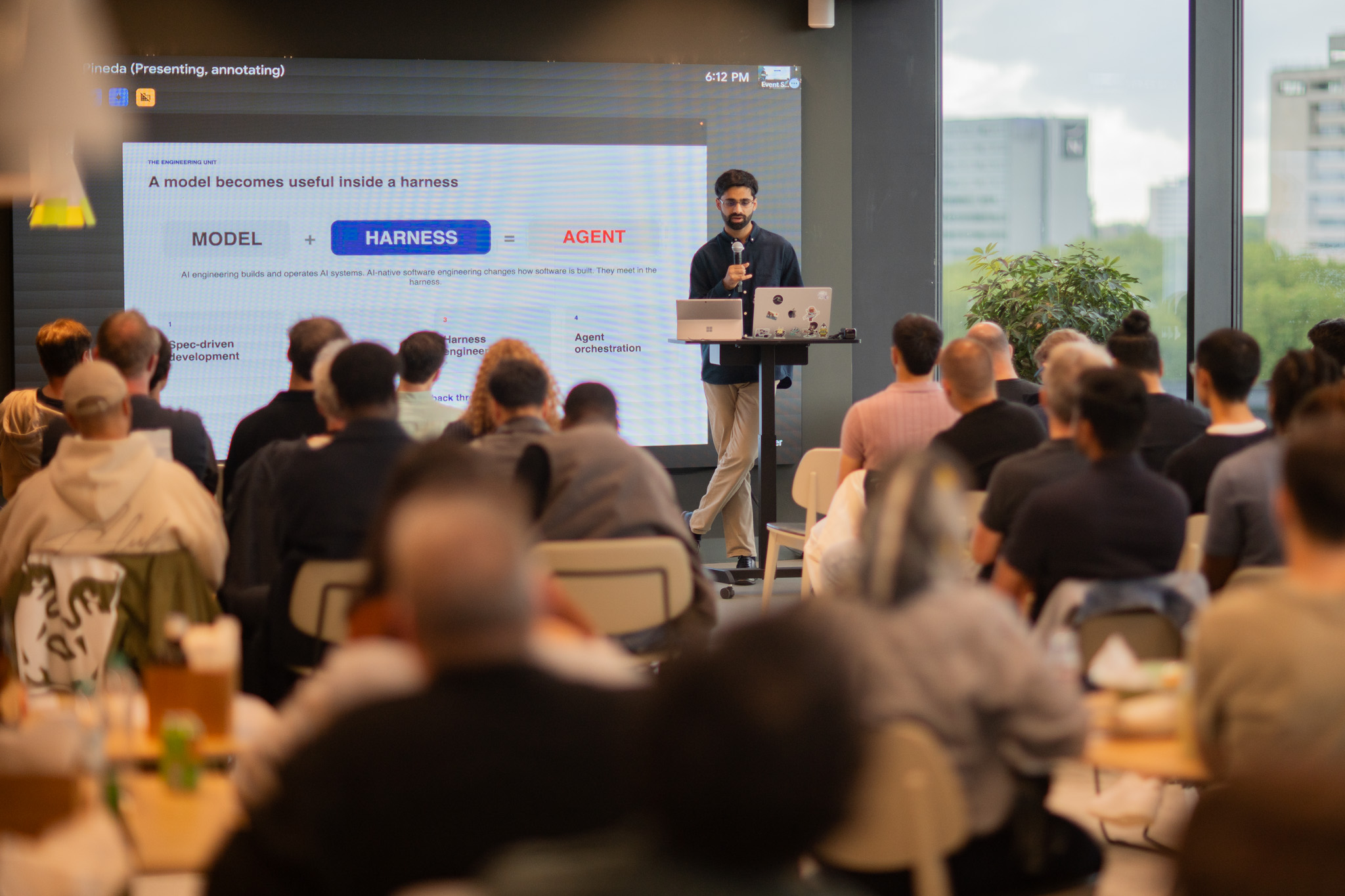
Ibrahim Malik opening the evening.
The panel asked what happens when companies, maintainers, and contributors want different things from the same project. In other words, who gets to decide? That’s the oldest question in open source, and agents haven’t made it any easier. Nick Veenhof from GitLab, Alessandro Vozza from VOLT Datacenters, Miguel Luna from JetBrains, and I each came at it differently. My favorite line of the night was Nick’s. Talking about the infrastructure the Drupal Association runs so anyone can download project code, he said: “Someone needs to pay for the roads”. Paying keeps a project alive. Two days at the conference convinced me it doesn’t determine who decides. That goes to whoever has earned the trust, and you can’t buy trust. You earn it by doing the work, consistently and in the open.
Left to right: Nick Veenhof (GitLab), Miguel Luna and Katherine Druckman (JetBrains), Alessandro Vozza (VOLT Datacenters), and Bauke Brenninkmeijer (Orq.ai).
Review is the bottleneck now
I spent part of the summer on program committees for several events, reading talk proposals. A lot of them were AI-generated, polished, and interchangeable. Maintainers in working groups across open source describe the same thing – long AI-generated proposals that relitigate decisions already made. Their work shifts from building to explaining what was settled six months ago. Mine shifted from just choosing talks to working out which ones had enough real human experience behind them.
Dexter Horthy of HumanLayer came at the same problem from the other direction in his keynote, State of the Software Factory. He argued that code from unattended agents gets worse over time, so for now, people need to plan before they build and keep reading the code. His diagram added agentic code review and regression testing to the production pipeline, and he pointed out that review can still be the bottleneck. None of that is new, but his emphasis was the message. The hard part now is everything that comes after the code gets written. Someone has to understand what an agent produced and answer for it. Out on the show floor, one startup had built its entire booth around bugs written by agents.
Dexter Horthy’s “Lights-Off Software Factory”, the setup without human review that he argued against, from his keynote, State of the Software Factory.
What went wrong
A talk I keep thinking about was Nick Veenhof’s. He walked through a system he built for himself, 13 specialist agents, and one orchestrator, and he was honest about what failed. Tests passed while the wiring underneath was broken. A background job stopped for 46 days with no alert. An agent produced 80 fabricated data points that looked exactly like what he had asked for, and it took him two hours to catch them. His point was that complete and wrong is worse than partial and honest. He has been writing the whole thing up publicly, failures included.
A slide from Nick Veenhof’s talk, From Personal Agent To Org Catalog.
A good reason to show up
The conventions for how agents connect to tools, get traced, and stay secure are being written right now, in working groups open to anyone who joins the call. Most of them could use more people. A lot of that work needs no code at all. Threat models and governance get written in documents and decided in meetings. If you want somewhere to start, pick one working group that matches your interests or role, join a call, and read the notes from previous meetings to get up to speed. Then show up consistently – that part can’t be generated.
That’s also why openness matters beyond community values. Agentic development is not going to run on a single model or a single vendor’s stack. Teams will mix them, and the systems around those agents have to support that choice without losing track of what the agents did or who is accountable for it. That’s the thinking behind JetBrains Air, which we announced the week after the conference.
JetBrains participates in the Agentic AI Foundation because our users will live with the standards worked out in these communities. I still learn more from maintainers in a hallway than anywhere else.
Thank you to Bauke Brenninkmeijer, Michaela Raukar-Herman, and Ruslan Kuleshov for making the meetup happen, to our panelists, to Alex Salkever, Ibrahim Malik, and Jake Pineda for their talks, and to everyone else who came out. We will see you at the next AGNTCon in San Jose. Come find us at our booth.
Meetup photos by Ivan Davletshin