I. The Suit
The first time Tony Stark’s Iron Man suit takes flight, its power is impossible to miss.
It can fly at extraordinary speeds, track multiple threats, deploy weapons, calculate trajectories, and respond to attacks in seconds. With every new armor, its capabilities become more sophisticated.
But Iron Man rarely faced a single attack – a dozen threats appear at once. One is approaching fast, another is aimed at someone Tony needs to protect, and a third could trigger even greater destruction.
Which threat should he tackle first? Should he attack, defend, retreat, or protect someone else? And what happens when the most powerful weapon isn’t the smartest response?
The challenge was never simply having enough firepower. It was knowing which capability to use, when to use it, and when not to act at all.
That’s where JARVIS changes everything. JARVIS does not make the suit powerful by adding another missile. He makes its existing power usable by interpreting what is happening around it – assessing threats, evaluating possible actions, and helping Tony determine what matters in the moment.
The suit answers one question: What can I do?
JARVIS helps answer another: What should I do now?
That’s the difference between having capabilities and knowing how to use them. And it’s a distinction that is becoming increasingly important in customer engagement.
II. A Thousand Superpowers
Generative AI has given marketing its Iron Man suit. It can write a thousand messages in the time it once took a team to approve 10. It can produce images, subject lines, product descriptions, offer variations, landing pages, and entire customer journeys. It can translate them, resize them, personalize them, and adapt them for nearly every channel a brand operates.
The creative constraint that shaped marketing for decades is beginning to disappear. That’s an extraordinary leap in capability. But the ability to generate more possibilities does not automatically translate into better decisions.
Suppose a system has created a hundred messages for a customer considering a new credit card – some emphasize rewards, some emphasize travel benefits, some explain fees, and some offer assistance. Others create urgency or recommend a different financial product entirely.
This only provides the system with more ways to communicate than any marketing team could manually produce. But it still has not answered the decision.
Which message should this particular customer receive? Should it arrive by email, push, WhatsApp, or inside the app? Should it arrive now, later this evening, or after the customer’s next session? Should the customer receive an incentive, more information, reassurance, or a simpler application path? Has something happened since those options were created that makes the entire credit-card conversation irrelevant? Should the brand say nothing at all?
Generating more options makes these questions more important. After all, building more possibilities is not the same as knowing which possibility matters. Every additional variant increases the number of potentially useful actions, but it also increases the number of ways the system can be precisely wrong.
This is the Iron Man problem. The suit can do almost anything. Something still has to decide what it should do now.
III. The Wrong Superpower
Consider a shopper who has spent several days comparing a premium laptop. A generative system can produce every conceivable response to that interest: a discount, a financing offer, a comparison guide, a stock alert, a product recommendation, a customer review, a warranty message, or a reminder that the item remains in the cart.
The customer returns to the product page, suggesting clear intent and interest. A discount offer might seem like a good move to drive the conversion.
Then the customer opens the delivery-information page three times. That small action changes what matters for the customer. The customer may need the laptop before an upcoming trip, a new job, or the beginning of a course. A discount offer will not matter if the real uncertainty is whether the product will arrive on time.
The system has the right customer, the right product, and a beautifully generated message, but it selected the wrong superpower. A better decision might be to highlight next-day delivery, recommend an available model that can arrive sooner, or provide pickup information for a nearby store.
Now, say, the moment moves again. Before the message is sent, the customer completes the purchase independently. The delivery reassurance that was useful seconds ago is now redundant. The right action is no longer a better message – but no message.
This is why decisioning cannot be reduced to just content selection. The choice is not simply between version A and version B. It may be between a message and an in-product experience, between an offer and reassurance, between acting now and waiting, or between intervention and deliberate silence.
Nor is decisioning the same as predicting what a customer is likely to do. A customer who is highly likely to buy may be the person least in need of an incentive. Someone less likely to act may not be persuadable at all. The useful question is not merely, “Who will convert?” It is, “Which action, if any, is most likely to improve the outcome for this individual?”
That requires more than an arsenal. It requires intelligence that can read the customer’s history, interpret what is happening now, compare the available choices, and determine which one advances the goal without crossing the marketer’s guardrails.
Generative AI expanded what marketing can do. Decisioning determines what marketing should do next.
IV. The Turn
For years, marketers have made most of their decisions before a campaign begins. They select the audience, choose the offer, determine the channel, and schedule the interaction. Once the campaign is live, those decisions largely remain in place until the next round of optimization.
AI has made much of this work faster. But making the same decisions faster is not the same as changing how decisions are made.
What happens when AI moves beyond helping marketers execute predetermined decisions to determining the next best action for every individual customer, as their context changes?
This is the shift from campaign-led execution to Live Decisioning.
Instead of deciding in advance what thousands of customers should receive, marketers can define the outcomes they want to achieve and the boundaries within which AI should operate. The system can then continuously evaluate individual customer signals, compare possible actions, and determine what is most relevant in that moment.
A decisioning system must begin with the goal the marketer has set: increase successful onboarding, improve retention, grow product adoption, reduce avoidable churn, or increase incremental conversions. It must stay within deliberate boundaries: approved offers, contact limits, brand standards, eligibility requirements, budget constraints, and regulatory rules.
Then, within those boundaries, it must evaluate the individual customer.
What has worked for this person before? What have they ignored? Which channels do they respond to? What stage of the relationship are they in? What has changed since the last interaction? Is the latest signal meaningful, or is it noise? Which available action is most likely to change the outcome rather than claim credit for something that would have happened anyway?
The marketer still decides the goal. The intelligence decides the move.
Tony Stark does not enter the suit and ask JARVIS to “win somehow.” He establishes what he is trying to accomplish, what must be protected, and which risks are unacceptable. The intelligence works inside that intent.
AI decisioning in marketing operates on the same principle – autonomy without a goal is drift; autonomy without guardrails is risk. Intelligence becomes useful when it can make granular, live decisions inside a strategy a marketer chose deliberately.
This is not about removing the marketer from the system. It is about changing the altitude at which the marketer operates – from selecting every message and wiring every journey to defining the outcome, the available choices, and the boundaries the AI system must respect.
V. Intelligence Behind the Armor
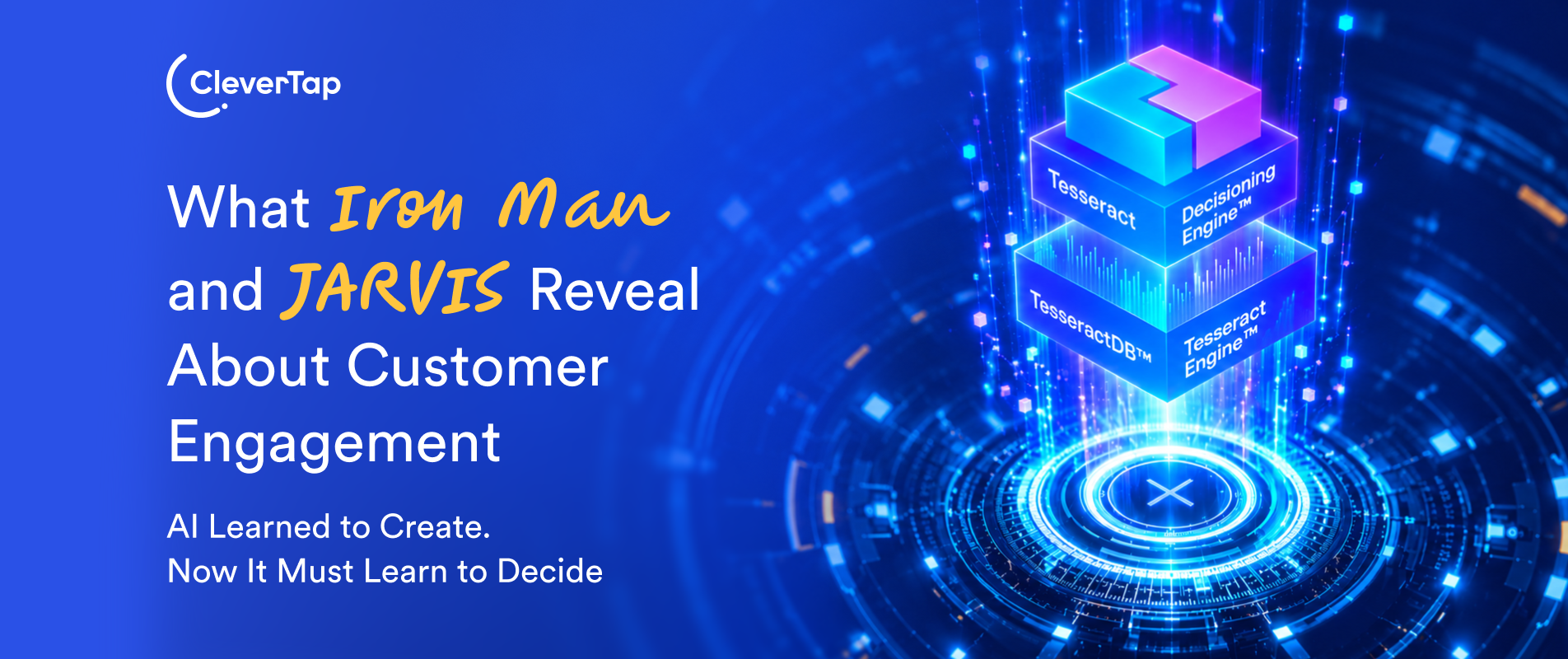
In the Iron Man analogy, JARVIS is the intelligence that helps turn an arsenal of capabilities into purposeful action. In CleverAI™, the Tesseract Decisioning Engine™ plays a similar decision-making role, bringing customer context, live intent, available actions, and business goals together to determine what should happen next.
Creation, decisioning, execution, and learning operate natively on the same platform to deliver Live 1:1 Personalization. That matters because if information needs to move between disconnected systems, the action selected moments earlier can become obsolete before it arrives.
A suit whose sensors, intelligence, and controls operate on different timelines would be dangerous, however advanced each component appeared on its own.
Customer engagement systems are no different. The intelligence has to see the change – whether a customer purchases, resolves the problem, changes intent, or stops being eligible – reconsider the action, and adjust while the moment can still be improved.
VI. The Move
For the last few years, much of the AI conversation has centered on capability – Can it write? Can it design? Can it predict? Can it automate?
Increasingly, the answer is yes.
The harder question now is whether those capabilities can work as one intelligent system – Can AI distinguish a customer who needs an incentive from one who was already going to purchase? Can it recognize when reassurance will outperform urgency? Can it stop a message that became irrelevant seconds before delivery? Can it decide that the most valuable interaction is no interaction at all?
The Iron Man suit becomes more spectacular every time another capability is added. But another weapon does not necessarily make Tony more likely to win. At some point, increasing the arsenal would not mean much unless the intelligence choosing among those capabilities becomes better too.
Marketing has reached a similar point. AI can already generate more content than any customer could reasonably consume and more variants than any team could manually evaluate. The advantage will not come from producing the thousand-and-first option but from knowing which of the first thousand matters now.
Generative AI gave marketing the suit. AI Decisioning is the JARVIS that makes it intelligent.
Posted on October 15, 2026








![What are Push Notifications? A Detailed Guide [Updated]](https://clevertap.com/wp-content/uploads/2024/04/Push-Notifications-The-Ultimate-Guide2024.png)