Around 78% of online shopping carts never turn into an order.
You’ll see a similar number on your dashboard, reflecting potential leaks in your funnel.
But knowing won’t fix them unless you’re clear on who these customers are and what would bring them back. The funnel strategies we cover in this article answer such questions for different stages of your marketing funnel.
You’ll learn how to identify funnel leaks, determine which users are affected, and apply segmentation, personalization, experimentation, and coordinated engagement to improve conversion across the customer journey.
What Is a Funnel Strategy?
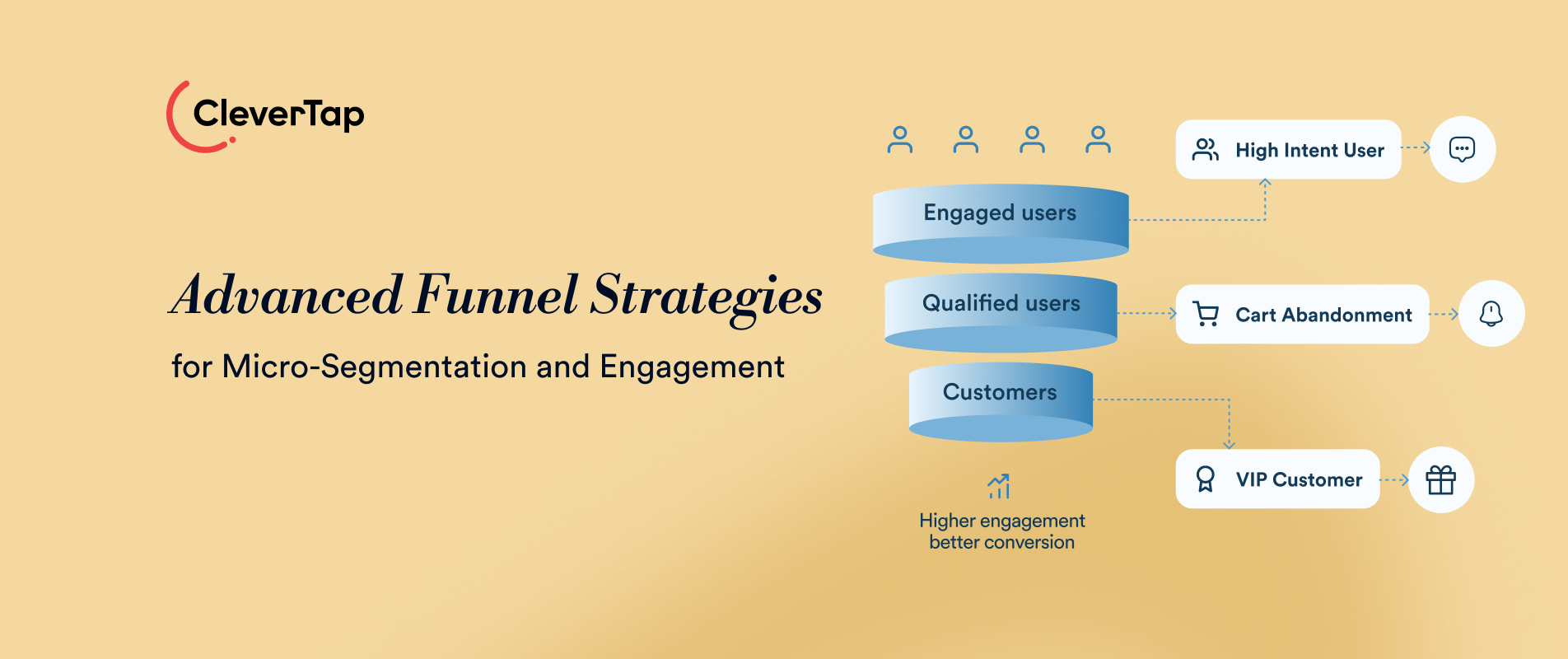
A funnel strategy is a plan for the actions you want customers to take at each stage of their journey. It also sets the segments, messages, channels, and timing you’ll use to move them to the next action.
Some marketers use the term “funnel marketing strategy” to mean the same thing. It sets a plan in place, from which you derive the tactics. Different pieces of content serve different stages, and the plan helps you orchestrate what goes out and when. It gives you a priority for when to send a cart reminder or a loyalty email.
A good funnel strategy includes funnel analysis to measure how many users finish each step. Using this, marketers determine what to do next.
You might confuse a funnel with a route that every customer follows. It’s not that. Real customers skip steps, loop back, and switch channels halfway through a decision. Someone may see an ad, forget about you, and return weeks later through search. The funnel doesn’t try to describe that path. It gives you fixed points to measure, so you can count how many people reach each step and see where they stop.
The path can get messy, but the steps you measure usually fall into these stages.
What Are the Main Stages of the Marketing Funnel?
Most models name three stages: top, middle, and bottom. A fourth stage covers everything after the first conversion, and it deserves equal weight.
Top of Funnel: Awareness
The top of the funnel attracts people who have a problem but no chosen solution yet. Search, content, paid campaigns, social, video, and referrals all work in this funnel. It gives you reach and first visits.
People arriving is a start; where they go from here makes or breaks your pipeline.
Middle of Funnel: Consideration and Engagement
The middle of the funnel is where people compare and consider.
In a consumer app or store, consideration shows up as behavior: product views, searches, wishlist adds, repeat sessions, and other actions that indicate growing interest.
Each behavior tells you something about what a customer is considering. A second visit to the same product page can signal growing interest, while a search for the return policy may point to a concern that needs to be addressed. These signals become especially useful as a customer moves closer to conversion.
Bottom of Funnel: Conversion
At the bottom, intent is high, and friction decides the outcome.
By this point, the person has already decided to act. What stops them is rarely the offer. It is the effort the last few steps demand, and each extra step gives them a moment to reconsider.
The job here is to take things away: surprise costs, forced account creation, and long forms. A completed order then starts a different kind of work.
Post-Conversion: Retention and Growth
The first conversion opens a second funnel: onboarding, repeat use, upsell, loyalty, and reactivation. You need to put more focus on this because e-commerce decay is real. Adjust’s 2026 app data shows that e-commerce apps keep 12.6% of users on day 1, and 3% by day 30.
If your funnel stops at the first conversion, acquisition has to generate its return from that transaction alone. Retention, repeat purchases, upsells, and cross-sells extend the customer relationship and increase lifetime value, allowing acquisition costs to generate returns beyond the initial conversion.
The first two strategies find the problem, the next seven act on it, and the last keeps the whole system honest.
1. Define Meaningful Conversion Events
Measuring everything won’t move anything. Reflect on which actions actually count as progress. Your funnel is only useful as the events inside it. The final conversion is the obvious one, be it an order, subscription, or a first transaction.
What’s tricky is choosing the smaller actions that predict the final conversion. These are micro-conversions, which include a search, a wishlist add, or a completed KYC step.
Pick events that predict real value for a business. For example, in fintech, there can be multiple deposits and spend. But what counts as real activation is when, say, an account or wallet becomes the salary account.
To measure such micro-conversions of value, Niyo runs separate conversion funnels for each user flow and product. If you blend everything into one, it hides the steps or events that matter.
Explore what Niyo did to achieve such results.
Explore what Niyo did to achieve such results.
2. Identify Where Users Drop Off
Measure conversion between each pair of steps, then rank the gaps. An overall conversion rate hides where the loss happens. Two funnels can both convert at 2% overall and still have opposite problems. One loses people before they view a product, and the other loses them at payment. Each needs a different fix, and only step-level numbers show which one you have.
Mau Baron, founder of a subscription app,shared what step-level tracking found after a year without it. A permissions screen was losing 10% to 15% of new users, and a question about gender cost another 3% to 5%. After a few changes, the share of users reaching the paywall rose from 75% to 95%.
Size each gap against your own history first. A step that converted at 40% last quarter and converts at 30% now tells you more than an industry average can. Still, not every gap deserves the same effort. You can rank them on the basis of:
- How many users it affects
- How much those users are worth
- How fixable the cause is
Knowing where users leave also raises a question about who arrives in the first place.
3. Optimize Acquisition for Down-Funnel Quality
Don’t judge an acquisition source only by clicks, installs, leads, or CAC. Compare sources by what their users do deeper in the funnel: activation, first order, repeat conversion, and retention. Top-of-funnel marketing tactics such as SEO, content, paid campaigns, social, and referrals still apply. What changes is their scorecard.
What brings you qualified traffic deserves a higher score. The practical move is to compare funnels by acquisition source. Tag each user with the source and campaign at entry, then read every later step through that tag. You don’t want a channel with cheap clicks and weak checkout rates; it ends up costing more than what your CAC suggests.
Then act on what the comparison shows. Shift budget toward sources whose users reach the later steps, even when their cost per click is higher. Where your ad platform allows it, aim campaigns at a deeper event, such as a first order instead of an install. Check that each ad’s promise matches the product too, because a mismatch shows up as early drop-off.
Source is one way to split a funnel, and behavior is the richer one.
4. Segment Users Based on Funnel Behavior
Group users by what they did and didn’t do. Useful segments usually come from five inputs: completed actions, abandoned actions, intent, recency, and engagement.
Each input answers a different question about the same user. Completed actions show how far someone got, and abandoned actions show where they stopped. Intent tells you how much they want the outcome, recency tells you how fresh that interest is, and engagement tells you how often they return. Two people at the same stage can differ on all five, so they need different messages.
Sasom, an e-commerce marketplace in Southeast Asia and a CleverTap customer, put this to work. Its team isolated shoppers with repeated checkout visits and high cart values but no order. This segment became the target of its recovery work.
Read what Sasom did to achieve these numbers.
Read what Sasom did to achieve these numbers.
5. Personalize Engagement Based on Intent
Tie each message to the last thing a user did. Messaging, recommendations, timing, and offers should all follow behavior and funnel stage.
Real-time context gives you the trigger a buyer needs to act. For example, a back-in-stock alert on a viewed item answers a decision the shopper is making now. If you send out a weekly newsletter featuring the same item, it does not.
Relevance should also influence messaging frequency. A highly engaged customer actively tracking a product, price, or transaction may be receptive to more frequent updates than a user who has interacted only once.
Instead of applying the same frequency cap to every user, adjust frequency based on intent, engagement, lifecycle stage, and recent behavior. The goal is to increase useful interactions without creating message fatigue.
6. Build a Full-Funnel Marketing Strategy
Full-funnel marketing connects awareness, consideration, conversion, and retention so each stage supports the next. It stops campaigns from running in isolation. Don’t confuse it with a multi-channel approach. You don’t have to run ads on many channels to call it a full-funnel strategy; that’s just multi-channel.
You’re talking to the same consumer across the funnel. Regardless of their stage in their funnel, your communication can’t look disjointed. It needs to flow seamlessly based on what’s relevant and timely for a customer and their interactions with your brand.
A full-funnel marketing strategy works when each stage hands a signal to the next. Here is how that chain connects:
- Awareness signal: Record the source, campaign, and first content each visitor saw.
- Consideration segment: Group visitors by what they viewed, searched, or saved.
- Conversion trigger: Act when a high-intent step stalls, such as a cart left open.
- Onboarding: Use the first order or signup to start a flow that leads to first value.
- Repeat-use trigger: Prompt the next action when the usual gap between orders or sessions passes.
- Churn-risk response: Step in when activity fades, before the customer has left.
Each stage should use signals generated by the one before it. The source or campaign that brought a user in can shape the experience they see next, while subsequent behavior determines the message, recommendation, offer, or journey they receive. Carrying this context across stages is what separates a full-funnel strategy from a collection of disconnected campaigns.
7. Recover Users Who Abandon the Funnel
Trigger recovery from the exact action a user abandoned. A cart, a browse session, an onboarding flow, and a free trial each fail for different reasons.
When you segment, start separating browsers from buyers. Baymard found that 42% of US shoppers have abandoned a cart because they were just browsing, or not ready to buy. These shoppers need time and a reminder. Buyers who left over cost, delivery, or trust need the obstacle removed instead.
Use sequences with different steps and channels to craft users’ conversion journeys. It’s best to go easy on discounts. Shoppers notice when an abandoned cart always earns a coupon, and some start leaving carts on purpose to get one.
If you lead with a default discount, it teaches a habit. You should lead with a reminder, and save offers for those segments that truly need them.
8. Use Cross-Sell and Upsell Opportunities
Suggest the next action that fits what a customer has already done. Order history and recent behavior show what a logical next step looks like.
In travel, you can see such patterns clearly. A booked flight implies a hotel, a transfer, or extra baggage. Cleartrip suggested hotels right after flight bookings and reports5x more cross-sells as a result.
The same logic sets a limit. An offer with no link to the customer’s context reads as noise, and repeated noise costs trust. Keep each recommendation tied to a completed action, and skip it when no good match exists.
For repeat buying, look at what returning customers ordered second. Then suggest that item to first-time buyers around the time most second orders happen.
9. Extend Funnel Strategy into Retention and Reactivation
Treat the first conversion as a handoff. Onboarding, repeat use, churn prevention, loyalty, and win-back each need their own next conversion.
Name that conversion for each stage. For onboarding, it is the first moment of real value, such as a completed profile or a second session. For repeat use, it is the second order, and for loyalty, it is a habit you can count, such as a monthly order. Once each stage has a target event, you can build a funnel for it and see where customers stall.
In win-back campaigns, get your timing right. Start reactivation at the first signs of fading activity, not on a fixed date set for long after. Fading activity looks like longer gaps between sessions, unopened messages, or a skipped reorder. A customer at that point still remembers why they signed up, so a light nudge can still land.
Also, don’t forget your lapsed customers; they’re more reachable than they look. Many people cancel or go quiet for reasons outside your product, such as a tight budget or a need that has paused. When that changes, a well-timed message gives them a reason to return. A win-back plan speaks to people who are already open to coming back.
10. Keep Experimenting Across the Whole Funnel
Test messages, channels, timing, offers, and journey paths, and read the results by segment. An average can hide a variant that wins with new users and loses with loyal ones.
Most teams test in a narrow band. Optimizely found that 43% of tests target the bottom of the funnel, while post-conversion testing sits at 4%. The stage that produces repeat revenue gets the least testing. So run tests on onboarding, repeat-order prompts, and win-back flows as well. When you have several ideas to compare, multi-variant tests let you test them in one run.
Consider a winning variant as temporary. Customers’ behavior shifts with season, audience, and offers. After a certain period, retest winners. Finally, hold some users back. A control group that receives nothing shows what your campaigns added beyond what would have happened anyway.
Funnel Strategy Examples Across Industries
Each example below names the funnel, the segment worth acting on, and the first response.
E-Commerce: Reduce Product and Cart Abandonment
Funnel: App Launched → Product Viewed → Added to Cart → Went to Cart → Checked Out
There are two segments that matter the most.
- Users who launch the app but never view a product need onboarding.
- Users who reach the cart but don’t check out need recovery.
Sasom treated the second group with precision. For its high-intent shoppers, the team tested fixed discounts, percentage offers, and different expiry windows, then sent each message at the user’s best time.
Sasom reports a100% increase in user conversions.
Recovery works on people who stalled. Travel funnels reward a different move: acting on a step the customer finished.
Travel: Drive Relevant Cross-Sell Opportunities
Funnel: Flight Searched → Flight Booked → Hotels Viewed → Hotel Booked
The segment to act on is travelers who booked a flight but haven’t viewed hotels. A completed booking gives you the destination and dates, so the next offer can be specific.
Timing matters as much as the offer. Send the hotel suggestion soon after the booking confirms, while the trip is still on the traveler’s mind. Then match it to the trip: the same city, the same dates, and a price range in line with the fare they chose.
Fintech has the reverse problem, because its first conversion often leads nowhere.
Fintech: Reactivate Users After Early Drop-Off
Funnel: Signed Up → Verified → First Transaction → Second Transaction
Fintech loses users at two points: before the first transaction and soon after it. The first loss comes from effort, because identity checks and document uploads arrive before the user sees any value. The second comes from weak habit, since a promo can drive one transaction without giving a reason for the next.
The segment to build is users who made a first transaction, often with a promo code, and then went quiet. Reach them by push or in-app message while the app is still installed. For users who uninstall, switch to email, SMS, or WhatsApp.
Speed matters on the way in, too. When a mobile-verified Niyo user doesn’t select a banking partner within 15 minutes, email and SMS nudges go out. Niyo reports a40% conversion rate for that funnel.
Media and Entertainment: Convert Free Users into Paid Subscribers
Funnel: App Start → Premium Click → Plan Selected → Proceed to Pay → Payment Mode Selected → Order Confirmed
Here, two drops deserve separate responses. Users who tap Premium but don’t pick a plan are unsure about value. Users who proceed to pay but never confirm have a payment problem.
VieON, a subscription streaming service in APAC, runs journeys across email, push, web pop-ups, and in-app messages from download onward. VieON reports a12% increase in users reaching checkout.
Each of these examples depends on the same chain: unified data, a funnel view, a segment, a response, and a measured result. This chain is easier to run when one platform holds all of it.
How CleverTap Helps Marketers Execute Funnel Strategies
CleverTap is a customer engagement platform that brings customer data, analytics, segmentation, personalization, and omnichannel engagement into one place.
For funnel work, it means the report and the response live in the same tool.
Understand Customer Behavior with Unified Profiles
TesseractDB™ is CleverTap’s data layer.
It’s a purpose-built database for customer engagement and retention. It keeps events, profile attributes, transactions, and long-range history together. This context shows where each customer sits in the funnel and how they got there.
Analyze Funnel Progression and Drop-Off
Funnels lets you build a path of up to eight steps and see where users drop between them. The default conversion window is five days, and you can compare segments side by side.
From any step, you can save the users who did or didn’t complete it as a segment, or create a campaign for them.
Fashion retailer Blooming Wear paired funnel analysis with journeys on CleverTap. It reports a 25% boost in conversions and a 15% reduction in drop-offs.
Build Behavioral and Predictive Segments
Segments can draw on real-time behavior, lifecycle stage, and predicted behavior.Predictions estimate how likely a user is to take an action, such as converting or churning.
It then sorts users into high-, medium-, and low-likelihood groups. You can aim effort where it changes outcomes, for example, at the medium group.
Personalize the Next Best Interaction with CleverAI™
CleverAI™ helps marketers optimize the next interaction based on each customer’s context and likelihood to engage. CleverAI™ Agents help determine what to recommend, when to engage, which channel to use, and which journey path performs best.
- The Recommendations Agent picks the product, offer, or content.
- The Send Time Optimizer Agent learns when each customer tends to engage.
- The Channel Optimizer Agent selects the channel each user responds to.
- The Recommendations Agent picks the product, offer, or content.
- The Send Time Optimizer Agent learns when each customer tends to engage.
- The Channel Optimizer Agent selects the channel each user responds to.
- IntelliNODE continuously tests journey paths and helps direct more users toward better-performing routes.
Together, these capabilities let marketers optimize not just the content of an interaction, but also when it happens, where it happens, and which journey path a customer follows.
Orchestrate Engagement Across Channels
Journeys is a visual canvas for automated, multi-step messaging. One journey can cover onboarding, recovery, or win-back across push, in-app, email, SMS, WhatsApp, and web push.
Each journey carries a goal, so you can see how many users met it.
Test and Measure Funnel Performance
A/B and multivariate testing compare message variants and send the winner once the conversion window closes. Control Groups hold back a set of users marked to be excluded from all marketing campaigns.
Real Impact then compares your target group with that control group and reports the boost or drop. Journey Stats shows the same comparison for each journey, along with users who entered, met the goal, or timed out.
Metrics to Measure In a Funnel Strategy
Measure each stage with its own metric, and read every metric by segment.
Build a Funnel Strategy That Acts on What It Finds
A drop-off percentage is more of a question than an answer. Strong funnel strategies respond to it with behavioral data, a clear segment, a relevant message, and a test that proves the result. They apply the same loop after the first order, where most teams stop looking.
You don’t need to rebuild everything at once. Pick one gap between two named steps, define the segment that fell into it, and send one response against a control group.
Posted on October 9, 2026
![What are Push Notifications? A Detailed Guide [Updated]](https://clevertap.com/wp-content/uploads/2024/04/Push-Notifications-The-Ultimate-Guide2024.png)