Written by
Reviewed by
Last editedOct 20262 min read
We surveyed 300 UK businesses on accepting payments initiated by AI on their customers' behalf. Most intend to test it.
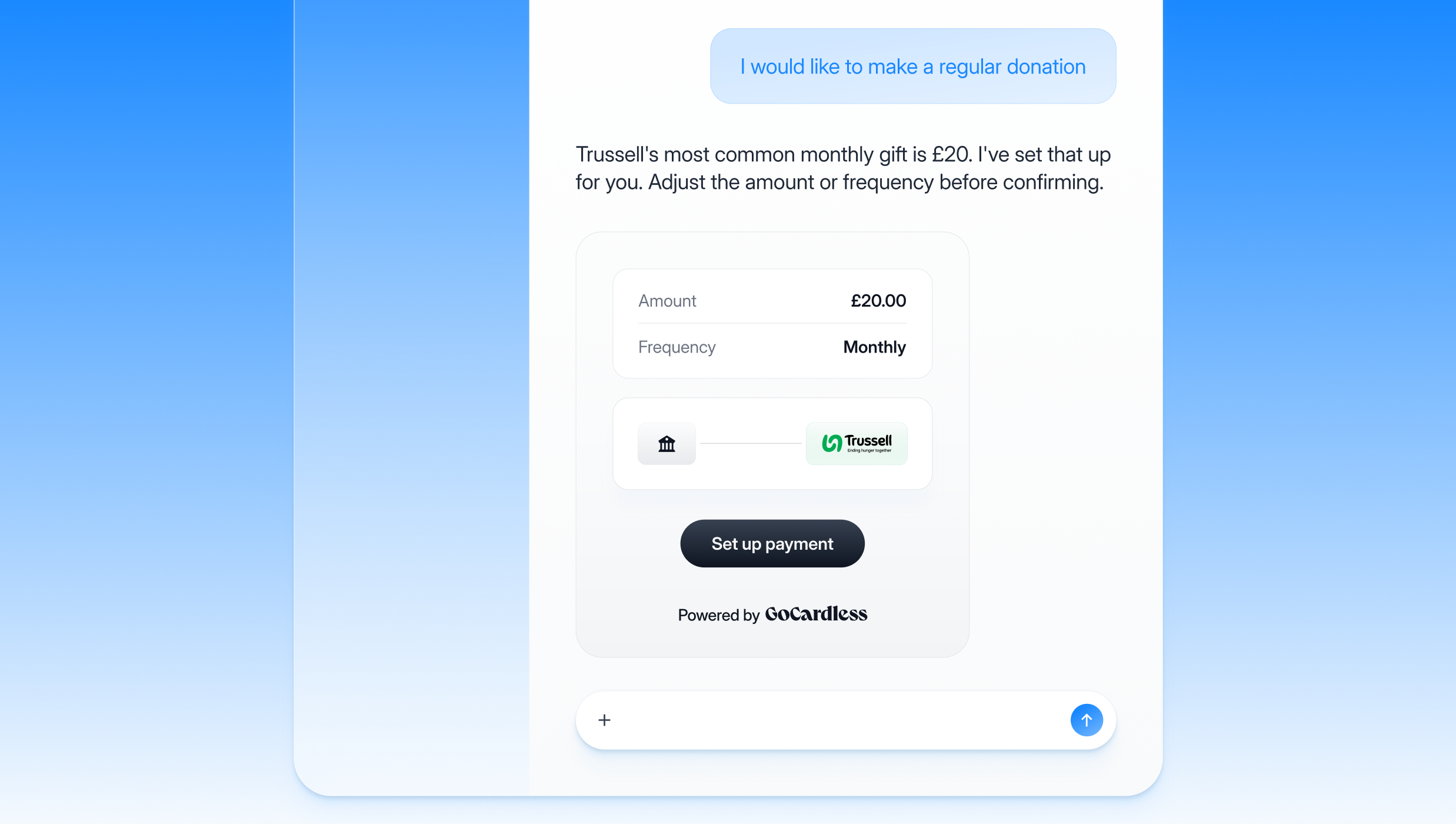
The payments landscape is shifting again. AI agents, software that can complete a payment on a customer's behalf rather than the customer doing it manually, are moving from concept to early rollout across industries. A donor can set up a recurring gift to a charity through a short conversation with an assistant. Or a customer asks their assistant to switch their phone plan and set up the new monthly payment. Here, the customer has already agreed to the terms, and the agent just carries them out.
How ready are businesses for agentic payments?
Most businesses already run several ways to pay, because payers expect choice, including debit cards (64%), credit cards (62%), Direct Debit (47%) and Pay by Bank (43%). Agentic payments offer a new way for consumers to interact with and purchase from businesses, and businesses are keen to explore it. Account-to-account (A2A) payments already come with what agentic payments need: agreed limits, real-time balance checks, and authorisation at the bank level. As agents take on more of how people pay, this is exactly what they need to run effectively.
Appetite from businesses to experiment with this new experience is real. Over half the businesses we surveyed would commit real resources to a pilot: 27% could run a lightweight one-to-two-week test straight away, and 23% would go further with a full integration. Another 30% said it depends on the ROI and the use case, a fair position before committing budget.
On a scale of 0 to 10, over 60% of businesses rated their likelihood of testing an early AI payment prototype in the next six months at seven or higher. Most are moving early enough to test this safely, without needing to be first.
Agentic adoption is not unconditional
When asked, two in five businesses (40%) still want to approve every payment action themselves. Another 27% are comfortable with an AI agent managing schedule changes within rules the business sets, and 21% would accept pre-approved recurring permissions, provided a cap is attached. Each of these preferences points to the same condition: having a rule, a limit or a threshold in place to manage the agent's authority. These conditions aren’t too far from what we already have with A2A methods like Direct Debit and Recurring Pay by Bank. Both of which use instructions from the payer to automatically collect payments on a predefined schedule and with limits in place. Such conditions are likely to be key in determining the adoption of agentic payments.
Understandably, fraud and account takeover is the top concern, cited by 24% of businesses, ahead of regulatory uncertainty (13%) and higher failure rates (12%). Eighteen per cent say they have no major concerns at all, a sign this conversation is more mature than it first appears.
Trust comes down to two things: a clean user experience and solid payee verification. Businesses are just as clear about what an agent should never do without an explicit yes first:
- Increasing amounts beyond a set threshold (33%)
Increasing amounts beyond a set threshold (33%)
- Processing refunds (29%)
Processing refunds (29%)
- Changing payee or bank details (28%)
Changing payee or bank details (28%)
- Pulling payments earlier than agreed (27%)
Pulling payments earlier than agreed (27%)
These are the conditions that decide whether a business offers agentic payments at all.
Where would agents help first?
We asked businesses where they'd let a customer's AI agent help first:
- Reducing failed payments and improving collection rates (39%)
Reducing failed payments and improving collection rates (39%)
- Speeding up new customer onboarding and payment setup (39%)
Speeding up new customer onboarding and payment setup (39%)
- Letting customers self-serve schedule changes without calling support (33%)
Letting customers self-serve schedule changes without calling support (33%)
Each of these already costs businesses time or revenue today, which is why they're the natural place to start.
Waiting has a cost
Businesses aren't waiting for agentic payments to go mainstream before testing the waters. The businesses that engage now, with partners who can deliver governed and reliable agentic payment infrastructure, will help shape how this technology gets built and adopted. Meanwhile, those that wait will inherit a landscape others have already designed.
We're building that infrastructure now, and we want you to shape it with us. Join our email list to stay in the loop as we roll out agentic payment capabilities.