The main difference between search engine types is where they source information and what kinds of results they return.
Crawler-based engines search an index they built themselves, while meta search engines combine results from several other engines. AI answer engines also use indexed sources, but unlike the other types, they don’t give you a list of links; they use the information to write a bespoke answer.
Here’s how the three main types of search engines work, with examples. We also cover the other types you’ll come across (privacy-focused, paid, vertical, regional, and enterprise engines, plus web directories) and questions that will help you choose one.
What is a search engine?
A search engine is software that finds content matching your search query and returns it as search results.
Internet search engines, like Google or Bing, search the World Wide Web, while others search within collections, such as a job board or a research paper database.
Depending on the type, the search result could be a ranked list of links to pages or a written answer built from the sources it finds.
Search engine vs. web browser
A web browser is the app you use to open and display web pages, such as Perplexity’s Comet, Chrome, Safari, Edge, or Firefox, while a search engine is a service that finds those pages for you.
When you type a web address into the browser's address bar, it takes you to the page. When you type a search term instead, the browser sends it to its default search engine (Perplexity for Comet, Google Search for Chrome, Bing for Edge), unless you change the default in your browser's settings
The three main types of search engines
Search engines differ in where their results come from and what the results look like. The results could come from the engine's own index, another engine's index under a license, or several engines at once, and they are a ranked list of pages or a written answer with citations.
Crawler-based and meta search engines both return a ranked list of links, but they get their results differently: a crawler-based engine searches an index it built itself, while a meta search engine sends your query to several other engines and combines what they return.
AI answer engines also search an index, but instead of listing pages, like traditional search engines, they write an answer. Many engines now do both. Google, Bing, and Brave Search add AI-written answers above their ranked links.
Type
Where results come from
What you get back
Best for
Trade-off
Examples
Crawler-based
Own index, or one licensed from a crawler-based engine
Ranked list (many add AI answers)
Broad searches, finding a specific page
One engine's view of the web; you compare pages yourself
Google, Bing, Brave Search, DuckDuckGo
Meta search
Several engines at once
Ranked list
A wider spread of results
Slower: waits for several engines, up to a time limit
eTools.ch, SearXNG, MetaGer
AI answer engine
Own index or a licensed one
Written answer with citations
Complex questions that need several sources
Check the cited pages
Perplexity, Google AI Mode
Crawler-based search engines
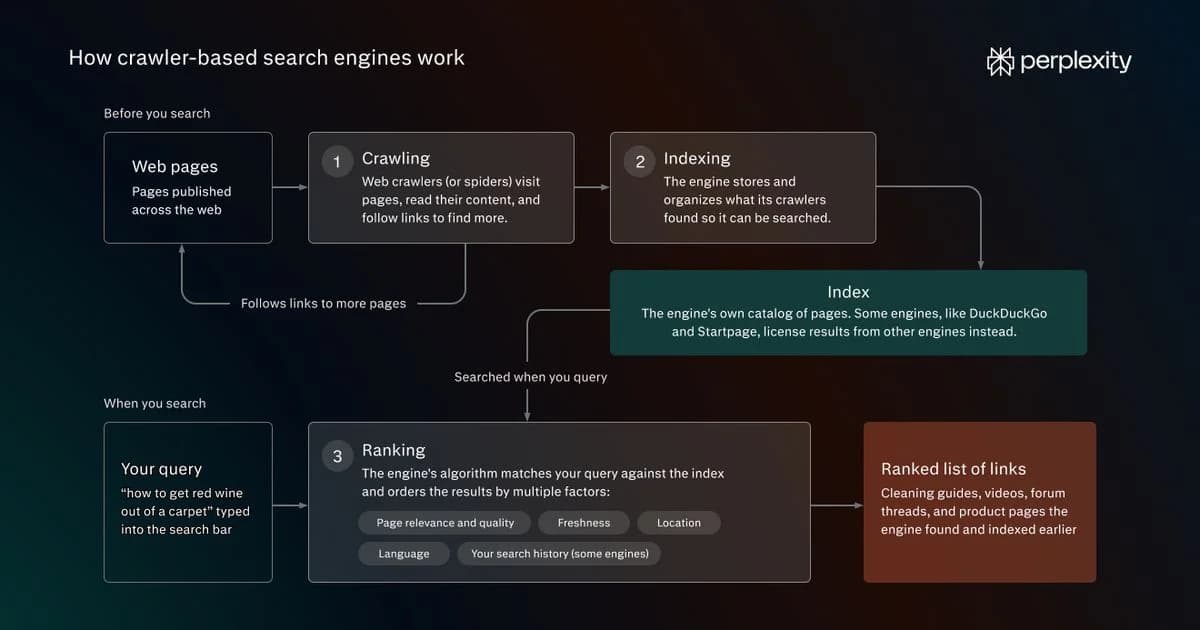
A crawler-based search engine, like Google or Bing, finds answers to your query on web pages in its own index. It’s best for broad web searches or for finding a specific site or page.
Here's how crawler-based search engines work:
- Crawling: Programs called web crawlers (or spiders) visit pages, read their content, and follow links to find more.
- Indexing: The engine stores and organizes what its crawlers found so it can be searched.
- Ranking: When you search, the engine's algorithm matches your query against the index and orders the results by multiple factors, such as page relevance and quality, freshness, location, language, and, for some engines, your search history.
So, when you type "how to get red wine out of a carpet" into the search bar, the search results page features a ranked list of cleaning guides, videos, forum threads, and product pages that the search engine has previously discovered and catalogued in its index.
To rank in crawler-based engines, search engine optimization (SEO) experts ensure every important page is easy to crawl and index, and answers the query behind the keyword better than competing pages.
Google Search, which holds the largest share of the search market, is the best-known crawler-based engine. Others include Bing, Brave Search, and independent engines such as Mojeek in the UK and Marginalia in Sweden.
Some engines don't crawl the web themselves but license results from others. For example, DuckDuckGo gets its traditional links largely from Bing (plus its own crawler), and Startpage from Google and Bing.
Meta search engines
A meta search engine sends your query to several other search engines and combines their results. For example, eTools.ch searches 17 different data sources.
Meta search engines answer search queries in four steps:
- Send the query out to several engines at once.
- Collect the results from each engine.
- Merge duplicates and re-score them. For example, if several engines rank a page highly, it moves up.
- Show a single page with ranked results.
When you search for "how to get red wine out of a carpet" on eTools.ch, you receive results from DuckDuckGo, Yahoo, Google, and more. In our test, the #1 Google result ranks only #4 here.
Meta search engines are a good choice when you want to cast a wider search net, but they can load more slowly because they wait for several engines to respond (up to a time limit).
Apart from eTools.ch, popular meta search engines include SearXNG, MetaGer, and Dogpile.
DuckDuckGo sometimes appears on meta search engine lists, but it licenses its results from Bing rather than combining results from several engines.
AI answer engines
An AI search engine, like Perplexity, searches for sources and uses them to write an answer to your specific question, with citations linking to the pages it used.
How AI answer engines work:
- Reads the question: A large language model (LLM) interprets your query, including long, conversational questions, and may split it into several searches, in a process called query fan-out.
- Searches for sources: It runs those searches against a web index, so the answer can draw on pages published after the model was trained, and scores individual passages, not just whole pages, against the question.
- Writes an answer: The LLM writes the answer from the retrieved passages.
Like crawler-based engines, AI answer engines also search an index, their own or licensed. For example, Perplexity runs its own index, while ChatGPT Search uses its own index paired with 3rd-party indexes.
AI answer engines compile answers from information across multiple sources, so they're best for complex or specific queries that a single page is unlikely to answer.
For example, when we asked Perplexity, "My 16-year-old has a learner’s permit in Illinois, but we’re moving to Arizona in March. Should she keep logging practice hours now, will Arizona count them, and what does she need to bring to the Arizona MVD?" it used 15 sources to answer each part of the question.
In Google's classic ranked results (without an AI Overview), the same question returns a list of pages, so you have to open each one and look for relevant information yourself.
However, LLMs may hallucinate when they write the answer, so open the cited pages and check the AI answer's claims before you rely on it.
To get cited in AI answers, webpages need the same SEO foundation. Answer engine optimization (AEO), however, focuses more on making content easy for AI answer engines to process and cite, for example, with sections that each answer one specific question clearly, even when pulled out of context.
Other types of search engines
Search engines can also be grouped by purpose, audience, or business model. Some of these groups overlap with the three main types. For example, a privacy-focused engine can run its own index or license its results.
Type
What sets it apart
Best for
Trade-off
Examples
Privacy-focused
Doesn't track personal data
Searches you don't want tied to your history
No personalized results
DuckDuckGo, Startpage
Paid, ad-free
Funded by subscriptions, not ads
Results without ads or ad targeting
Subscription after a short free trial
Kagi
Vertical
Searches one kind of content
Specialist content, with filters for that content
Nothing outside that collection
PubMed, Indeed, YouTube
Regional
Tuned to one country or language
Searching in that language or for local information
Weaker coverage outside its home language and market
Yandex, Seznam, Baidu, Naver
Web directory or hybrid
Sites picked by human editors, sometimes mixed with filtered crawler results
A vetted starting point on one topic or for one audience
Far fewer results, slow to update
Curlie, MedlinePlus, Kiddle, fragFINN
Enterprise
Searches an organization's own apps and files
Finding internal documents, messages, and records
Covers only the sources your organization connects
Coveo, Atlassian Rovo, Onyx
Privacy-focused search engines
A privacy-focused search engine, like DuckDuckGo or Startpage, doesn’t keep a record of what you search for that could be traced back to you.
DuckDuckGo doesn't save or share your search history, and Startpage strips your IP address and other personal data that other engines use to personalize results.
Both license their results from bigger engines (Bing for DuckDuckGo, Google and Bing for Startpage), so you still benefit from large indexes but with extra privacy.
Paid, ad-free search engines
A paid search engine, like Kagi, is funded by users' subscriptions instead of ads.
Paid search engines don't need to collect personal data for ad targeting, and they may rank pages differently.
For instance, Kagi ranks pages heavy with ads and trackers lower, because it has found they correlate with lower content quality, and promotes independent and personal sites.
Vertical search engines
A vertical search engine focuses on one kind of content, such as research papers, jobs, or videos. For example, PubMed searches biomedical literature, Indeed searches job listings, and UGC platforms, like YouTube, TikTok, or Reddit, search only their content.
Because each covers one type of content, it lets you filter search results in ways a general engine doesn't, like by salary range or publication type.
Regional search engines
A regional search engine, like Yandex in Russia, Seznam in the Czech Republic, or Baidu in China, focuses on one country or language. They can offer more relevant results when you search in that language or run a local search, like for nearby shops or services.
Some regional search engines hold a large share of their home market. For instance, Yandex has 70.22% of search referrals in Russia, against Google's 28.36% (StatCounter, October 2026).
Web directories and hybrid search engines
A web directory lists sites human editors choose and sort by topic.
For example, Curlie, the volunteer-run successor to DMOZ, lists over 3 million sites added by volunteer editors, and MedlinePlus, run by the US National Library of Medicine, collects vetted pages on each health topic.
Hybrid engines mix web directory listings with crawler results. Kiddle, a children's search engine, puts editor-checked pages at the top of its results, followed by results filtered through Google SafeSearch, and fragFINN only returns pages whitelisted by a team of media educators.
Enterprise search engines
An enterprise search engine, like Coveo, Atlassian Rovo, or Onyx, searches an organization’s own content, like documents, email, database entries, and chat messages, that public search engines can’t reach.
Enterprise search engines sync content and metadata from the organization’s apps, such as Slack, Gmail, Notion, or Salesforce, into a private index or query them live, then filter results against each user’s access permissions, so people see only what they’re authorized to view.
How to choose the best search engine
When choosing the best search engine for your needs, consider these factors:
- Relevance: Google and Bing cover many languages, but a regional engine may return more relevant search results in its home language. For specialist content, a vertical engine like PubMed indexes content and offers filters a general engine doesn’t.
- Answer format: For complex queries or when ranking content is thin, an AI answer engine is quicker. However, it may make mistakes, so never use the answers for high-stakes decisions without checking.
- Speed: Crawler-based engines load their results instantly, and meta search engines are only marginally slower. AI answer engines take longer to write, but save time when finding the answer requires reading multiple sources.
- Privacy: Some engines rank results partly on your search history and other personal data. If you don’t want to share that data, or don’t want your history to shape results, use private search engines like DuckDuckGo and Startpage.
- Ads: If you’d rather not see ads, use a paid engine like Kagi.
- Search experience: Check the filters and how easy the results are to scan. Google and Bing also let users search using images, so you can find pages that include a specific visual. DuckDuckGo, Brave Search, and Kagi support bangs, shortcuts that send a search straight to another site’s results.
Perplexity: an AI answer engine with its own search index
Perplexity is an AI answer engine that searches its index and the live web and writes an answer to your question, with numbered citations linking to the sources, so you can check where each claim comes from.
Perplexity's crawler, PerplexityBot, collects pages for its index. When you ask a question, Perplexity picks the passages that best answer it and writes the answer from them. Perplexity can also open a page live while answering.
For questions that need a deeper answer, Research Mode runs dozens of searches, reads hundreds of sources, and turns findings into a full report you can export as a PDF or document.
Frequently asked questions
What are the most used search engines?
By share of search referrals in October 2026, Google leads with 91.05%, followed by Bing (4.8%), Yahoo (1.18%), Yandex (1.14%), and DuckDuckGo (0.64%), according to StatCounter.
What are some popular search engines besides Google?
Besides Google, Perplexity is a popular AI answer engine, while Bing, DuckDuckGo, Yandex, Baidu, and Brave Search are popular search engines that return ranked page lists. Some of them also add AI-written answers.
What were the first search engines?
The first internet search engine was Archie, which Alan Emtage built in 1989. Crawler-based web search engines like WebCrawler followed in the mid-1990s. Dogpile launched in 1996 as one of the first meta search engines, and Google was incorporated in 1998.
How many different types of search engines are there?
By where results come from and what you get back, there are three main types: crawler-based, meta search, and AI answer engines. An engine can belong to more than one category, since many crawler-based engines now add AI answers.
Grouped by purpose, audience, or business model, there are more, including privacy-focused, paid, vertical, regional, and enterprise engines, plus web directories.
Are visual search and voice search types of search engines?
Visual search and voice search aren't types of search engines but ways of searching. Visual search, like Google Lens, starts from an image instead of words, and voice search, on your phone or smart home devices, starts from speech, but they often search the same index as typed search.
What’s the difference between a search engine and an answer engine?
A traditional search engine returns a ranked list of pages that match your query. An answer engine reads pages and writes one answer, with citations linking to its sources.
Some search engines now do both. For example, Google has AI Mode and AI Overviews, and so does Bing.