
![Top Hotel Management Software in Nigeria [2027]](https://images.unsplash.com/photo-1637019916030-9f851c2eca13?crop=entropy&cs=tinysrgb&fit=max&fm=jpg&ixid=M3wxMDgwOTg1fDB8MXxzZWFyY2h8MXx8VG9wJTIwSG90ZWwlMjBNYW5hZ2VtZW50JTIwU29mdHdhcmUlMjBOaWdlcmlhJTIwMjAyN3xlbnwxfDB8fHwxNzkxMjkxMzk4fDA&ixlib=rb-4.1.0&q=80&w=1080)
A hotel in Lagos can have a corporate booking arrive by email, two OTA reservations come in, a guest enquiry on WhatsApp, three walk-ins arrive, a bank transfer needs to be verified, restaurant charges need to be posted, and an event room needs to be booked—all before noon. That is where hotel management software in Nigeria becomes more than a booking tool.
Quick Answer: Which Hotel Management Software Is Best for Nigerian Hotels?
The best hotel management software in Nigeria is a PMS that fits the hotel’s property type, booking sources, payment processes, POS setup, reporting needs, staff capabilities, and growth plans. Beyond reservations, it should connect front desk, housekeeping, billing, payments, distribution, direct bookings, reporting, and management access. Nigerian hotels should also test payment reconciliation, connectivity procedures, implementation, migration, support, and permissions before choosing a system.
The table is a starting point, not a substitute for a product evaluation. Two hotels of the same size can have very different requirements depending on their booking mix, revenue outlets, staffing, and operating model.
Hotel PMS Buying Snapshot for Nigeria
For Nigerian hotels, the best PMS is not necessarily the one with the longest feature list. It is the one that handles the hotel’s actual booking, payment, connectivity, billing and operational workflows reliably.
Why Nigerian Hotels Need More Than a Basic Hotel Booking System
A reservation system answers one question: Who is staying, and when?
A hotel management system has to answer several more: Is the room ready? Has the guest paid? Where did the booking come from? Has the restaurant charge been posted? What does the property owe or collect? How is the hotel performing today?
Research on Nigerian hotels shows both the value and the gap. According to a 2026 study of 254 hotels in Lagos State, ‘Better Financial Tracking and Reporting’ was the most substantial advantage of PMS, while ‘Easy Hotel Check-in/Check-out’ was the most utilized function. However, overall utilization was classified as primarily low (51.6%), indicating that more than half of surveyed hotels are not using advanced revenue management tools like predictive analytics or dynamic pricing. System downtime was identified as the most significant technical obstacle.
This highlights why Nigerian hotels should evaluate not just whether a PMS has features, but how consistently staff can actually use them to drive revenue.
That difference becomes important as a hotel handles more booking channels and revenue sources.
Bookings Arrive From Too Many Sources
A Nigerian hotel may receive bookings through OTAs, its website, walk-ins, phone calls, WhatsApp, travel agents, corporate accounts, and group or event enquiries.
The problem starts when these channels do not share the same inventory.
For example, a room could be booked directly by a guest while an OTA still shows it as available. Staff then have to identify the conflict, verify which reservation is valid, and correct the inventory manually.
A PMS connected to a Channel Manager can give the hotel a central inventory and help synchronize availability and rates across connected channels. It does not remove every distribution risk, but it reduces the dependence on repeated manual updates.
Payments Are Not Always Confirmed the Same Way
Hotel payments can include cash, cards, bank transfers, online payments, deposits, part-payments, corporate credit, and refunds.
These transactions do not always follow the same process.
A bank transfer, for instance, may need to be verified before it is posted to a reservation. A corporate guest may stay on approved credit terms, while a walk-in guest may pay before receiving the room.
A useful PMS should therefore make the payment status clear and give staff a consistent way to record, reconcile, and track outstanding amounts.
The important question during a software evaluation is not simply “Can it record payments?” but “How does the payment move from receipt to reconciliation?”
Hotels Earn Revenue Outside Rooms
Room revenue is only one part of a hotel’s income.
Restaurants, bars, lounges, laundry, room service, airport transfers, spas, events, and banquets can all generate additional charges.
When these outlets operate independently of the PMS, staff may have to re-enter charges into guest accounts. That creates opportunities for missed postings, incorrect folios, and reconciliation issues.
A connected PMS and POS setup can reduce that gap by allowing eligible outlet charges to flow into guest bills and reports.
Owners Often Receive Information Too Late
Management should not have to wait until the end of the week for someone to consolidate spreadsheets before answering basic operating questions.
They may need to know the hotel’s current:
- Occupancy
- Revenue
- Room status
- Booking sources
- Cancellations
- Outstanding balances
- Payment activity
- POS sales
A connected PMS can make this information easier to access through system-generated reports.
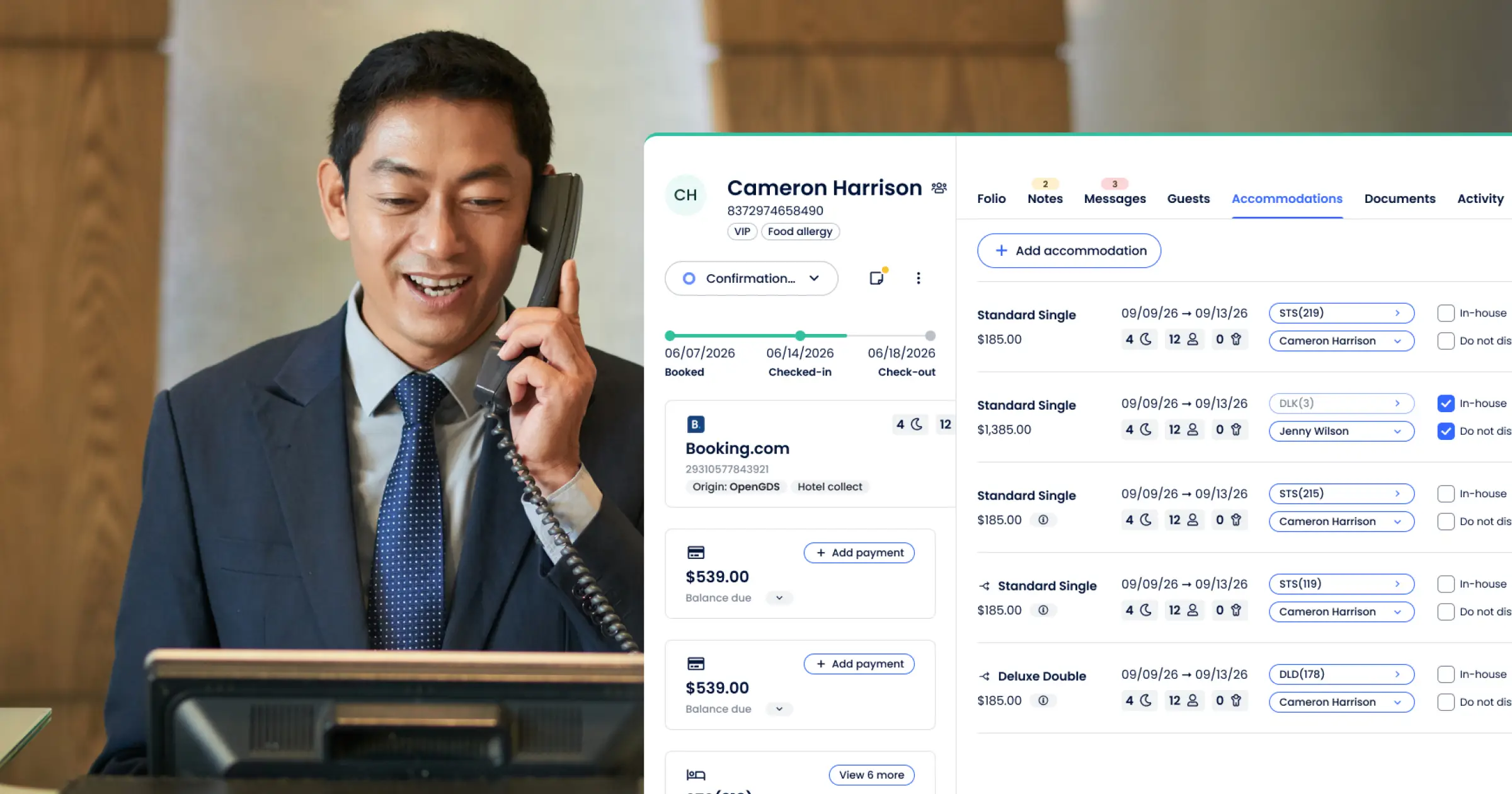
Still reconciling room bookings, transfers, outlet charges, and reports manually? See how Hotelogix brings hotel workflows into one connected system.
Want to See Hotelogix in Action
Book a Live Demo
What Should a Complete Hotel Management System Include?
A PMS manages the property’s core daily operations. Hotel management software becomes broader when that PMS connects with distribution, direct bookings, POS, payments, reporting, and multi-property management.
Core PMS
The core PMS should handle the operational journey from reservation to departure.
That generally includes reservations, room inventory, check-in and checkout, room assignment, guest profiles, housekeeping, folios, billing, night audit, and reporting.
These are not separate features in practice. Afront-desk employee may need to check a reservation, see room status, assign a room, post a payment, and generate a folio during one guest interaction.
That is why workflow matters as much as the individual capabilities.
Distribution Technology
Hotels that sell rooms through several channels need distribution tools alongside the core PMS.
A typical setup may include a Channel Manager, Booking Engine, OTA connectivity, travel-agent or corporate booking workflows, and rate and availability management.
The objective is to keep connected sales channels working from the same inventory rather than asking staff to update each one separately.
Hotel Revenue Outlets
Hotels with multiple revenue centres should also consider how the PMS handles:
- Restaurant and bar POS
- Room service
- Laundry
- Spa services
- Events and banquets
- Other chargeable services
The more revenue outlets a property has, the more important it becomes to connect transactions with guest folios and financial reporting.
Management and Growth Tools
As the hotel grows, other capabilities become more relevant.
These can include mobile PMS access, centralized reporting, multi-property management, user roles, audit trails, integrations, and APIs.
The important distinction is that not every hotel needs every capability on day one. A 30-room boutique property and a 500-room hotel group should not necessarily buy the same setup.
12 Capabilities Nigerian Hotels Should Test Before Buying a PMS
A feature page can tell you what a PMS offers. A live demonstration tells you whether those features work together in a way that makes sense for your staff.
1. One Inventory for Every Booking Source
The same inventory should support OTA, website, walk-in, corporate, travel-agent, and group bookings.
Ask the vendor to show what happens when the same room is booked through different channels and how availability changes after the reservation is confirmed.
2. Fast Front-Desk Workflows
Front-desk staff should be able to find reservations, assign rooms, check guests in, post payments, modify folios, move guests, extend stays, and check them out without unnecessary steps.
A useful test is to run through an actual guest journey rather than asking the vendor to show isolated features.
3. Live Housekeeping Visibility
Room status should be visible to the teams that depend on it.
Reception may need to know whether a room is dirty, being cleaned, inspected, blocked, or ready before assigning it to an arriving guest.
This is a small operational detail that can have a noticeable impact during busy check-in periods.
4. Group and Corporate Bookings
Business hotels should test how the PMS handles room blocks, negotiated rates, company profiles, credit terms, consolidated bills, and group payments.
A system that works well for individual bookings may still require closer evaluation when several rooms, guests, and payment arrangements are involved.
5. POS-to-Room Posting
Ask the vendor to demonstrate a restaurant or bar charge being posted to the correct guest folio.
Also test what happens when a charge needs to be corrected, split, discounted, or voided.
The objective is to reduce duplicate entry while maintaining a clear financial record.
6. Payment and Deposit Reconciliation
Test more than one payment method.
This is particularly relevant for hotels where payments may be received through several channels.
7. OTA Rate and Availability Control
Ask how quickly rate and availability changes move between the PMS,Channel Manager, and connected OTAs.
Also ask what happens when a room is modified, cancelled, blocked, or made unavailable.
8. Direct Booking Engine
A Booking Engine should be assessed from the guest’s perspective as well as the hotel’s.
Check whether the booking process works well on mobile, displays current availability, handles offers and payments, sends confirmations, and delivers the reservation into the PMS correctly.
9. Reports That Answer Operating Questions
Do not judge reporting by the number of reports available.
Ask whether managers can easily answer questions about occupancy, ADR or ARR, RevPAR, revenue, payment methods, outstanding balances, booking sources, cancellations, room status, and POS sales.
For groups, also check whether reports can be viewed at both property and group level.
10. Permissions and Audit Trails
As more employees use the system, it becomes important to know who changed what.
A hotel should be able to trace actions such as:
- Rate changes
- Discounts and voids
- Folio edits
- Check-ins
- Refunds
- Other sensitive transactions
Ideally, the system should also record when the action took place.
This is not simply an IT feature. It supports financial control and accountability.
11. Mobile and Remote Access
Mobile access is useful when managers need visibility without being physically present at the front desk.
Ask what they can actually view or approve from a mobile device and which functions still require desktop access.
12. Multi-Property Scalability
Hotels planning to expand should look at whether the PMS can support centralized reservations, property-level permissions, shared guest records, group reporting, standardized processes, and consolidated performance visibility.
The goal is not to buy for a hypothetical future. It is to avoid replacing the system when the hotel reaches its next stage of growth.
Nigeria-Specific Questions Global PMS Guides Often Miss
International PMS guides often focus on features that apply broadly across markets. Nigerian hotels have some additional questions worth putting directly to vendors.
How Are Bank-Transfer Payments Verified and Posted?
Ask whether bank transfers are handled manually, through an integration, through an approval workflow, or through a payment partner.
The hotel should understand exactly how a transfer moves from receipt to reservation and financial records.
Which Payment Gateways Should Nigerian Hotels Check?
Nigerian hotels should confirm whether their PMS supports the payment methods their guests and finance teams actually use.
Depending on the property’s booking and payment model, this may include:
- Bank transfers
- Cards
- Online payment gateways
- Deposits
- Corporate credit
- Refunds
- Part-payments
Hotelogix currently lists GTPay in its payment-gateway marketplace. Hotels should verify the current integration status, supported booking workflows, implementation requirements and commercial terms before relying on any specific gateway.
Do not choose a PMS based only on a list of payment logos. Ask the vendor to demonstrate the complete flow from payment initiation to reservation confirmation, folio posting and reconciliation.
Can a Cloud PMS Work During Internet Problems in Nigeria?
Acloud PMS depends on connectivity, so business continuity should be part of the evaluation.
Ask:
- Can essential front-desk tasks continue?
- Is any data cached?
- Which transactions have to wait?
- How is information synchronized later?
- Should the hotel maintain a backup connection?
Do not assume that a cloud PMS automatically provides offline operation. The vendor should explain the actual process.
Can Invoices and Tax Settings Be Configured?
Rather than relying on a generic claim of compliance, hotels should test their actual invoicing requirements.
Look at tax configuration, invoice fields, service-charge treatment, discounts, company billing details, credit notes, tax reports, and export options.
If a specific local requirement is essential, ask the vendor to demonstrate it and document the agreed configuration.
Is Support Available During Nigerian Operating Hours?
Support should be evaluated in practical terms.
Ask whether assistance is available 24/7, which channels are supported, whether there is a local implementation partner, how issues are escalated, expected response times, and what staff training is included.
The availability of support matters particularly during implementation and the first few months after launch.
Can the Hotel Manage NGN and Foreign-Currency Workflows?
Hotels serving international guests, travel agents, and corporate accounts may have to handle more than one currency or billing arrangement.
Confirm how the system handles the currencies, invoices, reports, and payment processes the hotel actually requires rather than assuming that a general multi-currency claim covers every workflow.
Hotel PMS and hotel management software are often used interchangeably, but the terms can describe slightly different scopes.
A Property Management System (PMS) manages core hotel operations such as reservations,room inventory, check-in and checkout, guest profiles, housekeeping, folios and billing.
Hotel management software can refer to a broader technology setup that connects the PMS with tools such as Channel Manager, Booking Engine, POS, payments, reporting, revenue management and multi-property management.
For a Nigerian hotel, the important question is therefore not which label a vendor uses. Ask whether the platform can connect the workflows your property actually depends on.
Best Hotel Management Software Options in Nigeria
There is no meaningful way to identify the best PMS through star ratings alone. The better approach is to compare the systems against the operating problems Nigerian hotels actually need to solve.
For this shortlist, the main considerations are core PMS functionality, distribution, direct booking, POS connectivity, reporting, mobile access, multi-property capability, integrations, implementation, and local operational fit.
Hotelogix — Best for Small & Independent Hotels for Connected Operations and Growing Hotel Groups & Chains
Hotelogix is a cloud PMS covering core hotel operations such as front desk, housekeeping, billing, reporting, POS, distribution integrations, direct booking tools, mobile access, and multi-property management.
It is particularly relevant for properties that want several hotel workflows connected rather than maintained through separate systems.
For Nigerian hotels, the important step is to confirm the local fit during the buying process, particularly around payments, invoices, implementation, connectivity procedures, and required integrations.
A mature cloud PMS for Nigerian hotels that need connected operations, distribution, direct bookings and multi-property management — with Nigeria-specific workflows verified before purchase.
InnGO — For Nigeria-First Simplicity
InnGO positions itself around the Nigerian hotel market, with an emphasis on areas such as Naira pricing, restaurant POS, local support, and connectivity.
Hotels that depend heavily on OTA bookings should examine its distribution capabilities carefully. Its current comparison information states that it does not have direct integration with major OTAs, which could be an important limitation for properties that rely on channels such as Booking.com or Expedia.
Venus — For Locally Supported Operational Breadth
Venus is positioned in Nigeria across PMS, POS, accounting, inventory, housekeeping, booking engine, and channel-management functions.
Hotels considering it should look beyond the module list and compare pricing, integrations, implementation, scalability, and support with their actual requirements.
eZee Absolute — For Broad Mid-Market Hospitality Tools
eZee Absolute provides a broader hospitality technology setup for properties looking for multiple operational capabilities.
Nigerian hotels should verify current support arrangements, available modules, pricing, integrations, and implementation requirements before treating it as a direct fit.
Oracle OPERA Cloud — For Complex Enterprise Operations
Oracle OPERA Cloud is more relevant to large, luxury, branded, or enterprise properties with complex operational requirements.
The breadth of the platform can make implementation and deployment more involved, so hotels should evaluate total cost, complexity, training, and operational fit alongside its capabilities.
Little Hotelier — For Very Small Accommodation Businesses
Little Hotelier is positioned toward smaller accommodation businesses such as guesthouses and small properties looking for simpler reservation and channel-management capabilities.
Properties with extensive POS, group, or multi-property requirements may need a more comprehensive setup.
Staycore — For African Hotel Operations and Control
Staycore positions its hotel platform around African hospitality operations, with capabilities covering reservations, front desk, housekeeping, payments, inventory, POS and reporting.
Hotels considering it should verify its current integrations, pricing, connectivity procedures, multi-property capabilities and support model against their specific requirements.
OnlineHotelPro — For Smaller Hotels Looking for Lower-Cost Cloud Tools
OnlineHotelPro combines PMS functions with booking, distribution and payment-related tools and has a presence in Nigeria.
Smaller properties can consider it when comparing lower-cost cloud options, but should verify the current plan limits, integrations, POS requirements, implementation process and total cost before choosing it.
Want to See Hotelogix in Action
Book a Live Demo
Hotel PMS Comparison Table for Nigerian Buyers
Product capabilities, integrations, pricing, and support arrangements can change. Hotels should verify shortlisted capabilities through a live demonstration and written proposal before making a final decision.
Comparing PMS options in Nigeria? Book a Hotelogix demo and test complete workflows—from reservation and room assignment to POS posting, checkout, and management reports.
Comparison note: Product capabilities, integrations, pricing and support can change. The table is intended as a starting point; confirm important requirements directly with each vendor before purchasing.
Best PMS by Nigerian Hotel Type
The right PMS can look very different depending on the hotel’s business model. A corporate hotel in Lagos may prioritize credit billing and negotiated rates, while a boutique property may care more about OTA connectivity and ease of use.
Business Hotels in Lagos, Abuja, and Port Harcourt
For business-focused properties, the evaluation should centre on how well the PMS handles corporate relationships and faster guest turnover.
Key priorities include corporate profiles, negotiated rates, direct billing, group stays, travel-agent bookings, credit control, and performance reporting.
Fast check-in also matters because delays at reception can affect the guest experience even when the underlying reservation is correct.
Independent and Boutique Hotels
Independent properties often need to balance functionality with ease of use.
Their priorities may include OTA connectivity, direct bookings, housekeeping, billing, owner reporting, and lower dependence on internal IT support.
For smaller teams, a system that staff can learn and use consistently can be more valuable than a long list of advanced features that rarely get used.
Serviced Apartments and Long-Stay Properties
Long-stay properties should test how the PMS handles extended reservations rather than evaluating it only around standard hotel stays.
Important areas include recurring charges, deposits, company billing, housekeeping schedules, guest history, and flexible invoicing.
Resorts
Resorts typically have more moving parts because accommodation may be combined with restaurants, activities, packages, and other guest services.
The PMS should therefore be evaluated around packages, POS outlets, guest services, direct bookings, rate plans, housekeeping, and revenue reporting.
Hotels With Restaurants, Bars, and Events
For properties with several outlets, the financial connection between the PMS and POS deserves particular attention.
Test room posting, banquet deposits, split bills, discounts, voids, outlet reporting, and any required inventory or accounting integrations.
Hotel Groups
A hotel group needs visibility across properties without losing the ability to control individual property operations.
Central reservations, group reporting, property-level permissions, shared guest records, rate and inventory control, standardized processes, and expansion readiness should all be part of the evaluation.
Cloud PMS vs On-Premise PMS in Nigeria
Cloud PMS is not automatically better for every property.The choice depends on connectivity, IT resources, remote-access requirements, data management, and growth plans.
For a growing Nigerian hotel group that needs remote access, centralized reporting, and less dependence on local IT infrastructure, cloud PMS will often be the stronger option to shortlist.
But the decision should still include questions about connectivity, backups, security, permissions, support, and what happens during an internet outage.
How Much Does Hotel Management Software Cost in Nigeria?
There is no reliable single price for hotel management software because the total cost depends on the property’s size and the modules it actually needs.
The revenue context helps justify the investment. According to Estate Intel’s Lagos Real Estate Development Pipeline Report, average hotel room rates in Lagos climbed to a record N205,534 by October 2025—more than doubling from N83,105 in 2023—while occupancy stood at 66.7% . With rates at record highs and occupancy expected to stabilise in the high-60% to low-70% range, the cost of a PMS should be evaluated against the revenue it helps protect and grow, not just the monthly subscription.
Typical cost drivers include room count, number of properties, PMS plan, POS outlets, Channel Manager, Booking Engine, mobile access, integrations, migration, training, implementation, support, payment processing, hardware, taxes, and contract terms.
When comparing proposals, ask vendors to separate the costs rather than providing one bundled figure.
What Is the Typical Cost of Hotel Management Software in Nigeria?
Hotel management software in Nigeria can range from relatively low-cost solutions for small properties to significantly higher costs for multi-property systems with POS, Channel Manager, Booking Engine, integrations, migration and advanced reporting.
There is no reliable single market price because vendors structure pricing differently. Some charge per room, some use monthly plans, and others provide custom quotes based on property size and required modules.
The cheapest monthly subscription can become expensive when essential modules, integrations, training, or support are charged separately.
Ask:



![Hotel Operations Management: A Complete Guide [2026]](https://images.unsplash.com/photo-1662620546993-54addae6f725?crop=entropy&cs=tinysrgb&fit=max&fm=jpg&ixid=M3wxMDgwOTg1fDB8MXxzZWFyY2h8MXx8SG90ZWwlMjBPcGVyYXRpb25zJTIwTWFuYWdlbWVudCUyMENvbXBsZXRlJTIwR3VpZGUlMjAyMDI2fGVufDF8MHx8fDE3OTA4OTgxNTl8MA&ixlib=rb-4.1.0&q=80&w=1080)

![25 Hotel Management Tips to Improve Hotel Operations [2026]](https://images.unsplash.com/photo-1558959357-685f9c7ace7b?crop=entropy&cs=tinysrgb&fit=max&fm=jpg&ixid=M3wxMDgwOTg1fDB8MXxzZWFyY2h8MXx8SG90ZWwlMjBNYW5hZ2VtZW50JTIwVGlwcyUyMEltcHJvdmUlMjBIb3RlbCUyME9wZXJhdGlvbnMlMjAyMDI2fGVufDF8MHx8fDE3OTA1ODMxOTl8MA&ixlib=rb-4.1.0&q=80&w=1080)

